

As Armenia heads to parliamentary elections on June 7, the incumbent government led by Nikol Pashinyan faces an opposition with strong sympathies toward the Kremlin. Rasmus Canbäck answers questions about what the election means for Armenia.
I am traveling to Armenia to cover the parliamentary election on June 7. This is a brief introduction to what is at stake in the Armenian elections.
 Who are the main contenders in the election?
"As of late May, it is clear that the election is primarily a contest between the incumbent ruling party Civil Contract and Strong Armenia, a newly formed opposition party. A third force, led by former president Robert Kocharyan and backed by the Armenian Revolutionary Federation (ARF), is also expected to enter parliament."
"Civil Contract, led by Prime Minister Nikol Pashinyan, is expected to win the election. The main question is by what margin."
"Put somewhat simplistically, Armenian politics can currently be divided into two camps. Civil Contract is westward-looking and advocates closer ties with the EU. Strong Armenia and the coalition around Kocharyan and the ARF instead want to normalize relations with Russia and emphasize the importance of maintaining Armenia’s security agreements with Moscow."
What does foreign influence look like ahead of the election?
"It is widely known that Russia has strong interests in Armenia. A few weeks ago, we at Blankspot revealed, through leaked documents from Russian intelligence, that Moscow is investing significant resources in supporting the opposition. This includes building up social media influencers and securing them electable positions within opposition parties. Since then, several similar revelations have emerged suggesting that large parts of the opposition receive financing from Russia. How effective the strategy has been is difficult to determine."
"At the same time, the Armenian government asked the EU in December for support in countering Russian influence operations ahead of the election, similar to the support Moldova received last year. The opposition often portrays this as EU interference in the election for geopolitical reasons. EU democracy assistance to media outlets and civil society organizations is also presented by opposition figures as a form of influence, with western aid often equated to Russian interference by them."
"Other leaked documents from Moscow have meanwhile shown that Russia views Armenia as a relatively easy country to influence. This is partly due to the widespread use of the Russian language and the close economic ties between the two countries, but also because Armenia’s democratic institutions are considered sufficiently open to infiltration."
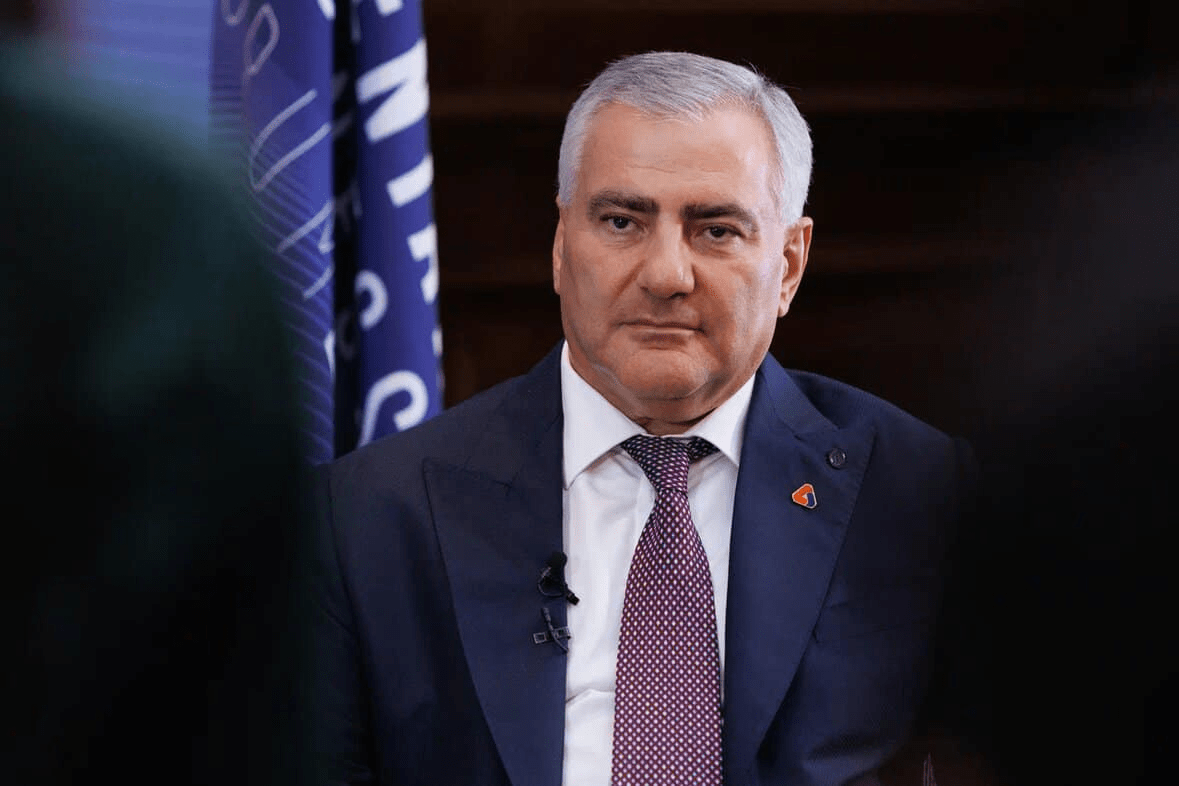 Because the Russian-Armenian businessman Samvel Karapetyan holds a Russian passport, he is not allowed to run in the election. Instead, his nephew Narek Karapetyan formally serves as the opposition leader. On May 22, charges were brought against Narek Karapetyan over allegations that he also holds a Russian passport, something he denies.
Photo: Press image from Samvel Karapetyan’s office.
What are the key issues in the election?
"From the outside, Armenia is often viewed more as a piece in a geopolitical chess game than as a country with its own domestic political dynamics. Discussions among foreign analysts tend to focus far more on the interests of major powers than on Armenia itself. That does not really reflect the nature of the domestic political debate."
"As in many other countries, the economy, the cost of living, and corruption are major issues. Housing prices have risen sharply, partly because around 150,000 Armenians from Nagorno-Karabakh have fled to Armenia since 2020 — especially after Azerbaijan’s offensive in 2023 (about 100,000 then) — and partly because of the influx of Russians who have left Russia since 2022."
"At the same time, the issue of Nagorno-Karabakh remains highly significant. Nikol Pashinyan occupies a unique position: he has lost two wars and Nagorno-Karabakh, yet still managed to remain in power. The opposition therefore portrays the election as existential. A vote for Civil Contract is described as a vote for Armenia potentially losing its sovereignty. The nationalist movement surrounding Nagorno-Karabakh has, in this context, largely become aligned with the opposition."
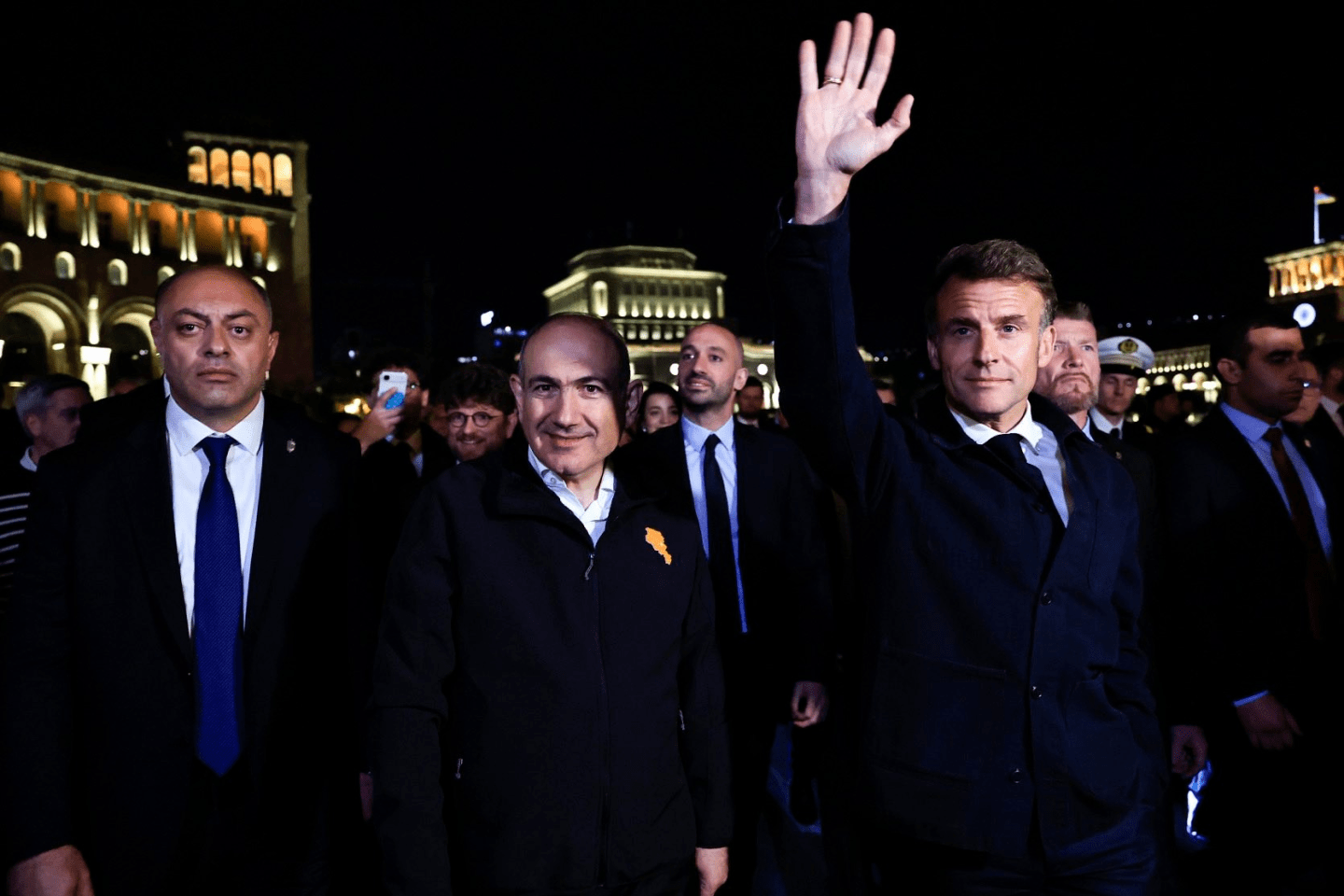 At the beginning of May, Armenia hosted a European summit. Here, Nikol Pashinyan is seen together with Emmanuel Macron, who openly expressed support for his Armenian counterpart.
Photo: Press image from Nikol Pashinyan’s office.
What is the government’s position on Nagorno-Karabakh?
"The government’s position is closely tied to Armenia’s defeat in the wars against Azerbaijan and the subsequent peace process. Baku demands that Armenia fully abandon all claims connected to Nagorno-Karabakh. This also includes issues related to identity, separatism, and special rights for the Artsakh Armenians. Artsakh is the Armenian name for Nagorno-Karabakh. Internationally, they are more commonly referred to as Karabakh Armenians. Some observers believe that the Armenian government’s rhetoric has shifted to more closely align with the Azerbaijani narrative. Perhaps this is a consequence of pressure from the victorious side in the conflict, which wants the history books written according to its own interpretation."
"The issue has become highly contentious. Human rights organizations in Armenia accuse the government of marginalizing the Artsakh Armenians, including by delaying their citizenship applications until after the election. One explanation may be that many of them are politically aligned with the opposition."
"From time to time, Nikol Pashinyan has become involved in open confrontations with Artsakh Armenians, and clips from these exchanges have spread widely on social media — not least because of the prime minister’s harsh language, including swearing and personal attacks."
"A more charitable interpretation of the government’s position is that it wants to move beyond the Karabakh issue in order to focus on ending Armenia’s isolation and transforming the country into a regional transit hub. A series of new agreements with the United States, Turkey, Azerbaijan, and Georgia suggest that the strategy may be working."
How healthy is democracy in Armenia?
"Armenia is often described today as the strongest democracy in the South Caucasus, especially after Georgia’s rapid democratic backsliding. But it remains a fragile democracy. In international indices, the country still ranks well below EU standards, roughly on par with countries such as Serbia, Kosovo, or Malaysia."
"The democratization that Nikol Pashinyan promised after the peaceful 2018 revolution has largely stalled. Corruption has decreased, but several democracy assessments point more toward stagnation than progress."
"In this year’s press freedom index by Reporters Without Borders, Armenia also dropped from 34th to 50th place. This can partly be explained by increased state control over public broadcasting and growing pressure on opposition media outlets."
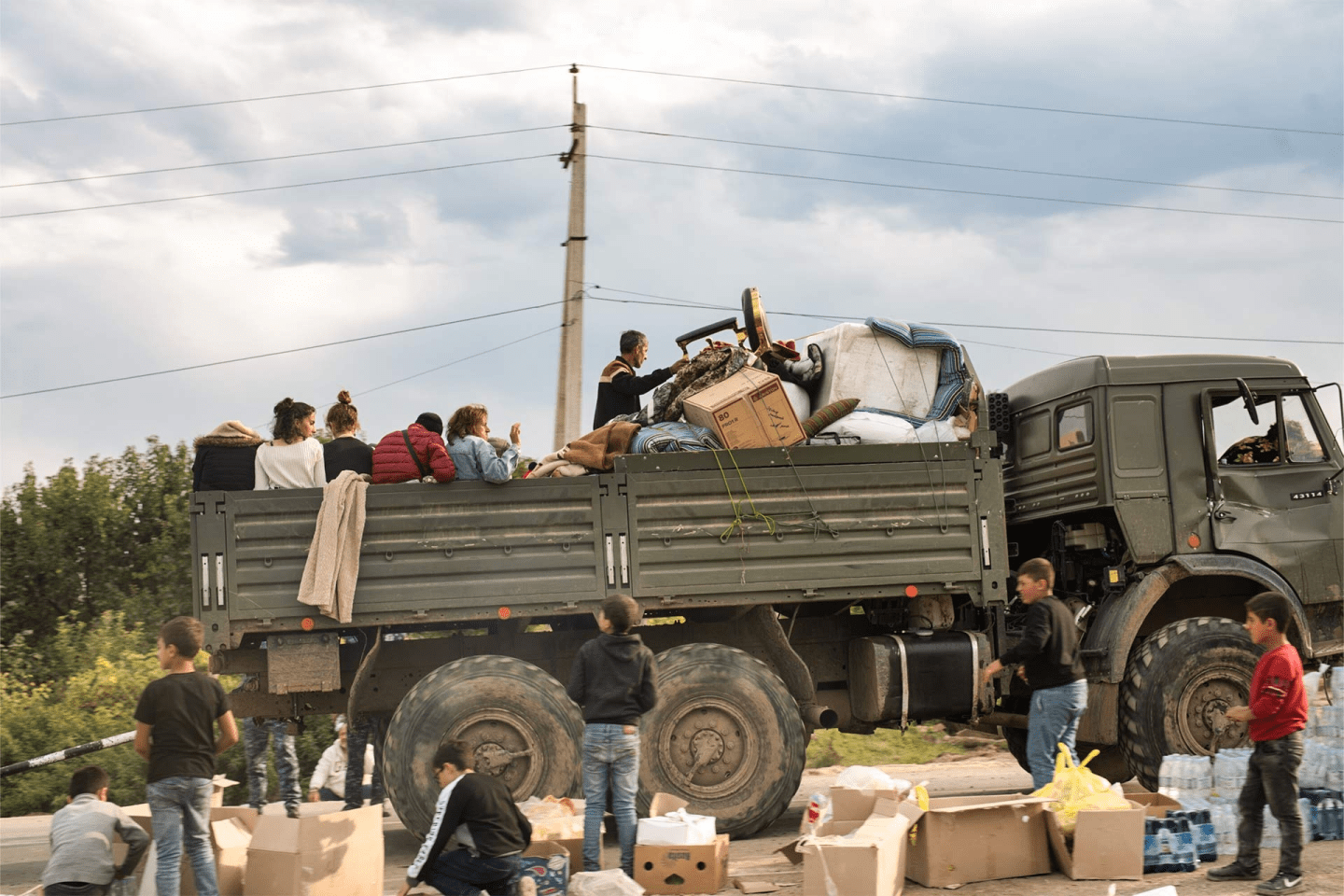 During a single week in September 2023, more than 100,000 Armenians were forced to flee Nagorno-Karabakh. As part of the peace agreement with Azerbaijan, the Armenian government has pledged to withdraw its cases against Azerbaijan at the International Court of Justice.
Photo: Rasmus Canbäck, September 2023.
What do the opinion polls say?
"The opinion polls show that roughly one third of voters remain undecided. However, Civil Contract holds a clear lead in almost all surveys."
"It also appears that only three political forces will pass the electoral threshold and enter parliament. This means that Civil Contract could secure a very strong parliamentary position even with around one third of the vote, since the seats would then be distributed among only the three parties that make it into parliament."
"At the moment, Samvel Karapetyan’s Strong Armenia is the second largest political force, polling at around 10–15 percent. Many are critical of his close ties to Russia and see him as part of the oligarchic system that many Armenians have wanted to break away from since the 2018 revolution."
"At the same time, there is widespread disappointment that Russia did not intervene when Azerbaijan attacked both Nagorno-Karabakh and Armenia in 2022, despite the existing security agreements between the two countries. A fundamental problem for the opposition is the absence of a credible pro-Western alternative to Civil Contract. As a result, many dissatisfied voters still tend to support the government, since the alternative is viewed as too closely aligned with the Kremlin."
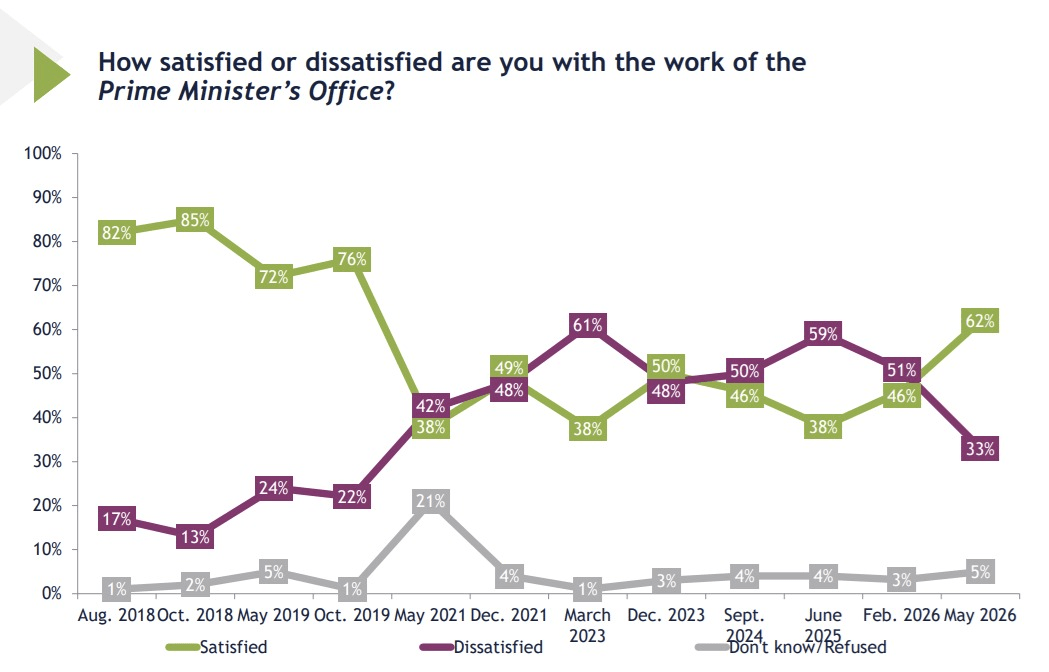 Despite two wartime defeats, support for the Armenian government is increasing. Graphic from the International Republican Institute opinion poll presented in May 2026.
How fair is the election?
"Compared to the snap election in 2021, this year’s campaign appears considerably dirtier. There is a widespread perception that Civil Contract is using state administrative resources to mobilize support. The government denies this, and Nikol Pashinyan has even instructed that several school principals who publicly supported him should be dismissed. That in itself may indicate a lack of respect for an independent civil service. The government also appears concerned that low voter turnout could otherwise weaken its mandate."
"Several opposition politicians have also been arrested ahead of the election. There may be legal grounds for some of the accusations, including corruption or incitement, but the timing and circumstances are widely perceived as politically motivated."
"At the same time, Samvel Karapetyan is one of Armenia’s wealthiest men and is likewise accused of using his financial and administrative resources to benefit Strong Armenia. This includes allegations of vote buying and pressure within his business empire. Opposition-aligned and often pro-Russian media outlets are also openly campaigning on his behalf."
What happens after the election?
"Most indications suggest that the incumbent government will win. The question is how strong a mandate it receives. That will have major implications for the peace process with Azerbaijan. Baku is demanding that Armenia hold a referendum to amend wording in the preamble of the constitution that Azerbaijan claims amounts to territorial claims against it. Armenia does not appear to be in any particular hurry to address the issue, but pressure from Azerbaijan is expected to continue."
"With a strong mandate, the government hopes to continue its strategy of ending Armenia’s isolation and opening the country economically and regionally. However, deeper democratization does not appear to be a top priority. That is where the EU and the United States may play an important role. Closer cooperation with the EU will likely require clearer reforms, particularly regarding judicial independence."
"Many observers argue, however, that developments in recent years have moved in the opposite direction. The risk is that this trend will continue."
The original article was published with CC Commons in Blankspot in Swedish.