

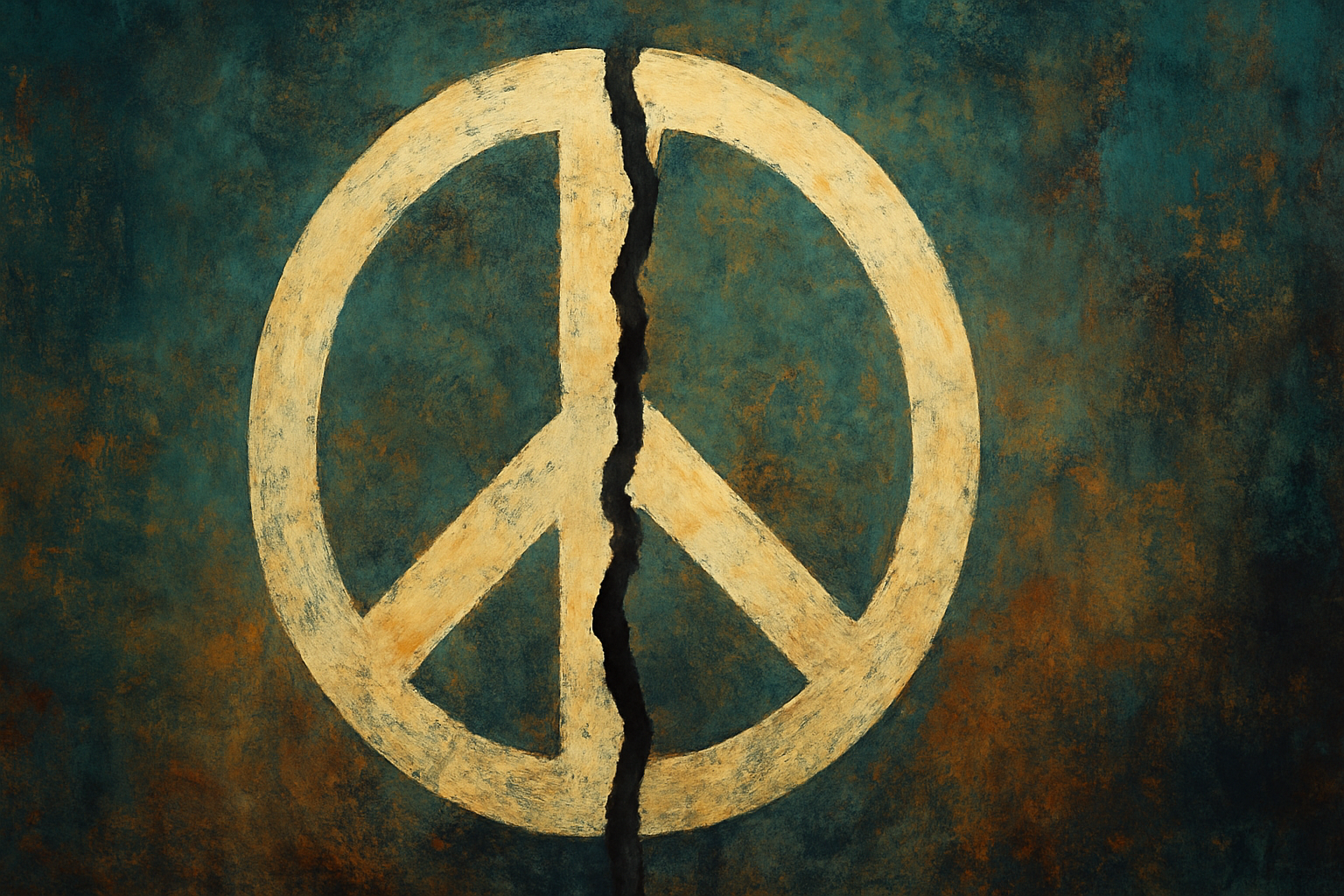
Recent talk of peace and reconciliation may sound hopeful — but behind the political handshakes lies a far darker reality. When justice is traded away for the sake of ceasefire, peace becomes a weapon of the strong rather than a shield for the vulnerable.
In recent months, discussions about peace, reconciliation and ceasefires have once again returned to the global agenda. It is a welcome development after a decade marked by more armed conflicts than we have seen in a very long time.
But when the concept of peace is reduced to being merely the opposite of war, justice risks being lost.
This is a contested dilemma within international law. A political settlement is far easier to reach than a just one — where perpetrators are actually held accountable. Almost always, it is the stronger party that dictates the terms of any agreement.
Another dangerous trend is emerging as well: the personification of peace. Increasingly, progress is associated with individual figures — presidents, leaders, charismatic negotiators — rather than with the diplomats and civil servants whose slow, patient work actually makes agreements possible.
International conventions, the UN Charter and the Helsinki Final Act are tools created to regulate humanity’s difficult art of co-existence. Through them, lawyers and diplomats have attempted to articulate how we can live together in order to survive — and not destroy one another.
But the paradox is that these conventions often prove insufficient when confronted with political reality. At least in modern times. The victim, who usually seeks justice, is forced into submission by the perpetrator. And in many conflicts, the roles are not clearly defined in the first place.
I have just returned from a trip to Armenia — perhaps my twentieth in recent years. This time, however, was different. It was about understanding what peace means when the parties, after 35 years of war and conflict, have finally changed their rhetoric. In fact, it was the first time since 2020 that I travelled there without fearing a sudden Azerbaijani lightning offensive.
But it also became clear to me that the current settlement between Armenia and Azerbaijan effectively means abandoning the pursuit of justice. In a similar way, the so-called reconciliation between Israel and Hamas will, at least in the short term, hardly lead to genuine coexistence. And in Sudan, many argue that attempts at justice have deepened the conflict rather than eased it.
It sounds contradictory, but the mechanism is simple: when parties try to bypass justice, morality becomes negotiable.
When I asked Armenian soldiers in Nagorno-Karabakh after the 2020 war how they viewed war crimes, they answered: “It’s us or them.” The same logic sometimes echoes among protesters in Georgia, who say they would rather see their opponents imprisoned than themselves — regardless of the methods used. The psychology behind democratic revolutions is not necessarily so different from that behind interstate wars.
More and more often I realise that a just reconciliation — or even a democratic one — lacks any platform in authoritarian environments. War is not democratic. But that does not mean the struggle for the rule of law and strong institutions should cease. On the contrary: it is in the abandonment of these principles that humanity slides toward moral decay. That is when the gravest war crimes and attacks on dissidents occur.
I recall an interview with former UN diplomat Hans Blix. He argued that, despite everything, it was positive that perpetrators at least relate to a rules-based order. This was not the case before the Second World War, when no rules for warfare existed.
That said, it is clear that authoritarian states and military powers have learned to master international law for their own benefit. When they commit a war crime, they already have a legal argument prepared to justify it. Hans Blix summed it up well: not everything that is legal is necessarily appropriate.
In principle, a democratic state’s war crimes are no more acceptable than those committed by a dictatorship.
 Picture: Rasmus Canbäck in Armenia in the beginning of October.
It may therefore seem contradictory to sign agreements that contain no element of justice — but in practice, it has proven effective. When Armenia and Azerbaijan agreed to set aside the question of accountability, the international community applauded. “Peace is finally within reach,” proclaimed states that for years had insisted on a rules-based peace process, Sweden included. By then, the parties had agreed to end a rules-based negotiation format (albeit a dysfunctional one) and to abandon legal proceedings in international courts.
At the same time, it was obvious that the stronger party, Azerbaijan, would walk away unpunished. Those who lost their homes and loved ones will, under the settlement, be expected to swallow the absence of justice. In a conversation with an Azerbaijani peace activist, he reflected that the same authoritarian structure that oppressed its own people was also the one waging war against Armenians in Nagorno-Karabakh. He is now serving a 15-year prison sentence, convicted of treason for having spoken with Armenians.
And once the terms of peace were set, it was, again, this same authoritarian regime that dictated them.
I once interviewed an Armenian man living in a border village who told me that as long as the situation remained insecure, they would never be able to climb to the next step of Maslow’s hierarchy of needs. I returned to the village this October. This time, that next step felt closer than before.
A political agreement on peace is rarely the end of a conflict. More often, it is the beginning of a new power struggle. It is understandable that such political compromises are praised internationally, but they also risk cementing inequality for generations.
A quick deal may look good in a press photo — but for the people who must live with its consequences, it becomes a promise never fulfilled. Such a deal risks creating a darkness that is hard to find light in, and could even deepen existing conflicts. Trying to contain discontent through force has rarely proved effective in the long run.
The hero status that some leaders gain for promoting democratic reconciliation inspires others — often more vain — to chase the same status to entrench their own positions. They treat the settlement as a game they must win, rather than as a moral process.
And when these individuals become symbols of something greater, a new danger emerges: loyalty shifts from principles to personalities. Both those in power and those resisting them turn toward these supposed “heroes,” who are often elevated to near-cult figures. They praise the individual who seems to be the queen on a chessboard in the hope of flattering them into supporting their political agenda.
It is therefore no surprise that activists or vulnerable individuals — whether in wartime or in protest movements — appeal to the outside world for support. They hope the world will choose them over their opponents. What they can offer is a moral alternative, but experience shows that this is rarely enough.
The result is a political settlement that rewards power, not responsibility. The side that already holds the upper hand emerges victorious — even in peace.
The cynical part is that this model works. It delivers ceasefire, not reconciliation. It produces silence, not security. And it is likely the kind of settlement the world will see more frequently in the future.
By the way, congratulations — you just read an entire text about the world’s ongoing peace processes without Donald Trump being mentioned.
 The original article was published with CC Commons in Blankspot in Swedish.