

Armenian Prime Minister Pashinyan secured a new term in office, but with a weaker mandate than he had hoped for. Blankspot reporter Rasmus Canbäck analyzes the election results and their implications.
Late in the night, Armenian Prime Minister Nikol Pashinyan declared victory in the election. At that point, only ten percent of the votes had been counted.
He defended the early announcement by arguing that all available analyses and incoming data pointed in the same direction: his party, Civil Contract, had won.
Yet the eagerness may be symptomatic of the campaign itself. In practice, it began as early as May last year, when the government escalated its confrontation with the Armenian Apostolic Church. It is hardly a secret that the church leadership has been aligned with the opposition. Nor is it surprising that the government has viewed it as part of the Russian-backed oligarchic system that Pashinyan says he is fighting against.
What has raised eyebrows, however, is the manner in which that struggle has been conducted.
When the Russian-Armenian oligarch Samvel Karapetyan, whose fortune is estimated to be roughly half the size of Armenia’s GDP, sided with the church, he was arrested. Officially, for calling for usurpation of power. The allegations may well be justified. But the timing and circumstances of the arrest led many to question just how independent the judiciary really is.
From detention, Karapetyan announced the launch of a new political party. In the absence of any other credible opposition force, the pro-Russian Strong Armenia emerged as the main challenger in the election campaign.
The problem is precisely that it has been pro-Russian. Voters who are sceptical of the direction Armenia has taken under Pashinyan have struggled to find a political home in an alternative that also looks toward the West. Opinion polls conducted before the election suggested that between 30 and 40 percent of voters made up their minds only at the very last moment.
That is why many are now questioning Pashinyan’s confident declaration of victory long before the final votes had been counted.
What kind of mandate does he actually have?
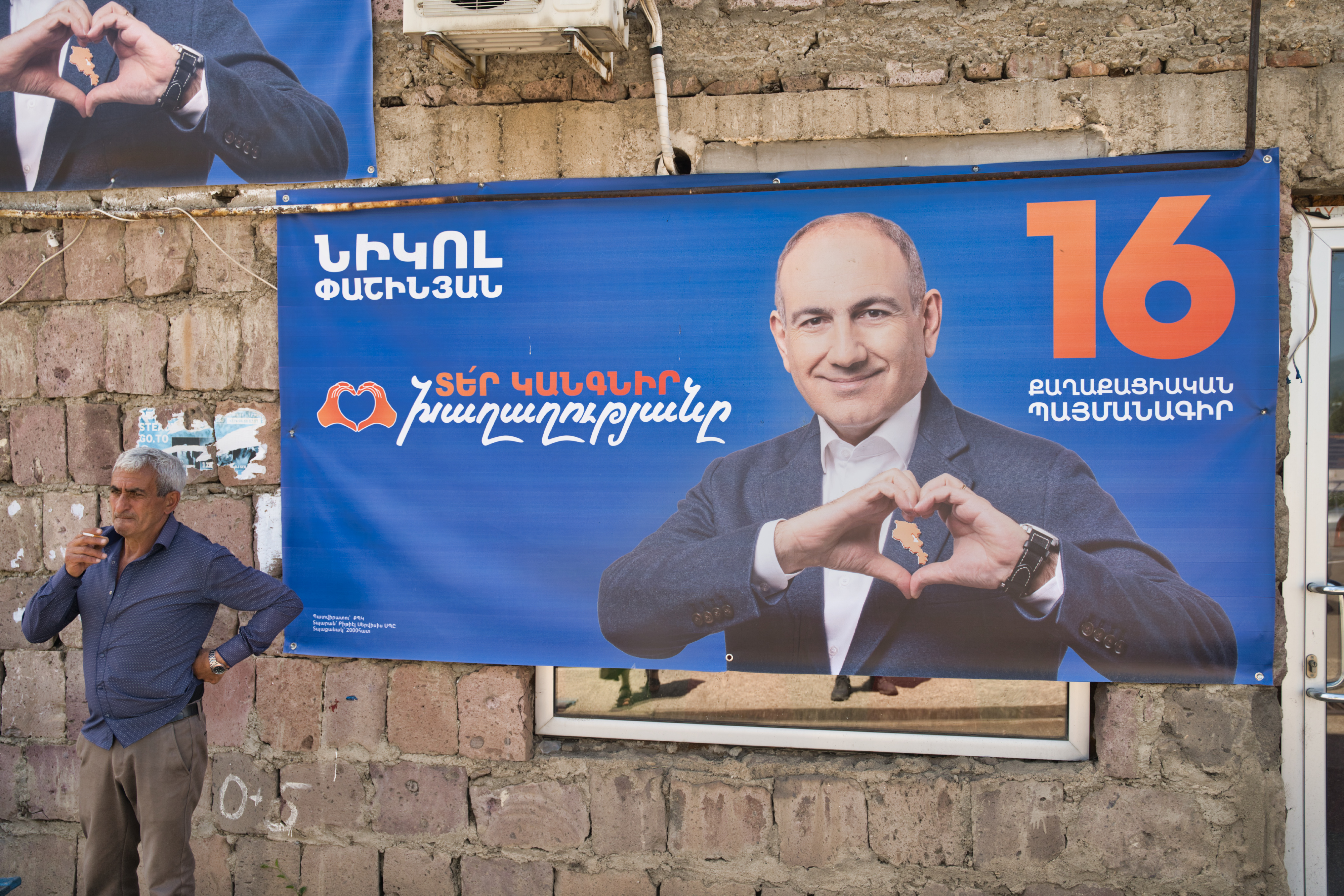 Preliminary results indicate that Civil Contract will see its representation in parliament fall from 71 to 58 seats out of a possible 105. That still provides a majority, but not the constitutional supermajority that Pashinyan had hoped for.
One immediate consequence is that the path toward a referendum on constitutional reform becomes significantly more complicated. Formally, Civil Contract has reasonably sound arguments for revising the constitutional framework.
Yet another issue dominates the discussion.
Azerbaijan, with which Armenia remains locked in a deep conflict, has demanded that Armenia amend a reference contained in an annex to the constitution. Baku argues that the wording implies territorial claims against Azerbaijan by referring to the former breakaway republic of Nagorno-Karabakh as being under Armenia’s protection.
The opposition can easily argue that a constitutional referendum would amount to yielding to the demands of Armenia’s arch-rival. The dilemma is that Azerbaijani dictator Ilham Aliyev has repeatedly demonstrated that his approach can shift rapidly. The relatively constructive rapprochement with Armenia that has taken shape since August, with U.S. mediation, could once again turn into coercive pressure.
Should that happen, the transatlantic and European vision of integrating Armenia into a transport corridor linking East and West—not merely Russia and Iran—could quickly unravel.
On the domestic front, Pashinyan has pledged to continue the fight against oligarchic influence. In practice, this is likely to mean the continuation of a campaign that at times raises concerns about due process, targeting opposition figures whom Civil Contract portrays as being closely connected to oligarchic interests.
The approach is sometimes justified by arguing that the methods Russia employs in Armenia must be countered with similar tools.
The question is how far Pashinyan is willing—or able—to take that confrontation. Russia has maintained troops in Armenia since the early 1990s. Armenia’s energy sector remains heavily dependent on Russia, and nearly half of the country’s exports are destined for the Russian market.
Several mining companies, arguably Armenia’s most important source of revenue, are also linked to Russian ownership. Armenian investigative journalists have previously revealed that Pashinyan was well aware of Russian influence in the sector, while politicians close to him have benefited financially.
Portraying Pashinyan simply as a pro-Western leader is therefore an oversimplification—one that often appears to reflect wishful thinking among European policymakers.
Armenian voters are well aware of these realities. They understand that any path toward EU membership would be long and uncertain, if it is even possible without major geopolitical shifts and without Georgia moving in the same direction. Many Armenians are—probably with good reason—cynical about the European Union, seeing it primarily as treating their country as a battleground in its broader competition with Russia.
And although a majority of Armenians support a foreign policy oriented toward Europe, Brussels still faces the challenge of building trust not only among the political elite, but among the public at large.
The coming parliamentary term will put all of these contradictions into sharp focus. My expectation is that, as Europe’s presence and engagement in Armenia increase, more Europeans will begin paying attention to the country.
When they do, it is worth remembering one thing: Armenians do not want to be treated as pieces on a geopolitical chessboard.
Rasmus Canbäck, reporting from Armenia.

The original article was published with CC Commons in Blankspot in Swedish.