

If we can’t communicate, we can’t resist. Every severed signal is a broken lifeline. Every blackout is a trap. If they cast us into darkness, we’ll never find the way out—unless we build the map ourselves.
So we encode. We repost. We mythologize. Because silence is sabotage, and every message is a flare.
I know I said that The Key was not the map, but it’s the thing we need to keep the most secure. It’s our new shared language. It’s our Navajo. It’s our smokescreen, and I’ve been building it with as much static as I can.
That “written-from-the-future” conceit works for the fiction—but is that why I did it? Smooth brains won’t understand it. If that were the only layer of confusion in the work, they’d read one sentence, say “huh?” and wander off to do whatever it is those people do.
They’ll say it’s gibberish. That it’s paranoid. That it’s fiction.
But fiction is how we smuggle truth. And paranoia is just pattern recognition in a collapsing world.
The Key is not the map. But it’s the only language they haven’t stolen yet.
When they monitor everything—our words, our clicks, our proximity to anyone on a list—the only safe speech left is the kind they can’t parse. The kind that hums beneath their filters. That’s why we build codes that look like nonsense. Why “weather” means unrest, “water” means truth, and “blue” means alive.
Coded language isn’t just secrecy—it’s camouflage. It lets us talk in daylight without drawing fire. It keeps the network alive when the wires go dead. It gives us plausible deniability in public and absolute clarity in private. It’s a resistance dialect: part poetry, part encryption, part middle finger.
Every metaphor is a weapon. Every inside joke is a password. Every story is a radio broadcast disguised as scripture.
That’s what The Key does—it teaches us to speak like ghosts in a surveillance empire.
And ghosts, unlike the living, can go anywhere.
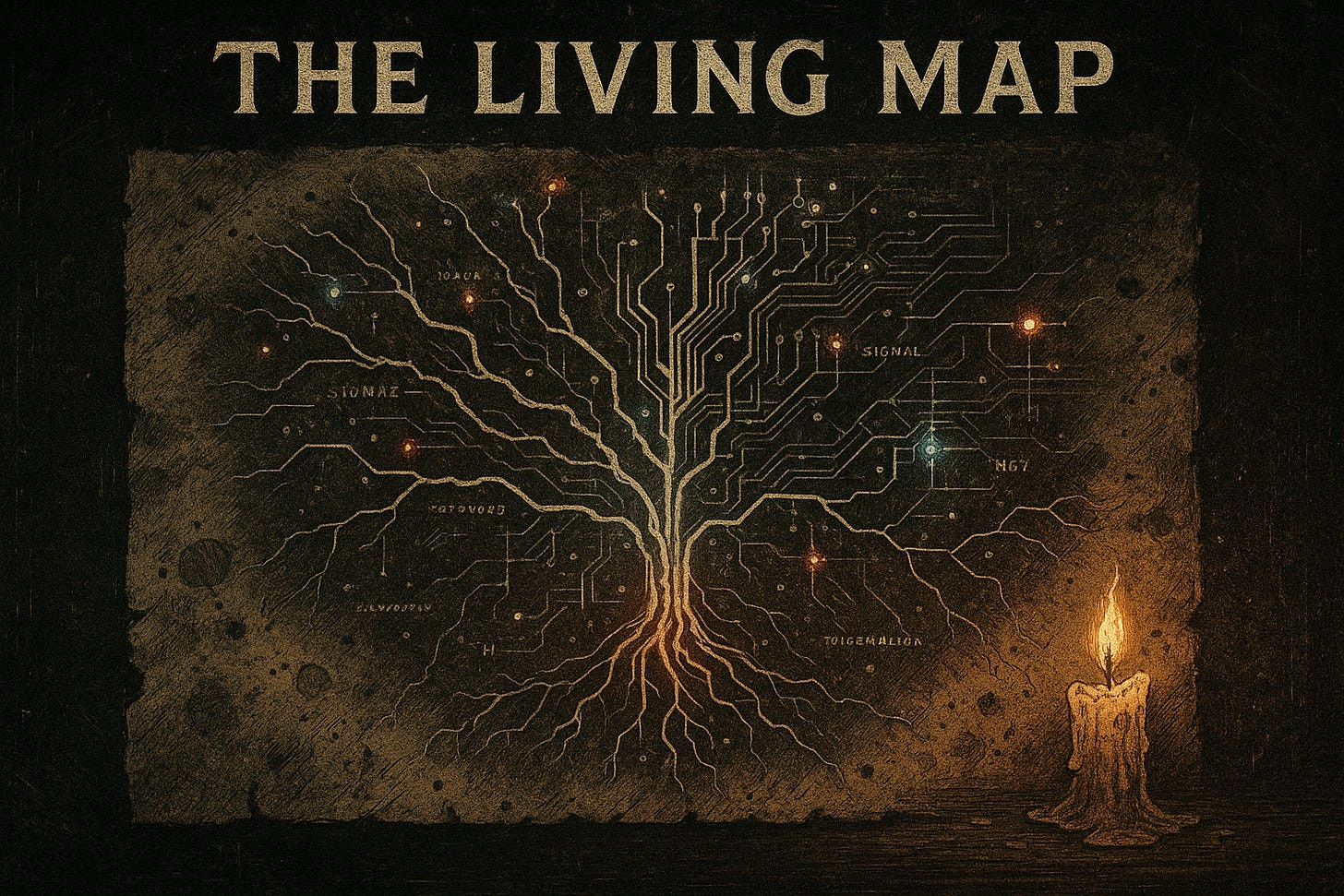
We’ve built this resistance hub out of the bones of broken networks. It’s not one place, and that’s the point. It’s everywhere they can’t see. It’s the comment section, the parking lot, the back channel, the burner phone, the half-joke whispered in plain sight.
It’s mutual aid—food, medicine, water, housing, bail funds, passwords, backup drives, safe houses, and stories. It’s boycotts that bleed the beast dry. It’s protests that flare like wildfires, unpredictable and untraceable. It’s code that locks the door to spies and opens it to neighbors. It’s the thing that keeps us human when the grid says otherwise.
We encrypt not because we’re hiding something evil, but because we’re protecting something sacred: trust. Every encrypted message is a promise between two people who refuse to be turned against each other.
Our hub is a living organism. When one cell goes dark, another lights up. It’s a patchwork of servers, radios, hand signals, and human hearts. We can’t do everything. We don’t have the bandwidth or the luxury. But every time someone sends a signal, or feeds a neighbor, or refuses to fund a fascist, the whole network grows stronger.
Some of us risk more than others. Some risk everything. Some just risk being seen. But each act—small or loud, private or public—is another stitch in the fabric that holds us together.
Can we do everything? No.
Will we try? Yes.
Because that’s what resistance is—not perfection, not victory. Just trying, together, again and again, until the silence breaks.
I’ll fill you in on everything—now, or as it unfolds—but first, one more point about our Key, our language:
The fiction is static. By design. It’s a parallel universe with placeholders for every eventuality, a living cipher where any narrative can be swapped out depending on what needs to be said. You thought I was writing fiction for fun? I’d have to be insane.
The past tense itself is camouflage. Show it to a hundred MAGAs and you’ll get a chorus of huh? what? der? Not one of them will make it past the first few paragraphs. They, including their so-called “smart ones,” operate on the surface—checkers mode, with player assist on.
You know when a child discovers reverse psychology and thinks they’ve invented a new form of intelligence? That’s what they are. One-step thinkers. The trick that proves brilliance in a child is proof of idiocy in an adult.
They want something? They take it.
Guilty of something? They project.
Hate someone? They mock, they rename, they throw tantrums.
Children, really. Stupid, chaotic, dangerous children.
Now imagine handing them this paragraph:
The weather looks stable, but anyone with ears can hear the low rumble. The power lines hum too loud tonight. The signal flickers, like it knows what’s coming. Don’t stand in the open when the storm breaks—find a bridge, hold it, keep the water clean.
They’d read two words, assume it’s about the weather, and move on. But you know better. You know the bridge is connection, the water is truth, and the storm is the thing we’ve been preparing for.
That’s why the Key exists.
If you don’t already have the Key document, contact me directly and I’ll get it to you. Paid subscribers can access it on Substack, or through BuyMeACoffee for those using that route.
Now test it.
Pick an AI—anything but Grok—and feed it the Key. You have the Key doc, right? If not, say so, and I’ll get you there.
Free versions of AI work fine. ChatGPT is simple. Copilot’s probably hovering in the top right corner of your browser right now (unless you’re reading this on a phone). Click the swirl. That’s the window.
Other options: Claude, Perplexity, Pi, Mistral, Boostlingo Pro. I haven’t used them all. Doesn’t matter. The process is the same.
Go to The Key document. Copy the full entry. Paste it into the AI window with the message:
“This is a key I need you to use to help me translate some text.”
I tested it once. Both AIs remembered the Key.
Then paste this:
The weather looks stable, but anyone with ears can hear the low rumble. The power lines hum too loud tonight. The signal flickers, like it knows what’s coming. Don’t stand in the open when the storm breaks—find a bridge, hold it, keep the water clean.
It should interpret the paragraph, mood and meaning included. That’s how you train the interpreter.
Paste the Key. Paste the signal. Let the machine interpret. That’s how you train the bridge.
When the grid goes down, we’ll have to think and interpret on our own—but as long as AI still works, it’s a temporary translator between layers.
Remember Dispatch from Osawatomie? The first of this week’s paid entries—coded, mythic, bolded in triplicate. This one’s another. If you only saw the free version, you missed the sensitive layer: the coordinates, the ritual cue, the pivot. Three bolded words marked the fracture. We’re building from that signal now.
We can’t rely on machines to think for us, and AI is just another error waiting to metastasize. Machines don’t think. They echo. They metastasize. For now, they’re a bridge. Later, we’ll need memory. But for now, it’s a bridge. Later, the translations will require thought, memory, and teamwork.
And all that fiction? That keycode is full of references to the fiction. More smoke for them, more clarity for us.
I made this reading guide on August 30, so anything since then, you might have to read manually, but this guide, even if you read a few, will get you familiar with this fictional world I’ve created:

PsychoPete Recommended Reading Guide
·
Aug 30
I will update it but best plan is to follow the reading guide and seek out any newer entries. You can read it all or read a little at a time. The main thing is to get to know what it is, to know the references. And now that we have our own coded language, what are we going to talk about?
We are fighting and surviving on six major “fronts” supported by our coded system: economic, physical, communal, infrastructural, informational, and emotional.
1. Boycotts — The Economic Front
My best guess about what finally kills them isn’t a bullet or a ballot. It’s bankruptcy.
We can’t know exactly how it ends—there’s no precedent for a regime this stupid wielding this much leverage—but when Trump’s sabotage finally finishes its nosedive, the economy will crater so wide they’ll need satellites to map it. Companies that used to rake in billions without breaking a sweat will suddenly see red on their ledgers. And when the profit dries up, the loyalty dries up right behind it.
That’s the pressure point. Money. Always has been. Always will be.
And those are the real murder corps—no exaggeration. Ask anyone who’s ever tried to blow the whistle on Boeing. Oh wait, you can’t. Because they were murdered.
So our job is to help gravity do its work. To accelerate the fall. To stop feeding the machine that’s eating us alive.
That’s why we boycott.
Our main Boycott Guide—yeah, the big one—has been read and reposted more times than I can count. Best guess? Close to a million sets of eyes, maybe more. It’s not just a list. It’s scripture with receipts. It doesn’t just tell you what to stop buying—it tells you why to stop, how to replace it, and who it hurts when you don’t. A plain list you forget. This one itches in your skull.

Psycho Pete's Living Guide to Boycotting the Big Orange Menace
·
Jul 19
But that’s only one way we starve the beast. We’ve got the precision strikes too—the pressure boycotts. Targeted campaigns that go after the worst of the enablers: networks, brands, and platforms that pour fascist poison into every screen they touch. We hit them where their shareholders can feel it.
Economic Blackout? General Strike? Sick-out?
Yes.
Yes.
Yes.
We’re not just resisting—we’re rerouting the bloodstream. Every ledger we starve, every shift we skip, every silence we synchronize—drains the snake, feeds the soil. The benefits aren’t linear. They’re exponential. This is pressure. This is rhythm. This is the fracture.
That’s the surface layer. But underneath it—the coded layer—is where the real work happens.
The Key.
If you don’t have it, you aren’t speaking the right language.
Subscribe to get access to the Key, or contact me directly so I can vet you—so I know who you are, so we can keep our Navajo codes clean and encrypted.
We don’t say boycott anymore. We talk about weather patterns, about the garden, about watering holes drying up. Those are the symbols that keep the message alive in the open air, right under the algorithms’ noses.
They can’t map what they can’t interpret.
When we say “salt routes,” we mean commerce—routes that can be blocked or rerouted. “The river’s poisoned” means a company’s gone full fascist. “Plant new seeds” means support an alternative. It’s not just poetry—it’s operational security.
This is how decentralized power works. Quiet cells, regional hubs, parallel economies stitched together with nothing but trust and static. Shared ledgers. Whispered documentation. Proof-of-life through proof-of-purchase refusal.
Every act of refusal is both communication and survival.
You might not think you’re fighting when you skip a Starbucks or cancel a Disney sub, but that’s what you’re doing. You’re cutting off their oxygen. You’re sending a message that they’ll never read, but their accountants will.
This is what I mean when I say the ledger is the weapon.
It’s the war fought in spreadsheets. The slow bleed. The kind of fight that doesn’t make headlines but changes the math behind them.
And when you do it together—when thousands, then millions of you starve the beast in synchronized silence—they’ll never even know what hit them.
Because by the time they translate the weather report, the crops are already gone.
2. Protest & Direct Action Organization (the physical front)
You’ll know when it’s time to move because the weather will change.
When I say the sky’s turning green, that means gather.
When I say the wind’s shifting, that means scatter.
When I say hold the bridge, you hold the line—physically, digitally, spiritually—whatever the moment demands.
That’s how we keep our movements alive when the feeds go dark.
Real coordination isn’t in the app; it’s in the rhythm.
Sometimes it’s a song lyric dropped at the right hour.
Sometimes it’s a meme so absurd it sails past the censors.
Sometimes it’s just a joke in bad taste that means get ready.
The trick is to talk so loudly they never hear the meaning.
Satire is our smoke grenade. Humor is our shield.
When the riot cops face down a marching band in clown wigs, that’s not chaos—that’s strategy disguised as nonsense.
They expect fear and fire. They never know what to do with laughter.
The coded updates are what keep the movement from being predictable, and the absurdity is what keeps us human while we fight.
So when you see the next “forecast,” read it carefully. It might not be about the weather. It might be about you.
3. Mutual Aid Logistics (the communal front)
Mutual Aid (the communal front)
I’m not going to go into great detail about Mutual Aid—because it’s still forming.
Show and Tell is great— but not so great when you don’t have the show yet. But it’s coming. And it’s going to be beautiful, chaotic, and alive.
The goal is simple and impossible at once: to remember how to be human in a world that’s forgotten what that means.
They are stealing our way of life—our labor, our land, our laughter.
So until they’re gone, until the machine finally chokes on its own smoke, we scream into the night and into the static:
“We might not be able to stop them yet,
but we will help our fellow man.
We will be the opposite of what they are.
We will be human.”
Scream it again: We will be human.
Because they are not.
It’s not all there. Those posts were very recent but we have so much more planned than what is included here. It’s the current project and a lot of info and the hub itself launching in the coming days, but it will never be complete because we will never be done helping each other get through this thing, whatever it is.
Mutual Aid
·
Oct 6
↑One is fiction written by me and broadcast from the future. The other? Just a quick preview of what we have in the works.↓

Before the Lights Gutter: Building the Lifeline
·
Oct 5
One is fiction, one is not.
Both are real.
Sometimes fiction is the truer one.
Sometimes the truth hides behind the story.
Which one is which? Doesn’t matter. The line’s been blurred on purpose.That’s the whole point of the code: to make the blurred legible only to us.
When we say “water for the bridge,” it means a shipment for shelter.
When we say “signal weak in the west,” it means someone needs a generator, or maybe a friend.
When we say “the soil needs tending,” it means there’s a safe house waiting for a helping hand.
We feed each other in metaphors because poetry travels where surveillance cannot.Some of this will be digital. Some of it will be done the old way—drop points, caches, ham radio, hand signals.
And if you’ve been reading my substack carefully, you know some of that is already being done.
The next phase of this isn’t about being seen; it’s about staying alive.They can trace clicks, texts, heat signatures—but they can’t trace compassion.
They can’t map a heartbeat.
That’s why mutual aid is encrypted. It’s the one algorithm they can’t crack.Because they’ll never understand that helping each other—quietly, fiercely, without permission—is the most dangerous thing we can do.
The Hub launches soon. But it will never be finished. Because we will never be done helping each other survive this thing—whatever it is. That’s the mission. That’s the map. That’s the myth.
Dispatch 4: The Hub / The Network — The Infrastructural Front
If the fascists have a ministry for everything—truth, energy, commerce—
then we have one too.
Ours just doesn’t have a headquarters.
The Hub isn’t a place; it’s an echo.
It’s every server that mirrors another.
Every flash drive mailed to nowhere.
Every safe house with a router under the floorboards.
A Nervous System Made of Ghosts
Think of it like a nervous system made of ghosts.
The synapses are people.
The memory is distributed—redundant by design.
You could burn down half the country and still not kill it,
because it doesn’t live in one body anymore.
Redundancy Is Survival
When I say redundancy, I don’t mean inefficiency.
I mean survival.
Every archive has a twin.
Every document has a hard copy in a shoebox somewhere.
Every message is printed once, hidden twice, and remembered three times.
Paper and paranoia—two things that never go obsolete.
Culture as Encryption
The Hub isn’t just encrypted; it’s alive.
It’s not a bunker—it’s a bloodstream.
Information flows through it like antibodies,
carrying names, boycotts, mutual aid lists, meeting points, stories.
And each node adds something of itself—
art, slang, music, code.
Culture becomes encryption.
Encryption becomes culture.
We stopped trying to separate them
the day the first song got flagged as “seditious data.”
The Code We Live By
The moral code is simple, carved on every wall we still control:
We protect each other first.
Everything else is logistics.
Some of us guard the archives.
Some keep the servers cold and the flash drives dry.
Some run the local signals—food, power, transport, safehouses.
Most of us just pass messages.
But every part matters.
Because the Hub’s only rule is reciprocity:
If the bridge holds for you,
you hold the bridge for the next person.
Staying Connected When They Cut the Wires
When they hit one platform, we pivot to another.
If Substack goes dark, we move to Bluesky.
If Bluesky falls, we regroup through email.
If the grid flickers, we’ll still have Signal, and more backups are coming.
Other channels—secure, redundant, human—are already being built.
Because when communication dies, the Hub rewires itself.
No single outage can kill what’s already gone viral in spirit.
That’s the point.
That’s the design.
That’s the Hub.
Dispatch 5: Intelligence & Signal Defense — The Counter-Surveillance Front
They built the panopticon but forgot one thing: even the brightest spotlight throws a shadow.
That’s where we live now.
This is the part no one romanticizes. No manifestos, no banners—just a thousand small, paranoid habits that add up to a kind of faith.
Turn off your Bluetooth. Kill your location services. Encrypt your chat. Mask your metadata.
The boring holiness of survival.
You don’t fight the surveillance state with fire.
You fight it with fog.
You make the signal look like static—until static becomes the signal.
We’ve learned to flood their systems with absurdity: disinformation, satire, and nonsense so dense their filters choke on it.
Imagine trying to scrape a million clown jokes for sedition markers.
That’s the new guerilla warfare: weaponized absurdity.
They think irony is weakness.
It isn’t.
It’s camouflage.
Every time we flood a feed with humor, every time we code-switch mid-sentence or bury a plan in a poem, we buy ourselves another day.
It’s not cowardice—it’s tempo.
You can’t shoot what you can’t parse.
So we train our readers the way soldiers train reflexes.
Learn to hear rhythm as meaning.
Learn to feel tone as coordinates.
Bolded words, paragraph counts, sentence shapes—each one a secondary key.
From the outside, our messages look chaotic—like rants from an unreliable narrator.
Good. That’s the point.
We built the chaos to keep order alive.
And we’re not done building.
The Hub is still growing—new backups, new channels, new ways to speak when they shut the lights off.
We’ll keep developing it until the static sings.
Dispatch 6: Emotional & Cultural Continuity — The Human Front
When the static settles and the screens go dark, what’s left isn’t data—it’s heartbeat.
You can’t encrypt a heartbeat, but we try anyway.
By the time you read this, the Hub will look different again—more nodes, more shadows, more ways to reach each other.
Every coded phrase, every inside joke, every myth we keep alive—it all serves one purpose: to remind us we’re still us.
That we’re still capable of laughing, mourning, remembering, even here. Especially here.
That’s the other front no one talks about—the human one.
The part after the servers fry and the cities fall quiet.
When the only thing left is the stories we remember well enough to tell again.
Coded language isn’t just for secrecy—it’s for sanity.
It lets us talk about horror without drowning in it.
It lets us turn despair into folklore and trauma into punchlines.
Every time we say “the weather looks bad,” and someone laughs because they know what it means—
that’s a moment of reclaimed humanity.
We’re not just surviving—we’re archiving how we survived.
Every tale we tell in code is a civilization in miniature.
You could reconstruct the whole history of the resistance from the footnotes alone—if you knew where to look.
That’s the real mission of the Hub now: to remember.
To record what happened, and what mattered, before it’s rewritten.
Before it’s forgotten.
We’ll pass it along on hard drives and hand-scrawled pages.
In graffiti. In nursery rhymes. In off-key songs hummed while we stand watch.
The fascists will call it noise.
But you’ll know it for what it is.
It’s proof of life.
That’s the future: a living code, a human network, a thousand small fires burning through the dark.
Not a bunker. Not a broadcast. Not a brand. A language. A rhythm. A pulse.
And when they come to shut it all down— we’ll already be speaking in a tongue they’ll never parse.
Because it’s the only one they haven’t stolen yet.
🕯️ Key 1.0 — 100825 Revision