
Out of Service
“Who do you think Otis is?”
Vance finally asked it.
He’d been staring at the elevator’s brushed-steel nameplate for the full four minutes they’d been stuck. They would later agree it was a long four minutes. The minutes after would be measured differently—by tone, by posture, by who spoke without being invited.
“I’ll bet it was a Black guy,” Vance said.
The elevator reacted before the people did.
A collective intake of air. A tightening. The subtle recalibration that happens when rules are tested and not immediately enforced.
The women clutched nonexistent pearls. The men exchanged looks.
Some of those looks meant Don’t be racist.
Others meant Don’t be racist in close quarters.
“Why?” Schumer asked carefully.
He had been the last one through the doors. Everyone knew it. Seniority mattered—even now. Especially now. There were systems for moments like this. Schumer trusted systems.
Vance shrugged. “Because most people named Otis are black.”
Silence followed—not disagreement, but processing. This was how ideas became acceptable: first spoken, then examined, then allowed to linger.
Schumer adjusted his glasses—nudging them impossibly farther down his nose—and studied the nameplate as if it were scripture, or at least precedent.
“The company,” he said at last. “Otis Elevator Company. Founded by Elisha Otis in the 1850s. He invented the safety brake. Prevented free fall.”
The words safety brake settled the room.
They liked that. Safety sounded like leadership. History sounded like control.
Vance blinked. “So Otis is… a white guy?”
“At least historically,” Schumer said.
At least two witnesses would later insist Vance followed this with “Gee, gosh, mister.” The recovered surveillance footage would not support their claim.
What Vance really said was, “From Vermont?”
No one answered. Facts had already done their work. Certainty, once cracked, tended to drain quickly.
“Well,” Mitch McConnell said.
He was wedged into the corner, arms folded, unmoving. The oldest among them. The quietest. The one several people found themselves watching without realizing they’d started.
“This is unfortunate,” he continued. “But manageable.”
The word manageable mattered.
“It doesn’t matter who Otis was,” McConnell said. “What matters is order. And weight. And why this elevator—his elevator—has stopped between floors.”
He glanced down. Then up. A brief inventory.
“Unlucky,” someone whispered.
McConnell did not correct them.
“Let’s make some rules,” Mike Johnson said, his bobble of a head just visible between clustered shoulders.
The word rules rippled through the car.
“The Speaker wants to make some rules,” someone said, amused.
Then louder.
Then, laughing now:
“The Speaker wants to make some rules.”
A woman’s voice cut through the noise from the back. Sharp. Irritated.
“No farts.”
The rule landed oddly. Specific. Petty. Immediately useful.
There was a pause—just long enough for it to feel real.
Then Rubio farted.
It was not subtle. It was wet, resonant, and inescapable. The kind that announced itself as a fact rather than an apology.
“Who said that?” Rubio asked, turning slightly, though everyone already knew. It was Nancy Mace. “I agree with the congresswoman,” he added. “I just needed to get mine out so I’m in compliance going forward.”
A few people laughed. Too loudly.
“Rubio doesn’t like farts because he’s short,” Vance said, grinning. “He operates at ass level.”
“I’m taller than you are, motherfucker!” Rubio snapped.
He wasn’t. He knew that. Still, some traitorous part of his brain immediately staged a back-to-back height duel—shoes off, neutral ground, witnesses present. No one offered. The moment passed.
Schumer cleared his throat.
“Really,” he said. “How are we going to regulate—”
The laughter swallowed him.
Not deliberately. Not unkindly. He was simply absorbed.
After that, it was understood—without a vote, without a rule—that no one would speak to Schumer.
And for the remainder of the elevator ride, no one did.
Time stretched.
Hunger arrived early, the way panic always does.
“If we have to eat someone,” Rubio said, “I don’t want it to be someone old.”
“Agreed,” Vance said. “Or too famous.”
Eyes began to move. Calculating. Measuring relevance.
The least famous congressman in the elevator felt them settle on him and began to sweat.
“If they were coming to save us,” Ted Cruz said, panic cracking his voice, “they would have saved us by now.”
“Now, Ted,” Schumer said drowsily. “It’s been less than fifteen—”
He trailed off, the sentence dissolving into the stale air, the way a ghost stops speaking once it realizes no one can hear it.
The fart debate replaced him.
Liberty versus regulation. Enforcement versus inevitability.
Hakeem Jeffries pointed out—calmly—that farts were an uncontrollable bodily function and therefore could not, should not, and constitutionally must not be regulated.
“Easy for you to say,” Cruz squeaked. “You’re tall.”
“Me being tall has nothing to do with it,” Jeffries said. “But if you try to stop me from farting, you’re going to get it good.”
He was not bluffing.
They spent forty-five minutes in that elevator.
The doors slid open.
Light flooded in—harsh, fluorescent, unmistakably alive. Cool air rushed the car. Voices followed. Radios crackled. A firefighter leaned forward, smiling too quickly, already rehearsing relief.
For half a second, no one moved.
Ties were straightened. Jackets tugged into place. Faces reset—creased into gratitude, resolve, bipartisanship. Someone laughed, a little too loud, as if cued.
And then the unknown congressman ran.
He bolted from the corner like the floor was lava, scrambling over shoes and knees, shoving past Vance and Cruz without apology, shoulder-checking a staffer who hadn’t cleared the doorway fast enough. He burst out of the elevator as if it were on fire and did not slow down.
Tie flapping. Shoes squealing against the marble. One hand still clenched in a fist he no longer needed.
“Sir?” someone called. “Sir, are you okay?”
He did not answer.
He did not look back.
He ran down the corridor, past cameras, past flags, past portraits of men who had never been afraid of their colleagues, until he disappeared around a corner toward the nearest exit.
Inside the elevator, the famous ones watched him go.
A beat.
Vance chuckled, thin and nervous. “Little dramatic.”
Rubio muttered something about stress.
McConnell adjusted his stance, unmoved.
Schumer—still not quite addressed—said softly, to no one, “He’ll be fine.”
They stepped out together then, smiles fully in place. Hands shaken. Photos taken. Statements made about ordeal and cooperation and the enduring strength of American democracy.
The unknown Congressman has been lost to history. Some in that elevator that day knew who he was but that detail never made the news cycle. He might as well be dead. White guy. GOP. Survived by a wife, one presumes, and the statistically appropriate number of children.
The others posed with firefighters and praised first responders.
By the time anyone thought to ask what had happened in the elevator, the news cycle had already moved on.
The car was cleaned and back in service by morning.
The Scan
Krasnov lay there under the surgical lamps, God’s own rotisserie—skin puckered and shining like scripture scorched at the edges, the smell of him already clotting the vents: meat gone too long in the warmer, laughter mine bubbling up small and cracked and wrong, but truer than the prayers we murmur before each scan, before the hum claims us.
She pictured an apple wedged in his mouth, and it fit perfectly. A giggle escaped—unprofessional as hell, the only honest exhale all shift.
His trademark orange shellac sluiced south in greasy rivers, pooling in the soft, sagging topography of his chest, where gravity had long ago quit the fight. A twitch, just once: not revival, but complication—a spiteful comma in the sentence of his ending. The MRI hummed indifferent, lights unblinking.
She’d seen his type before: flesh as monument, ego as its own rotting ecosystem. Up close, stripped of stage lights and filters, he wasn’t a man anymore—a failed lab experiment in hubris. The reek hit worse than expected, sweet-spoiled under the tanning spray and pharmaceuticals, dragging her back through the years like a hook in the gut—rough hands over diner coffee gone cold, the dawn texts like talismans: still breathing, still us.
Years before, under the same humming fluorescence, then silence, thicker than the diesel sweat from ICE trucks idling below the window.
His wave cut short by a shove, head bowed into the van’s dark maw.
Ma’am, step back.
Transfer, they called it.
Southward, maybe to Alligator Alcatraz, that swamp-fed black site.
Two thousand names erased from the ledger. None etched back in.
The mail piled like unanswered accusations; she stopped slitting the envelopes.
Her gloved hands squeaked against the gurney rail. She twisted off the wedding ring, cold coin under the latex, grief-forged and heavier than memory alone.
The machine whirred to life, magnets spinning up to that disorienting frequency where thoughts fray into incantations, bones humming in your skull until guilt unravels into chant.
The monitor flickered.
Opportunity, crystalline.
A slip across the field, and it’d spark chaos—circuits frying, his implants igniting like cheap fireworks, or worse, his whole meat-sack frame convulsing in the pull.
They’d blame a glitch. Malfunction. No headlines. No heroes. Just a cleaner scan log.
Justice unnamed? Murder that polishes the world’s dull edges?
She paused, her reflection fracturing in the observation booth’s glass—doubled, haloed in fluorescent static: one merciful, one afraid, both hands extended like offerings.
Was it justice if no one’s watching?
Her hand hovered over his chest, steadying against the tremor.
Krasnov gurgled then—a wet, deflating wheeze, like the universe auditing its own bad math and finding it short, divine revision mid-sentence.
She froze.
The ring slipped free, tumbling down the doughy contour of his gut, a small bright coin of love and anger nestling into the deep crease between folds like a beggar’s palm.
She held her breath.
The machine thrummed, ravenous.
Deep in the bore, the magnet woke—unseen claws snagging, a faint clink against his skin, then a sharper snap as it bit into flesh.
The ring burrowed, a ravenous silver parasite, hauling every hidden ferrous sin toward its center: filings ground fine in decades of lies, screws anchoring his empire’s false hips, gold lies from forgotten cuffs.
His eyes flew open, bulbous and uncomprehending, mouth gaping in a silent O of betrayal—newborn-stupid with the weight of physics remembering itself.
He arched, not in agony yet, but in that primal oh shit of a body yanked back through its own wreckage—veins rooting up like accusations, skin rippling over stone, the machine wringing his confession in howls.
Alarms wailed.
Red lights strobing like a migraine.
Monitors guttering out in cascade—vitals flatlining, failsafes crumbling, protocols birthing error upon error until only light and acrid smoke remained.
A low moan escaped him—half-groan, half-prayer—begging mercy he’d never extended.
He convulsed once more, grotesque marionette reeled through his strings, then crumpled slack.
The magnet whined down to silence, leaving ozone’s bite mingled with cooked arrogance, his melted shellac streaking the gurney like a defeated general’s war paint.
She stepped back, gloves slick, heart hammering in time with the overload.
Not triumph, not quite—but the gasp after drowning’s grip loosens, the first breath after a decade underwater.
She slipped the empty glove from her hand, pocketed it. No ring. No evidence. Just a tech’s report: Unforeseen anomaly. Subject non-viable.
By morning, it’d be autopsy fodder, buried in red tape.
The paper mills would chew the truth to chaff.
One fewer monument to starve the faithful.
Outside, desert wind keened through the facility’s glass ribs—Krasnov’s empire, all spite and spires, now just another echo in the groan of collapsing bone.
She texted the group chat, fingers steady for the first time in months:
Done. Still breathing. Come home.
But as she walked the corridor, heels clicking like countdowns, the hollow she’d carried started to brim—not with grief, but fire.
The vanished didn’t haunt; they excavated.
And the excavated, left too long, filled wild and unquenched.
Dawn cracked the halls with murmurs:
Data purge. Oversight lapse. Celestial glitch.
The new tech lingered on her bare hand, eyes narrowing like a poorly tuned scope.
Channels blazed—The Leader Ascended, Divine Surge Confirmed—and they swarmed the gates, pilgrims peddling credit cards for votive flames, candles for the pyre of his husk.
She strode past, bag feather-light, gaze horizon-bound.
Wind hauled the scent of scorched metal; sirens bruised the plain distant, closing slow.
Badge flung to the ditch’s anonymity.
Static fractured the shortwave: a voice, frayed but familiar.
“Still breathing?”
“Still us,” she murmured.
The wind replied, freighted with dust and the first susurrus of the afterworld rising—carrying the empire’s collapse behind her, carrying what comes next.
The Marlin
I’m not going to sit here and tell you my hand shook or that everything went slow-motion like in the movies. It didn’t.
For half a second Uncle Danny flashed across my head; the way he used to say, “Just do the job, kid. The thinking’s above your pay grade.”
He’d been dead eleven years, so whatever he might’ve told me if he’d lived long enough to see something like this didn’t matter.
The TAO said fire. The solution was good. My thumb came down on the pickle and the missile was gone before I finished letting out the breath I was holding.
That’s it. That’s all the time there was. That’s how it’s supposed to work.
There’s not much else to say about the moment itself. People keep asking me to describe it—lawyers, investigators, reporters who pretend they’re my friends—but that’s all it was: a thumb, a button, a brief flicker on the console that meant the missile was on its way. If you blinked, you missed the moment I became a war criminal.
I never even saw the impact. That’s another thing the movies get wrong. They always show the guy glued to the screen, watching the fireball bloom like he’s proud of it. Bullshit. The missile leaves the rail, the dot slides off the edge of the display, and that’s the last you ever see of it. By then you’re already back on your checks, your cross-checks, your stupid little confirmations, because that’s the job. The explosion isn’t background noise; it’s nothing at all. Just a radar return that isn’t there anymore.
Later, looking back, that blank spot on the radar reminded me of a marlin disappearing into deep water — there one second, gone the next, leaving only a faint disturbance behind. A disappearance so clean it felt intentional.
I didn’t understand what I’d done until much later. Months later. Maybe I didn’t let myself understand it. Maybe that’s more honest.
THE FIRST TIME IT HIT ME
The first time it grabbed me by the throat, I was sitting in a VA clinic waiting for someone to decide whether the nightmares meant I was “adjusting poorly” or “maladapted.” They love their categories. Makes guilt easier to alphabetize.
The TV on the wall started running a story about fishermen off the coast. Their families had filed something—an international complaint, a petition, maybe just a plea someone thought was newsworthy. I don’t remember the legal term.
I remember the photograph: eight men lined up shoulder-to-shoulder on a dock, all squinting into the sun like the camera wasn’t important enough to squint for.
One of them, I later learned, was named Esteban Morales. He had a wife and a daughter.
The daughter was eight. There was a picture of her holding a papier-mâché marlin she’d made for a school festival. Bright blue paint, crooked fins. She was smiling like she’d invented the ocean.
That detail hit me harder than anything else. A marlin. Of all things.
The marlin was what I’d written about in my sixth-grade essay — the part my teacher praised, the part my parents actually read. Not some explorer. Not a history lesson. Just the fish.
I wrote five pages about marlin migrations, marlin anatomy, marlin myths. I even used the phrase “apex precision,” like any sixth grader should have to carry a phrase that heavy.
I was proud for once.
Then the next day happened. The essay came down. The ribbon disappeared. Nobody mentioned it again.
Seeing that girl with her crooked marlin felt like an accusation from a place I didn’t know existed.
I knew those men’s faces. I’d never seen them before, but I knew them. You don’t forget a radar return that cold.
When the anchors said the names, I wrote them down on the back of a VA intake form and folded it into my wallet. I kept it there until the day the marshals came for me.
So here I am. Steel door. Concrete bed. A pen that feels like a joke. They tell me to write everything down while I wait for trial. I don’t think they expect me to take it seriously.
They don’t understand that this is the first time I’ve had to think about any of it without a console in front of me or an officer over my shoulder telling me what matters and what doesn’t.
I was good at not thinking.
Turns out that’s not a defense.
UNCLE DANNY
I was five, maybe six, the first time I saw Uncle Danny in uniform. Young enough that most men looked enormous, but he looked different—taller, straighter, like he’d been carved out of a cleaner material.
He stood in our living room like a man who’d taken a wrong turn out of a parade and ended up in a house that smelled like cigarettes and microwaved dinners.
The brass caught the light when he moved. His shoes were so polished I could see the sagging ceiling reflected in them.
But what stuck was how the room reacted. My mother froze mid-sentence. My father straightened. My sister stopped rolling her eyes.
It was the first time I’d ever seen my family impressed by something not on a television.
He knelt to look me in the eye and said, “You’re growing fast, kid. Keep your head on straight. Do the job in front of you and the rest will sort itself out.”
I nodded like I understood. I didn’t.
Years later, at a console halfway across the world, I heard that voice again — just long enough to shut out everything else.
I wish I could say that wasn’t the reason.
THE ESSAY
If I’m being honest, the only thing I was ever good at before the Navy was writing. In sixth grade I wrote an essay about marlins — where they lived, how they moved, how the ocean seemed to part for them — and it won a district prize. My teacher called it “promising,” mostly because of one line about their movement: cutting through water like thought, like certainty.
Maybe I was always drawn to things that didn’t hesitate.
My mother taped the essay to the fridge. My father read it. For one afternoon, I felt seen.
Then the next day happened. The essay came down. The ribbon disappeared. No one mentioned it again.
I didn’t write anything that mattered after that — not until they put me in this concrete box and told me to “process my experience.”
Funny thing is, the words still come easy. Maybe they always did. I just never had a reason to use them until now.
THE LAWYER
When they told me I’d been assigned a lawyer, I felt relieved. Television had taught me lawyers win cases. They find loopholes. They conjure Latin spells. They walk you into the sunny parking lot afterward.
“How do we beat the case?” I asked.
“Beat the case?” She tried not to laugh. Failed. Not cruel — just stunned, like I’d asked her how to beat the tides.
“We can’t beat the case,” she said. “You did it. I’m here to keep you alive.”
And that’s when it hit me:
There is no misunderstanding.
No bad intelligence.
No superior officer coming to explain it away.
This is gravity.
They gave me discovery binders thicker than the Kansas City phone book. Eighteen months of message traffic. And there were other boats. Not the first. Not the fifth.
Same missile. Same range. Same quiet report the next morning.
The running joke: “You want that in writing, Hale?”
We laughed. All of us. A school of fish convinced we were moving in perfect formation.
WHAT SHOULD I HOPE FOR?
My lawyer asked me once, “What are you hoping for?”
Life in prison? That’s the optimistic outcome.
A pardon? Only if the country swings back into fascism.
If that happens, I walk out a free man. A medal. A handshake. A commendation for “decisive action.”
And the sick part is: I could hope for that.
I could hope for the return of the thing that broke me if it meant I could breathe outside air again.
But every version of that future ends with innocent people suffering.
I’ve already destroyed enough lives. I’m not sure I get to hope for my own.
THE QUESTIONS
They keep asking:
“What did you know?”
“When did you know it?”
“Did you feel threatened?”
Every question is a life raft they want me to grab.
The sentence they crave is simple:
“I believed the craft was hostile, and I acted in accordance with my training.”
That sentence absolves everyone.
The Navy.
The chain of command.
The doctrine writers.
The politicians.
Even me.
It’s a magic trick — a spell that turns eight dead fishermen into eight unfortunate data points.
But I can’t say it.
Not because I’m brave. Not because I’m noble.
But because the moment I say it, I become the kind of man who deserves to rot in here.
And I don’t want to be him.
Not even for a pardon.
THE VISIT
My mother visits.
I wish she didn’t.
Love, in here, feels like evidence.
“They said the men… the fishermen… were doing nothing wrong.”
I nod.
“They had families.”
I nod again.
“Did you know that? When it happened?”
“No.”
Her shoulders slump. The worst answer possible.
Guilt is a time machine. It keeps dragging me backward to the moment before the missile left the rail and forces me to stay there.
“I still love you,” she says.
That’s the hardest part.
Love is also a verdict.
THE VIDEO
Someone on a tanker had a drone up that day.
No explosion. No fireball. Just a shape in the water—
Then the frame jerks.
The boat folds like wet cardboard.
The water around it flares like a fin catching sunlight, then disappears.
Mens rea, they say. Intent.
The hammer that drives guilt into bone.
I watch it three times.
The fourth time, I ask them to leave.
Stars are easier to look at than oceans.
THE JOURNAL
They tell me to write.
“It helps the defense.”
“It’s therapeutic.”
“It’s mandatory.”
They all think the journal is for them.
It’s not.
It’s for the men on that boat.
For the eight-year-old girl with the papier-mâché marlin.
For the part of me I’m not sure survived.
I write their names:
Esteban Morales.
Javier Rojas.
Daniel Salazar.
Luis Obando.
Miguel Vargas.
Santiago Herrera.
Pablo Jimenez.
Oscar Torres.
Eight names. Eight men. Eight miles of ocean. Eight seconds of radar before they vanished — like a marlin cutting deep and leaving the surface smooth behind it.
Some days I think I’m trying to resurrect them. Other days, to bury them properly.
Most days, I don’t know the difference.
THE REAL CHOICE
People think the choice was the missile.
It wasn’t.
The real choice is now:
Tell the truth and die in prison.
Tell the lie and live with it.
Truth versus survival.
Honor versus denial.
Nuremberg versus self-preservation.
Death is easy.
Living with yourself is harder.
Here’s the part I haven’t said:
Sometimes I want the world to turn fascist again just so I can walk free.
Not because I believe in it.
Not because I want it.
But because I’m tired.
And that terrifies me.
Because marlins move in perfect coordination — until one breaks formation, and the entire hunt collapses.
Maybe that was me.
Maybe the missile wasn’t the betrayal — maybe it was the revelation.
The moment I realized I’d been swimming out of pattern my whole life.
A marlin that zigged when the rest zagged.
And now I’m alone in cold water.
–––begin signal / 11‑29‑50 / source: unknown–––
This is Pete. I found these pages in a lockbox under what used to be the courthouse in Norfolk. The paper’s still white. The ink hasn’t faded. The world didn’t last that long.
The man’s name was Hale. He would be fifty now. No way of knowing if he survived the fall, the fires, the waterline.
There was a child’s drawing in there too—a marlin. Blue paint, crooked fin. It survived when nothing else did.
If you can hear this, don’t do what we did. If you can’t… well.
At least he got the last word.
–––signal lost–––
The Turkeys Are Soy Now
The turkeys are soy now.
We had real ones for a while after the collapse, but hunger does something to your reasoning. One day—I couldn’t tell you which—we ate the second-to-last turkey.
And once you eat the second-to-last turkey, that’s it.
There’s no more future in the system. Just one bird left, and you can’t repopulate an entire species with a single, terrified survivor.
So we did what desperate people do: we ate the last one too.
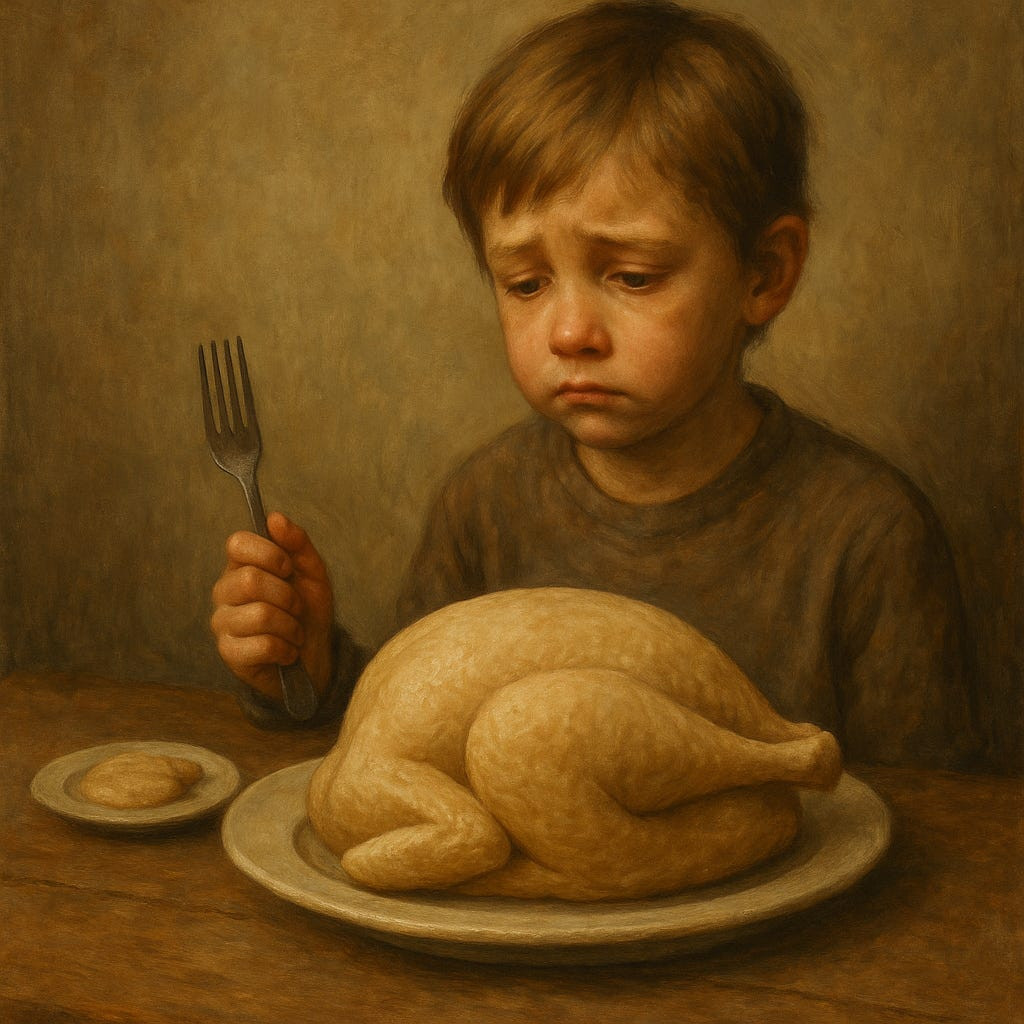
You can’t build hope from one turkey, but you can take a sack of soybeans and shape them into a cartoon bird, bake it under a dying sun, and pretend tradition survived.
And now the children sit down to the soy turkey and give thanks in all the traditional ways, and I believe some of them know I was the one who ate that second-to-last turkey years earlier (I was!), but I will never admit it because laying blame gets us nowhere— not when so much more has been lost.
If anyone wants to accuse me directly, I’ll fess up.
But so far, none of them have.
Just little eyes darting back and forth between their tiny plates of soy turkey and me, with my slightly bigger plate of soy turkey.
Just old-fashioned thanks and communion.
But the communion is counterfeit, the bird is soy, and the silence at the table is louder than prayer.
“So what did happen to all the real turkeys?” one of the children finally asked.
“They ran out,” I said. “Same way everything else did.”
“But how?”
I dodged his judgment the way adults always do—with history. I started the story twenty‑five years earlier.
And it wasn’t lies.
I told no lies.
November 2025
Back then, the country was divided.
The list of things that divided us could fill a thousand bunkers: politics, profit, poisoned feeds, the endless hum of blame. It was the peak of the fracture, when the MAGA faithful were still mortgaging their homes for larger and larger trucks. That would be the last year of that.
The rich got richer until the scale finally tipped and everything slid off.
But one thing still remained, however sparse compared to the past: we still had Thanksgiving with family in common. Not abundance, not tradition, not the old feast with birds and hams and endless sides. Just the ritual of sitting together, plates in hand, pretending the table was whole.
A free turkey from the food pantry.
Some mashed potatoes—still cheap, not a currency yet.
It wasn’t unity. It wasn’t healing.
It was the last scrap of common ground, brittle as wishbone, and we clung to it because there was nothing else left to share. Nor pull apart.
“What happened to the reds?” Timmy asked.
His name may not be Timmy. I wouldn’t know. In times like these, names drift. But the question—that one stays solid as stone.
The reds?
“They celebrated Thanksgiving that year,” I said.
That much I know. When the lights flicker, when the old generators groan and cough and the night stretches long, people tell stories. Most of what I know about 2025 comes from those nights—stories traded like contraband between the convoy kids and the Blues who took them in.
But every now and then a different kind of story came through the firelight:
a red who’d broken ranks.
One.
Then another.
Then another. Then another. Then hundreds more in the years that followed, drifting toward us like stunned survivors after a storm.
They all wore the same look—that hollow, bruised expression people get when they realize the joke was on them the whole time.
And their stories gave me a picture. Not perfect. But enough.
A Single Red Thanksgiving, 2025
A TV bolted to the wall, volume cranked high, rerunning the same loop of pundits insisting everything was fine.
A turkey bought on credit.
Powdered gravy.
Kids already thin around the cheeks, but no one talking about it.
Krasnov, mumbling denials from the bunker of his own making. Not stone. Not steel. Not yet. Walls of enemies. Shelter turned exile. Headlines about sealed files—the one crime they couldn’t pray away, couldn’t meme away.
And at the table, the adults doing their damndest not to look at each other—because deep down they knew. But knowing and admitting are two different currencies.
One defector said he spent the whole meal staring at his fork, thinking, What if this is our fault?
Another caught her uncle wiping tears when he thought no one was watching.
Another remembered the hush that fell whenever the children left the room—a hush full of fear, and guilt, and the first faint sense of betrayal.
The food tasted wrong. No merriment. Only children, hunched over coloring books already half-spent. Crayons broken, wrappers peeled, hope shaved down to stubs.
Every story was different in detail, but they rhymed.
Same room.
Same food.
Same sinking feeling.
That’s what happened to the reds, Timmy.
Their world didn’t end all at once.
It ended at a table turned altar. Prayers whispered to a counterfeit god.
He left them hungry. He stole their farms. He devalued their money. He destroyed their lifelines. He taxed their last pennies to feed the wealthiest few men on earth.
That’s who they had trusted. And by then, they were starting to wonder why.
But it was too late.
Their world ended the moment they realized he would never save them. And the rest of us couldn’t.
“You ate the last turkey, didn’t you?” Timmy said.
“No,” I said—truthfully. “I helped eat the next-to-last turkey.”
Timmy studied me for a moment, then looked down the table.
“Maybe the turkeys being gone are my fault,” I said. “But all of this is his fault.”
The man didn’t look up. He sat there sheepishly, picking at his soy turkey—the kind he hadn’t hunted, hadn’t grown, hadn’t traded for. Just chewing carefully, like attention itself might break something.
“He says he’s a former Congressman,” I added.
I’d never heard of him.
Timmy just shook his head sadly, in judgment and disapproval, and took a bite of his protein effigy.
And in that moment I remembered trying to be an honest man—everything Krasnov was not, and nothing that he was. A man who owned his sins.
So I confessed.
“After we ate the next-to-last bird, we figured—what’s the point in saving this one?”
I sighed.
“Then we ate the last one.”