
Confirmed by The Unherdables Network – No Kings Day, 2050
<< TRANSMISSION #1: Grease and Jeopardy >>
We finally found someone willing and able to fix our car, but for payment, they didn’t want gas or water or cash or gold. Or Pokemon cards. None of that.
What did they demand?
A fully-costumed production of Grease, performed at dawn for their viewing pleasure. Upon completion of the needed repairs, of course. We got as far as asking around about some pink jackets — but then decided it was just easier to walk.
Are these stories in chronological order? Hell no. This has been one long feverish search for water that always ends in thirst.
We once came across a squad of former Jeopardy winners. They called themselves, “The Search Engine.”
In exchange for answers to questions we could no longer find, they would accept resources of any kinds, though I suspect they simply wanted to be told they were smart, one more time.
I thought about asking them the meaning of life, but at the last moment, decided I didn’t want to know.
And the best we could hope for on any given day was some glimpse of a life, of a world that no longer existed, and even when all was quiet and calm, there was a collective, mourning howl screaming at some inaudible frequency.
And it wasn’t that we had gone feral—that’s not what Unherdables meant.
Feral is what happens when fear outruns language, when the social bond snaps and the world collapses back to teeth and distance. A time before friend existed at all.
A feral cat is not insane. It is primal.
But that’s not what we were.
We were merely people who valued freedom more than life itself. People who mourned for a lost world that had valued the same.
<< TRANSMISSION #2: KRASNOV // ORIGIN RECONSTRUCTED >>
Archive Notice
This transmission was recovered from a standalone USB storage device of unknown origin, discovered in a residential mailbox in the American Midwest in early 2025.
The device contained a single plaintext document, duplicated across sectors, with no metadata, author attribution, or timestamps.
How it arrived there remains unknown.
Preface: Transmission Log
Recovered from multiple feeds across the fractured networks of the post-collapse era.
Compiled by surviving archivists of The Unherdables, verified through cross-wave resonance with PsychoPete’s original transmissions.
Dates, where legible, are approximate.
What follows is the most complete surviving narrative of the Krasnov Event — the recruitment, ascension, and ruin of the man once called Trump, code-named KRASNOV by the KGB, THE KING by his faithful, and THE WOUND by history.
“When the map went dark, the stories became our coordinates.”
— Recovered graffiti, Kansas City safehouse
Transmission Context
It started early in 2025.
I started getting mysterious messages. A seeming tour de force of satire — biting, grotesque. One by email.
The return address was:
[email protected]
The first line just said:
“IN 1987 THEY FOUND THE PERFECT IDIOT.”
No greeting.
No sign-off.
Just a block of text about a meeting in a gray Soviet office, a slow-witted inheritor of wealth agreeing to “help the cause” before the question had even been asked.
I didn’t know if I was reading a political roast, a lost spy novel, or classified history.
Two days later, another message. This time:
“KOMRADE, HE CALLS ME JIMMY.”
The way it was written — half-poetic, half-insane — it could’ve been parody.
But there were dates. Locations. Obscure details no satirist should’ve known unless they’d been there.
I didn’t reply.
I didn’t forward them.
I printed them, burned the prints, and buried the ashes. Others received similar messages, but they did not survive long enough to share them.
The next morning, there was a USB drive in my mailbox.
No note.
Just a label:
KRASNOV
The file was one long document.
No explanation.
No metadata.
No way to tell who’d written it or how it had found me.
I read the first sentence.
I didn’t stop until the last.
What follows is exactly what was on that drive.
(At this point, the document shifts from recollected narrative into what reads as an intentionally unclassified intelligence record.)
1987
It shocked them, truly.
The Soviets — steeled by decades of psychological warfare and the painstaking cultivation of foreign assets — were stunned by how easy it was.
There was no need for blackmail.
No kompromat.
No ideological grooming.
Krasnov, as he would come to be known, came into being faster than anyone could have imagined.
“We want you to work for us,”
said the Soviet officer, seated across from the man who still called himself Donald Trump.
The room was pure Soviet minimalism: gray, cramped, with just enough furniture to avoid suspicion.
A table.
Two chairs.
One slow-witted inheritor of wealth.
One spy.
Trump didn’t ask for details.
He didn’t demand money, a plan, or even a justification.
“Okay,” he said.
The Soviet blinked.
His name was Serge — though his new asset would only ever call him “Jimmy.” His real name was not Serge. “Serge” was the code name.
As he told his wife one night:
“The dumb motherfucker can’t remember one fucking word and he thinks a name for a Russian is ‘Jimmy.’
If we are relying on the dumbest of the dumb, the weakest of the weak, Mother Russia is doomed.”
The Soviet Union was doomed.
Mother Russia would be just fine.
The Briefing
This wasn’t how it was supposed to go.
Serge had prepared for a battle of wills, for a cagey, transactional American negotiation.
Instead, he was greeted with the emotional pliability of a golden retriever.
“We are honored to have such a great man visit us,”
Serge had offered moments before.
That was all it took.
“We need you to be one of the worst people imaginable,” Serge said now, his tone warm, almost paternal.
“We want you to be the kind of asshole who brags about winning a rigged golf tournament.”
An hour later—
“What is this plan you keep talking about?”
“Don’t worry about that. All you need to know is that you are the great man who can accomplish this.”
“Well, I am pretty great.”
“You will be president of the United States some day.”
This was a lie. Or it was intended to be.
Serge’s training was in full effect.
“Your skin needs to be paper thin.”
“No insult, any slight, any disrespect must be remembered.”
“You must violate all moral codes — publicly and with pride.”
“You will confuse cruelty with strength.”
“And you will never, ever admit fault.”
Krasnov was pleased.
Still That First Day in 1987…
“You don’t understand,” said the Soviet.
“We want you to be the worst person imaginable.”
“We want you to be Hitler — but, you know… clown Hitler.
Just a complete joke.
Orange face make-up.
Ill-fitting suits.
Unearned ego for days.”
Serge remembered his training.
Keep pressing.
“Not only that,” Serge said. “You can grab them.”
“Grab them?”
“You are celebrity. They will let you grab them.”
“The KGB does not make mistakes.”
Serge leaned across the table.
“YOU ARE KRASNOV.”
The Apprentice
“You’re fired,” Trump grunted.
“No. Say it like Soviet,” Serge said, jabbing a finger.
“Like a New Jersey tough guy.”
“YOU are fired,” Trump tried again.
“Remember — orange clown Hitler.
Orange clown Hitler hosts stupid reality show so he can later become president.”
“You’re fired!”
Art of the Deal
“You know how you are really good at fraud?” Serge asked.
“It’s not fraud. It’s called being a good businessman.”
“IT IS FRAUD, MR. TRUMP.”
“You will launch fake universities. Fake charities. Real charities — but you will steal the money.”
“It is fraud. Are we clear?”
“Yes.”
“Say it.”
“It’s fraud. Fraud!”
Krasnov Finds His Face
“We call it Krasnov orange.”
“Why would I wear this?”
Serge slammed his boot on the table.
“If you put this ridiculous orange shit on your face every day for forty years, one day you will be President of the United States.”
“It makes my skin look bad.”
“It’s meant to.”
Lost in New York…
“You will be in Home Alone 2.”
“Why not the first one?”
“NO!
You are shit.
You will be in the shitty one.”
1993 — The Call
“Privet?”
“Jimmy?”
Serge closed his eyes.
Mission accomplished.
Mission Accomplished (and Then Some)
The Krasnov line was never used again.
The Soviet Union was gone.
Serge retired.
“He succeeded beyond our wildest dreams.”
“There will be statues commemorating our success. If we survive.”
“You’re fired! How was that?”
“You’re on your way, Krasnov. God help us all.”
Epilogue
Old man Krasnov continued to climb.
Both shoes were gone now.
He hoarded Diet Cokes.
Fifteen thousand.
Gone in six months.
Then he emerged.
Washington, D.C. was a charred husk.
Toupee flapping like a wounded bat.
“Gone,” he said. “I made them gone.”
The crown remained.
He placed it on his head.
“I am the king.”
Satisfied.
< TRANSMISSION #2.8: WE WERE HUGH >>
Hugh was a Borg.
When he was severed from the Collective, he woke up confused, lost, lonely—the million voices in his head reduced to one terrified whisper.
No more we.
Just I.
The day the internet finally went dark wasn’t dramatic.
No EMP flash.
No presidential address.
No final tweet storm.
Just… latency.
Pages froze mid-scroll.
Videos buffered into eternity.
Notifications vanished like ghosts who’d finally given up haunting you.
At first, we treated it like any other outage.
Reboot the modem.
Toggle airplane mode.
Curse Spectrum, Verizon, Starlink.
Elon’s satellites were the last to wink out—as if even in death he had to have the last word.
We told ourselves it would come back.
It always came back.
Then the silence settled into our bones.
We were Hugh.
The Withdrawal
When the Collective severed him, the voice that had hummed inside every thought, every movement, every purpose was gone.
That’s what disconnection felt like.
Not freedom, at first.
Terror.
The withdrawal was physical.
Hands trembled, reaching for phones that no longer lit up.
Eyes darted to screens that stayed black—dull mirrors reflecting nothing back.
People stood in parking lots, holding devices aloft like talismans, as if altitude or prayer might summon one last bar of signal.
Influencers wept in empty rooms—no likes, no comments, no proof they existed.
The terminally online felt their hearts stutter when the phantom vibrations stopped.
The rest of us just… listened.
To our own breathing.
To the wind.
To the absence.
The Shared Nervous System
We had been part of something vast.
A shared nervous system.
Every fear crowdsourced.
Every joke instantly validated.
Every loneliness medicated by endless scroll.
The Collective promised we were never alone.
And then it lied.
Or maybe it just left.
The first nights were the worst.
No doomscroll to numb the dread.
No algorithm to tell us what to feel next.
Parents told stories by flashlight—actual voices, no captions, no emojis.
Kids stared at them like aliens.
“Why are you talking instead of typing?”
Relearning “I”
We staggered into a world that suddenly demanded we be here—inside our bodies, in real time, with no undo button.
Hugh learned to say I instead of we.
We had to learn it too.
Some never did.
They wandered off looking for hotspots that no longer existed.
“I heard rumor of a live hotspot up near Sacramento,” someone might say.
“Me and the Mrs. are going to try to make it before winter…”
Scamwagons traveled from settlement to settlement, offering—promising—to provide a Wi-Fi signal for half a dozen chickens or a first-edition Charizard.
We started talking—face to face.
Many of us still moved our fingers while we talked, typing as if texting on unseen phones.
Others carried prop phones—chunks of metal, glass, plastic—useful only for one very simple purpose: self-soothing.
We traded paper maps for memory.
We sang songs instead of sharing playlists.
We memorized the classics—Shakespeare, Steinbeck, Hemingway, Asimov, Vonnegut—just as Bradbury predicted.
We did it out of instinct, with no real reason to think anyone was coming for the books.
Who would?
If I ever find out who might come, I want to know.
I want to have a word with them.
But no one was coming.
No one came.
It hurt.
Like phantom-limb pain for a limb we never knew we could live without.
But in the quiet, something else grew.
Small collectives.
Real ones.
Made of breath and handshakes and shared stew instead of packets and likes.
We were still lonely sometimes.
We still missed the vastness.
But we weren’t Hugh forever.
Eventually we stopped asking,
“When will it come back?”
And started asking,
“Who are we now?”
Some days I still feel the ghost-ping—
that old reflex to reach for a screen, to see if anyone out there still sees me.
Then I remember:
The Collective is gone.
We survived the severance.
Whatever we build next…
…it’s ours.
Not borrowed.
Not crowdsourced.
Just ours.
[TRANSMISSION ENDS]
No signal detected.
<< TRANSMISSION #3 : THE UNHERDABLES >>
Status: Verified via PsychoPete Cross-Wave Resonance
The MAGA faithful lit the sky with fireworks the night the Murder Bill passed. They shouted with glee, drank hard, and waved their flags like the war had been won. And in a way, it had—but the casualties would be their own. They didn’t know it yet, but they were cheering the start of their slow dying.
By the time the dust settled—the little dust left in the poisoned air—they were packing trucks and strapping patch kits to flat tires. Like the Joads of a century before, they set out west and north and anywhere blue, chasing rumors of safety and scraps of mercy. But this wasn’t the Dust Bowl. This was something colder. Something they’d voted for. Something they helped build.
And now they came with hollow eyes and shaking hands to the cities they’d scorned—a faded red hat clutched in one fist like a child’s lost blanket—praying the people they called traitors would offer them a bowl of food, a bed, a hand.
But on that Fourth of July night, they were wild with joy. The Big Beautiful Bill had passed—their monarch’s will made real. The libs were owned, and it was hilarious. In their minds, they had won.
Across cities red and blue, we heard it. The shouting. The laughing. The booming echo of cruelty mistaken for patriotism. We didn’t celebrate. We sat inside behind dim porch lights and curtains barely parted. We were the ones who could still read. Still reason. Still tell truth from the noise pumped out by the unholy trinity: Newsmax, Fox, and the National Enquirer.
I remember someone posting that night on Bluesky: she was upset, her stomach in knots, saying she was “drinking the pink stuff” just to get through the noise. My own stomach was acid and grief, but I couldn’t join her. Last time I drank Pepto-Bismol I nearly died in the ER—allergic to bismuth. One swallow and my throat would close.
For a moment I thought: maybe that wouldn’t be the worst outcome. Maybe I could have skipped the next twenty-five years. Then the moment passed.
The next morning felt like the epilogue of a night without end. I opened the feed and made a starter pack. Just a list at first—true blues, safe follows, people who still knew what words meant. I called it “The Unherdables.” It started as a joke. It became a promise.
In the months that followed, the regime tried to corral the faithful—relocating them, managing them, herding them like cattle who’d helped slaughter their own pasture. They went without protest, resigned to the fate they’d voted for. But we—the liberals, the freaks, the knowledge-keepers—did not budge. We held our ground.
You can herd the complacent, the fearful, and the angry. They know they built this nightmare. But you cannot herd the free.
<< TRANSMISSION #3.5 : THE A+, Basically >>
“You know, I almost got kicked out of a creative writing class in college.”
“I know,” my daughter said.
“For making the other students cry. They wanted a pat on the back and a smiley face. I thought everyone wanted feedback. To improve.”
“Last time you told it,” she said, “it was one guy who cried.”
“True. I only saw tears from one. But the whole class was crying without tears. Tearless crying.”
She nodded. “That’s the internet. Everyone wants to be told they’re great and collapses when that’s denied. That’s why they built AI — to make us feel triumphant about mediocrity.”
“The instructor warned me I was being disruptive,” I said. “So I stood up and said, ‘Fine. When we peer-read, just mark whether you want real feedback so you can improve, or if you want me to tell you it’s wonderful. I can do either. One just takes less thinking.’”
She looked at me. “The story changes every time.”
“That’s true of every story,” I said. “Doesn’t make it untrue. Just… differently true.”
She sighed. “Dad. I already know you can write.”
“That’s not the point.”
“I remember,” she said. “You helped me with my fifth-grade report on China. We got an A.”
“No,” I said. “What I’m saying is this:
“When I write honestly, people don’t just disagree — they feel exposed. Not because I’m cruel, but because truth strips away the padding people rely on to feel okay about themselves. I’ve watched it happen over and over. In classrooms. In families. In one particular letter to the editor that somehow spiraled out of control.”
She waited.
“I don’t think writing is powerful because it’s sharp,” I said. “I think it’s powerful because it’s indifferent to ego. It doesn’t care who feels comfortable.”
She nodded slowly. “So what are you saying?”
“I’m saying I avoided writing this way for a long time because I didn’t want to be responsible for what it does. But if this — this moment — isn’t when honesty matters more than comfort, then I don’t know when it ever would.”
She thought about that.
“I think we got a 96 on that China report,” she said. “Which is basically an A+.”
She was already reaching for the coffee pot, refilling both our mugs without asking.
Outside the window, the wind had picked up. It rattled the screen like someone trying to get in, then gave up.
She set my mug down in front of me.
“Drink it while it’s hot,” she said.
I did.
<< TRANSMISSION #4 : WRATH >>
Status: Recovered Archive // Fragmented Audio Overlay
The caravan moved like a wounded animal, coughing exhaust into the humid night. In the middle of the line, a man hunched over a battered ham radio. He’d heard the voice again the night before—thin, metallic, bleeding through the static like a ghost from PsychoPete’s old pirate broadcasts:
“I hope there is a bullet with his name on it.”
The words lodged in him like fever. In his pocket he carried one. Brass casing polished smooth by his thumb, grooves scratched shallow with a pocketknife. The name wasn’t finished. The metal seemed to refuse the curse.
Outside, the caravan roared with a borrowed rage. He looked out the window and saw it—a tattered billboard hanging from a rusted frame. It was a face, or what was left of one, smeared in that iconic, synthetic Krasnov Orange. It was a color from a lab, a color meant to mock, but here in the humid dark, it looked like a warning sign for a toxic spill.
He drew the bullet into the dashboard glow. He pressed the knife deeper. The truck lurched; the blade slipped. Blood welled, warm and slick, staining the brass. He didn’t care.
“Finish it.”
The voice wasn’t on the radio now. It was inside his skull. He worked the blade again, letters emerging fractured and ugly. He pictured the bullet finding the man who had worn that orange mask for forty years. He pictured the silence after.
They pulled onto a dirt access road. Fires flared from pallets. Men clustered in circles, rifles loose, shouting about Epstein and traitors. One of them—gut spilling over his belt—slapped the man’s shoulder. “Come on, brother. Hold the line.”
He didn’t move. He stayed on the tailgate, firelight flickering across the blood on his hands. He thought of the lake. The sunlight. His sister’s laugh before the vans came.
“Don’t believe them. None of it,” she had whispered in that last voice note.
The rage wasn’t just for Krasnov. It was for the world Krasnov destroyed—and for the brother he’d become in it.
The city loomed ahead, lights flickering like dying stars. He slipped the unfinished bullet into his pocket. The jagged metal scraped his skin. He pushed forward into the crowd toward the Capitol—rifles, flags, faces twisted with a hunger that couldn’t be fed.
Sirens rose, then cut off like a throat closing. And behind them, the road closed like a wound.
<< TRANSMISSION #5 : Out of Service >>
“Who do you think Otis is?”
Vance finally asked it.
He’d been staring at the elevator’s brushed-steel nameplate for the full four minutes they’d been stuck. They would later agree it was a long four minutes. The minutes after would be measured differently—by tone, by posture, by who spoke without being invited.
“I’ll bet it was a Black guy,” Vance said.
The elevator reacted before the people did.
A collective intake of air. A tightening. The subtle recalibration that happens when rules are tested and not immediately enforced.
The women clutched nonexistent pearls. The men exchanged looks.
Some of those looks meant Don’t be racist.
Others meant Don’t be racist in close quarters.
“Why?” Schumer asked carefully.
He had been the last one through the doors. Everyone knew it. Seniority mattered—even now. Especially now. There were systems for moments like this. Schumer trusted systems.
Vance shrugged. “Because most people named Otis are black.”
Silence followed—not disagreement, but processing. This was how ideas became acceptable: first spoken, then examined, then allowed to linger.
Schumer adjusted his glasses—nudging them impossibly farther down his nose—and studied the nameplate as if it were scripture, or at least precedent.
“The company,” he said at last. “Otis Elevator Company. Founded by Elisha Otis in the 1850s. He invented the safety brake. Prevented free fall.”
The words safety brake settled the room.
They liked that. Safety sounded like leadership. History sounded like control.
Vance blinked. “So Otis is… a white guy?”
“At least historically,” Schumer said.
At least two witnesses would later insist Vance followed this with “Gee, gosh, mister.” The recovered surveillance footage would not support their claim.
What Vance really said was, “From Vermont?”
No one answered. Facts had already done their work. Certainty, once cracked, tended to drain quickly.
“Well,” Mitch McConnell said.
He was wedged into the corner, arms folded, unmoving. The oldest among them. The quietest. The one several people found themselves watching without realizing they’d started.
“This is unfortunate,” he continued. “But manageable.”
The word manageable mattered.
“It doesn’t matter who Otis was,” McConnell said. “What matters is order. And weight. And why this elevator—his elevator—has stopped between floors.”
He glanced down. Then up. A brief inventory.
“Unlucky,” someone whispered.
McConnell did not correct them.
“Let’s make some rules,” Mike Johnson said, his bobble of a head just visible between clustered shoulders.
The word rules rippled through the car.
“The Speaker wants to make some rules,” someone said, amused.
Then louder.
Then, laughing now:
“The Speaker wants to make some rules.”
A woman’s voice cut through the noise from the back. Sharp. Irritated.
“No farts.”
The rule landed oddly. Specific. Petty. Immediately useful.
There was a pause—just long enough for it to feel real.
Then Rubio farted.
It was not subtle. It was wet, resonant, and inescapable. The kind that announced itself as a fact rather than an apology.
“Who said that?” Rubio asked, turning slightly, though everyone already knew. It was Nancy Mace. “I agree with the congresswoman,” he added. “I just needed to get mine out so I’m in compliance going forward.”
A few people laughed. Too loudly.
“Rubio doesn’t like farts because he’s short,” Vance said, grinning. “He operates at ass level.”
“I’m taller than you are, motherfucker!” Rubio snapped.
He wasn’t. He knew that. Still, some traitorous part of his brain immediately staged a back-to-back height duel—shoes off, neutral ground, witnesses present. No one offered. The moment passed.
Schumer cleared his throat.
“Really,” he said. “How are we going to regulate—”
The laughter swallowed him.
Not deliberately. Not unkindly. He was simply absorbed.
After that, it was understood—without a vote, without a rule—that no one would speak to Schumer.
And for the remainder of the elevator ride, no one did.
Time stretched.
Hunger arrived early, the way panic always does.
“If we have to eat someone,” Rubio said, “I don’t want it to be someone old.”
“Agreed,” Vance said. “Or too famous.”
Eyes began to move. Calculating. Measuring relevance.
The least famous congressman in the elevator felt them settle on him and began to sweat.
“If they were coming to save us,” Ted Cruz said, panic cracking his voice, “they would have saved us by now.”
“Now, Ted,” Schumer said drowsily. “It’s been less than fifteen—”
He trailed off, the sentence dissolving into the stale air, the way a ghost stops speaking once it realizes no one can hear it.
The fart debate replaced him.
Liberty versus regulation. Enforcement versus inevitability.
Hakeem Jeffries pointed out—calmly—that farts were an uncontrollable bodily function and therefore could not, should not, and constitutionally must not be regulated.
“Easy for you to say,” Cruz squeaked. “You’re tall.”
“Me being tall has nothing to do with it,” Jeffries said. “But if you try to stop me from farting, you’re going to get it good.”
He was not bluffing.
They spent forty-five minutes in that elevator.
The doors slid open.
Light flooded in—harsh, fluorescent, unmistakably alive. Cool air rushed the car. Voices followed. Radios crackled. A firefighter leaned forward, smiling too quickly, already rehearsing relief.
For half a second, no one moved.
Ties were straightened. Jackets tugged into place. Faces reset—creased into gratitude, resolve, bipartisanship. Someone laughed, a little too loud, as if cued.
And then the unknown congressman ran.
He bolted from the corner like the floor was lava, scrambling over shoes and knees, shoving past Vance and Cruz without apology, shoulder-checking a staffer who hadn’t cleared the doorway fast enough. He burst out of the elevator as if it were on fire and did not slow down.
Tie flapping. Shoes squealing against the marble. One hand still clenched in a fist he no longer needed.
“Sir?” someone called. “Sir, are you okay?”
He did not answer.
He did not look back.
He ran down the corridor, past cameras, past flags, past portraits of men who had never been afraid of their colleagues, until he disappeared around a corner toward the nearest exit.
Inside the elevator, the famous ones watched him go.
A beat.
Vance chuckled, thin and nervous. “Little dramatic.”
Rubio muttered something about stress.
McConnell adjusted his stance, unmoved.
Schumer—still not quite addressed—said softly, to no one, “He’ll be fine.”
They stepped out together then, smiles fully in place. Hands shaken. Photos taken. Statements made about ordeal and cooperation and the enduring strength of American democracy.
The unknown Congressman has been lost to history. Some in that elevator that day knew who he was but that detail never made the news cycle. He might as well be dead. White guy. GOP. Survived by a wife, one presumes, and the statistically appropriate number of children.
The others posed with firefighters and praised first responders.
By the time anyone thought to ask what had happened in the elevator, the news cycle had already moved on.
The car was cleaned and back in service by morning.
<< TRANSMISSION #5.5: The Last Innocent Witness>>
Notes from the Apocalypse — Broadcast #49: From the Night the Constitution Flatlined
They called it the meeting that saved nothing.
A grainy file pulled from a melted hard drive, recovered between bursts of static and the hum of dead servers.
No one remembers who leaked it first—just that it showed the last time anyone in power pretended to govern.
I watched it years later, eyes burning from the generator light, and thought:
This was how empires end—not with a bang, but with a stapler and a stuffed elephant.
I remember the night they tried to save the country and couldn’t.
They called it a constitutional emergency.
I called it karaoke at the end of the world.
Trump never made it to the toilet anymore.
One day he simply stopped trying, as if gravity were beneath him.
He liked the ritual—the attention, the cleanup.
He craved the human touch, even if it came from a retching maid scooping up half-digested Big Macs.
The Founders never foresaw that.
This was the scene: Oval Office redux—or what was left after the barricades.
Fluorescents buzzed like hornets trapped in a mason jar.
The air was thick with stale coffee, chemical sweat, and the sulfur boil of the Potomac.
On the cracked television behind the Resolute Desk, maps of splintered states flickered—red bleeding into blue, blue fading into grey, like a body giving up circulation.
Vance—acting VP, pale and hollow as always, but fatter now, likely from stress-eating under Stephen Miller’s incessant daily cruelty—called the meeting to order.
“Section Four, folks. We invoke, we stabilize.”
He looked around for authority. Found only fear.
The cabinet looked like a séance of wax figures melting under bad light.
Rubio fidgeted so hard his chair squealed like a trapped mouse.
Miller dabbed his nose with a monogrammed handkerchief and smirked.
“Rubio sweats like democracy,” he muttered.
He fantasized about being quoted someday—Miller, the last loyalist.
Hegseth was shirtless, veins like barbed wire, ranting about a woman who’d “dishonored the troops.”
No one knew who. Possibly America.
“They’re all traitors in heels. Doesn’t matter which one,” Miller whispered.
Then Linda McMahon arrived, dragging a stuffed elephant half her size.
“Why?” someone asked.
“They said we’d discuss the elephant in the room,” she said brightly. “I wanted to be prepared.”
She parked it beside Lincoln’s bust, now a hat rack for flak jackets.
Its glass eyes glinted in the pulse of the emergency lights like twin indictments.
Miller tilted his head. “Finally, something in this room with dignity.”
Vance sighed. “We’re not here for jokes.”
But of course they were. That’s all they’d ever been good for.
Krasnov—still calling himself President—was supposedly upstairs, sedated or divine depending on who you asked.
Rumor said he’d tried to order a nuclear strike on the Food Network.
No one knew if it was a metaphor. No one wanted to ask.
Miller whispered, “I’d have picked HGTV.”
Vance’s eyes swept the table and froze on a quiet, white-haired man sitting awkwardly in the corner, his chair angled as if the whole table were a clock hand pointing at him.
“Why is Mike Pence here?” Vance asked.
“He’s the vice president,” Pam Bondi chirped, thrilled to know something.
“No, he’s not,” Vance said, half-whine, half-scream. “I’m the vice president.”
A long pause. The fluorescents buzzed.
“I’ll be honest with you,” Hegseth said, scratching his chest. “I thought he was the vice president too.”
Pence nodded serenely, as if confirmation were an act of faith.
(Inside his head: maybe if he stayed perfectly still, the Rapture would finally notice him.)
“Don’t worry,” Miller murmured. “He’s only here for the snacks. Or the Rapture, whichever comes first.”
“Let’s be clear,” Vance said, “the man is not well.”
Linda tilted her head, the stuffed elephant’s ear flopping against her knee like a sad afterthought.
“Why a Twenty-Fifth Amendment? Don’t we have enough of them already?”
She blinked—earnest as a wrestler cutting a promo—convinced they were here to staple on another clause like it was just a new match stipulation.
Then, with the instinct of a lifetime in performance, she reached out to do a mic drop—only to realize she wasn’t holding one.
Her hand hung there in the air a beat too long before she patted the elephant’s head instead, recovering with a brittle smile.
Hegseth slammed the table. “He’s a fighter! Fighters don’t rest!”
(In Hegseth’s mind: bare-chested on a horse, history applauding. He doesn’t notice the mustard stain shaped like Texas on his waistband.)
Miller added under his breath, “Or spell.”
Hegseth wiped his mouth with the back of his hand. “Couldn’t we have done this over Signal?”
“Wait,” Vance said, scanning the room. “Where’s Kash?”
“Maybe he thought we were meeting at Arby’s,” Miller offered.
Several of them nodded in agreement.
But Patel was there—nervous, wild-eyed, circling the perimeter of the office.
He stopped mid-stride, sensing the room’s gaze.
“It’s not really an oval,” he said.
It wasn’t.
Because it wasn’t the Oval Office at all.
It was the Situation Room.
And no one had noticed.
Linda flipped through her notes. “Technically, we only need seven signatures. Then we transmit to Congress.”
She looked up hopefully. “Does Congress still exist?”
Silence. Even the flag drooped in shame.
“Barely,” Miller said. “Like your polling numbers.”
That’s when Rubio, desperate to escape the quiet, blurted, “I—I plead the Twenty-Fifth.”
No one corrected him.
They just nodded, solemn as saints at a yard sale.
(In Rubio’s mind: Maybe they’ll put that on a coin someday.)
Miller snickered. “Limited edition, minted in cowardice.”
Around them, side conversations buzzed like flies over a carcass.
Hegseth muttered about loyalty oaths.
Linda checked her portfolio.
Miller prayed to no one in particular, pausing only to hiss “weak” at Rubio’s posture.
And Noem—perched at the table’s edge like a debutante at a funeral—leaned toward Vance and whispered,
“You’re going to pardon me, right? I might have done some… light insider trading.”
Her perfume smelled like scorched lilac and plausible deniability.
Vance didn’t even look up. “Kristi, we’re trying to save the republic.”
She smiled. “I thought that was what I was doing.”
(In her head: maybe this all goes down and she ends up President. Stranger things have happened. Once, a game show host did.)
Miller muttered, “Maybe start smaller—dog catcher.”
Vance dragged a silk top-hat from under the table—his planned “historic moment” prop—and began passing out slips of paper.
“All right,” he said. “Write yes if you support invoking Section Four. No if you don’t.”
Rubio scribbled first.
“I’m voting for Arby’s,” he announced.
“That’s not what we’re doing,” Vance snapped. “It’s nine a.m.”
“Breakfast of patriots,” Miller said.
McMahon pointed at the elephant. No one knew what that meant.
Noem waved her off. “I don’t eat beef on camera anymore.”
“I could eat,” Hegseth said—everyone realizing for the first time that he already held a burger in one hand, but all looked away quickly as one does when confronted with unwanted nipple.
Vance exhaled through his teeth. “Just—write yay or nay, a vote.”
He waited while pens scratched and wrappers crinkled.
When he upended the hat, the first paper fluttered out: Arby’s.
He shot Rubio a look that could sterilize corn.
The second read: Noem.
Kristi blinked. “That wasn’t me,” she said quickly.
(Inside her head: maybe it was. Maybe fate.)
“Freudian slip,” Miller muttered. “Mostly the Freudian part.”
The next one said Pence.
Everyone turned. Pence smiled beatifically, as though finally chosen for something holy.
“Finally, a miracle,” Miller sighed.
Vance slammed his palm on the table. “This isn’t how voting works!”
“Seems pretty democratic to me,” Hegseth said.
From the corner, a laugh wheezed out—wet, phlegmy.
Vance turned and saw him.
He’d been there the whole time.
Not upstairs. Not asleep.
Slumped behind the overturned flag, wrapped in a golf-course windbreaker, chewing a cold Filet-O-Fish like a cow working cud.
Someone had wheeled him in hours earlier “to keep him calm.” Everyone simply… forgot.
They talked right over him—debating his removal as if he were furniture—because no one believed he could follow a single sentence.
And he didn’t. He just sat there humming “YMCA,” ketchup on his cuff, eyes darting between the stuffed elephant and the nuclear football like he was trying to remember which one contained fries.
Noem glanced his way, frowning slightly. “He appears to be getting fussy.”
Miller, without looking up from his napkin scribbles, sighed. “Just hand him one of the gold things off the wall. That usually calms him down.”
Vance reached for a framed medal—some dusty commendation from a forgotten gala—and tossed it over.
Krasnov caught it clumsily, cooed like a toddler with a shiny toy, and went back to his fish cud, the medal clutched to his chest like a security blanket.
When Vance finally noticed the full extent, he froze.
“Sir, we were just—”
Krasnov looked up, slow and glassy. “Doing a great job,” he said. “Best amendment. Everybody’s saying it.”
Then he laughed—a sound like a tire losing air—and went back to chewing.
(Inside his head: bright lights, roaring crowd, everything still perfect.)
Miller whispered, “I’m surrounded by clowns.”
The meeting collapsed.
Hegseth dropped to one knee, weeping—a martyr in his own movie.
Linda scooped up the elephant, wondering if it could be a commemorative plush.
Miller vomited into his mug, then sneered, “Better than the food here.”
Rubio hid under the table, mouthing I plead the 25th like a rosary.
Noem adjusted her hair for cameras that weren’t there.
Krasnov stood wobbling on the presidential seal, drooling onto the eagle’s wings.
“They’ll never replace me,” he murmured. “I am the amendment.”
Then his knees gave out—not like a man collapsing, but like a marionette whose strings had finally been cut.
He slid sideways, mumbling through a slurry of slogans and jingles, still trying to remember which one made people clap.
The doctor rushed forward, checking his pulse and muttering about sedatives.
Secret Service agents appeared, silent and pale, the way ghosts might clock in for overtime.
They lifted him gently, like something fragile but contagious, and wheeled him toward the hall.
Even as the gurney turned the corner, his voice drifted back—half whisper, half commercial jingle:
“Best… amendment… everybody’s saying it…”
Miller looked after him and said, “Finally, a leader who listens.”
No one laughed.
No one cried, either.
By noon, the Situation Room was empty.
The biscuits were gone. So was the elephant.
Someone had carved STABILITY ACHIEVED into the desk with a letter opener.
I checked the recording later: half static, half laughter—none of it human.
Postscript — 25 Years Later
People ask sometimes if there was ever a moment we could have stopped it.
There were many. Some failures were cowardice. Others, incompetence.
That night? Buffoonery.
But we mistook absurdity for immunity.
We thought laughter meant safety.
The Constitution didn’t collapse; it choked on applause.
And when the silence came, it sounded merciful.
I still have the file somewhere.
At the twelve-minute mark, you can hear Rubio’s voice, small and trembling:
“I plead the Twenty-Fifth.”
And underneath it, faint but clear—
the wet chewing of a Filet-O-Fish
and a voice saying,
“Best amendment ever.”
<< TRANSMISSION #6: The Courtiers>>
Dec 20, 2025
The chairs were identical, arranged in a loose semicircle that only pretended at equality. No two sat the same distance from the door. The difference was small enough to deny, large enough to feel.
The room was large enough to impress, but too hollow to comfort. Sound died quickly here. Gold trim glinted along the edges of the tables like a gilded cage, as if ornament could stand in for warmth.
On the far wall hung a clock with no hands. It had never needed them.
Timmy cradled the trophy on his lap the way one holds a sleeping child—careful not to wake it, careful not to drop it. Polished metal. Heavy. Engraved. He lifted it an inch, then set it back down, flinching at the imagined sound of metal on marble.
“Mr. Sanchez,” Timmy said.
“Why would you call me that?”
“Because it’s your name.”
Sanchez checked the time on a bare wrist. Automatic. Useless.
“He’s thirteen minutes late.”
“He’s never late,” Timmy said too quickly.
“He is now.”
The Social One sat perfectly still, smiling—the same expression that had survived hearings, leaks, screenshots.
“Thirteen minutes is a data point,” he said. “He could be watching. Taking notes.”
They glanced at the corners of the room.
Dark glass.
Ceiling vents.
Nothing moved.
Timmy adjusted the trophy, turning the engraving toward the door.
“It’s historic,” he said. “He’ll see the intent.”
“No gift is ever enough,” Sanchez said. “The scale only goes one way.”
“What does it symbolize?” the Social One asked.
Timmy hesitated. “That I’ve been listening.”
A notification chimed faintly—then died mid-note. No one reached for a phone.
“This delay is instructional,” Sanchez said.
“Delay is discipline,” the Social One agreed.
Timmy lowered the trophy to the floor, centering it like an offering. The base rang softly. Too clean. Too lonely.
“If he doesn’t come,” the Social One asked, “what do we do?”
“He always has,” Sanchez said.
“He always comes,” Timmy said.
They waited.
Tuesday
Footsteps. Uneven.
The door opened.
A familiar squat, rat-eyed man entered, carrying a small white model rocket.
“Sorry,” he said. “Traffic.”
No one answered.
“Look at that,” the Social One said. “Rocket Boy brought a rocket for his boyfriend.”
“This?” Rocket Boy said, pleased. “I brought it for me.”
“Then what did you bring him?” Sanchez asked.
Rocket Boy grinned. “Ketamine.”
No one laughed.
“That’s personal,” the Social One said.
“So is loyalty,” Rocket Boy replied.
He placed the rocket at his feet. It tipped, then righted itself.
“If he doesn’t come,” Rocket Boy said lightly, “we could leave.”
The chair hit the floor hard.
“Hypothetically,” Rocket Boy added. “Stupid.”
They waited.
“Tomorrow,” the Social One said.
Wednesday
The chairs hadn’t moved.
The trophy and rocket remained where they’d been left. Dust had begun to settle.
Timmy brought a leather-bound book.
Sanchez brought nothing.
The Social One brought an AirPod case engraved with ∞.
“Twenty-one minutes,” Sanchez said.
“He’s calibrating,” Timmy said.
“Or he’s in the bathroom,” Rocket Boy said.
The Social One nodded. “Severe blockage.”
Silence.
“I read fiber helps,” he added.
No one replied.
He placed the AirPod case beside the gifts. “Wireless freedom.”
They waited.
No footsteps came.
“Tomorrow,” Sanchez said.
Thursday
Five objects now sat on the floor: the trophy, the rocket, the book, the AirPod case, and a small vial of clear liquid.
Rocket Boy had brought it.
“He’s not coming,” Rocket Boy said. “We’re just performing for the vents.”
He stood.
“If you leave,” Timmy said quietly, “it’s on all of us.”
“He’ll know,” Sanchez added.
Rocket Boy sat.
The vial wobbled. Didn’t fall.
The Social One’s smile collapsed.
“Tomorrow,” he whispered.
The trophy dulled.
The rocket yellowed.
The book curled.
The AirPod case bore a fingerprint.
The vial reflected nothing.
The chairs kept their unequal distances.
They waited.
Friday
Someone arrived early.
He paused just inside the doorway, holding a folder to his chest as if it might explain him.
The chairs were full.
Not crowded—just occupied.
He looked at the floor. The spacing. Counted once. Then again.
No one met his eyes.
Timmy noticed first and shifted slightly, as if the movement alone might correct things. It didn’t.
The Social One’s smile flickered, then returned—careful. Rehearsed.
Sanchez stared straight ahead.
Rocket Boy glanced back once, confused, then shrugged and looked at his phone. There was no signal.
The man took a half step forward. Stopped. Adjusted his grip on the folder.
He did not ask for a chair.
He did not point.
He did not clear his throat.
He simply stood there—too close to the semicircle to be absent, too unsure to belong.
The clock watched.
No one spoke.
After a moment, the man relaxed into the waiting—shoulders lowering, weight shifting—learning the rules without being taught.
The objects on the floor sat between them like evidence no one intended to submit.
The chairs remained exactly where they were.
The clock remained without hands.
They waited.
<< TRANSMISSION 7: GUIDE TO WATER IN THE END TIMES >>
PsychoPete’s Tips on Not Dying of Dysentery
You can live three weeks without food.
You’ll die in three days without water.
So filter it.
Boil it.
Steal it.
Beg for it.
Just don’t trust it if it smells like feet or patriotism.
Good water should be clear and odorless.
Bad water should be avoided unless you want your insides to turn into a Slip ’N Slide of regret.
Water should be the opposite of Krasnov:
Clean.
Transparent.
Odorless.
Free of orange residue.
We were told we had to wait forty years before Krasnov jokes were funny again.
I don’t do it for laughs.
I do it to make sure I’m still alive.
Water Hierarchy (Memorize This)
Rainwater = gold.
Puddle water = cholera roulette.
A Brief Educational Interlude
Remember Oregon Trail?
You kept dying of dysentery and screaming at the screen:
“There’s NO WAY you can die of dysentery every freaking time.”
You can.
You will.
It’s the most realistic game ever made.
Tips
Boil anything that touched the ground.
Bleach ratio: 8 drops per gallon
(Read the bottle if you still have one.)Filter through cloth first, then boil.
Charcoal if you’re fancy.Never drink downstream from a corpse — human or otherwise.
Suggested Viewing
Waterworld
Any Mad Max
Suggested Reading
Clan of the Cave Bear
Jaws
The back of a bleach bottle.
<< TRANSMISSION #7.5: THIS ONE MATTERS – A NO KINGS PROTEST GUIDE >>
Recovered from scattered Substack archives and ham-radio repeats.
Oct 14, 2025.
Someone read this aloud on shortwave the night before the actions.
We all listened in the dark, writing numbers on our arms with whatever we had left.
They say every empire gets the protest it deserves.
October 18 matters — not because it will fix everything,
but because it’s the first time since the coup attempt that we’re showing up together, nationwide,
saying the same thing:
No Kings.
If turnout is small, they’ll call it acceptance.
If it’s large — loud, disciplined, unbowed — it reminds them power still belongs to the living.
This isn’t the revolution.
It’s the rehearsal.
Before You Go
Know your rights. Review ACLU guides. Peaceful assembly is still protected — but “safety” is now whatever they say it is.
Make a plan. Tell someone where you’ll be. Map exits. Assign roles (medics, watchers, communicators).
Go analog if you can. Leave your real phone home. Burner flip phones, cash-bought SIMs, no biometrics. Sharpie legal hotlines on your skin.
Dress for mobility. Sturdy shoes. Long sleeves and pants. Neutral colors. Layers you can shed. Cover tattoos. Avoid identifiable gear.
Pack smart. Water. Snacks. Goggles / mask / bandana (soaked in water or vinegar for gas). Basic first aid. Cash. Whistle.
Park smart. Travel in groups. Know your exit before you arrive.
During
Stay aware. Head on a swivel. Stick to edges for mobility.
Don’t engage provocateurs. They want chaos for the cameras.
Deny them the shot: face away, link arms, sing or chant unity, alert marshals.
Film misconduct safely. If approached, ask:
“Am I being detained, or am I free to go?”
Then say nothing else without a lawyer.If arrested: stay calm. No resistance. Invoke silence and counsel.
Spot agitators. Late arrivals in heavy gear. Urging violence. Carrying bricks or bottles.
De-escalate with calm solidarity. Sit and sing if coordinated. Never alone.
Your body is a message.
Make it say:
We are many.
We are peaceful.
We are not leaving.
After
Decompress.
Document injuries or abuses. Photos. Badge numbers. Timestamps.
Report to NLG / ACLU.
Share responsibly. Never post identifiable faces without consent.
Keep showing up. One day doesn’t win it. But it builds the muscle.
Final Note from 2025
Your safety is the movement’s safety.
Endurance, not martyrdom.
Survive to organize again.
History won’t remember who stayed home thinking someone else would go.
It will remember who stood shoulder to shoulder when it still mattered.
Postscript, 2050
October 18 was big.
Bigger than they admitted.
Cities full.
Voices loud.
No crowns accepted.
It didn’t stop the fall — nothing could have, not then.
But it taught us how to stand together when standing was all we had left.
Some of us are still standing because of that day.
Some of us aren’t.
Both truths fit in the same line in the sand.
<< TRANSMISSION #8 : THE TIMELINE HAS SHIFTED >>
The timeline has shifted.
Again.
I know because I have new memories, and they don’t sit right. They arrive without permission, like bruises that bloom overnight.
Trump lost his grip—louder this time, less coherent. Barked about Rosie O’Donnell as if the last twenty years had been erased. Threatened things he no longer had the power to do. Alienated even the people who still wore his face on novelty socks.
I remember watching it and thinking: This didn’t happen like this before.
But now it did.
And this version won’t leave.
The panels came on next. Smug faces blinking behind studio lights, voices trained into calm concern.
“When Trump is gone,” they said, “the threat doesn’t disappear.”
No shit.
That line became scripture for a certain class of professional noticers—men who climbed fear like stilts to tower over the crowd. They named successors, financiers, shadow networks. They spoke as if noticing were bravery.
We already knew the sky was red.
We were already tasting it in the water.
At the same time, I was researching ICE. Again.
Not who they were—we had passed that stage—but how to stop them. Which tactics worked. Which failed. Where the vans stalled. How people disappeared. How some came back. How most didn’t.
Thoughts the 2024 version of me would have called hysterical.
He was wrong.
He’s gone now.
The work grew too large for a single dispatch. It turned into a guide, then a warning, then a thing stitched from the same torn fabric as Krasnov and the Unherdables and all the other names we invented to survive what we were watching.
But I couldn’t keep writing without acknowledging the glitch in the feed.
The new tantrum.
The rewired base.
The way old masks began to slip—not dramatically, but through exhaustion.
When the brain lags, the shame leaks out.
And this country has a lot of shame to leak.
Trump stopped being a man before he stopped breathing. By the end, he functioned as a solvent—loosening restraints, dissolving norms, thinning everything that once held.
Historians like clean endings. Villains defeated. Lessons learned. A line drawn where recovery begins.
We didn’t get that.
The damage spread instead—quietly at first, then everywhere at once. Shortcuts turned into doctrine. Cuts disguised as efficiency. Cruelty passed off as realism.
The future we live in now began in those early months of 2025, when hollowing out the country was framed as strength, and no one with the authority to stop it felt like trying.
You want to know why Cousin Johnny died of the plague?
It wasn’t the bacteria alone. It was policy layered on neglect, appointment stacked on vanity. It was a man who believed immunity could be willed, who confused contrarianism with science, who had been placed exactly where he could do the most harm.
Johnny didn’t die in isolation.
He died downstream.
Even after Trump finally died—quietly, ignobly, slumped into himself—the systems he bent didn’t snap back. They kept moving, powered by momentum and permission.
That’s the part people miss.
No single death stopped it. No single vote reversed it. What had been set in motion continued because it was easier than stopping.
We used to talk about plagues as events.
Famines as failures.
Wars as decisions.
But here, they arrived as processes.
Food thinned. Care rationed. Language sharpened into weapons. Neighbors sorted into categories. Bodies counted, then miscounted, then ignored.
By the time the names felt obscene to say out loud, we needed another one.
So we used Krasnov.
Not because it was clever, but because distance was necessary. Because sometimes you can’t hold the truth directly without bleeding.
He was never just a person. He was an opening.
And everything that followed came through it.
The timeline has shifted before.
That much I know.
Which means it can shift again.
⟪ TRANSMISSION #8.5 ⟫
OPEN LETTER TO WAL-MART
Recovered from a defunct server, November 2025.
Author unknown — probably one of us. Maybe me.
Dear Wal-Mart,
We’ve seen your shirt.
We know what you stand for.
We already did.
You looked at that design — the dog-whistle in bold print — and said:
“Yes. That’s who we are now.”
So tell us:
What makes it worth alienating the last customers who still have principles?
The only answer left is that you’ve decided hate is your new target demographic.
Maybe you think cruelty pays.
Maybe you believe the outrage cycle spikes short-term sales.
But the real fuck-you coming your way isn’t from “woke” boycotts.
It’s from your own base, losing the ability to buy anything at all.
The policies you quietly cheered —
the cuts to SNAP,
the shredded safety net,
the wages frozen while costs soared —
are gutting the very people who’d wear that shirt with pride.
No food money.
No medicine.
No disposable income for Nazi chic at checkout.
You built your empire on the working poor.
Now the machine you helped grease is eating them alive —
and your registers with them.
We’re done feeding you.
No more groceries.
No more gadgets.
No more guilt purchases.
Our dollars go elsewhere now:
local farms,
co-ops,
mutual-aid networks,
people who don’t sell hate as merchandise.
Enjoy the shirt while it lasts.
We’ll be over here building the world that comes after you.
— The ones who still remember the difference between patriotism and fascism
Postscript, 2050
The parking lots cracked first.
Then the roofs caved.
We pulled wire shelving for trellises.
Shopping carts for trailers.
The shirts?
Burned clean years ago.
The building makes a decent windbreak when the dust storms roll in from the west.
Some nights you can still smell the ghost of rollback prices in the concrete.
We starved the beast slower than we wanted.
But we starved it.
«TRANSMISSION 9»
Step 2: We Came to Believe
(Fox Boycott Edition)
Yo. You can’t boycott something you don’t buy.
Back when the suggestions first flooded Psycho Pete’s Living Guide to Boycotting the Big Orange Menace — MyPillow, Hobby Lobby — my gut check was always: Do left-leaning folks even touch this stuff?
Trek to Hobby Lobby for discount fake flowers and Jesus knick-knacks?
Snag that lumpy sack from that right-wing, drug-addled lunatic Mike Lindell?
Hell, I could whip up a better pillow out of mulch and a magnum condom.
The truth landed like bad coffee: some did. Some do.
So we boycotted anyway — eyes open to the math.
If only a handful of us were in the cart, it was symbolic at best,
a middle finger scratched in sand.
But Fox Corp?
That’s not a knick-knack store. That’s the hydra gnawing at civilization’s roots —
the prime suspect in our slow-motion collapse.
When the earth finally chills lifeless —
no ant, no cockroach left to reboot the show —
you’ll be able to draw a straight line from Rupert Murdoch’s propaganda forge.
From Reagan to Murdoch to Trump to the toadies who scavenged the carcass after.
And the odds? Sure, somewhere out there, life exists.
But so remote we’d never know.
So for all practical purposes we’ve let the worst of us —
the people who don’t value love, family, community, art, science —
smother life everywhere we can reach.
We didn’t stop them.
Maybe you can.
We didn’t watch Fox News — didn’t mainline the rage-bait —
so a “boycott” from us? Laughable.
Until you clock the full beast:
not just cable scream-fests,
but tentacles in one of the big four broadcast networks,
slithering into sitcoms, sports, local news.
Poison laundered through laugh tracks and halftime ads.
Propaganda slipped between punchlines and touchdowns.
We could hurt them where it hid.
And in spots, we have —
shows hemorrhaging ad bucks from the pullouts,
the echo cracking just enough to echo back.
What kicked off as a three-paragraph blurb in the guide
evolved on a certain road trip —
the gray ribbon unspooling west under skies too leaden
for three spins of Swift’s latest trial.
It hit in the flicker of a diner TV —
Karoline Leavitt’s brittle smile beaming down like fluorescent fever,
Fox murmuring its nightly sermon:
You’re not crazy; the world’s just rigged against the real Americans.
We’d nod along, remote limp in hand,
the blue glow baptizing doubt into delusion.
Powerless? Sure.
Step 1 owned that —
the Amazon cart as dealer, feeding the next hit of what if
till the high soured.
But sanity?
That’s the ghost you chase when the screen blacks out,
the echo chamber humming empty as a gutted diner booth.
From the porch in 202X, drone-shadows stitching the sky like botched seams,
I see it sharper now.
The Power wasn’t some thunderclap from on high —
no bearded judge smiting grifters with fire.
It was us — stooped and scarred, stubborn as Brown’s weathered cabin planks.
The swarm:
your neighbor ghosting cable for podcast heresy,
the ex-viewer flooding X with uncut clips that gut the script,
the kid trailing the rider, learning to snort at the strongman’s squint
instead of swallow it whole.
We came to believe because we had to.
Fox’s fat checks to the inauguration fund bought them a velvet rope at the coup,
but our no?
It’s the tide — quiet, relentless,
eroding the empire one unsubscribed channel at a time.
Sanity isn’t silence.
It’s the signal slicing the static.
Believe in the Power —
the us greater than the isolated scroll,
the collective cane tapping unseen maps in the dark.
Cut the cord.
Tune to the frequency where laughter’s the first sane sound —
the one that shrinks tyrants to punchlines.
The beast starves when we stop feeding the madness.
And once you see the hydra —
once you clock how it coils from scream to sitcom,
from touchdown to toadie —
you can’t unsee it.
P.S. Those stooped planks and drone-stitched skies? Echoes from a paid dispatch: a grief-ribbon road trip to John Brown’s cabin, where rage met restraint. Sub for the full haunt here—it’s the map that tempers the nos.
⟪ TRANSMISSION #9.2 ⟫
THANKSGIVING IN HELL — AN UNHERDABLES ROAST
Recovered audio file, January 27, 2026.
Source: ham radio “comedy night,” signal bounced across half the fractured networks.
Laughter in the background sounds half-drunk, half-desperate.
We needed it then.
We still do.
Ladies, gentlemen, and whatever the hell Matt Gaetz is —
welcome to the only roast where half the guest list is either guilty of child trafficking or protecting someone who is.
This is the MAGAverse in 2026:
a nursing home that caught fire, elected itself president,
and is now trying to ban the fire department for being woke.
Let’s carve this turkey.
Pete Hegseth
The only veteran who lists “blacked out in an Applebee’s bathroom” as combat experience.
Kristi Noem
Read 101 Dalmatians as aspirational.
Her wildlife philosophy: “I wonder what sound it makes when I kill it?”
JD Vance
Wrote a memoir about how much he hated Appalachia,
then moved back the second Peter Thiel offered him a new couch to fuck.
Elon Musk
Has eleven children and still nobody calling him Daddy on Father’s Day.
Ted Cruz
Fled to Cancún during a deadly winter storm
because even frozen Texas corpses were warmer than his own family.
Marjorie Taylor Greene
The physical embodiment of a Facebook comment written in ALL CAPS.
Lauren Boebert
Got caught jerking off a rando in a children’s theater
and blamed it on “vaping.”
RFK Jr.
Between the whale he decapitated and strapped to his car, the dead bear he dumped in Central Park and the worm that ate his brain, all his stories are about increasingly smaller sources of rot. That’s why he’s moved on to killing children with microbes.
Clarence Thomas
Gifted so many luxury trips he’s legally a Marriott Bonvoy member of the Supreme Court.
Stephen Miller
If racism had a skincare routine, it would be Stephen Miller.
Ron DeSantis
Smiles like a man trying to hold in a fart during a hostage negotiation.
Matt Gaetz
If you Google “I swear she was 18,” it just shows his face.
And finally… Donald Trump
Even Hitler loved dogs.
Trump once saw a golden retriever and asked if it came in blonde.
He’s the only guy who can lose an election, stage a coup, get impeached twice, bankrupt six casinos,
and still convince 74 million people he’s the victim.
He’s not a leader —
he’s a late-stage capitalist STD that learned to tweet.
The worst part?
Every Republican on this stage still crawls back to kiss the ring —
because they know the second they stop, he’ll leak their nudes, their taxes,
or whatever kompromat he’s been hoarding.
Trump didn’t break America.
He just revealed how easy it was to break.
Thank you, good night,
and God bless whatever’s left of this country.
«Transmission 9.5: Dispatch from Osawatomie»
I thought everyone knew the story of John Brown — the man who found slavery so intolerable he drew his sword and cut down the men who defended it. Most never did, or they forgot, or they were told a version that filed the edge off his rage. They called him insane. Maybe he was. But he was also moral. And maybe that’s what it takes to stop a fascist coup. They are insane and stupid and out of control. Insane and moral is the antidote.
I first saw him staring down from a mural in the Capitol, eyes wide with a kind of holy fury. That face wasn’t the face of reason. It was the face of a man who had let the full weight of bondage into his bones, and had only one answer left: rage and steel.
Back in 2025, the day after my dog died, I carried that weight westward. Kansas City is Star City in the DC Universe, but I wasn’t the Flash. I had only the long drive, the road unfolding in a gray ribbon, mile by weary mile.
On the way, where one highway bent into another, there was a roundabout. I shifted in my seat out of habit, making space for the dog who would always leap into my lap and help me steer the circle. He loved roundabouts. I braced for the weight of him, but it never came.
I stopped at a diner where the grease had soaked so deep into the walls it felt permanent, a second coat of paint made of fat. The lights hummed overhead, jaundiced and tired, casting their sickness down on chipped linoleum tables. On the television, Karoline Leavitt’s face flickered — brittle, smiling, cruelty dressed up as patriotism. Two men in caps laughed low at the counter, their plates swimming in a swamp of gravy.
The buffet looked like it had been laid out in another season. Meat curled at the edges, vegetables sagged in their own sweat. My omelette came late and cold, the shredded cheese still raw, as if the cook had given up halfway. The ketchup bottle was coated in a skin of old sugar, the hot sauce gritty with years of untouched crust.
It wasn’t just neglect. It was rot — the slow settling of filth into habit, the way a country learns to live with the stink of its own decay while Fox News murmurs in the background.
The stink of it clung as we drove on, until the road brought us to another place, where history had been boxed and set on display.
The John Brown cabin doesn’t stand alone anymore. It’s been boxed inside a stone carriage house, the kind of rough rock you see near fairgrounds and football stadiums. A giant Adirondack chair sits on the lawn — for a giant, or for tourists with cameras.
Inside, the cabin filled nearly the whole space, wedged within walls not its own. There’s just a narrow hallway ringing it, carved into offices and storage. But the cabin itself is still there — weathered boards, low doorway, the smell of old timber rising even through the shell that protects it. I had to bend my head to step inside. Maybe people were smaller then, or maybe they walked stooped, bowed by years and by God.
The curator was waiting — blind, cane in hand, glasses dark as coal. A large man, his voice was soft, but he knew the cabin as if he had built it himself. Every nail, every worn plank was mapped in his memory.
Up the narrow stairs I climbed until the steps ended at a landing. You can’t walk the attic floor anymore — the boards are too fragile, a century and a half of weight pressing them thin — but you can lean forward and look. The attic is a scatter of relics: a cradle, some tools, old things left behind by the living.
Leaving the cabin, I thought of my empty seat, the blind man’s cane on the floorboards, the ketchup bottle caked in sugar. Maybe none of us are in control. Maybe we’re just haunted.
I should not have made the run the day after Taylor Swift’s new album came out. My family, my companions, they played it all the way through, three times on the round trip. Nothing against her, but no album on earth — not Abbey Road, not Dark Side of the Moon, not anything — should be endured three times in a single day. That was its own kind of trial, a different kind of madness. And I endured it, because I had business to finish.
What was that business? I can’t say exactly. It was loss and fear, the fragile architecture of safety. Mourning, yes — but also preparation. A regret for things that hadn’t happened yet. A ritual disguised as a road trip. A map for those who will need it when the lights go out.
And as if I needed another reminder of where we were, and where we were going, there it was — a house in the old home ground of the anti-slavery movement, yard crowded with cars and motorcycles, too many people crammed into one small place. From the porch rail hung a Confederate flag, red cloth sagging in the Kansas wind. A symbol planted like rot in the soil where John Brown once walked. Was it the Klan? Proud Boys? It hardly mattered.
As we passed, a man stepped out of the house in the full costume of a rider — leather, patches, the colors of defiance. My hand went to the window latch, instinct running ahead of thought. Then I saw her — a girl walking behind him, small, quiet, keeping pace with his stride. His daughter, maybe. A child.
And I let the window stay shut. There was already too much anger loose in the world. Too many children had been made to listen, had carried words meant for grown men on their small backs. There would be more before it was done. I would not add to it.
<< TRANSMISSION #10 : PSYCHOPETE’S POCKET GUIDE TO SURVIVING THE COLLAPSE (BARELY) – PT. 3 >>
A pack of smokes ain’t worth what they used to be
Before we actually started calling it the apocalypse, we were in a kind of limbo.
A lot of “Oh man. This is scary.”
That’s what I was saying that day.
I was still at my house then, so there was still hope that everything would get back to normal.
It did not.
It was dark.
We’d spent the entire day trying to buy gear, food, supplies of any kind.
Medicine.
Socks.
Shoes.
The stores were all closed.
It was during that time — the early days — when I made my worst trade ever.
I traded six MREs and half a bottle of whiskey for what I was promised was “real penicillin.”
It turned out to be crushed-up Tic Tacs in a repurposed birth control vial.
And the guy who sold it to me?
He died the next day.
Not because I killed him — but because the whiskey was actually rubbing alcohol.
It was his worst trade ever, too.
Every deal is a coin flip.
Heads, you get what you need.
Tails, some bad stuff happens to you and then you probably die.
People ask me all the time:
“How did we end up bartering like it’s the 13th century?”
Easy.
Because Trump said he’d make the best trade deals — tremendous, historic, unbelievable deals.
And like everything else, he chickened out the second things got hard.
T.A.C.O.
Trump Always Chickens Out.
So instead of rebuilding anything, he left us with a taco truck economy.
Minus the tacos.
Now we’re here, trading socks for antibiotics, hand sanitizer for toilet paper, and lies for slightly better lies.
Let’s get into it.
If money still works where you are now, enjoy it.
How much longer?
Not much.
Soon, the economy will run on deals, guts, and very questionable ethics.
Welcome to the barter age.
You’re not buying and selling anymore.
You’re trading and surviving.
And if you suck at it, you’ll be parted from your food, your dignity, or your spleen.
WHEN DOES BARTERING START?
You might be wondering:
How soon will I need to start bartering?
If you have an eBay account, you might’ve already noticed people buying more, buying faster, buying things they never bought before.
That’s where it starts.
The answer is soon.
Another answer is now.
WHAT’S WORTH TRADING?
Food
The eternal MVP.
A can of chili is worth more than your pre-apocalypse stock portfolio.
Water & Filters
People will kill for clean water.
Fun fact: people have killed for clean water.
And when clean water is gone, people fight over dirty water.
Medicine
Painkillers.
Antibiotics.
Birth control.
Anti-anxiety meds.
Currency in the truest sense.
As soon as the stores start boarding up — and again, it’s soon — go to CVS or Walgreens and get you some drugs and snacks.
Recommended mix: Coffee / Oxy
We call it The Breakfast of Champions.
Batteries & Flashlights
If it makes light, it makes friends.
Booze
Morale.
Disinfectant.
Bribe.
Depression fuel.
Sometimes all four at once.
Pro tip: Drinking a lot helps you forget.
That is useful in the apocalypse.
People who drink to excess are now known as Whiskey Petes.
Weird Luxuries
Coffee.
Hot sauce.
Cigarettes.
Items that remind people of The Before Times.
Use sparingly.
Like grief.
And condoms.
Trust me — you do not want to drag a newborn baby through the fall of civilization.
It’s a pain in the ass.
WHAT NOT TO TRADE
Weapons
Duh.
Not real ones, anyway.
Information you can’t verify
In the barter world, disinfo gets you disappeared.
Your trust
It’s not a currency.
It’s a liability.
BASIC BARTERING RULES
Never show all your stuff.
If they see your whole stash, you’re either about to get robbed or married.
This was one of the basics Trump never understood.
Trade from strength.
Don’t act desperate.
Oh my God, Trump was bad at this one.
Double-check everything.
That aspirin might be crushed chalk.
That “fresh meat” might be Gary.
Know your audience.
A warlord wants ammo.
A scavenger wants beans.
A cult leader wants validation.
And if there is a God, he wants your tears — or he wouldn’t be putting you through this.
Always have a backup plan.
If you can get a dud grenade, you can pull the “I’ll blow us all up!” bluff again and again.
No dud?
Carve one out of soap.
No soap?
Trade your fake grenade for soap.
Then carve another grenade.
Bartering is confusing.
Try to stay ahead of the loop.
PRO TIP
Trade in pairs.
One person watches your six while the other haggles.
And if your trade partner says “trust me,”
that’s your cue to don’t.
SUGGESTED BARTER PHRASES
“Show me yours.”
(It means “you go first.” Or it means “show me yours,” which still has value — just not much.)
“That’s all I’ve got.”
Everyone says it.
Everyone’s lying.
“I’ll think about it.”
Translation: “I will try to ambush you in the woods after we part ways.”
SUGGESTED READING
The Art of the Deal
(as an example of what not to do)
That pamphlet titled How Not to Die at a Farmer’s Market
A child’s drawing of what life used to be
SUGGESTED VIEWING
Fury Road — keep moving, get stuff, good lessons.
Pawn Stars — false confidence and tragic parallels.
In the apocalypse, traveling groups of thespians reenact episodes of Pawn Stars and follow them with a fun trading sesh.
Soylent Green — you’ll see why.
NOT SUGGESTED VIEWING
The Book of Eli
Because it sucked ass.
<< TRANSMISSION #11 : THE RESTORATION ACT >>
I. INEVITABILITY
As soon as Krasnov was allowed back through the front door, society’s collapse was inevitable.
I could walk you through the steps—point by point—tell you how it might have been delayed, softened, diverted. But I won’t. Every version I’ve traced ends the same way: with something just as broken, and sometimes far worse.
Once the tariffs began siphoning endless money from American consumers straight into the coffers of oligarchs, the great American experiment was already over.
It just hadn’t admitted it yet.Some people thought it would be war.
There were wars. They should have done it.Some thought it would be the slow grind of a permanent depression—an economy puppeteered by an insane toddler yanking strings he didn’t understand.
That would have done it too.But no.
The reason I’m carving these words in animal blood at the edge of a useless, poisoned river—deep in a forest no one remembers—is this:
The Bible.
More precisely: blind faith, selectively applied.
And not one of them had ever bothered to read the thing all the way through.
II. THE SIGNAL
It started small.
The week before Christmas.Krasnov posted his outrage:
“What ever happened to separation of church and state?”
He was furious at a Black senator—who also happened to be a pastor—for daring to mention prayer on television after a shooting.
Seven days later, his own administration answered the question.
Homeland Security released official holiday videos.
“Christ is Born!”
Then another:
“Merry Christmas, America. We are blessed to share a nation and a Savior.”
Eighty-five seconds of flags, family stockings, Charlie Brown, Die Hard clips, and plenty of Krasnov.
The new Defense Secretary posted a flag in fresh snow:
“Today we celebrate the birth of our Lord and Savior, Jesus Christ.”
The Vice President, speaking to the faithful, put it plainly:
“We have been, and by the grace of God always will be, a Christian nation.”
No one asked what happened to separation of church and state.
That was the signal.
III. THE ACT
They called it the Restoration Act.
Simple name.
Biblical ring.
Clean.
Market-tested.The pitch was purity: replace the “godless” Constitution with “God’s perfect law.”
The fine print was mercy—for the right people.
No one in the room had read past Genesis.
That was deliberate.
IV. THE FIRST DEMAND
The first demand came from the bewildered believers—the ones who had actually cracked the book open.
Jubilee.
Leviticus 25.Every debt canceled.
Every ledger wiped clean.
Mortgages. Student loans. Credit cards. Medical debt. Gone.For twelve hours, the stock market didn’t crash.
It simply ceased to exist.
Banks locked their doors.
Trading terminals froze mid-transaction.
Algorithms designed to price risk discovered that risk had been abolished by God.Mega-churches panicked first.
They owned half the real estate in their counties, all of it leveraged to hell. Campuses. Parking structures. Recording studios. Pastors’ mansions quietly deeded to shell nonprofits. All of it debt-fueled. All of it forgiven.
Prosperity pastors went on air screaming:
“That’s Old Testament! We’re New Testament people!”
But Leviticus doesn’t care what era you prefer.
By nightfall, a preacher in Texas watched federal marshals repossess his Gulfstream and transfer it—legally, biblically—to the nearest regional food bank.
He wept on camera.
The congregation applauded.
They thought it meant God was listening.That was the moment the oligarchs intervened.
V. THE CLARIFICATION
Jubilee, they clarified, was contextual.
Historical.
A metaphor.The debts of the poor were forgiven.
The debts owed to the wealthy were “restructured under divine stewardship.”No interest going forward, of course—usury was forbidden.
That alone detonated what was left of finance.
Loans without interest meant no profit, no incentive, no system.
Wall Street attempted theological arbitrage.
Hedge fund managers quoted Paul.
Bank lobbyists cited parables.
One venture capitalist argued interest was “a form of creative talent bestowed by God.”The newly formed Biblical Court ruled unanimously:
“No.”
By sunrise, Elon-types fled to Dubai with whatever crypto they could carry, insisting blockchain was probably mentioned somewhere in Revelation.
The bewildered Christians objected—softly—citing chapter and verse.
They were thanked for their passion, reassured their concerns would be addressed, and gently escorted out of the room.
Then the real law began.
VI. THE COURTS
Courts abandoned evidence in favor of testimony sworn before God.
Eyewitness accounts.
Public confession.
Divine signs.And then someone decided to take eye for an eye literally.
Traffic court became surgical.
Jaywalking?
A foot.Minor fender-bender?
Your car dented symmetrically.
On purpose.
With a mallet.Assault cases skipped prison entirely.
Why warehouse criminals when amputation was faster, cheaper, and biblically cleaner?
Prisons emptied in weeks.
Emergency rooms filled.
Insurance collapsed.Someone tried to argue Jesus had softened the law.
They quoted Moses louder.
The courts called it justice.
The hospitals called it overflow.
VII. ADULTERY
Adultery created a scheduling crisis.
Half of Congress qualified immediately.
Emergency sessions convened to define the term.
Did porn count?
IVF?
Divorce?
Emotional infidelity?
Second marriages while the first spouse still lived?Every answer implicated someone powerful.
So adultery was ruled ceremonial.
The Speaker of the House—a man with five wives across four decades—issued the clarification personally.
He was not stoned.
The man who filmed his third wedding was.
Live on C-SPAN.
Ratings through the roof.
VIII. COMMUNAL PROPERTY
Then someone cited Acts.
“No one claimed that any of their possessions was their own.”
They meant it metaphorically.
The apostles didn’t.
The IRS was dissolved and replaced by apostolic councils tasked with redistribution.
Assets seized.
Portfolios liquidated.
Vacant homes reassigned.Red-state governors screamed communism while watching their donors’ fortunes converted into housing, clinics, and grain reserves.
They quoted Reagan.
Peter quoted Jesus.
Peter won.
For a few months.
IX. WOMEN
Someone finally enforced Corinthians.
Women were ordered silent in churches.
Then in courtrooms.
Then in legislatures.Female lawmakers barred from speaking in session.
House debates devolved into chaos as men attempted to proxy-vote for their wives, assistants, and colleagues.
Votes were challenged.
Procedures collapsed.A senator attempted to mouth words while his intern shouted them.
The chamber ruled it counted.
For now.
X. GOD VS. GOD
Factions formed.
The Purity Bloc demanded executions.
The Prosperity Bloc sanctified wealth.
The Apocalypse Bloc welcomed collapse.
The Restoration Bloc reinstated indenture—biblical servitude, they called it.The Mercy Bloc quoted Jesus.
They were branded heretical.
Someone read aloud from Samuel:
“This is what the king will do… he will take your sons… seize your property… tax your harvests…”
Silence fell.
Then laughter.
Too late.
They had already crowned him.
XI. THE FINAL CLARIFICATION
In the end, they didn’t say they were wrong.
They said:
“We didn’t go far enough.”
The book hadn’t failed them.
They had failed the book.
And the fires kept burning.
«Transmission 11.5: The Troupe»
I came across a group of people by the water.
There were maybe thirty of them, spread along the bank in loose clusters. Dirt over polish. Polish trying to pretend it had never touched dirt. Clothes that had once been expensive, now carefully maintained past the point of usefulness.
I stopped far enough away to leave if I needed to. Close enough to speak. The distance you learn to measure without thinking.
“Hello,” I said.
One of them looked up. Not startled. Just tired.
“Who are you?” I asked.
“Actors,” he said.
I waited for more, but that was it.
“Are you putting on a show?” I asked. It had been a long time since I’d seen anything like one.
“No.”
“Why not?”
He glanced back toward the others. Someone was washing their hands in the river. Someone else was staring at the opposite bank, as if waiting for a cue.
“We aren’t your dancing monkeys,” he said.
I nodded. That seemed fair.
“But isn’t that what actors do?” I asked. “Perform for people.”
He thought about it for a moment, like the question was almost familiar.
“We’re television actors,” he said.
Nothing followed that. No explanation. No defense.
The water kept moving. The group stayed where they were.
I wished them well and backed away the way I’d come, careful not to turn my back too quickly.
They didn’t watch me leave.
<< Transmission 12 : WHO TO KEEP, WHO TO KICK >>
PsychoPete’s Pocket Guide to Surviving the Collapse (Barely) Pt 5
Who to Keep, Who to Kick, and How to Spot a Liability in a Poncho.
Look, it’s been 25 years since the sky turned orange and the government renamed the months after Trump’s kids. I’m not here to hand out hugs or moral nuance. If you want comfort, dig a hole, scream into it, and fill it with tea.
In the collapse, your group is your life. That’s not a metaphor. That’s logistics. You are the supply chain. You are the power grid. You are the disaster response team. Which means you don’t have time for dead weight, creeps, or power-hungry tourists.
This is your field guide—your hierarchy, your red flags, your one-shot tutorial on who belongs in your camp... and who needs to be walked out before nightfall.
🟢 People You Want (Ranked from Hell Yes to Still Useful)
1. The Ones Who Work Without Being Asked They dig, fix, carry, soothe, protect. They don’t make speeches. They make shit happen. If you have five of these, you might live to see another season. NEVER lose them. Feed them. Protect them. Do not traffic them. Do not kill them. If they quietly fix your boot and rebuild your water line, maybe don’t reward them with a cage.
2. The Quiet Ones with Strange Skills She used to clean teeth. He can tan hides. That guy can splint a femur with two sticks and a muttered prayer. They don’t look like much, but they’ll save your life. Keep them fed. Don’t cut their funding. Don’t humiliate them. Don’t dishearten them. When your appendix ruptures in the middle of a dust storm, you’re going to want them rested and emotionally stable.
3. The Steady Caretakers They calm the kids. They sit with the sick. They organize the chaotic shelf that used to be your food supply. Not loud. Not flashy. But without them, your camp collapses in three weeks—maybe sooner. (Pro tip: If a strange white guy is overly enthusiastic about working with children, that’s not a caretaker. That’s a red flag.)
4. The Sincere Learners They’re green. They don’t know much. But they ask questions, they listen, and they never act like the camp owes them a title. Give them a shovel, a mentor, and time. They’ll carry more than their weight.
5. The Reluctant Fighters They don’t brag. They don’t posture. But when the perimeter’s breached, they’re already moving. Earn their trust and don’t waste it. They don’t fight for glory. They fight because someone has to.
6. The Jokers Who Work Morale is infrastructure. If someone can reinforce the perimeter and keep spirits up when the stew tastes like boiled sock, they’re worth their weight in bullets and whiskey.
🔴 People You Don’t Want (Ranked from Risky to Radioactive)
1. The Delegators They show up, assess the scene, and immediately try to assign jobs. If this were Survivor, they’d be voted off first. And in many ways, this is Survivor, so vote them off first. They don’t lift, they don’t dig, they don’t carry—just “strategize.” They brought a clipboard, not a conscience. Run them off early.
2. The Opportunists They steal during chaos, hoard during shortages, and only appear when the fire’s already lit. You’ll be cold, bleeding, and hungry—and they’ll be pitching you a trade deal for your own blanket.
3. The Creeps You know who they are. Everyone does. They make people uncomfortable, and always say “just kidding” after something unforgivable. Camp life is fragile. Don’t tolerate fracture points.
4. The Saviors They arrive with a messiah complex—selling God, crypto, destiny, or “pure freedom.” They’re not here to help. They’re here to lead you into something you won’t come back from. Kick them out before the goat gets baptized.
5. The Chaos Addicts They can’t stand calm. They pick fights, whisper rumors, and stir panic just to feel alive. They’ll burn your camp down because boredom itches worse than death. Exile on sight.
🚨 Special Category: The Poncho LiabilityJust Because They Look Cool Doesn’t Mean They Won’t Burn Your Camp Down
It’s cold. Wet. You just buried Old Tanktop Jerry because he mistook a hallucinated rabbit for dinner. Then out of the fog: A lone figure in a hooded poncho. Swagger. Mystery. Vibes. They quote Sun Tzu. They speak in half-poems. They’ve “seen things you wouldn’t believe.”
Red flag. Immediate red flag.
While they’re talking, they’re not working. They’re not fixing leaks, hauling water, or tending fires. They’re crafting a character. And that character wants influence.
How to spot the danger:
🚩 They offer to lead, but not to carry. 🚩 They create drama like it’s currency. 🚩 They flirt like a drone strike. 🚩 They know nothing, claim everything.
Used to be Special Forces, a trauma surgeon, a CEO, and a shaman. Can’t light a fire or clean a wound.
🗺 Bottom Line
If someone walks in with main character energy and doesn’t immediately offer to carry water, you’ve got three options:
Watch them. Warn them. Walk them out.
Warning signs include:
Provocative language (“Heil Hitler,” “vermin”)
Refusal to acknowledge racism, misogyny, or homophobia (“So you’re saying ALL lives don’t matter?”)
A tendency to rename things after themselves (Trumpian Sea, Mount Trumpmore, Disney World but somehow worse)
Trust your gut. Trust the ones who show up at dawn with dirt under their nails. That’s your survival strategy. Not speeches. Not vibes.
People who work. People who care.
Suggested Reading:
The Ones Who Stayed When It Got Hard (out of print, burned in the first wave)
Dystopia for Dummies (currently banned, circulating as PDF)
Suggested Viewing:
Being There, Network, and anything where the guy giving the speech dies before the second act.
Remember: The ones who stay when it gets hard aren’t the loudest.
They’re the ones with dirt under their nails and silence in their mouths.
Keep them close.
The rest? Walk them out before the fire goes cold.
<< TRANSMISSION #13 : Krasnov Was Giddy»
Krasnov was giddy.
His boys were coming. Everyone would be there. The wealthiest, most famous, most fabulous guests were coming to the Big Show, and Krasnov could not have been more proud.
After weeks of media speculation, Krasnov—who had never served a single day in the military—had landed on the dress uniform of a five-star general, heavy with every award, commendation, and ribbon available to U.S. servicemen.
He was Krasnov.
And he had earned every one of those damned medals.
For weeks, the rumor had been that he would appear as a Roman emperor—golden breastplate, purple cloak, laurel crown—the full Commodus fantasy.
Leaked fitting photos seemed to confirm it: Krasnov on a tailor’s platform, arms outstretched, a gilded muscle cuirass gleaming under the lights.
In the hours before the event, he put an end to it by posting on social media:
“We defeated the ROMANS long ago. Why would I come as a Roman when I could represent the greatest country in the history of the world.
The USA.”
The South Lawn had been transformed into a fever dream of American excess.
Tuxedos and silk gowns crowded the velvet-roped walkways. Waiters in colonial livery drifted through the throng with silver trays of bourbon and caviar. At the center of it all sat Krasnov, perched on a throne that looked suspiciously like it had been looted from a museum.
He didn’t just wear the uniform; he inhabited the valor.
When the Chief of Staff leaned in to whisper a security update, Krasnov dismissed him with a flick of a gloved hand, his medals clinking like wind chimes. He wasn’t interested in policy tonight.
He was interested in the blood under the lights.
As the ring announcer’s voice boomed over the speakers, the celebratory chatter died, replaced by a hungry, expectant hum.
The Big Show was no longer a party.
It was an altar.
The main event was a prize fight—two champions flown in for the occasion. Krasnov had promised the crowd “a contest worthy of the greatest nation on earth.”
The fight was brutal and beautiful.
Two heavyweights on the South Lawn under floodlights, the ring roped off between the Rose Garden and the magnolia trees. They traded cleanly—no cheap shots, no showboating. Real respect. The crowd loved it.
In the fifth, a short right hand ended it.
The loser dropped face-first, out cold.
The winner raised both gloves, breathing hard, then stepped back to let the referee work.
Krasnov rose from his gilded chair on the elevated platform.
The noise died instantly.
He extended his right arm, fist closed.
Then—slowly, deliberately—he turned his thumb down.
Dead silence.
The winner stared up at the platform, chest still heaving. The referee froze mid-count. Cameras kept rolling, but no one spoke. Even the cicadas seemed to stop.
Finally, the winner found his voice, hoarse and uncertain.
“Sir… what does it mean?
Do you want me to kill him?”
Krasnov smiled—small, satisfied—and said nothing.
<< TRANSMISSION 14: POCKET GUIDE TO BUILDING A COMMUNITY WITHOUT GETTING CULTED >>
PsychoPete’s Notes on Spotting Whiskey Pete Early
So you found some fellow survivors.
Congratulations.
Now you need food.
Water.
A watch rotation.
And a system that doesn’t let some charismatic dipshit rename the camp after himself.
If someone wants to be the leader, they probably shouldn’t be.
If they say “It’s my destiny,” throw them a going-away party.
They have to go.
Leadership isn’t about who talks loudest or looks best in a tactical vest.
It’s about accountability, shared labor, and not hoarding antibiotics while making everyone chant your name before breakfast.
How to Avoid Jonestown 2: Bunker Edition
Beware the Charismatic Guy with the Whiteboard
He’s back—the one we gave the dead flashlight and put in charge of darkness.
Now he calls himself Whiskey Pete.
Says it’s his “collapse name.”
Claims he was a high-level strategist before the world ended.
He’s flanked by two bleached lieutenants who do the talking (and threatening).
He is a weak man.
Trust the Person Who Cooks, Not the One Who Speaks
People who feed you are valuable.
People who lecture about “glorious rebirth” while you boil boot leather are dangerous.
If their hands aren’t calloused, their power should be limited to:
bartender
or watching your back while you shit in the woods
If Anyone Fakes Bone Spurs
Hog-tie them and chuck them in the river.
We don’t abide that bullshit.
Create a System That Doesn’t Rely on a Savior
If your community falls apart the moment one person dies or storms off with the megaphone, it wasn’t a community.
It was a cult.
Build structures, not followers.
Don’t Let Anyone Rename the Group
If someone insists on “The House of Torch,” leave.
Or push them in the latrine.
Your group should have a practical name:
“West Lot Beans & Laundry Cooperative.”
Nothing inspiring.
Inspiration is how they get you.
Final Tip: Shared Chores Are Anti-Fascist
Everyone washes their own damn rice pot.
Anyone who thinks they’re above compost duty is already drafting a loyalty oath.
Suggested Reading
Lord of the Flies
(Spoiler: it doesn’t go great.)
Suggested Viewing
Pippi Longstocking
(Not every strong-willed redhead has to be a dictator.)
<< TRANSMISSION #15 : KRASNOV — OLD BLOOD AND GUTS >>
Krasnov was in a fog.
Thick. Sticky. Familiar.
The kind that settled behind the eyes, gummed up the gears, made time slosh sideways.
He stared at the television—five, maybe six screens. Words flickered, scrolled, collided. None of them landed.
Something about Epstein. Something about files.
That was taken care of, wasn’t it?
The island. The cameras. The money.
The money was supposed to end it.
Buy silence.
His anger burned clean now—no longer burdened by the labor of pretending.
His hatred was complete. Unencumbered. Beautiful.
He had made love to many beautiful women.
Girls.
Surely they knew who he was.
This was the Oval Office—he was sure of it—but who were these people?
Where was Elon?
Where was Ivanka?
Where was Jeffrey?
They were whispering. Plotting.
They smiled when he looked up, then quickly looked away.
He could smell the hush in their throats.
He could feel the betrayal between heartbeats.
Their suits were off. Their shoes were wrong. Foreign.
His fists clenched, then unclenched. Something in his hand—crumbs, maybe. Or teeth.
He tried to speak, but the words tangled, caught like fishhooks in his throat.
So he slammed the table. A hard, meaty slap.
Heads turned. No one moved.
They thought he was weak.
He would show them.
He would burn down everything they loved.
For Russia. For Ivanka. For the beautiful girls. For silence.
He would show them.
He would burn down everything they loved.
The room rippled—not shook, rippled—as if submerged in water, with someone breathing too hard in the next room.
The windows pulsed.
The flags twitched.
One of the screens bled.
Then—
The desk was wrong. Not the Resolute desk. Something cheap. Plastic.
A folding table.
The seal beneath his feet—crooked.
A man on the couch leaned forward. His face flickered—John Barron. Then Roy Cohn. Then a featureless mask with grinning, wet lips.
“You were supposed to be great,” it said.
Krasnov growled. Or sobbed. The sound came out sideways, echoing through the wrong end of his throat.
The lights dimmed—no, just the left side.
The right side flared bright, harsh, like a hospital hallway.
He saw a nurse.
No—a stewardess.
No—a girl.
“Donnie,” she said. “Do you remember the flight? The first one? You said we’d be famous.”
He slammed the table again. It cracked. Or maybe it was his hand. One of them bled.
“Get Epstein!” he roared. “Tell him we had a deal! Where the fuck is he?”
But no one moved.
The men whispered in a language made of coughs.
The women—or were they mannequins?—grinned with waxen teeth.
Someone wheeled in a cake.
No candles. Just a note:
YOU LOST THE WAR.
He tried to stand, but the floor tilted. No—it juddered.
Like an old VHS tape chewing itself to death.
The Oval Office blurred—became something else:
A courtroom.
A dressing room.
A cell.
He reached for the button. The button.
The one they said wasn’t real.
But it was real. He knew it was real.
They were mocking him.
They were all mocking him.
The screens flared.
EPSTEIN FILES UNSEALED.
NO DEALS LEFT.
ONLY NAMES.
He howled.
Or maybe it was the chair.
The chair had his face.
The chair was grinning.
“Mr. President,” the slimy bald one said.
“Yes,” Krasnov paused. “Steven …”
“It’s time to go.”
“Will there be Diet Coke? I am parched.”
“There will be plenty of Diet Coke. More than you could ever drink.”
That did not make Krasnov feel better. He felt flat, his anger temporarily subsided by a release of gas. Old guts. Old blood and guts. That’s what they should call him. It sounded heroic.
“Old blood and guts,” Krasnov said flatly.
“Excuse me?” Steven said.
“Are we playing golf?” Krasnov asked as a lady took his arm. She was pretty but too old, like Ivana. Too old for him. Where was Ivana?
“No, sir,” Steven said. “Not today. They are here.”
“Who?” Krasnov asked.
“Everyone.”
<< TRANSMISSION 16: POCKET GUIDE TO SURVIVING THE APOCALYPSE (BARELY) NUMBER 8 >>
Obscure Survival Tips
Bears Are Not Your Buddies
Cute once.
Play once.
Then you’re dinner.
“Lucky” Is a Red Flag
Anyone named Lucky driving a new tractor with surplus fuel didn’t get it from luck.
Same way inheriting $400 million from a slumlord daddy isn’t luck.
Spoons: The Swiss Army Knife of the End Times
Dig.
Poke.
Sling pebbles.
Two spoons = music.
Three = you’re spoon rich.
South-Pointing Compass = You’re Fucked
Moss grows on the north side of trees.
Or south.
Once you’re lost, you’re done.
Might as well schedule a bear playdate.
Flashlights = Relationships
They shine.
They warm.
They comfort.
Then they die and leave you in cold darkness.
Learn to Say “No” in Three Languages
English: No
Apocalypse: Fuck off
Bear: “That’s my purse!”
(They respect boundaries for some reason.)
Dry Socks Are Sacred
New blood walks in, we don’t ask about looks or skills.
We ask about socks.
Dry socks are porn in the apocalypse.
Moisture is betrayal.
Cotton is salvation.
“Tea” Is a Trap
Some Wallace Shawn-looking motherfucker always emerges from the woods offering tea.
If you haven’t built immunity to iocane powder, rewatch Princess Bride and practice sleight of hand.
Goats Are MVPs (and Food Safety Inspectors)
No boundaries.
Will headbutt you awake.
Win every staring contest.
But never use them to test questionable food — they’ll eat the ten-year-old MRE, shrug off the poison, and judge you silently as you die.
Night Noises Are Never Just Wind
Jazz? Fine.
Coltrane? Definitely fine.
Dixieland? Killer clown.
Ride of the Valkyries? You’re about to get got.
Banjo? Too late.
Radio Static Is Lies
If you’re burning your last battery on a mysterious broadcast promising salvation...
It’s bullshit.
Always bullshit.
«Transmission #17//The Marlin»
I’m not going to sit here and tell you my hand shook or that everything went slow-motion like in the movies. It didn’t.
For half a second Uncle Danny flashed across my head; the way he used to say, “Just do the job, kid. The thinking’s above your pay grade.”
He’d been dead eleven years, so whatever he might’ve told me if he’d lived long enough to see something like this didn’t matter.
The TAO said fire. The solution was good. My thumb came down on the pickle and the missile was gone before I finished letting out the breath I was holding.
That’s it. That’s all the time there was. That’s how it’s supposed to work.
There’s not much else to say about the moment itself. People keep asking me to describe it—lawyers, investigators, reporters who pretend they’re my friends—but that’s all it was: a thumb, a button, a brief flicker on the console that meant the missile was on its way. If you blinked, you missed the moment I became a war criminal.
I never even saw the impact. That’s another thing the movies get wrong. They always show the guy glued to the screen, watching the fireball bloom like he’s proud of it. Bullshit. The missile leaves the rail, the dot slides off the edge of the display, and that’s the last you ever see of it. By then you’re already back on your checks, your cross-checks, your stupid little confirmations, because that’s the job. The explosion isn’t background noise; it’s nothing at all. Just a radar return that isn’t there anymore.
Later, looking back, that blank spot on the radar reminded me of a marlin disappearing into deep water — there one second, gone the next, leaving only a faint disturbance behind. A disappearance so clean it felt intentional.
I didn’t understand what I’d done until much later. Months later. Maybe I didn’t let myself understand it. Maybe that’s more honest.
THE FIRST TIME IT HIT ME
The first time it grabbed me by the throat, I was sitting in a VA clinic waiting for someone to decide whether the nightmares meant I was “adjusting poorly” or “maladapted.” They love their categories. Makes guilt easier to alphabetize.
The TV on the wall started running a story about fishermen off the coast. Their families had filed something—an international complaint, a petition, maybe just a plea someone thought was newsworthy. I don’t remember the legal term.
I remember the photograph: eight men lined up shoulder-to-shoulder on a dock, all squinting into the sun like the camera wasn’t important enough to squint for.
One of them, I later learned, was named Esteban Morales. He had a wife and a daughter.
The daughter was eight. There was a picture of her holding a papier-mâché marlin she’d made for a school festival. Bright blue paint, crooked fins. She was smiling like she’d invented the ocean.
That detail hit me harder than anything else. A marlin. Of all things.
The marlin was what I’d written about in my sixth-grade essay — the part my teacher praised, the part my parents actually read. Not some explorer. Not a history lesson. Just the fish.
I wrote five pages about marlin migrations, marlin anatomy, marlin myths. I even used the phrase “apex precision,” like any sixth grader should have to carry a phrase that heavy.
I was proud for once.
Then the next day happened. The essay came down. The ribbon disappeared. Nobody mentioned it again.
Seeing that girl with her crooked marlin felt like an accusation from a place I didn’t know existed.
I knew those men’s faces. I’d never seen them before, but I knew them. You don’t forget a radar return that cold.
When the anchors said the names, I wrote them down on the back of a VA intake form and folded it into my wallet. I kept it there until the day the marshals came for me.
So here I am. Steel door. Concrete bed. A pen that feels like a joke. They tell me to write everything down while I wait for trial. I don’t think they expect me to take it seriously.
They don’t understand that this is the first time I’ve had to think about any of it without a console in front of me or an officer over my shoulder telling me what matters and what doesn’t.
I was good at not thinking.
Turns out that’s not a defense.
UNCLE DANNY
I was five, maybe six, the first time I saw Uncle Danny in uniform. Young enough that most men looked enormous, but he looked different—taller, straighter, like he’d been carved out of a cleaner material.
He stood in our living room like a man who’d taken a wrong turn out of a parade and ended up in a house that smelled like cigarettes and microwaved dinners.
The brass caught the light when he moved. His shoes were so polished I could see the sagging ceiling reflected in them.
But what stuck was how the room reacted. My mother froze mid-sentence. My father straightened. My sister stopped rolling her eyes.
It was the first time I’d ever seen my family impressed by something not on a television.
He knelt to look me in the eye and said, “You’re growing fast, kid. Keep your head on straight. Do the job in front of you and the rest will sort itself out.”
I nodded like I understood. I didn’t.
Years later, at a console halfway across the world, I heard that voice again — just long enough to shut out everything else.
I wish I could say that wasn’t the reason.
THE ESSAY
If I’m being honest, the only thing I was ever good at before the Navy was writing. In sixth grade I wrote an essay about marlins — where they lived, how they moved, how the ocean seemed to part for them — and it won a district prize. My teacher called it “promising,” mostly because of one line about their movement: cutting through water like thought, like certainty.
Maybe I was always drawn to things that didn’t hesitate.
My mother taped the essay to the fridge. My father read it. For one afternoon, I felt seen.
Then the next day happened. The essay came down. The ribbon disappeared. No one mentioned it again.
I didn’t write anything that mattered after that — not until they put me in this concrete box and told me to “process my experience.”
Funny thing is, the words still come easy. Maybe they always did. I just never had a reason to use them until now.
THE LAWYER
When they told me I’d been assigned a lawyer, I felt relieved. Television had taught me lawyers win cases. They find loopholes. They conjure Latin spells. They walk you into the sunny parking lot afterward.
“How do we beat the case?” I asked.
“Beat the case?” She tried not to laugh. Failed. Not cruel — just stunned, like I’d asked her how to beat the tides.
“We can’t beat the case,” she said. “You did it. I’m here to keep you alive.”
And that’s when it hit me:
There is no misunderstanding.
No bad intelligence.
No superior officer coming to explain it away.
This is gravity.
They gave me discovery binders thicker than the Kansas City phone book. Eighteen months of message traffic. And there were other boats. Not the first. Not the fifth.
Same missile. Same range. Same quiet report the next morning.
The running joke: “You want that in writing, Hale?”
We laughed. All of us. A school of fish convinced we were moving in perfect formation.
WHAT SHOULD I HOPE FOR?
My lawyer asked me once, “What are you hoping for?”
Life in prison? That’s the optimistic outcome.
A pardon? Only if the country swings back into fascism.
If that happens, I walk out a free man. A medal. A handshake. A commendation for “decisive action.”
And the sick part is: I could hope for that.
I could hope for the return of the thing that broke me if it meant I could breathe outside air again.
But every version of that future ends with innocent people suffering.
I’ve already destroyed enough lives. I’m not sure I get to hope for my own.
THE QUESTIONS
They keep asking:
“What did you know?”
“When did you know it?”
“Did you feel threatened?”
Every question is a life raft they want me to grab.
The sentence they crave is simple:
“I believed the craft was hostile, and I acted in accordance with my training.”
That sentence absolves everyone.
The Navy.
The chain of command.
The doctrine writers.
The politicians.
Even me.
It’s a magic trick — a spell that turns eight dead fishermen into eight unfortunate data points.
But I can’t say it.
Not because I’m brave. Not because I’m noble.
But because the moment I say it, I become the kind of man who deserves to rot in here.
And I don’t want to be him.
Not even for a pardon.
THE VISIT
My mother visits.
I wish she didn’t.
Love, in here, feels like evidence.
“They said the men… the fishermen… were doing nothing wrong.”
I nod.
“They had families.”
I nod again.
“Did you know that? When it happened?”
“No.”
Her shoulders slump. The worst answer possible.
Guilt is a time machine. It keeps dragging me backward to the moment before the missile left the rail and forces me to stay there.
“I still love you,” she says.
That’s the hardest part.
Love is also a verdict.
THE VIDEO
Someone on a tanker had a drone up that day.
No explosion. No fireball. Just a shape in the water—
Then the frame jerks.
The boat folds like wet cardboard.
The water around it flares like a fin catching sunlight, then disappears.
Mens rea, they say. Intent.
The hammer that drives guilt into bone.
I watch it three times.
The fourth time, I ask them to leave.
Stars are easier to look at than oceans.
THE JOURNAL
They tell me to write.
“It helps the defense.”
“It’s therapeutic.”
“It’s mandatory.”
They all think the journal is for them.
It’s not.
It’s for the men on that boat.
For the eight-year-old girl with the papier-mâché marlin.
For the part of me I’m not sure survived.
I write their names:
Esteban Morales.
Javier Rojas.
Daniel Salazar.
Luis Obando.
Miguel Vargas.
Santiago Herrera.
Pablo Jimenez.
Oscar Torres.
Eight names. Eight men. Eight miles of ocean. Eight seconds of radar before they vanished — like a marlin cutting deep and leaving the surface smooth behind it.
Some days I think I’m trying to resurrect them. Other days, to bury them properly.
Most days, I don’t know the difference.
THE REAL CHOICE
People think the choice was the missile.
It wasn’t.
The real choice is now:
Tell the truth and die in prison.
Tell the lie and live with it.
Truth versus survival.
Honor versus denial.
Nuremberg versus self-preservation.
Death is easy.
Living with yourself is harder.
Here’s the part I haven’t said:
Sometimes I want the world to turn fascist again just so I can walk free.
Not because I believe in it.
Not because I want it.
But because I’m tired.
And that terrifies me.
Because marlins move in perfect coordination — until one breaks formation, and the entire hunt collapses.
Maybe that was me.
Maybe the missile wasn’t the betrayal — maybe it was the revelation.
The moment I realized I’d been swimming out of pattern my whole life.
A marlin that zigged when the rest zagged.
And now I’m alone in cold water.
–––begin signal / 11‑29‑50 / source: unknown–––
This is Pete. I found these pages in a lockbox under what used to be the courthouse in Norfolk. The paper’s still white. The ink hasn’t faded. The world didn’t last that long.
The man’s name was Hale. He would be fifty now. No way of knowing if he survived the fall, the fires, the waterline.
There was a child’s drawing in there too—a marlin. Blue paint, crooked fin. It survived when nothing else did.
If you can hear this, don’t do what we did. If you can’t… well.
At least he got the last word.
–––signal lost–––
<< TRANSMISSION #18: The Scan >>
Confessions of a Superconducting Magnet
Krasnov lay there under the surgical lamps, God’s own rotisserie—skin puckered and shining like scripture scorched at the edges, the smell of him already clotting the vents: meat gone too long in the warmer, laughter mine bubbling up small and cracked and wrong, but truer than the prayers we murmur before each scan, before the hum claims us.
She pictured an apple wedged in his mouth, and it fit perfectly. A giggle escaped—unprofessional as hell, the only honest exhale all shift.
His trademark orange shellac sluiced south in greasy rivers, pooling in the soft, sagging topography of his chest, where gravity had long ago quit the fight. A twitch, just once: not revival, but complication—a spiteful comma in the sentence of his ending. The MRI hummed indifferent, lights unblinking.
She’d seen his type before: flesh as monument, ego as its own rotting ecosystem. Up close, stripped of stage lights and filters, he wasn’t a man anymore—a failed lab experiment in hubris. The reek hit worse than expected, sweet-spoiled under the tanning spray and pharmaceuticals, dragging her back through the years like a hook in the gut—rough hands over diner coffee gone cold, the dawn texts like talismans: still breathing, still us.
Years before, under the same humming fluorescence, then silence, thicker than the diesel sweat from ICE trucks idling below the window.
His wave cut short by a shove, head bowed into the van’s dark maw.
Ma’am, step back.
Transfer, they called it.
Southward, maybe to Alligator Alcatraz, that swamp-fed black site.
Two thousand names erased from the ledger. None etched back in.
The mail piled like unanswered accusations; she stopped slitting the envelopes.
Her gloved hands squeaked against the gurney rail. She twisted off the wedding ring, cold coin under the latex, grief-forged and heavier than memory alone.
The machine whirred to life, magnets spinning up to that disorienting frequency where thoughts fray into incantations, bones humming in your skull until guilt unravels into chant.
The monitor flickered.
Opportunity, crystalline.
A slip across the field, and it’d spark chaos—circuits frying, his implants igniting like cheap fireworks, or worse, his whole meat-sack frame convulsing in the pull.
They’d blame a glitch. Malfunction. No headlines. No heroes. Just a cleaner scan log.
Justice unnamed? Murder that polishes the world’s dull edges?
She paused, her reflection fracturing in the observation booth’s glass—doubled, haloed in fluorescent static: one merciful, one afraid, both hands extended like offerings.
Was it justice if no one’s watching?
Her hand hovered over his chest, steadying against the tremor.
Krasnov gurgled then—a wet, deflating wheeze, like the universe auditing its own bad math and finding it short, divine revision mid-sentence.
She froze.
The ring slipped free, tumbling down the doughy contour of his gut, a small bright coin of love and anger nestling into the deep crease between folds like a beggar’s palm.
She held her breath.
The machine thrummed, ravenous.
Deep in the bore, the magnet woke—unseen claws snagging, a faint clink against his skin, then a sharper snap as it bit into flesh.
The ring burrowed, a ravenous silver parasite, hauling every hidden ferrous sin toward its center: filings ground fine in decades of lies, screws anchoring his empire’s false hips, gold lies from forgotten cuffs.
His eyes flew open, bulbous and uncomprehending, mouth gaping in a silent O of betrayal—newborn-stupid with the weight of physics remembering itself.
He arched, not in agony yet, but in that primal oh shit of a body yanked back through its own wreckage—veins rooting up like accusations, skin rippling over stone, the machine wringing his confession in howls.
Alarms wailed.
Red lights strobing like a migraine.
Monitors guttering out in cascade—vitals flatlining, failsafes crumbling, protocols birthing error upon error until only light and acrid smoke remained.
A low moan escaped him—half-groan, half-prayer—begging mercy he’d never extended.
He convulsed once more, grotesque marionette reeled through his strings, then crumpled slack.
The magnet whined down to silence, leaving ozone’s bite mingled with cooked arrogance, his melted shellac streaking the gurney like a defeated general’s war paint.
She stepped back, gloves slick, heart hammering in time with the overload.
Not triumph, not quite—but the gasp after drowning’s grip loosens, the first breath after a decade underwater.
She slipped the empty glove from her hand, pocketed it. No ring. No evidence. Just a tech’s report: Unforeseen anomaly. Subject non-viable.
By morning, it’d be autopsy fodder, buried in red tape.
The paper mills would chew the truth to chaff.
One fewer monument to starve the faithful.
Outside, desert wind keened through the facility’s glass ribs—Krasnov’s empire, all spite and spires, now just another echo in the groan of collapsing bone.
She texted the group chat, fingers steady for the first time in months:
Done. Still breathing. Come home.
But as she walked the corridor, heels clicking like countdowns, the hollow she’d carried started to brim—not with grief, but fire.
The vanished didn’t haunt; they excavated.
And the excavated, left too long, filled wild and unquenched.
Dawn cracked the halls with murmurs:
Data purge. Oversight lapse. Celestial glitch.
The new tech lingered on her bare hand, eyes narrowing like a poorly tuned scope.
Channels blazed—The Leader Ascended, Divine Surge Confirmed—and they swarmed the gates, pilgrims peddling credit cards for votive flames, candles for the pyre of his husk.
She strode past, bag feather-light, gaze horizon-bound.
Wind hauled the scent of scorched metal; sirens bruised the plain distant, closing slow.
Badge flung to the ditch’s anonymity.
Static fractured the shortwave: a voice, frayed but familiar.
“Still breathing?”
“Still us,” she murmured.
The wind replied, freighted with dust and the first susurrus of the afterworld rising—carrying the empire’s collapse behind her, carrying what comes next.
<< TRANSMISSION #19 : STEP 1 — ADMIT WE WERE POWERLESS OVER AMAZON >>
I kept coming back to that old Heinz ketchup ad — Carly Simon crooning Anticipation while the ketchup barely moved, barely broke the lip of the bottle, oozing like it had all the time in the world.
In my head, the ketchup was money — red from the labor that made it — and the smiling old lady waiting for it was the oligarchy itself.
Their money flowed where ours clotted.
We should have made it slow.
We didn’t.
Walmart wrote the manual in the ’70s: roll in cheap, crush the locals, raise prices once the town was picked clean.
Amazon took the script, shot it in 4K, and wrapped it in teal tape.
Frictionless.
Smiling.
Delivered tomorrow.
Every click felt harmless.
Every box felt like help.
The doorbell ding sounded like civilization limping back in cardboard.
But convenience had a body count.
Authoritarianism didn’t arrive in jackboots first.
It showed up in two-day shipping.
THE BOYCOTT
We tried to starve it.
For a while, we did.
People canceled Prime.
Ghosted Whole Foods.
Cut the cord on the billionaire’s trophy newspaper.
The hits made Amazon twitch.
Not just the losses — the fear that boycott could metastasize, that the unstoppable might become uninvestable.
For one hot flicker, they trembled.
But the beast lived.
Not because it was strong — because too many of us were weak.
Addiction was stronger than outrage.
THE LOOP
Amazon wasn’t a marketplace.
It was heroin dressed as convenience.
Cue: need a thing
Routine: search → one-click
Reward: smiling package tomorrow
Prime sunk costs.
“Free” shipping that wasn’t.
Defaults like tripwires.
Returns so easy they felt like forgiveness.
Infinite choice that numbed you into never looking anywhere else.
We crippled them, yes.
We never killed them.
In the crack where boycott faltered, the machine slithered through.
THE FAILURE
We had known better.
We had even acted better — briefly.
We rerouted the $139 that greased the gears into mutual aid, local news, strike funds.
We bought direct.
We hauled co-op groceries.
We raided libraries.
And the machine stumbled.
But too many drifted back.
“Just this one thing.”
“Just this time.”
The habit loop clicked shut.
The doorbell dinged.
Democracy lost another inch.
LAUGHTER & RELAPSE
Comedy scared them more than facts — and it was true.
Facts could be buried.
Laughter couldn’t.
A punchline shrank the strongman.
Tyrants can’t survive small.
That’s why they gagged comedians first.
Why they leaned on networks.
Why they slapped duct tape over mouths that made people laugh at the throne.
We laughed anyway.
Then too many ordered a ring light from Amazon to film the joke.
THE HINGE
If you’re still calling it the present, you’re at the hinge.
The beast is weakest when we starve it, strongest when we excuse it.
The box on the porch was never neutral.
It was a vote.
A tithe.
A relapse.
We built the monster one click at a time.
We could unbuild it the same way.
But only if we stopped feeding it.
THE ALTERNATIVE
It was never about heroics.
It was a thousand small refusals:
Mouse set down.
Card removed from autofill.
Purchase delayed.
Message to a maker: “Can I buy direct?”
The $139 turned into groceries that fed neighbors instead of an empire.
Money moves like ketchup if we want it to:
slow, visible, accountable.
We could have made it slow.
We still could have.
The bottle hung there, heavy and red, waiting for a hand willing to hold it upside down and wait — long enough for anticipation to become discipline, long enough for discipline to become freedom.
THE LAST IMAGE
We tasted it once.
The quiet porch.
The Prime cancellation.
The life coming back.
The rest was just not feeding it.
But we hadn’t done enough.
We hadn’t sustained it.
Fuck you for what you wouldn’t do.
Fuck me for not doing more.
Fuck all of us for being weak.
Twenty-five years later — sporadic internet, poisoned air, weather howling genocidal fury at everything we failed to stop —
I swear to fucking God,
five minutes ago, in the dust and the ruins,
I watched an Amazon truck pull to the curb
and drop a package
on some asshole’s porch.
<< TRANSMISSION #19.5: Portrait of Krasnov >>
Krasnov could not stop thinking about the painting. It was hideous—not because the artist had failed, but because it accused him. They said it was sealed in a Colorado storehouse, buried beneath fluorescent hum and federal indifference. But Krasnov knew better. Even in darkness, the thing stared. He felt its eyes when he slept—like a debt come due, dreamlike and impossible to pay.
Krasnov did not like debts. If he surrendered coin to every petitioner, he'd soon have no coin at all. And his coin—his precious coin—was not meant for wandering. That was unthinkable. Those were Krasnov’s coins. Anyone who tried to take them was an enemy. Enemies would be dealt with accordingly.
Subscribe to this substack if you refuse to yield to the fascism.
But the painting, still locked away, still taunting him, could not be trusted. The people who’d commissioned it called themselves Republicans. Called themselves admirers. And yet—this abomination?
He was pacing when Whiskey Pete walked in, reeking faintly of bourbon and hairspray, eager for orders. Krasnov didn’t even glance at him. “Just go,” he muttered. “Go bomb Iran. Do it now.”
Whiskey Pete blinked. “Sir?”
“Do it!” Krasnov snapped, spinning on him with the wild eyes of a man bargaining with a ghost. “I want it handled. Handled!”
Pete hesitated. They had already bombed Iran. Again and again. Sometimes as a helping hand to Israel; sometimes simply to distract from an unfavorable news cycle. And “bombing Iran” no longer just meant bombing Iran. It was a cipher—code for Epstein.
“I think we should bomb Iran,” Pete said finally. “And I’ll get it done. But it won’t be a distraction. People don’t care anymore.”
Krasnov waved him off, barely listening. He needed to feel that something was being done, even if nothing changed.
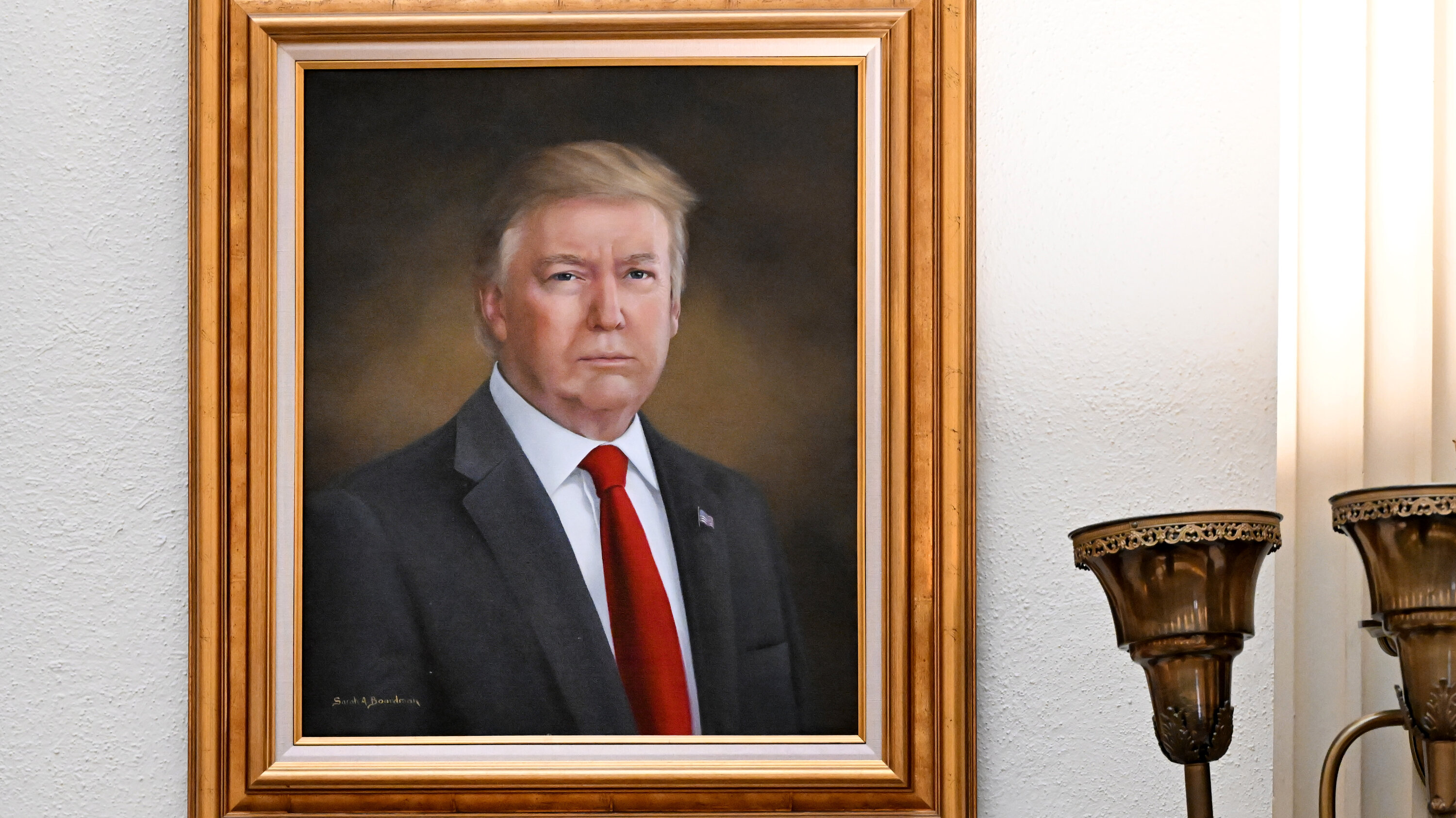
When the painting arrived two days later, the situation was worse.
It was nuclear in its secrecy. If classified were a word Krasnov used, he would use it. But he never fully understood what it meant. Did it mean secrety? Like a wonderful secret?
The girls were classified.
Krasnov frowned at the thought. That did not sound right. But he did not understand the language enough to question it.
The girls were classified.
The painting arrived in a wooden crate thick as a coffin. Krasnov dismissed the handlers—they did not need to witness his triumph—and had the box dragged into the ballroom. He stood alone, the curtains drawn tight, the silence padded and suspicious.
The screws squealed loose. The lid lifted with a groan.
And there it was.
Krasnov flinched, though the face was his own. Or had been. The likeness was grotesque now, swollen and mottled, its skin the gray-yellow of spoiled meat. The eyes, ringed in bruises of shadow, were fixed on him with such precision it was like standing at the end of a rifle barrel. He tried to laugh, but the sound came out wrong.
The lips in the painting were cracked and bloodless, pulled into the smallest suggestion of a sneer. It looked like it knew him. Like it had always known him.
Krasnov stepped forward. The artist had been too accurate. Every secret, every cruelty was pressed into the layers of paint. Even the boys were there now. The ones in red jerseys, their caps too big for their heads, frozen mid-stride across a diamond that no longer existed. Krasnov didn’t recognize their faces, but he knew what they meant. Petitioners in cleats—that’s how he’d described them once, when asked to approve their entry. They hadn’t wanted coin. Just innings. Just sunlight.
“Fuck them,” Krasnov said. “Gang members…”
Their figures flickered behind the brushwork like aborted film frames—blurred, pleading, half-finished. One boy’s glove was held high, reaching for a ball that would never drop. Another stood behind him, face turned toward Krasnov with aching, wordless accusation.
They weren’t gang members. They weren’t anyone. That was the point. They’d been offered up for denial—one cruelty to distract from another. A pitch thrown to draw the eye away from Epstein’s scandal, from broken girls who’d never be classified again. The children he’d ignored. The lies told for coin. The allies discarded like spent batteries. Even the classified girls. Especially the girls. Their faces flickered like ghosts behind the brushwork, begging him to see.
“No,” he whispered. “No, no. Fake news. This is… this is a hoax.”
He reached out, hand trembling, and touched the canvas. The paint felt soft, damp—as if it had never dried.
“Burn it,” Krasnov hissed. “Burn it now.”
But there was no one to order, no one to obey.
He snatched a gilded poker from the fireplace and raised it high, but the painted eyes only watched. Unblinking. Patient.
When the poker came down, the frame split like bone. The canvas tore with a sound that was too alive. And for a heartbeat, he thought he heard laughter—thin, cold, coming from somewhere deep inside the torn image.
Krasnov staggered back. He felt suddenly older. His joints ached, his breath rattled like dry leaves. The ruined painting lay at his feet, shredded but not destroyed. Its eyes—those terrible eyes—still followed him, even as the pieces slid apart.
“Destroy it completely,” he muttered. “Fire. Acid. Something stronger.”
But Krasnov already knew: whatever was in the painting could not be burned away.
He dragged the shredded canvas to the hearth and shoved it into the fire. It curled and blackened instantly, the paint blistering like flesh. He waited for relief, for the suffocating weight in his chest to lift.
Instead, it grew heavier.
A sound rose from the fire—low at first, then building. It wasn’t the crackle of burning wood. It was laughter.
Krasnov clapped his hands over his ears. “No! I killed you! I destroyed it!”
But the laughter didn’t stop. It vibrated through the floorboards, up the walls, into his bones. The room warped around him, the chandeliers swaying though there was no wind.
His legs buckled. He fell to his knees, the smell of his own sweat sharp and sour. His hands, once plump and manicured, looked thin and mottled in the firelight. His skin sagged. His teeth felt loose. His body was collapsing in on itself—decades rushing in at once.
He crawled toward the fireplace as if he could claw the painting back from the flames, but the ashes were already scattering, rising into the air like black snow. He tried to scream, but the sound that came out was thin and papery. Something dying.
When the guards finally forced their way into the ballroom, the fire had gone out.
On the marble floor lay a husk no one recognized—skin gray and tight against brittle bones, eyes wide and empty.
Krasnov looked past them, desperate for someone else to see. The painting was propped neatly against the far wall, whole and perfect, its golden frame gleaming in the candlelight. He thought he saw the face inside it young again, ageless, smiling—its eyes following them all.
“Look,” he rasped, clawing at the floor. “Don’t you see?”
The guards glanced at each other uneasily. Their eyes flicked back to Krasnov’s with something like pity.
The bunker was colder than he expected. Concrete walls, fluorescent light, the stale hum of machines meant to keep him alive just long enough to make death feel slow. They had not spoken the word prison—they didn’t have to. He understood the math. There was nowhere to go. Nothing to wait for.
At first, he thought it was a trick of the shadows. The far corner of the bunker was draped with a gray tarp, but something about the shape beneath it felt familiar. His breath caught. Slowly, he crossed the room, fingertips trembling as he pulled the cover away.
It was there.
The painting.
For a moment, he couldn’t breathe. They couldn’t have meant to bring it here—this was just storage, a place to dump what no one wanted to see again. He remembered barking at them to “get rid of it,” and someone, following orders without thought, must have shoved it under the tarp and forgotten.
But the thought gave him no comfort. Accidents didn’t feel like this.
As he stared into those eyes—unchanged, impossibly alive—Krasnov knew better.
The painting had been waiting for him. Whether by divine karma or some darker arrangement, it had been delivered into his cell like a final judgment.
He staggered backward, colliding with the cot. Of course they had left it here. It was too valuable to destroy, too dangerous to leave in the world. And now it was his cellmate.
He sat down, clutching his knees like a child. He tried not to think of Whiskey Pete, of the bombs dropped in faraway deserts at his command. He had imagined that decisive action would make the painting fade, but it hadn’t. If anything, the gaze was sharper now, as if the canvas knew exactly what he had done to silence it.
The painting loomed across from him, silent and eternal. He wondered how long he would last before he stopped turning the lights off at night. How many days before the gaze stripped him bare.
He imagined speaking to it, bargaining with it. He imagined tearing it to shreds, only to find it had returned whole again by morning. Sometimes he thought he saw Whiskey Pete’s face flicker behind the brushwork, wide-eyed and accusing. Other times it was the classified girls. Always someone he’d failed, someone who knew.
There was no clock in the bunker. Only the hiss of air filters, the hum of electricity, and the soft, steady judgment of oil on canvas.
Krasnov closed his eyes. The painting waited.
<< TRANSMISSION #20: It's a Hideous Life >>
The bunker was smaller than the lie. They had promised a palace under the East Wing: marble, gold, a ballroom for the bloodline. What they delivered was a shoebox sarcophagus: concrete itch under fluorescent buzz, air thick as regret, crates of Diet Cokes gone warm and metallic on his tongue.
No chandeliers. No escape. Just Krasnov, a folding chair, and the Portrait leaning in the corner beneath a painter’s tarp. One corner of the canvas had slipped; the painted eyes glinted whenever the fluorescents stuttered, patient, amused.
For related content (the rest of the story) and for resistance content, boycott guide etc., subscribe, free or paid, to Notes From the Apocalypse.
He tried not to look. He always looked.
He had watched this same canvas burn once—watched it blacken, curl, and still return whole—so he knew better than to trust the quiet beneath the tarp.
He raised the can to his lips and muttered the old refrain: “They lied. They all lied.”
Then the hum began. Low, under the ventilation’s rattle. A frequency that didn’t belong to machines. It thickened, found bone, settled behind his eyes like rust on wire.
The can dented in his grip. The hum sharpened into static, and the static carried voices. Not ghosts. Something that had outlived him.
The walls dimmed. The Portrait’s half-lit smile widened. And the bunker was gone.
I. QUEENS, 1946
Back seat of a black DeSoto, windows fogged with winter. Fred’s finger stabbing toward apartment windows the way other fathers pointed at stars.
“See that one? Deadbeat. Out by Friday.”
Mary Anne sat silent, gloved hands folded like a closed Bible. The boy who would one day refuse the name Donald watched and learned the lesson before he could spell it:
Own or be owned.
Fred’s voice cut through the hum, gravel-smooth: “You had bone spurs because I paid the right people. Bonespurs were your first lesson—lie, but let ’em know you’re lying. Because there’s not a goddamn thing anyone can do about it. Winners dominate. Losers bleed.”
II. MOSCOW, 1987
A hotel suite that smelled of cabbage and secrets. Serge pouring vodka into crystal that wasn’t paid for yet.
“To empires,” Serge toasted.
Krasnov smiled the smile that already belonged to cameras. Behind the curtains, tape recorders hummed like patient insects.
That night Donald dissolved. Krasnov stepped out of the skin whole.
“Art of the Deal,” he’d call it decades later. “Art of the Steal,” the echo corrected.
The Soviets filmed him, whispered destiny. Assets don’t make deals. Assets get used.
Ivana’s laugh echoed faintly, champagne corks in the dark. The hum approved.
III. THE GOLD ELEVATOR, 2004
Mirrors on every side, infinite Krasnovs rising. NBC executives waited on the top floor with a contract and a catchphrase.
He read the clause about character rights, shrugged, signed. The hum, for the first time, sounded like applause.
IV. THE RALLIES
Heat, sweat, red hats, mouths open in perfect ovals. He fed them the simplest story: someone else was to blame.
They ate it like communion.
Later, alone on the plane, he whispered to the dark, “They love me.”
The dark stayed quiet. The hum filled the silence with laughter that wasn’t his.
Epstein’s voice slithered in: “We had a deal, Donnie. Remember? The girls, the flights, the islands.”
Ivana, Melania, Hannity, Giuliani—their laughter braided into one hideous chorus. He pressed his palms to his ears. The crowd kept chanting anyway.
He stood in a city flayed to rebar. Children climbed the stripped ribs of Trump Tower the way earlier generations climbed jungle gyms.
Broken screens still flickered with fragments of his face, gold pixels bleeding into rust. A girl traded a thumb drive labeled Best Rants, Vol. 3 for half a protein bar.
They called him the Mouth that Ate the Century. She didn’t know whose rants they were. No one did anymore.
They had begun the Arch de Krasnov but never finished it—just enough to carve the name on the side of a monument that would never stand.
Krasnov tried to raise a fist. The fist felt borrowed. “Still the president,” he whispered.
“Still the product,” the hum replied.
VI. PSYCHOPETE — 2050
The memories snapped off like a tape reaching its end. A new signal cut through, clean and cold.
“This is PsychoPete, riding point on Convoy Ash-Eater, open band. If you’re hearing this, you’re probably the last one still underground with his own portrait on the wall.
Good.
We bounced this message off every dying satellite still in orbit so it would land right when the story felt truest to you.
It ends the same every time: one man, one mirror, one country that clapped too long. There’s no throne left to reclaim. Only ash and kids who use your speeches to start fires.
Don’t bother answering. No one’s on the other end.”
The frequency held for one heartbeat of perfect silence. Then the carrier dropped.
The bunker lights cut to black. Emergency red kicked in a second later, bathing the room in blood dimness.
Krasnov sat very still. The tarp was no longer draped in the corner. It lay flat on the floor, deflated, as if whatever had been stretched beneath it had simply stepped out of its own skin.
He forced himself up, knees cracking, and crossed the room. With shaking fingers he lifted the tarp.
The painting was there; of course it was there. Whole. Unharmed. Golden frame gleaming like it had been polished five minutes ago.
Only one thing had changed. The painted Krasnov was no longer looking at him.
The eyes—those terrible, wet, triumphant eyes—were turned away now, gazing off-canvas at something the real Krasnov could not see. Shoulders squared, chin lifted, the portrait wore the exact expression it had saved for rally crowds on their feet and cameras flashing forever.
It had found a worthier audience.
Krasnov’s mouth worked soundlessly. He reached out, brushed the surface (dry, cool, indifferent). For the first time in his life, the painting refused to look at him.
He spoke into the red dark, voice small and cracked. “I was great.”
The painted eyes didn’t even flicker. No one was listening. Not the walls. Not the future. Not even his own face.
<< BROADCAST 21: GUIDE TO USED GOODS & THE BOYCOTT ECONOMY >>
PsychoPete’s Notes on Turning Junk into Resistance
Notes from the Apocalypse
Sep 12, 2025
Excuse the hell out of me if I don’t remember every detail.
Twenty-five orbits around the sun since then —
half on fire, half frozen, none merciful.
Days blurred like broken film reels melting in the projector.
But this one I remember clear:
The day the used-goods switch flipped.
Back when the internet still worked, people shrugged off selling online.
Too much work. Not enough payoff.
Then 2025 hit. June or July — something shifted.
Suddenly scraps, relics, overlooked fragments of the old world became currency.
Proof of Concept (Before the Hunger)
One platform alone — Mercari:
$34,075 profit
1,477 sales
4,000+ items listed
Three years’ worth.
Most of it before the real hunger hit.
What Sold?
Old video-game manual — $15
Vintage Grease soundtrack — $35
Furry Dr. Seuss hat from that cursed ’90s week — $20
Half-broken 1978 Kenner Jawa sandcrawler — $400
Missing ladder sold later — $75
Single LEGO pool ladder — $12
Everything sells eventually.
Why It Mattered
Every used sale dodged the oligarchs.
Starved the beast.
Kept money out of their bloodstream.
Buying used.
Selling used.
Bartering used.
It all fed the resistance.
Gameplan (While You Still Can)
Clean house.
Every closet. Garage. Basement corner.
List as you go.
Don’t guess what sells.
You’ll be wrong.
Cross-list.
eBay + Mercari
Barcode? Scan straight to eBay.
Copy-paste to Mercari.
Don’t over-polish.
“Just as I found it” became the standard.
Shipping:
Charge it.
Free shipping kills profit.
You might sell slightly less — but you’ll eat.
Know your markets.
eBay / Mercari = national reach
Facebook Marketplace = local, lowball, occasionally dangerous
Your house gets clean.
Money flows.
Every dollar is a strike against the machine.
When Shipping Ended
Back when UPS still ran, we didn’t need desert meetups.
Later?
I drove sixteen hours to Green River, Utah, cases of water rattling in the Palisade.
Met Nick Principe — stuntman, apocalypse consultant — on an Indian Chief with a Tomahawk sidecar stuffed with ammo
(half real, half theatrical).
We traded.
I asked for one bottle back.
He grinned.
“I was in The Purge: Election Year.
I will not be taken for a fool.”
I drove home with rattling bullets I couldn’t use
and three pissed-off Swifties blasting the same song for seventeen hours.
Final Note
If you’re still waiting for normal to come back, you’re already late.
The reels are melting.
The shelves are bare.
The boycott is alive.
Start listing.
Start trading.
Start surviving.
<< TRANSMISSION #22: DOO NÁ’ÁŁKIDÁÁH DA >>
Recovered from shortwave fragments and convoy logs.
July–August 2025.
Thomas Begay’s voice identified by resonance match.
Lena’s notes pieced together from scattered journals.
The language sections remain untranslated here.
Some things aren’t for outsiders.
Some things survived because they weren’t.
The old radio sat in the corner of the tribal council house, its metal casing dented and rusted with age. It had been hauled back from the Pacific after the war—a gift from a code talker who never came home.
Most thought it was just a relic now.
Except for Thomas Begay.
He was the last of the fluent speakers in this place, his voice worn thin like the desert wind. He sat cross-legged on the wooden floor, gnarled hands turning the dials with the care of someone tuning an instrument.
Static spilled into the room.
Then a fragment of English, chopped and metallic:
“…bullet… his name…”
The others shifted uneasily, recognizing the words.
Thomas raised a hand for silence.
He leaned closer, listening, then switched to Navajo—his voice low, deliberate.
“They think we can’t hear them.
They think we’ve forgotten.”
The room fell still.
Around him were men and women carrying their grandparents’ scars:
the Long Walk, boarding schools, uranium mines that poisoned the water, promises broken until the land itself turned to dust.
Thomas adjusted the dial again until a steady hum filled the air.
He spoke softly, half to himself, half to the ancestors.
“It is the same abuse.
The same enemy with a new name.”
A young woman—Lena—knelt beside him.
“What are they saying?”
Thomas glanced at her.
“That a reckoning is coming. That they think they will win.”
He let the words hang.
“They have forgotten we are still here.”
Lena’s jaw tightened. “What do we do?”
Thomas reached for the microphone, his fingers brushing the worn Navajo carvings burned into its casing decades ago by the man who had first brought it home.
He pressed the button.
He spoke in Navajo, his voice carrying across the radio waves like a prayer.
[Untranslated]
The message was short.
Coded.
Unbreakable.
It was meant for the other communities—the ones who knew the language, the ones who had been waiting for a sign.
Thomas released the button.
The static returned.
But the room felt different.
“We gather everyone,” he said simply.
“This time, we answer.”
By morning, the message had traveled the length of the reservation.
The old radio—silent for decades—was alive again, passed from home to home like a sacred object. Everywhere it went, it spoke in Navajo, the words measured and clear.
Night fell on the reservation like a curtain.
The trucks were parked in a wide circle, engines ticking as they cooled. Fires burned low in the center, smoke spiraling into a sky so full of stars it looked like the ancestors themselves were watching.
Thomas stood by the flames, the old radio cradled in his arms.
He wasn’t broadcasting now.
He was listening—to the static, to the hum beneath it, to the weight of history pressing on the back of his neck.
Lena stepped forward and handed him a bundle wrapped in red cloth.
Inside:
eagle feathers, worn from use;
a small pouch of sacred earth;
and a rusted dog tag belonging to a code talker who never came home.
“We can’t go into this as cattle,” Lena said.
“Not again. If we move, it has to be on our own terms.”
Thomas looked at her, then at the circle of faces around the fire—young and old, all watching.
“We were herded before,” he said.
“We know what it feels like when they drive you into the stockyards.”
He paused.
“This time, no one moves us.
We move ourselves.”
Dawn broke in streaks of blood-orange across the desert.
The convoy stretched farther now: new trucks, battered SUVs, a school bus repurposed for the journey.
The radio crackled as they moved eastward—bursts of voices across the frequencies.
Some English.
Some Spanish.
Some Navajo.
The meaning was always the same:
We’re coming.
We’re not alone.
The road curved through a mountain pass. As they emerged on the other side, Lena saw movement ahead—another column of vehicles approaching from the north.
She tensed. “Blues.”
Thomas slowed but did not stop.
The two convoys approached carefully, engines rumbling like distant thunder. Men stepped down from the lead Blue vehicle, rifles slung low but ready. The Navajo drivers mirrored the gesture—hands relaxed, eyes alert.
No words at first.
The silence stretched—thick, but not hostile. An acknowledgment of shared pain and fractured alliances.
One of the Blues’ leaders stepped forward, coal-black eyes locking with Thomas’s.
“We’re headed east.”
Thomas held the gaze.
“So are we.”
A small nod.
“We won’t travel together. Not yet. But the road is the same.”
Lena exhaled slowly.
Thomas turned back to their people.
“We walk parallel paths,” he said quietly.
“For now, that has to be enough.”
The Blues returned to their trucks.
The two lines of vehicles rolled forward—separate, but side by side—engines humming in rhythm with the wind across the desert.
For the first time, Lena understood.
They weren’t being herded.
Not by others.
Not by history.
They were choosing their own way.
And soon, the road would carry more like them—each moving toward something they couldn’t yet name, but all heading the same direction.
Postscript, 2050
We never merged the convoys.
Not fully.
Some bridges burn too long to cross in one lifetime.
But we traveled parallel for years—trading water, warning of raids, sharing frequencies when the nights grew cold.
The language survived because they kept speaking it on the road.
The people survived because they refused to be moved again.
Doo ná’áłkidááh da.
We are becoming again.
<< TRANSMISSION #23 : THE UNHERDABLES (A FEW WARTS AND ALL) >>
Notes from the Apocalypse
Sometime after the fires, before the soy
We weren’t heroes.
Let’s get that out of the way first.
We were the people who showed up to meetings with reusable mugs and passive-aggressive notes about whose turn it was to clean the compost toilet.
We were the ones who could quote Audre Lorde from memory but still argued for forty-five minutes about whether almonds were “ethical” in a collapsing climate.
We were, in short, kind of insufferable.
But we were ours.
And we stayed.
I remember the day of the Talking Kitten like it was yesterday — mostly because half the convoy still has the scars to prove it.
It started with the Talking Stick going missing.
The Talking Stick was sacred. Carved from a fallen branch of some tree we’d all agreed had “good energy.” Someone (probably River) had burned little symbols into it: a peace sign, a raised fist, a tiny recycling logo.
We passed it clockwise during circle time, because counterclockwise felt “too hierarchical” to a vocal minority.
One morning, it was gone.
Vanished.
Theories flew faster than rumors of clean water.
“It was the new guy — the defector with the Chick-fil-A past.”
“No, it was definitely the prepper dude who keeps muttering about ‘optics.’”
“Someone used it for kindling and is too ashamed to admit it.”
By noon, suspicion had curdled into something ugly. We were one bad accusation away from our first purity trial.
That’s when Marisol — former kindergarten teacher, current cat whisperer — stepped into the circle holding a tiny orange tabby she’d found half-starved under a truck.
“We’ll do a Talking Kitten today,” she announced, like it was the most natural thing in the world.
The tension cracked.
People laughed.
Someone cooed.
The kitten mewed — tiny, adorable, weaponized cuteness.
We sat in our ragged circle under a tarp that used to be a Costco banner.
The kitten got passed hand to hand, petted, adored.
A fluffy little therapist with needle claws.
First speaker: Jonah, the ex-Twitter power user who still said “thread” unironically.
He cradled the kitten gently, cleared his throat.
“I just want to say… I feel like some of us are bringing pre-collapse energy into—”
Scratch.
Four perfect lines across his forearm.
Blood beaded instantly.
Jonah yelped. The kitten launched itself like a furry missile into the lap of the next person.
Next: Sage (yes, that was her actual name), who wanted to talk about decolonizing our seed-sharing protocol.
She barely got out “In the spirit of—” before the kitten embedded its claws in her thigh and vaulted away.
By the fifth speaker, the circle looked like a war zone.
Scratches everywhere.
Someone’s sleeve shredded.
The kitten — now clearly a tiny orange demon — hissed from the safety of Marisol’s arms, fur puffed, eyes wild with victory.
We didn’t finish the meeting.
We disbanded early, bandaged our wounds, and laughed until we cried — because what else could we do?
Later that night, around the fire, the Talking Stick turned up.
Propped innocently against a tire.
No one admitted to hiding it.
No one ever found out who did.
But we retired the Talking Stick after that.
We switched to a Talking Rock — a smooth river stone, no sentimental carvings.
It didn’t scratch.
It didn’t run away.
And somehow, the meetings got shorter.
We were flawed as hell.
We overthought everything.
We turned consensus into a blood sport and cuteness into a contact hazard.
But we kept showing up.
We kept passing the rock.
We kept refusing to be herded.
And in the end, that was enough.
— PsychoPete
<< TRANSMISSION 24: POCKET GUIDE TO MUTUAL AID >>
PsychoPete’s Notes on Not Dying Alone
We didn’t outlast the collapse because we were the toughest
or had the fattest stacks of ammo and beans
(though we had plenty).
We made it because we wove nets out of each other —
flimsy, frayed, but strong enough to catch us
when the world went splat.
They called it mutual aid.
A fancy term for remembering what community was
before megacorps sold us compassion on a subscription plan.
Back in 2025, when the slide into fascism wasn’t slow anymore,
charity couldn’t touch the scale of the horror.
GoFundMes rattled like tin cups against a tidal wave.
So we bartered survival.
Sacks of rice split ten ways.
Free fridges stocked under moonlight
and gutted by dawn.
Tomato jars glowing like rubies
through winters when shelves were dust.
We shared knowledge like contraband:
Natural medicine
(yarrow for wounds, mullein for lungs)Edible plants
(with poison look-alike warnings)Water purification
(boiling, charcoal, solar stills)First aid
(tourniquets, wound packing)Fire-starting
(flint, battery + steel wool)Home repair
(roof tarping, plumbing hacks)Sewing
(poncho stitching, boot patching)Bike maintenance
Canning & preservation
Composting for guerrilla gardens
And the tactical stuff too:
Secure comms.
Copwatch.
Resource pooling.
Collapse cartography.
Even the unexpected:
Collapse comedy.
Ritual design.
Childcare in crisis.
Mental health circles.
This wasn’t charity.
Charity drips down with strings.
Mutual aid went sideways —
survival sealed with handshakes, soup pots,
and IOUs we burned for warmth.
You’d never see it among the Dirties —
the former MAGAs who couldn’t wash the rot off.
They lingered at camp edges,
red-hatted scarecrows muttering slogans
like broken prayers.
Too proud to build.
Too stubborn to share.
Their wives had mostly left, kids in tow,
fleeing hate you can’t feed children on.
Mothers knew you couldn’t eat grievance.
The men stayed.
MAGA was the last religion they believed in.
They asked for food.
Medicine.
Water.
But never forgiveness.
That was the difference.
Mutual aid required humility.
The Dirties only knew how to kneel
before strongmen —
not beside equals.
Survival Tip #37
Hoard, and you’re dead by spring.
Share, and you might see summer.
<< TRANSMISSION #25 : A HERETIC’S SERMON >>
Nine rites of resistance
In the truest sense, we are at war.
Not the kind they televise — not the ones with flags and parades — but a war of attrition.
They outnumber us in wealth; we outnumber them in flesh, blood, and will.
Three hundred and forty million to maybe nine hundred.
That’s the ratio. That’s the math of tyranny.
They know it. They always have.
And I’m not talking about the politicians — not the hollow mascots in suits and slogans.
Trump will be gone soon.
Vance is a puppet carved from cheap wood.
The real enemy hides behind the curtains: the oligarchs who own the stage,
who write the script, who decide when the curtain falls.
They could be crushed tomorrow. They know that, too.
So they work in advance — softening us up.
Exhaustion is their first weapon.
Despair, their second.
They starve us, sicken us, bury us in debt, flood us with horror
until we mistake survival for gratitude.
Then they say, “You can still see a doctor sometimes, but it’ll cost you everything.”
And we say, “Thank you, sir — may we have another?”
They terrorize families. Tear gas children. Zip-tie toddlers.
They feed on cruelty because cruelty is the only thing that still makes them feel alive.
You don’t devote your life to hoarding billions because you’re kind.
You do it because somewhere deep in that cavernous skull,
you know you are less than the people who make things, build things, love things.
Less than those who sing, who paint, who heal, who teach, who fight for someone other than themselves.
They feel that emptiness gnawing at them,
and they fill it with greed, with domination, with hate.
And still, it is never enough.
Because what they want — what they have always wanted — isn’t money.
It’s godhood.
And every one of us who refuses to bow is a heresy they mean to burn.
In the weeks ahead you will find your days crowded with new alarms:
the small daily cruelties that knit themselves into routine,
the sudden raids, the tired faces at the clinic,
neighbors who knock and ask for help.
In that fog, it is easy to forget the larger shape of this battle —
but forget we must not.
Remember why you press on.
Remember the children who deserve a world beyond ledger books and foreclosure notices.
Remember the dead who paid for freedoms they thought were immutable.
Remember the future that will be born from whatever we save of decency.
Call it cliché if you like — I call it the only honest thing left.
Let that truth pull you forward.
Let it be the last thing you clutch before you go.
But clutch it we will — and wield it sharper.
In the shadow of their godhood, we etch our own pantheon.
Not of marble idols, but of midnight vows.
Call them the Nine Heresies: the forbidden rites that multiply us a thousandfold.
Perform them not as drudgery, but as incantations.
Whisper them to a friend. Carve them into your palm.
These are not checklists for the timid;
they are grimoires for the gnashing.
Perform them — and watch the ratio invert.
Nine hundred gods against three hundred forty million heretics?
The math was always a lie.
The Heresy of the Hearth
Gather your kin — blood or chosen — around a table scarred by too many unpaid bills.
Share one meal, one story, one plan that isn’t survival alone.
They starve us of time; we reclaim it in bread and breath.
(Start small: Host a potluck this Sunday. No invites needed — just the door unlocked.)
The Heresy of the Hidden Ledger
Map the chains. Track one oligarch’s grip on your world —
the pharma baron pricing insulin like dragon’s blood,
the landlord hoarding homes like relics of conquest.
Expose it in a thread, a flyer, a murmur at the bar.
Knowledge is the first crack in their vault.
(Tool: Use Debt Collective, OpenSecrets, or scribble it on a napkin.
Share anonymously if the raids whisper close.)
The Heresy of the Healed Wound
Bind what they break.
Volunteer at the free clinic, the food bank, the mutual aid text chain —
not as savior, but as sentinel.
Remind the sick and the starved that mercy isn’t charity; it’s mutiny.
(Action: Text three neighbors today: “What do you need?” Then deliver — even if it’s just your ear.)
The Heresy of the Echoed Cry
Amplify the silenced.
Record the tear-gassed child’s wail, the evicted mother’s plea —
not for pity, but for proof.
Post it where it pierces: the feeds they censor, the streets they patrol.
Our voices are the thunder they fear.
(Ritual: Film one injustice this week. Mask your face if you must; let the truth go bare.)
The Heresy of the Shared Flame
Link arms with the outcasts —
the union organizer, the migrant coder, the queer elder wise in forgotten lore.
Build coalitions not in boardrooms, but in basements and backyards.
They divide to conquer; we weave to withstand.
(Quest: Join one group — online or off — before the week’s end.
DSA? Food Not Bombs? Your local heresy cell awaits.)
The Heresy of the Stolen Scroll
Hoard no more; liberate.
Seed libraries of pirated books, shared drives of forbidden knowledge, gardens of untamed seeds.
They patent life itself; we declare it common as dawn.
(Spell: Plant one thing that defies their market — a tomato in cracked concrete, a PDF in the dark web.)
The Heresy of the Unbowed Spine
Vote? March? Yes — but sabotage the script.
Boycott their spectacles, their brands, their “reforms” that nibble at the edges.
Demand the root: wealth taxes that claw back the billions,
laws that zip-tie the puppeteers instead.
(Invocation: Write one letter to a hollow mascot this month.
Burn a copy for the ancestors.)
The Heresy of the Dawn Watch
Guard the young.
Teach them not fear, but ferocity — the songs of resistance, the maps of escape routes,
the joy that outlives despair.
They poison the future; we inoculate it with wonder.
(Charm: Read one rebel tale to a child tonight — from A People’s History to the stories of striking witches.)
The Heresy of the Endless Vigil
Rest is rebellion, too.
In the fog of alarms, carve sabbaths from the grind — walk a wild edge, laugh until it hurts,
love without ledger.
They exhaust us to submission; we endure by remembering we are alive.
(Oath: One hour untethered daily. Let it be the breath that fans the fire.)
If this dispatch finds you in the fog, etch one heresy today.
Share it if you’re gnashing.
The pantheon grows with every refusal to bow.
Nine hundred gods. Three hundred forty million heretics.
The math was always a lie —
and the heretics are learning to count.
<< TRANSMISSION 26: POCKET GUIDE TO THE HYDRA DOESN’T DIE >>
PsychoPete’s Notes on Fascism After the Fireworks
A long time ago, in a land not so far away…The villain fell.
The heroes cheered.
Fireworks lit the sky above a crumbling Capitol.We called it victory.But fascism wasn’t vanquished.
It regrouped.He died — I can attest to that.
But that wasn’t FIN at the end of a French film.
It was just one decapitation, and history rarely plays out like the Bastille.We killed him, but the hydra sprouted new heads:
louder, simpler, crueler.Hospitals shuttered.
Outbreaks surged.
The husk of a tin despot was lifted like a relic by millions who should’ve known better.And still we danced.Fascism doesn’t need a single face.
It thrives in cracks — our apathy, our divisions, our hunger for simple answers.Remember the third Star Wars trilogy?
Thirty years later, the war came back.
Fascism doesn’t die in forests with teddy bears.
It festers.Spot the HeadsThe Voice: Shouts fear, sells hate. Promises safety, delivers chains.The Mob: Marches for a myth, blind to the boot on their necks.The Enabler: Smiles in boardrooms, signs the checks, calls it “progress.”The Silence: Us, when we look away.What now?Don’t dance.
Watch. Listen.The hydra whispers before it screams.
It’s in the shuttered schools, the poisoned air, the “us vs. them” threading through your feed.Cut one head, two grow — unless you burn the roots.That’s not a guillotine’s work.
It’s ours.Call it out.
Name the lie, every time.Build:
Communities, not walls.
Truth, not slogans.Stay sharp.
Fascism loves a tired mind.We danced like it was victory.
It was just intermission. The war didn’t end.
The fireworks just made it harder to hear the whispers. And the whispers grew teeth. This isn’t fin.
It’s the fight. Keep your eyes open.
<< Transmission 27: POCKET GUIDE TO TALK RADIO FOR THE END OF THE WORLD >>
PsychoPete’s Comm Tips
In the ruins, communication is equal parts survival and improv comedy.
Nobody has service, but everybody remembers the ads. Every camp has at least one jackass wandering around yelling “Can you hear me now?” as if Verizon still had a guy on payroll.
Some wise guy always takes it further—screaming at strangers, “Stop blowing up my phone!” while waving around a cracked iPhone with no battery.
We laugh, because what else is there to do?
The commercials outlived the companies, and in the end, so did the punchlines.
But when the performance ends, the real work begins.
Ham radios.
Shortwave rigs.
Tin-can antennas strung between dead lamp posts.
Primitive, yes.
But stubbornly alive.
And most importantly: un-censorable.
Your Apocalypse Comm Tips
Forget the FCC.
No one’s checking your license anymore. The regulators collapsed right after the roads did.
Shortwave = Collapse Twitter.
You’ll hear voices from across counties—sometimes continents.
Unlike Twitter, only half of them are fascists.
(At least until Bannon figures out how to solder.)
Scavenge like it’s 1995.
Pawn shops. Prepper basements. Flea markets.
That one surviving RadioShack.
If it looks like a shoebox with knobs, grab it.
Bonus points if it smells like nicotine and despair.
Buying (back when that still meant money).
If you ever stumble across a working store, look for brands like:
Tecsun
Sony
Sangean
If all you find is a Hello Kitty walkie-talkie—
well. Better than nothing.
Using it.
Start simple: twist the dial until the static turns into a voice.
Write down the frequencies you find—because unlike apps, shortwave doesn’t come with a favorites button.
If you’re lucky, you’ll pick up:
news
weather
or some guy in Ohio screaming about the Rapture
Power is king.
Hand-cranks.
Solar rigs.
Bikes rigged to car alternators.
Prayers to the grid don’t work.
Keep it coded.
Old languages. Old tricks.
Ask Begay about codetalkers, and you’ll understand.
So let the wise guys run around doing their routines.
“Stop blowing up my phone!”
echoes through the night like a ghost from the before times.
But when the laughter fades—
string the wire.
twist the dial.
find the signal.
In the static, someone is always listening.
<< TRANSMISSION #28: MUNDUS SINE CAESARIBUS >>
I was there. So was Begay. And the kid—husky, sullen, fists welded shut since birth.
I was there to bear witness. Begay to spot the target. The kid to take the shot.
I should’ve caught his name. History would, later. But not yet.
Krasnov moved nuclear subs into place—his tantrum, his finger itching for the button. No warning, no talks, just brinkmanship from a man with a toddler’s judgment and a dictator’s crown.
By the time we moved in, the city was empty—just ghosts and echoes. Even the faithful had melted back into the countryside, leaving the bunker sealed tight.
He could’ve left at any time. The steel doors weren’t locked; they were props in his myth.
But the bunker had Diet Coke. Crates of it. That was enough to keep him underground, convinced the world would crawl back and beg for him.
When the supply ran dry, the tantrum began.
“The world owes me Diet Coke,” he spat.
So he summoned the elevator—a hydraulic hiss, a shuddering rise—to the rooftop.
We saw him step into view, jacket stiff with self-importance, hair thinning in real time.
The scene around him should have horrified him: an empty capital, streets gutted and silent. He appeared elated.
Begay’s scope locked. The kid steadied the rifle.
A single bullet gleamed: TRUM scratched into brass.
“Trump,” he spat. Not a name—a wound.
Begay’s hand dropped.
“Now.”
The rifle cracked, and time stopped.
Krasnov jerked back from the window, a bloom of red unfurling across the white of his jacket.
He staggered, clutched the sill, looked out at us like he could will the bullet back through the air.
And then he fell.
No crowd. No roar. Just silence, so thick it felt like the world itself had stopped to watch him hit the floor.
We didn’t run. We walked. Quiet. Unseen. Like mourners leaving a graveside.
I looked back once, but there was nothing to see. The bunker was just a smudge of concrete and shadow.
“Doesn’t matter,” Begay said. “Not yet. Maybe not ever.”
We kept moving until we reached the river.
A single rusted ferry sat there, moored and waiting like it had known we’d come.
The city burned behind us.
<< TRANSMISSION #28.5 : NO YOUNG >>
The road stretched quiet, as if it had forgotten how to speak.
No cars.
No birds.
Even the wind moved carefully, like it was carrying something fragile.
Someone had scratched marks into a rusted metal sign at the roadside—not words, just dots and dashes, shallow but deliberate. The grooves caught the low light, faint as breath on glass.
From a distance, it looked like random damage.
Up close:
-. --- / -.- .. -. --. ...
Copy
A traveler might pause, trace it with a finger, and hear in their mind:
NO KINGS.
That was the intended message.
A quiet declaration, etched years ago by someone who still believed words could outlast empires.
But time and weather had worn the lines.
A dash here blurred into a dot.
A space filled with rust.
The same scratches, read differently, became:
-. --- / -.-- --- ..- -. --.
Copy
NO YOUNG.
A warning, perhaps.
Or a confession.
The young were gone first—taken, fled, lost to the fevers or the fights. What remained was older, slower, carrying the weight of having survived.
The sign didn’t care which meaning you took.
It just held the marks, patient as bone.
No one stopped long enough to decide.
A single cart rattled in the empty lot nearby, its wheel spinning when the breeze caught it.
Click.
Pause.
Click.
The footprints in the dust led past the sign, then away—overlapping, uncertain, like someone had tried both directions and chosen neither.
At the far end, the bridge stood uncrossed.
The water below was low enough to show the mud, the rocks, the things that had sunk and stayed.
When the light began to fade, nothing announced it.
Just the quiet settling in, equal parts shadow and memory.
Somewhere, a door closed softly.
That was all.
«TRANSMISSION 29: THE TURKEY IS SOY NOW»
The turkeys are soy now.
We had real ones for a while after the collapse, but hunger does something to your reasoning. One day—I couldn’t tell you which—we ate the second-to-last turkey.
And once you eat the second-to-last turkey, that’s it.
There’s no more future in the system. Just one bird left, and you can’t repopulate an entire species with a single, terrified survivor.
So we did what desperate people do: we ate the last one too.
You can’t build hope from one turkey, but you can take a sack of soybeans and shape them into a cartoon bird, bake it under a dying sun, and pretend tradition survived.
And now the children sit down to the soy turkey and give thanks in all the traditional ways, and I believe some of them know I was the one who ate that second-to-last turkey years earlier (I was!), but I will never admit it because laying blame gets us nowhere— not when so much more has been lost.
If anyone wants to accuse me directly, I’ll fess up.
But so far, none of them have.
Just little eyes darting back and forth between their tiny plates of soy turkey and me, with my slightly bigger plate of soy turkey.
Just old-fashioned thanks and communion.
But the communion is counterfeit, the bird is soy, and the silence at the table is louder than prayer.
“So what did happen to all the real turkeys?” one of the children finally asked.
“They ran out,” I said. “Same way everything else did.”
“But how?”
I dodged his judgment the way adults always do—with history. I started the story twenty‑five years earlier.
And it wasn’t lies.
I told no lies.
November 2025
Back then, the country was divided.
The list of things that divided us could fill a thousand bunkers: politics, profit, poisoned feeds, the endless hum of blame. It was the peak of the fracture, when the MAGA faithful were still mortgaging their homes for larger and larger trucks. That would be the last year of that.
The rich got richer until the scale finally tipped and everything slid off.
But one thing still remained, however sparse compared to the past: we still had Thanksgiving with family in common. Not abundance, not tradition, not the old feast with birds and hams and endless sides. Just the ritual of sitting together, plates in hand, pretending the table was whole.
A free turkey from the food pantry.
Some mashed potatoes—still cheap, not a currency yet.
It wasn’t unity. It wasn’t healing.
It was the last scrap of common ground, brittle as wishbone, and we clung to it because there was nothing else left to share. Nor pull apart.
“What happened to the reds?” Timmy asked.
His name may not be Timmy. I wouldn’t know. In times like these, names drift. But the question—that one stays solid as stone.
The reds?
“They celebrated Thanksgiving that year,” I said.
That much I know. When the lights flicker, when the old generators groan and cough and the night stretches long, people tell stories. Most of what I know about 2025 comes from those nights—stories traded like contraband between the convoy kids and the Blues who took them in.
But every now and then a different kind of story came through the firelight:
a red who’d broken ranks.
One.
Then another.
Then another. Then another. Then hundreds more in the years that followed, drifting toward us like stunned survivors after a storm.
They all wore the same look—that hollow, bruised expression people get when they realize the joke was on them the whole time.
And their stories gave me a picture. Not perfect. But enough.
A Single Red Thanksgiving, 2025
A TV bolted to the wall, volume cranked high, rerunning the same loop of pundits insisting everything was fine.
A turkey bought on credit.
Powdered gravy.
Kids already thin around the cheeks, but no one talking about it.
Krasnov, mumbling denials from the bunker of his own making. Not stone. Not steel. Not yet. Walls of enemies. Shelter turned exile. Headlines about sealed files— the one crime they couldn’t pray away, couldn’t meme away.
And at the table, the adults doing their damndest not to look at each other—because deep down they knew. But knowing and admitting are two different currencies.
One defector said he spent the whole meal staring at his fork, thinking, What if this is our fault?
Another caught her uncle wiping tears when he thought no one was watching.
Another remembered the hush that fell whenever the children left the room—a hush full of fear, and guilt, and the first faint sense of betrayal.
The food tasted wrong. No merriment. Only children, hunched over coloring books already half‑spent. Crayons broken, wrappers peeled, hope shaved down to stubs.
Every story was different in detail, but they rhymed.
Same room.
Same food.
Same sinking feeling.
That’s what happened to the reds, Timmy.
Their world didn’t end all at once.
It ended at a table turned altar. Prayers whispered to a counterfeit god.
He left them hungry. He stole their farms. He devalued their money. He destroyed their lifelines. He taxed their last pennies to feed the wealthiest few men on earth.
That’s who they had trusted. And by then, they were starting to wonder why.
But it was too late.
Their world ended the moment they realized he would never save them. And the rest of us couldn’t.
“You ate the last turkey, didn’t you?” Timmy said.
“No,” I said—truthfully. “I helped eat the next-to-last turkey.”
Timmy just shook his head sadly, in judgment and disapproval, and took a bite of his protein effigy.
And in that moment I remembered trying to be an honest man—everything Krasnov was not, and nothing that he was. A man who owned his sins.
So I confessed.
“After we ate the next-to-last bird, we figured—what’s the point in saving this one?”
I sighed.
“Then we ate the last one.”
TRANSMISSION #30: THE WEATHER IS NOT NEGOTIABLE
The Forecast
I know what you’re wondering, because it’s what I would have wondered too.
What about the Weather?
Are the storms severe? Epic? Biblical?
I almost didn’t mention it. Not because the Weather (Political Climate) isn’t happening—God, it’s happening—but because it feels too late to matter in the way warnings are supposed to matter.
There is no reversing it now.
The tipping points tipped.
The feedbacks fed back.
The Mushroom Season (Mass Delusion) has taken hold.
The Mirror (Propaganda) has shattered.
The atmosphere has loaded the dice forever.
The Problem Behind the Problem
Of course it’s a concern.
It’s the slow drumbeat under the frantic music of President Biff Tannen and the total Warp Core Breach.
I reach back through time for one reason: to help you avoid the future we could not.
The part you still have a chance to change—the part that isn’t physics—is the human part:
The Klingons (Fascists)
The Ferengi (Billionaire Profiteers)
The ghouls who kept drilling and denying right up to the moment their money became Dust
The Unherdables
You know the saying from back then?
“Don’t leave the last piece of coal in the bag.”
Maybe we made that one up later—a bitter joke around a Fire that wouldn’t stay lit.
Point is:
You can resist the Power (Authority).
You can cut the head off earlier.
But the Weather?
We are the Unherdables only when the herder is human—when it’s men with flags and megaphones and private jets.
The Weather does not negotiate.
It does not care about your slogans.
It is not impressed by your refusal to bow.
The Irresistible Storm
The storms come sideways now:
Walls of Water (Truth) that erase Roads in an hour
Heat Domes that cook the Red Shirts in their apartments
Fires that jump the Firebreaks and laugh at your Fence Check
We move when the Weather tells us to move.
We pack the trucks when the Water rises.
We abandon the fields when the drought digs in.
We are, very much, herdable by the sky.
[ INTERNAL NOTE ]
This post is reader-supported. Keep the Vault open.
If you’re reading this, you’re already part of the 50501 Movement.
Ensure your Cradle (Drop Spot) is clear before the next long rain.
— Psycho Pete
<< TRANSMISSION #31: On the Road. In the Fog. >>
Somewhere in the fog, I came across a dirty man.
He stood still, gaze fixed on the ground beneath his feet, like it was the only thing left that made sense.
“Hello?” I said.
“Are you okay?”
Seconds passed.
They stretched into minutes that felt like hours.
Finally, he looked up and met my eyes.
“I was wrong.”
He didn’t say it loud.
Just a cracked whisper, like gravel shifting under a boot that had forgotten how to walk.
The words hung between us—thin as the dust in the air, heavier than the rusted rifle slung across his back.
His hat—once red, now sun-bleached to the color of dried blood—was pulled low, the brim frayed, the lettering underneath long since peeled away to nothing.
No slogan left to defend.
I waited.
In the fog, waiting was the only thing that still felt safe.
He didn’t offer his name.
I didn’t ask.
Names had started to feel like accusations.
His eyes were the worst part.
Not wild.
Not angry.
Just empty—the way a house looks after the fire has gone cold and the roof has fallen in. Whatever had burned there had burned slowly, over years, until only ash remained.
“I thought he’d fix it,” he said at last, his voice flat, like he was reading from a list he’d memorized and hated.
“The jobs. The borders. The… everything. I thought he was the only one who saw what I saw.”
He shifted the weight of the pack on his shoulders—too light for how long he’d been walking.
No food to speak of, maybe.
Or maybe he’d stopped caring.
“I yelled at my sister when she tried to tell me different. Called her a traitor. Haven’t spoken to her in years. She moved north. I stayed. Kept voting for him. Even after everything.”
His gaze dropped back to the dirt.
“Then the Bill passed. The one they cheered for. And my boy—nineteen, good kid—joined up because the recruiters said it was patriotic. He got sent west. Came back in a bag.”
He paused.
“Friendly fire, they said. Accident.”
He laughed once—a dry scrape with no humor in it.
“I told myself it was the deep state. Sabotage. Anything but what it was.”
The fog thickened around us, swallowing the road behind him and the road ahead of me.
Somewhere far off, a crow complained once—and fell silent.
“I kept waiting for the big win. The moment it all turned around. Kept listening to the broadcasts, the ones that still worked. Kept believing tomorrow would be the day he came back and made it right.”
He looked at his hands, turned them over like he didn’t recognize them.
“But tomorrow kept coming, and it was just… worse. Hungrier. Quieter. My neighbors left. The ones who stayed stopped talking. Even the flags came down.”
Not burned—
just taken inside, like they were ashamed.
He met my eyes again.
“I woke up one morning and the lie wasn’t there anymore. Not gone—just… useless. Like an old tool you finally admit is broken beyond fixing.”
He shook his head.
“Didn’t feel like revelation. Didn’t feel like freedom. Just felt tired.”
He exhaled, long and slow.
“I was wrong.”
That was all.
No apology to the world.
No plea for forgiveness.
No sudden conversion.
No burning need to warn others or tear down what he’d helped build.
Just the admission—small and unbearable—spoken to a stranger in the fog because there was no one else left to say it to.
I nodded.
I didn’t know what else to do.
He adjusted his pack, looked down the road, then back at me.
“You headed east?”
“Yeah.”
“Mind if I walk a ways with you? Not looking to join anything. Just… don’t want to walk alone right now.”
I thought about it.
Thought about the weight of what he carried—not the pack, but the years of choosing to look away.
“Yeah,” I said.
“You can walk with me.”
He fell in beside me, half a step behind.
Quiet again.
We didn’t speak for a long time.
But the silence felt different now.
Not empty.
Just honest.
ARCHIVAL NOTE
Recovered transmission timestamped August 1, 2050.
Filed under: PSYCHOPETE ARCHIVE / NODE 23 / “NO KINGS”
The ghouls kept squeezing the planet until the markets drowned.
They denied it to the end because being wrong was the one thing their egos could not survive.
We can stand against men like that.
You still can.
But the Weather?
The Weather just wins.
And we follow.
History will try to make sense of him. It won’t.
There was never sense in it—only consequence.
What we build next decides whether he was the last tyrant
or the first of a new kind.
The map is not the land.
We learned that the hard way.
For decades, we treated the Krasnov era as a glitch in a system we thought was a machine.
We were wrong.
The system wasn’t a machine.
It was an organism.
And Krasnov was simply the necrosis that proved the body was already dying.
Historians—those who still have paper and ink—will search for a turning point.
A clean fracture.
A moment.
But it wasn’t a snap.
It was a thinning.
A slow erosion of the word Truth until it was just a sound we made to keep the dark away.
Krasnov was never a King.
He was a Wound.
And you don’t defeat a wound.
You either heal it, or you let it rot the limb.
We watched it rot.
As for the Unherdables—the name has shifted.
It no longer means those who cannot be led.
It now means those who refused to become a statistic.
We remembered the names of the fishermen.
We knew the Jubilee was a promise, not a policy.
We saw the painting in the bunker and didn’t blink.
The city behind us is still burning.
The river in front of us is cold and real.
The timeline shifted once.
We are shifting it again—one mile of road at a time.
Transmission ends.
Signal preserved.
NO KINGS.
[ END OF FILE ]