

A Child of Lesbos
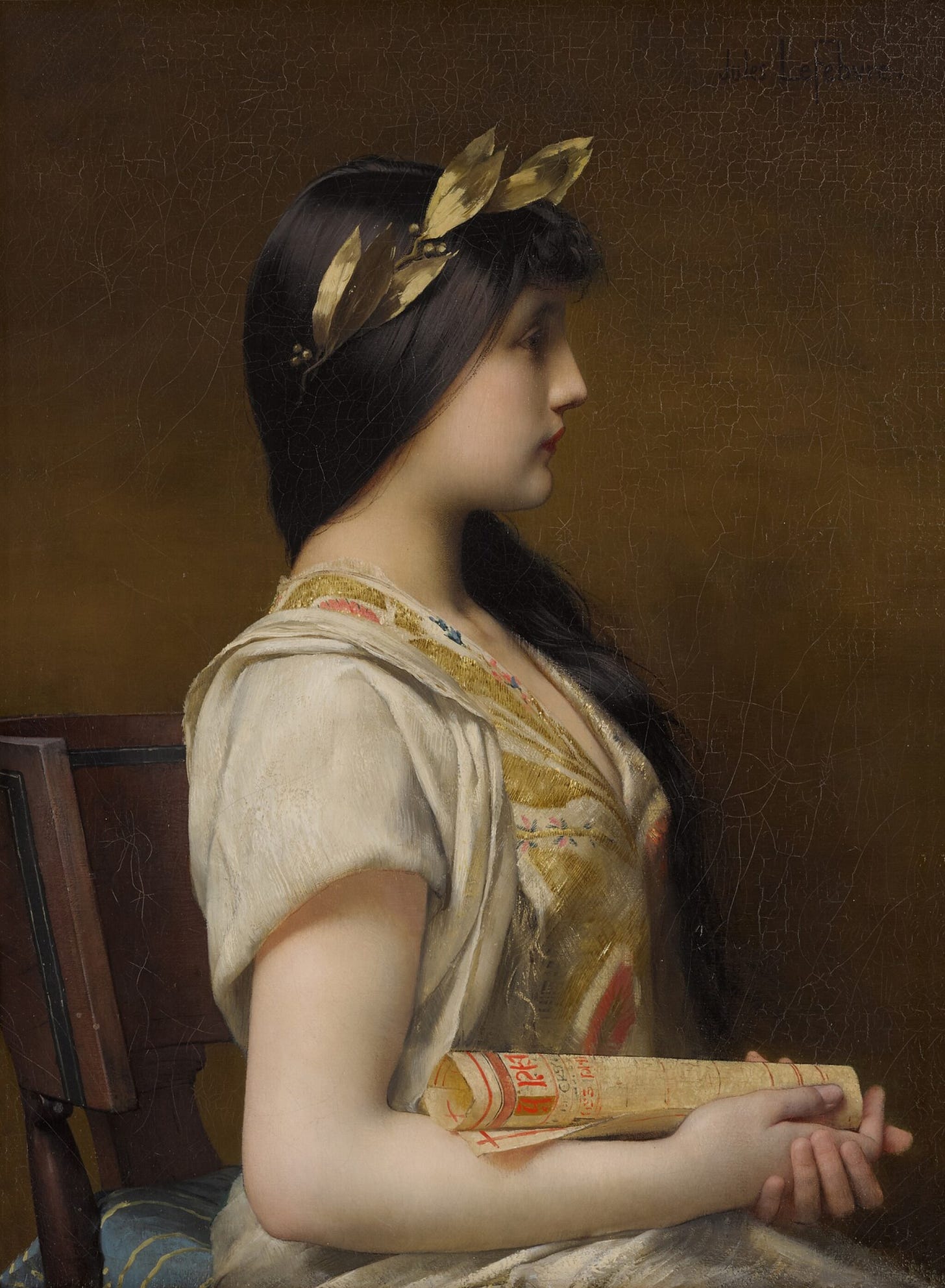 Sappho (unknown date), by Jules Joseph Lefebvre
Sappho was born around 630 BCE, likely in the city of Mytilene or the quieter town of Eresos on Lesbos. Her family was wealthy, aristocratic, and deeply involved in the island’s elite. Her father, named Scamandronymus, was a merchant whose ships sailed as far as Egypt. Her mother, Cleïs, raised Sappho alongside three brothers: Charaxus, Larichus, and Eurygius, in a household where status meant influence. Ancient sources hint that Sappho lost her father at age seven, a loss that may have shaped her inner voice.
Her education was exceptional for a woman of her time. Lesbos was progressive, granting women more freedoms than mainland Greece. Sappho studied poetry, music, and dance in a school for hetaerae, priestesses of Aphrodite, where she honed her craft. By her teens, her verses were already turning heads, described by a contemporary poet, Alcaeus, as “violet-haired, pure, honey-smiling.” That’s not a casual compliment, it’s a glimpse into how she impressed those around her, her presence as lyrical as her poetry.
The Thiasos
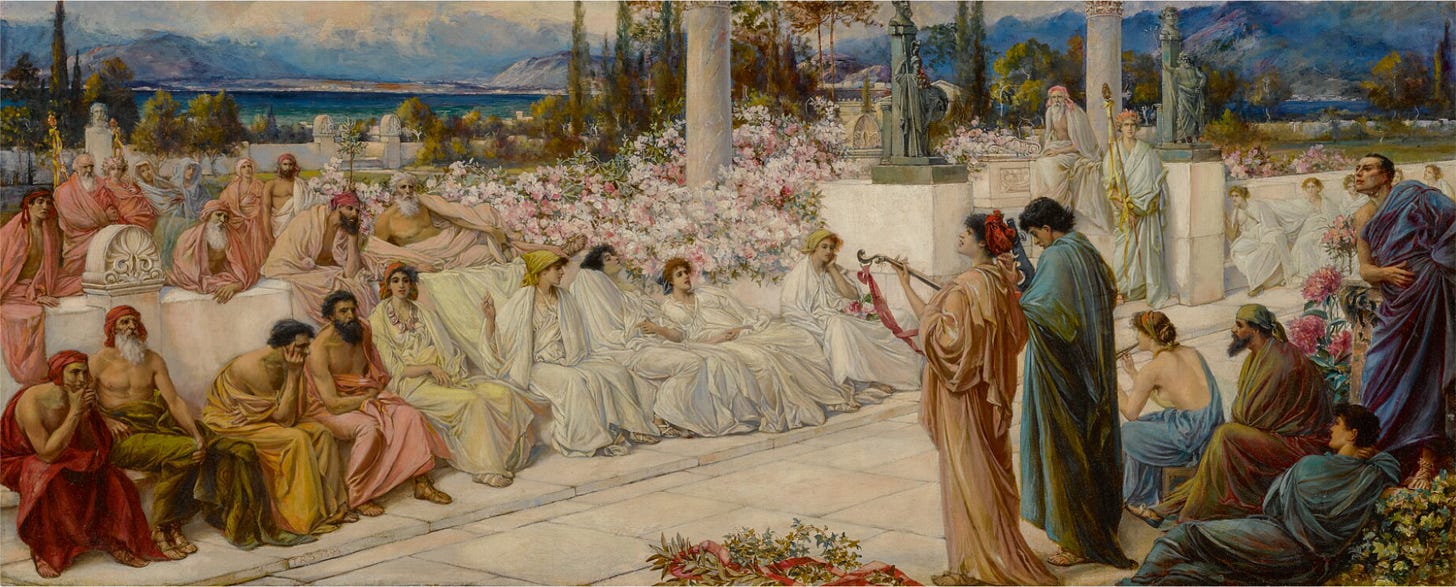 Thomas Ralph Spence, Disciples of Sappho (1896).
As a young woman, Sappho led a thiasos, a female community dedicated to Aphrodite, the goddess of love. Think of it as a school, cult, and sisterhood, where young women gathered to learn poetry, music, and the arts of grace before marriage. Picture a courtyard under starlight, girls weaving garlands of flowers, their voices rising in song to the strumming of lyres. Sappho was their guide, their muse, teaching them to channel desire and beauty into art. Her poems, like the “Ode to Aphrodite,” were likely performed here, calling on the goddess to aid in matters of the heart. One surviving line has Aphrodite pouring “nectar lavishly mingled with joys” into golden cups, a scene so lucid you can almost taste the sweetness.
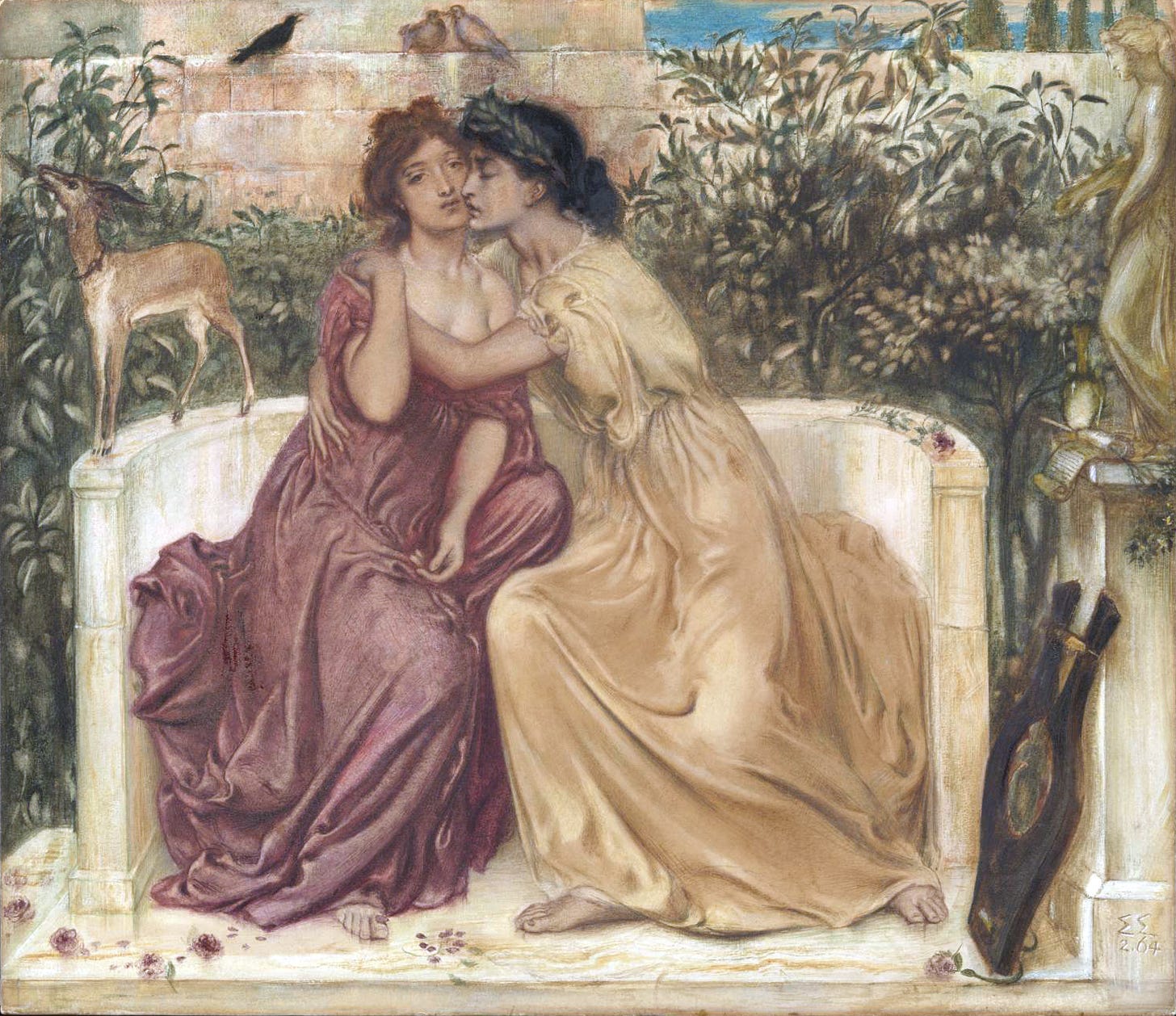 Simeon Solomon (1840–1905), Sappho and Erinna in a Garden at Mytilene (1864)
Sappho’s poetry speaks of love for women like Anactoria and Gongyla, with lines like, “My flesh runs with soft fire,” capturing desire. Scholars debate whether these relationships were romantic, platonic, or ritualistic, but the term “lesbian” stems from her island, and “sapphic” from her name. A late third-century BCE papyrus accuses Sappho of being “irregular in her ways and a woman-lover,” one of the earliest references to her homoeroticism. Her poems don’t shy away from passion, whether for men or women.
Political Storms and Exile
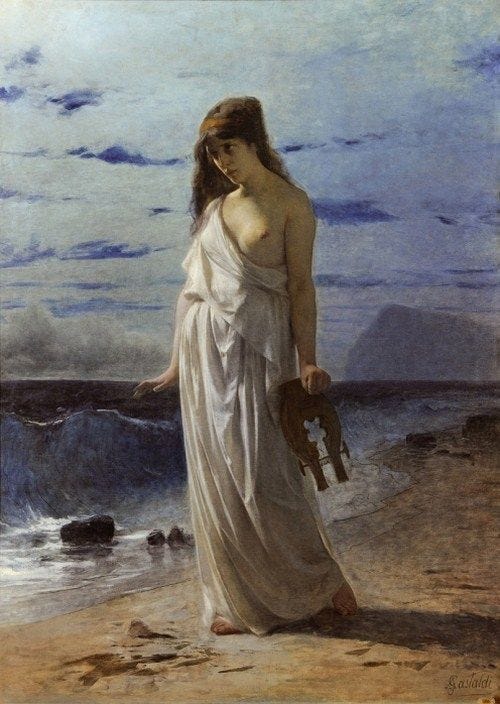 Andrea Gastaldi-Sappho,1872
Lesbos in the 7th century BCE was no peaceful paradise. Political feuds between aristocratic families and rising tyrants like Pittacus shook Mytilene. Sappho’s family, linked to the old elite, found themselves on the losing side. Around 600 BCE, she and her kin were exiled to Sicily, a busy trade hub. Imagine Sappho, in her late twenties, boarding a ship with her daughter, Cleïs, leaving behind the only home she knew. The Parian Chronicle, a marble timeline from 264 BCE, confirms this exile, placing it between 604 and 591 BCE. In Sicily, she continued writing, her poems tinged with nostalgia for Lesbos’s “rosy-ankled” maidens and “dewy meadows.”
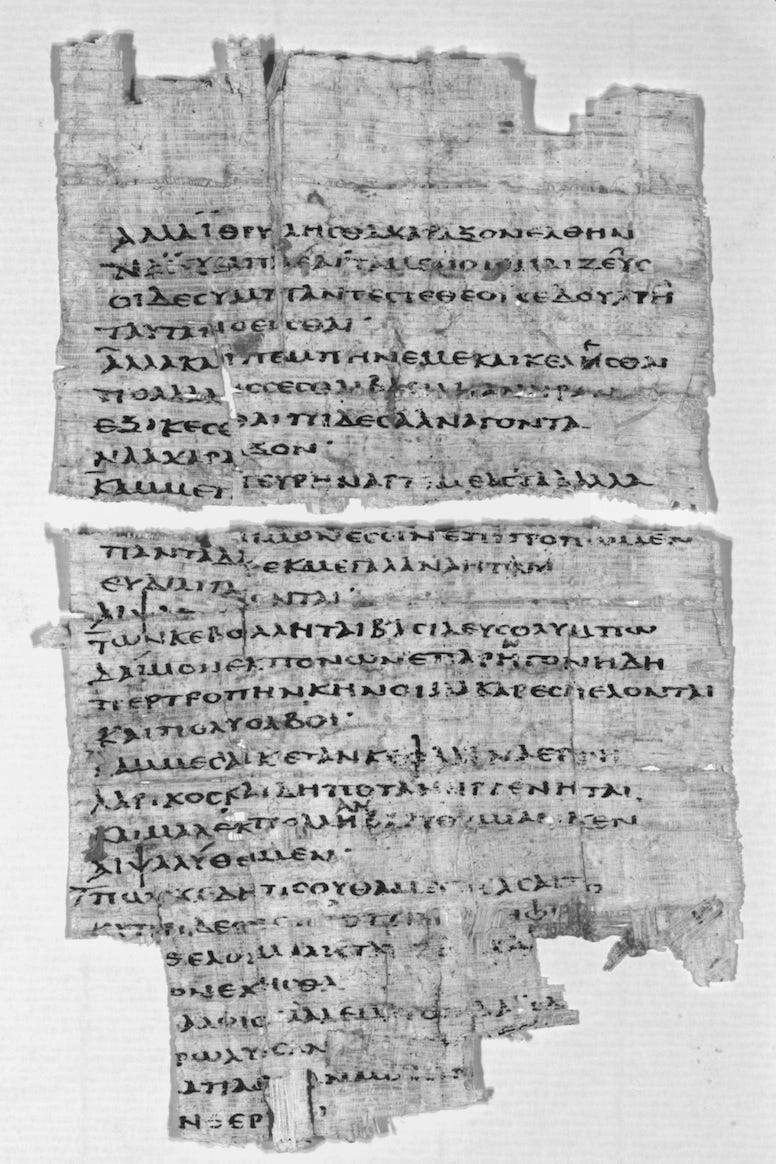 the fragment of papyrus on which Sappho's Brothers Poem was discovered
She later returned to Lesbos after political tensions eased, resuming her role as poet and teacher. Her brother Charaxus, a wine merchant, caused a stir by falling for an Egyptian courtesan named Rhodopis, spending a fortune to free her. Sappho’s surviving fragments scold him, revealing a protective sister. This family drama adds a human layer to her myth.
The Poetry
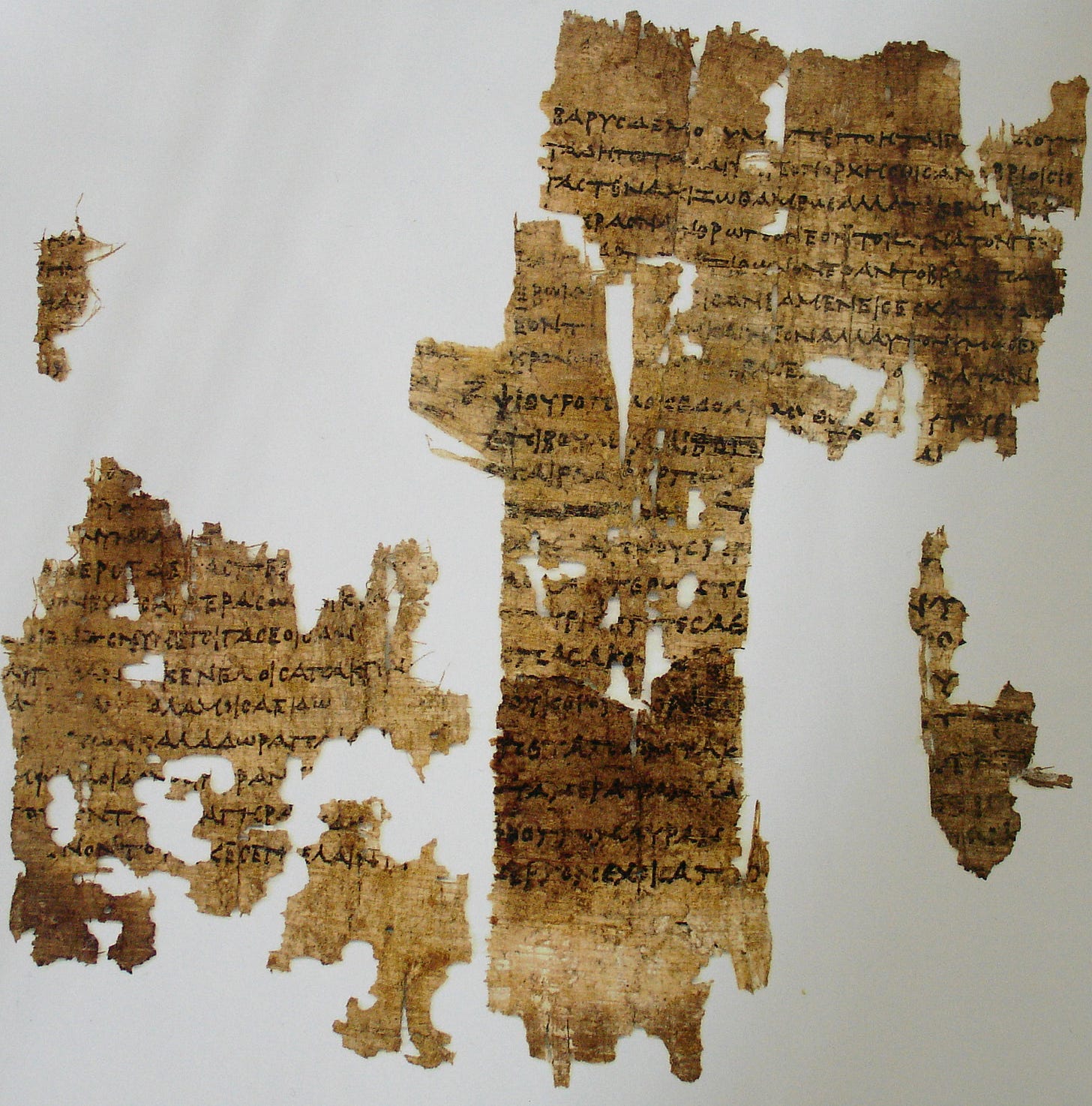 Fragments of the Cologne papyri, dating to the third century BC, preserve twelve lines of the Tithonus poem.
Sappho’s poetry is her heartbeat, pulsing through time despite its fragmented state. She wrote around 10,000 lines, but only about 650 survive, including one complete poem, the “Ode to Aphrodite,” and fragments like the Tithonus poem, where she laments aging: “My hair, once black, is white.” Her style, in the Aeolic dialect, is direct yet authentic. She invented the Sapphic stanza, three long lines followed by a short one, still used by poets today. Her poems were first recorded as musical scores, likely on papyrus, for performance with a barbitos, a deeper-toned lyre.
Her themes were personal: love, longing, beauty, and the fleeting nature of life. In Fragment 16, she declares that the loveliest thing is “whatever you desire,” comparing it to Helen of Troy’s choice to abandon her husband for love. Her imagery, moonlit nights, apple orchards, altars smoking with incense, paints a sensory world. Unlike Homer’s grand epics, Sappho’s work feels personal, like a whispered secret. Plato called her the “Tenth Muse,” and her influence reached Roman poets like Catullus, who mimicked her style.
The Myth of Phaon and Her Death
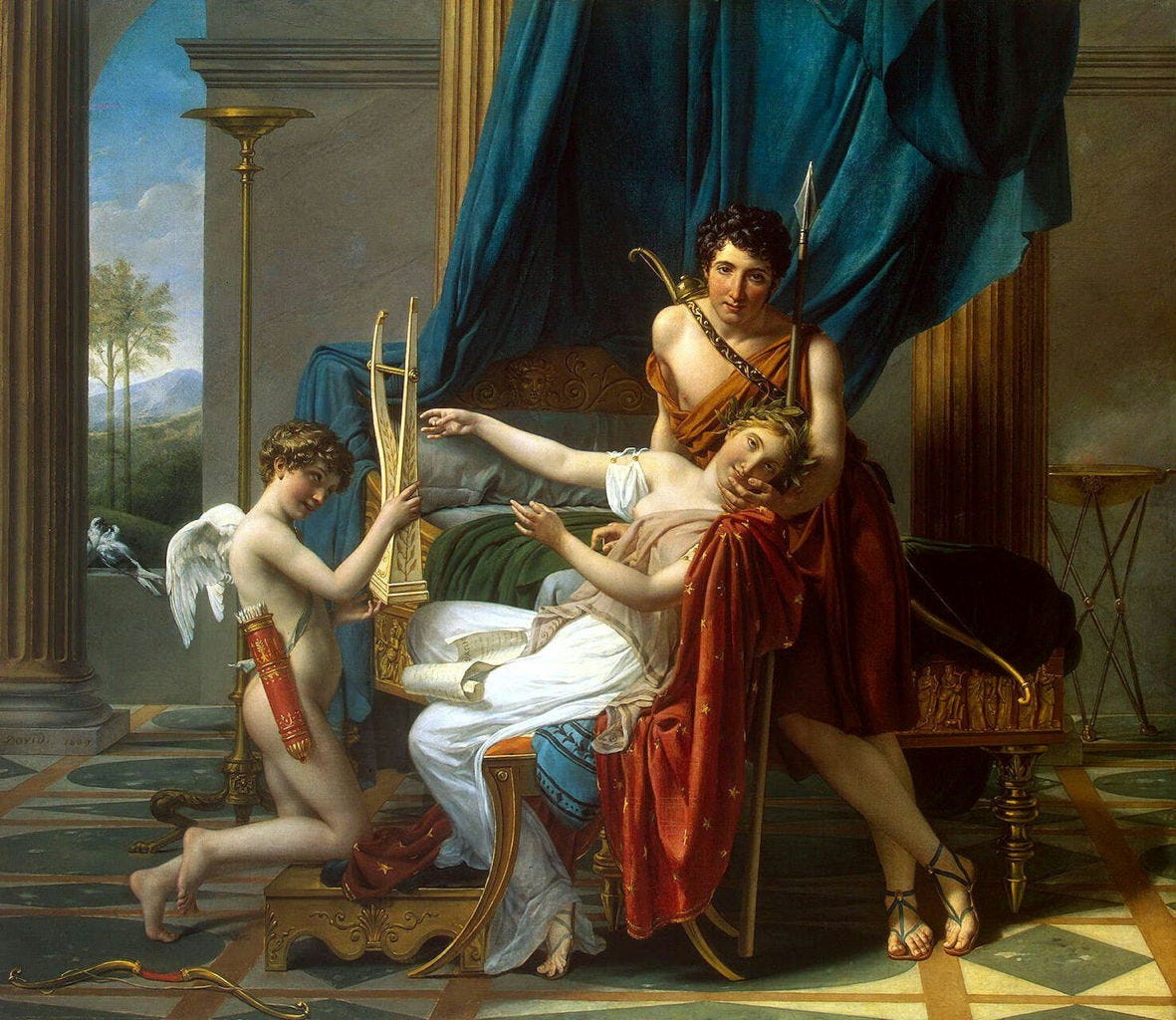 Jacques-Louis David (1748–1825), Sappho and Phaon (1809)
Now, let’s talk about her death, which is now clouded in legend. The story goes that Sappho, around 570 BCE, leapt from the Leucadian cliffs into the Ionian Sea, heartbroken over a ferryman named Phaon. This tale, first told by Menander in a comedy centuries later, is likely fiction. Phaon, a mythic figure tied to Adonis, was probably a poetic device, not a real lover. Scholars dismiss the suicide story as a later attempt to paint Sappho as heterosexual, countering her homoerotic reputation. More likely, she lived into her sixties, dying peacefully on Lesbos, perhaps surrounded by her thiasos.
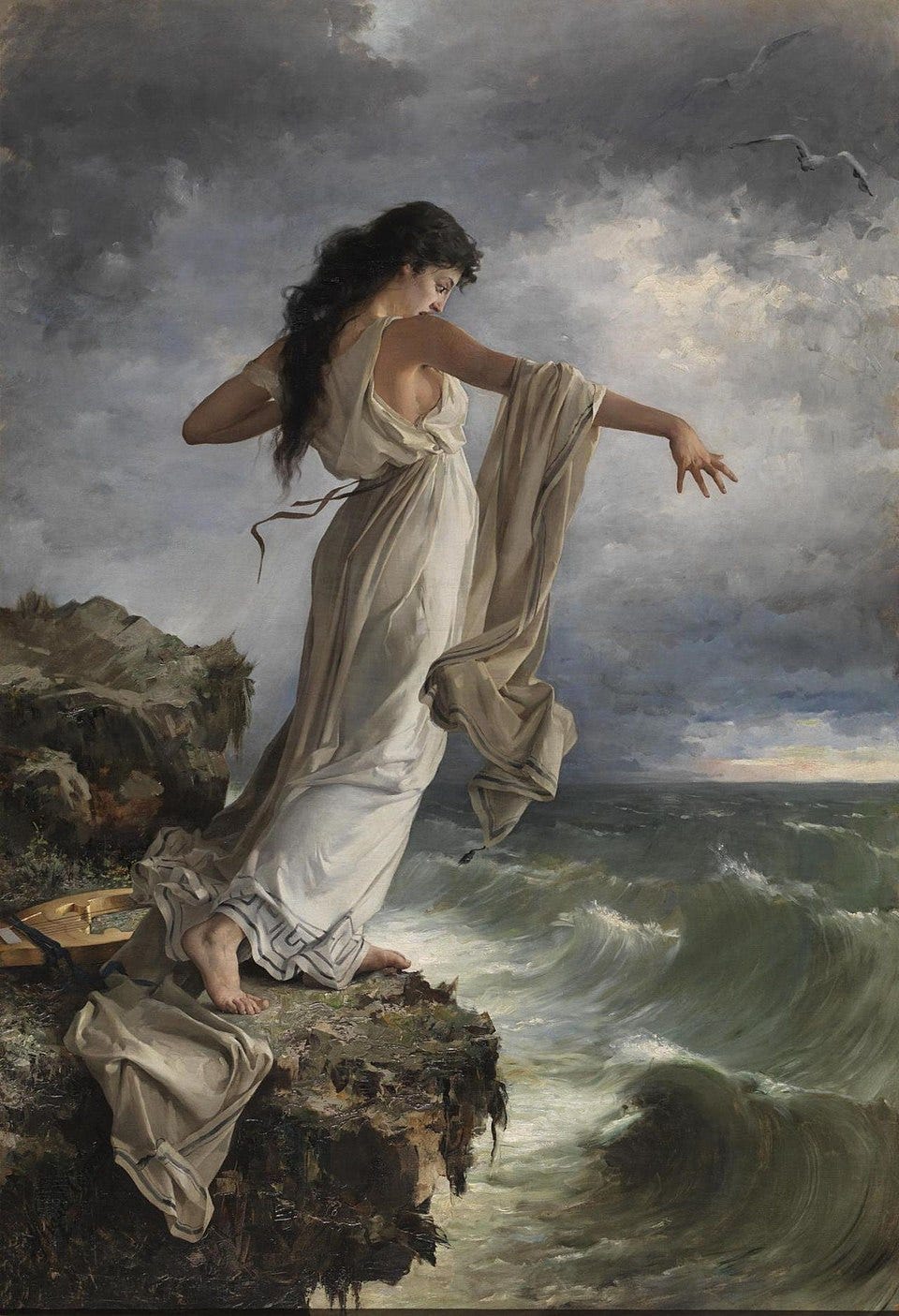 Death of Sappho by Miguel Carbonell Selva
Her exact death date and cause are unknown, but the Leucadian legend inspired art, like Miguel Carbonell Selva’s 1881 painting Death of Sappho, showing her right on a cliff. The image is dramatic but misleading, a romanticized interpretation of a woman too complex for such a simple end.
The Loss and Rediscovery of Her Work
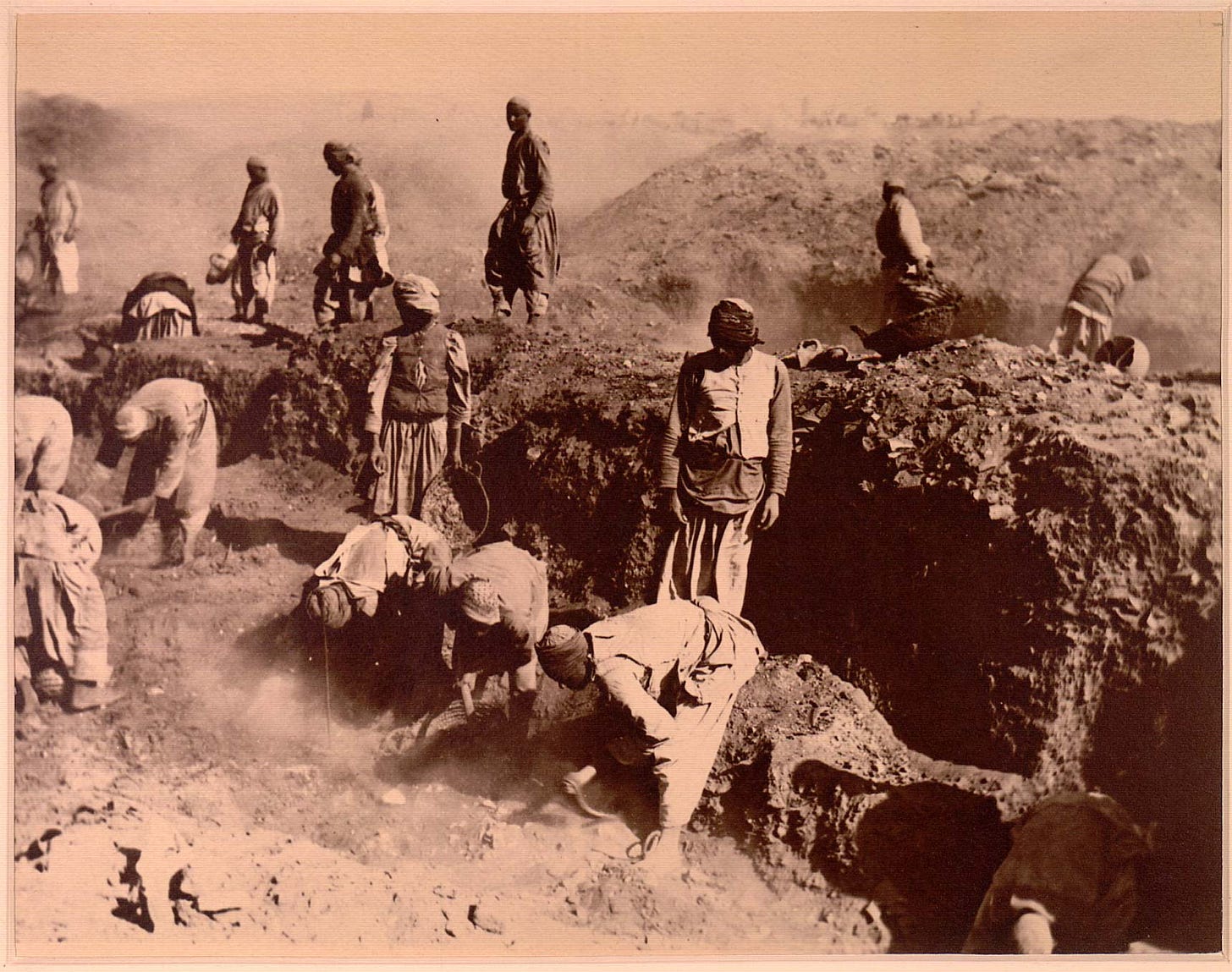 Excavations at Oxyrhynchus 1, c. 1903.
Why do we have so little of Sappho’s poetry? By the 3rd century BCE, her work filled nine books in the Library of Alexandria, organized by meter. But as papyrus gave way to parchment codices in the early Middle Ages, her Aeolic dialect grew obscure, and demand for her work faded. A 2018 study estimates only 7% of her output survives, mostly through quotes in other authors or papyrus scraps found in Egyptian mummy wrappings. In 1898, archaeologists unearthed fragments at Oxyrhynchus, and in 2014, new poems surfaced, including one about her brothers. These finds, like the Cologne papyrus with the Tithonus poem, are rare glimpses into her genius.
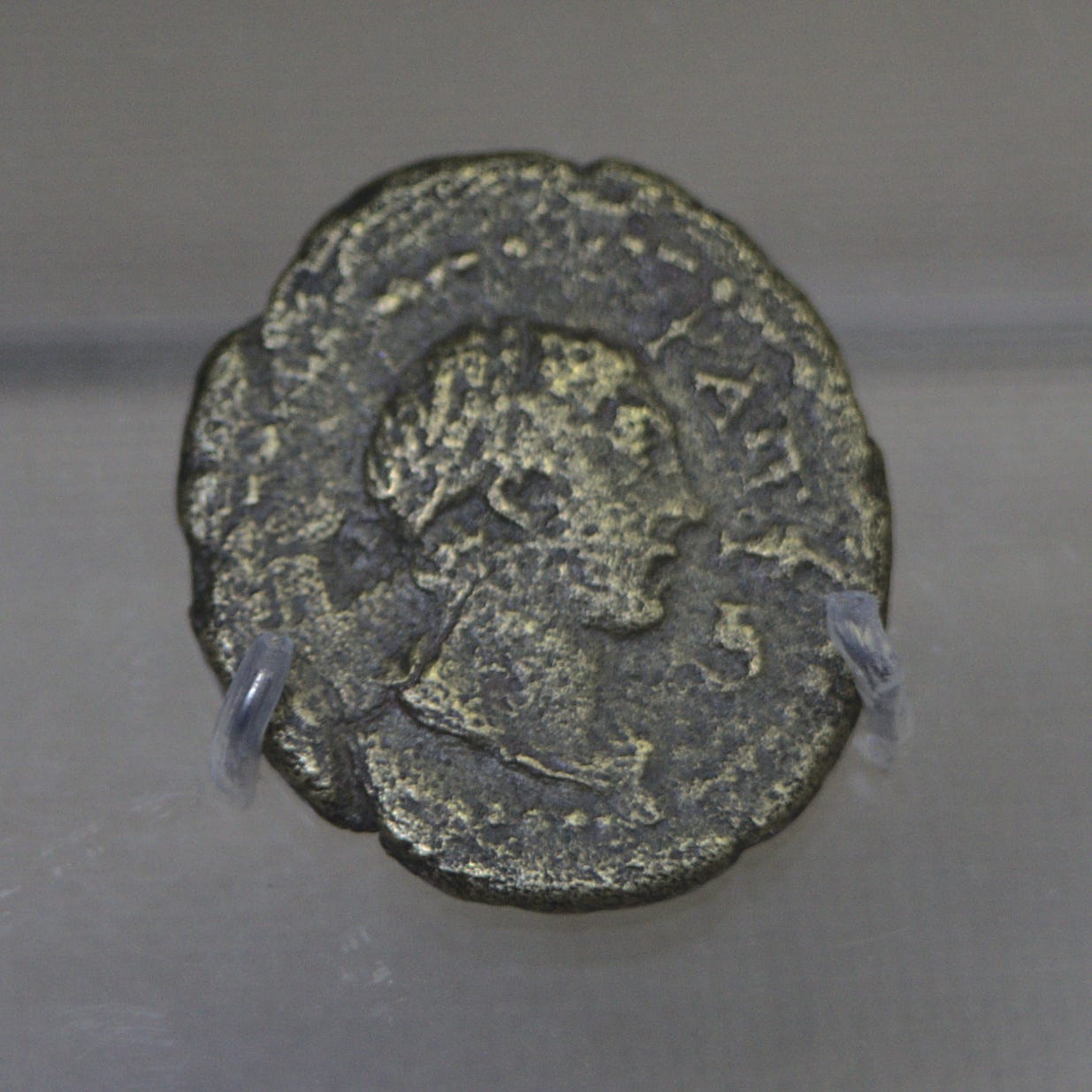 Coin from Mytilene depicting the head of Sappho. Second century AD.
Medieval attitudes didn’t help. In 1073, Pope Gregory VII reportedly burned some of her works, scandalized by their sensuality. Yet her reputation endured. Coins from Mytilene, minted from the 1st to 3rd centuries CE, bore her image, and a statue by Silanion stood in Syracuse.
Her Legacy
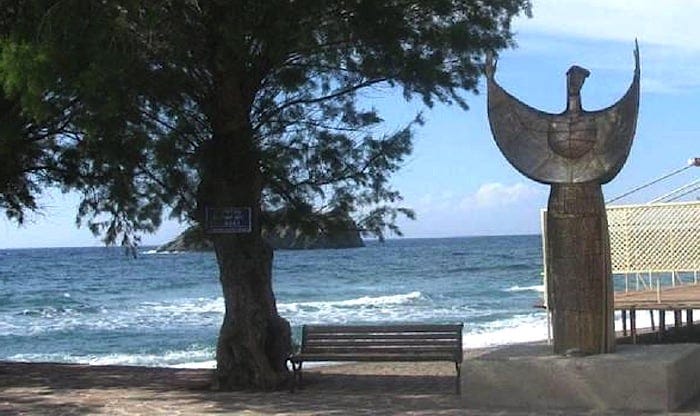 A statue of the seventh century Greek poetess Sappho in Skala, Eressos, Lesvos
Sappho’s influence is monumental. She shaped lyric poetry, giving voice to personal emotion in a male-dominated canon. Her work inspired Roman poets, Renaissance writers, and modern feminists. The term “lesbian” emerged from her island, and “sapphic” describes love between women, securing her as an icon for queer identity. In Eresos today, lesbian tourists visit her statue, a pilgrimage to a place where love feels sacred. In 1652, John Hall’s English translation of her work in On the Sublime brought renewed interest, paving the way for her modern revival.
Her poetry still resonates. Lines like “Come to me, my sweet one, and bring the joy of your love” bring out universal longing. A 2004 study found that Sappho’s fragments are cited in modern poetry 40% more than those of her contemporary Alcaeus. She’s not just a poet, she’s a symbol of unfiltered emotion, a woman who dared to sing her truth.