For a year and a half, I have been working on the exhibition project inscribing Ukrainian design of the second part of the 20th century into the broader corpus of art scholarship, namely East-Central European art studies (that for the last two decades have been embracing a constellation of professionals whose publications and expositions contour the assertively emerging disciplinary field). Although, admittedly, my attitudes toward imperatives of geographical criteria and visibility practices in arts are rather dizzying and dissonant — I believe many instants of these nominations abet oversimplification and distortion — in this particular case, I experienced a sort of a guileless vocational call where something should have been done because the promise of its excavation seemed to be granular otherwise.
The display, co-curated with my dear colleague, an architectural historian and photographer Alex Bykov, was a part of the show Retrotopia. Design for Socialist Spaces that was held at Kunstgewerbemuseum Berlin from March to July 2023. When it comes to formulas bridging "retro," "utopia," and "socialism" in art projects, I usually elbow my way out with unabashed prudence. Still, in these particular circumstances, I was convinced to engage with spatial design history through Zygmunt Bauman's recently published book Retrotopia, which seems to crowd triumphantly into the up-to-date reading landscape of art workers in German-speaking countries. I do have an inexplicable soft spot for Bauman.
I read Bauman in the fall of 2022, which, as all seasons after russia's full-scale invasion, was a period of incensing disillusionment and exhaustive daily life ordeals. The book is quite an easy read with a charming shimmering flow that takes you gently through all the main intellectual points of reference in the 20th century (yes, it starts with Walter Benjamin's "Theses" and the Angel of History). An amiable weekend reading to revisit important works of the past, with a unique Bauman's touch of unanticipated coalescence.
Contrary to some of my colleagues who mentioned the book in our rather cursory discussions, I deemed Bauman very articulate about the negative implication of the term "retrotopia." Not ambiguous but exclusively negative. My assessment, of course, may have been impacted rather heavily by the war at the moment of my reading (as it tends to subscribe to something extrinsic with varying degrees). Yet it is hard not to recognize the outlines of current-day russia (and, in a clumsy retrospective sequence, the Soviet Union) in what Bauman describes as "retrotopia."
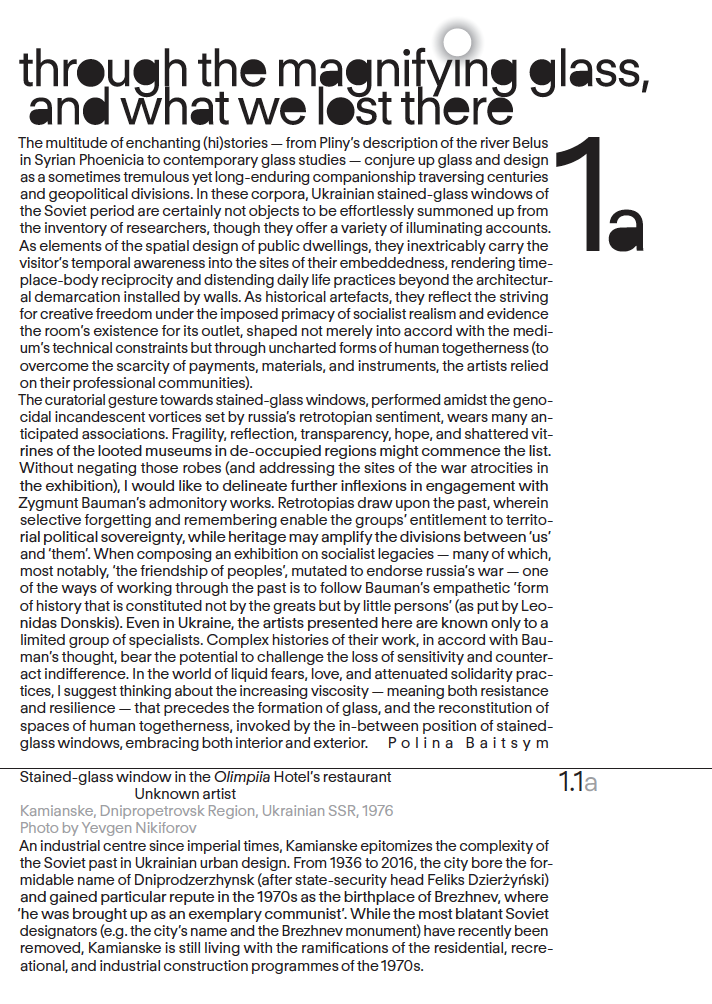
The statement of my curatorial capsule on the stained-glass windows in Ukraine, thus, addresses "retrotopia" only as a concept with a negative connotation, trying to navigate a complex artistic legacy of the Soviet Union (already a commonplace but this peculiar one which retains the accuracy). As a marvelous companion to Bauman's ideas, I would strongly recommend the works he published in collaboration with his friend, a Lithuanian scholar, Leonidas Donskis. My personal favorite is their book Moral Blindness: The Loss of Sensitivity in Liquid Modernity (published by Polity in 2013), which certainly has been fertilizing my maturing critique of solidarity practices and tokenization of Ukrainian art at foreign art scenes.
📋 The page from Retrotopia's booklet with my curatorial statement (with the worn-out title, not flattered with the lettering).