

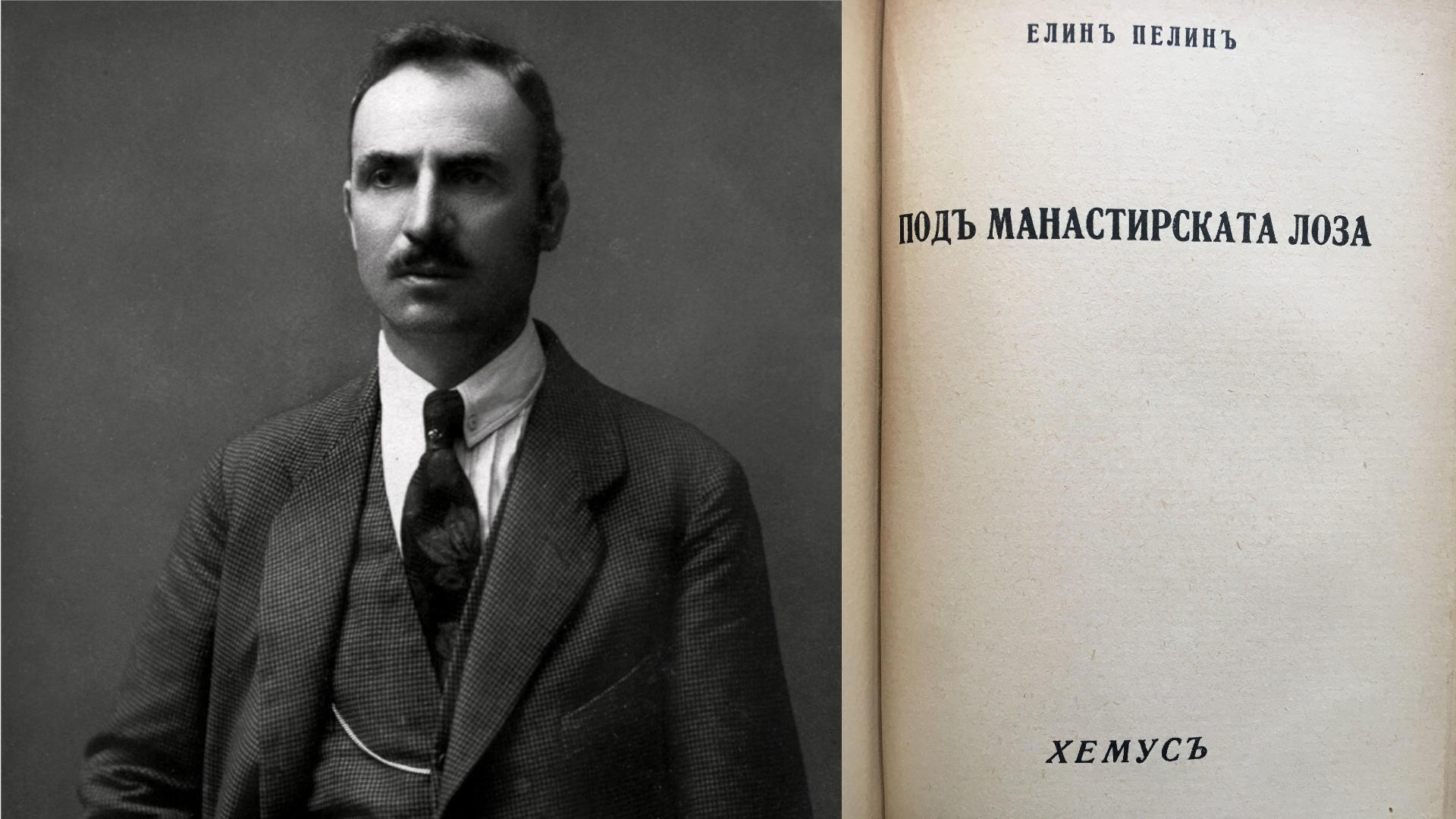
Soup from the Sins of Father Nicodemus
A short story by Elin Pelin
Translated from Bulgarian by Petar Toushkov
Original title:
„Чорба от греховете на отец Никодим“ © 1936 Елин Пелин
That day itself, an ordinary weekday though it was, had been a thing of splendour. The sky’s expanse was somewhat festive and not unlike the sun, which shone for joy. There was devotion in the silence of the woods and in the drinking fountain’s pious chant. There was humility in that black tomcat’s gait as, lost in thought, he crossed the inner yard and slowly climbed up to the chardak.
Father Sisoës and I had made ourselves comfortable near the table under the grape vine, enjoying this beautiful day. Before us, down below, stretched out the green expanse of the plains, rounded by the blue silhouette of the mountain and its branching forested ranges, their smoothed backs humbled in prayer under the sun.
Father Sisoës, absorbed in silence, reclined against the backrest of the bench, his pleasantly plump hands slowly and calmly telling the beads on his amber rosary.
Across the yard, carrying utensils, came out the mostly deaf kitchener in his white apron.
Father Sisoës inclined his hand at him.
“Is it ready now, is it ready?” he articulated loud and sharp, glancing at the watch he had produced from his plush waistband-pocket.
“Right away it will be”, the monastery’s cook said, waving back for us to have patience, and continued on his way to the kitchen expecting no further questioning.
A smile full of kindness lit Father Sisoës’ face.
“Do you know what we’ll eat?” he said.
“Another one of your temptations, Father,” I said, my eyes pointing at the wine bottle currently cooling down in the basin of the fountain.
That bottle, whenever it presented itself in the basin, always forebode something rather special for lunch. Ghivetch, peppery lamb stew, roasted chicken, or shish kebob.
“No,” Father Sisoës said, placing his hands on the table. “Today, we’ll eat something simple in and of itself, though of significance. Today, I’ll regale you with soup from the sins of Father Nicodemus.”
I looked at him, surprised and appreciative of his amusing joke.
“I am not joking, dear,” Father Sisoës said, his head bowing down in reflection. “I speak only the truth. Today, we’ll eat soup from the sins of Father Nicodemus. It’s almost a year since, God bless his soul, poor Nicodemus has been resting in the monastery graveyard under the quince he planted out and nurtured himself. The humility this good man showed during his lifetime—although his soul led a God-fearing life, striving for the heavenly blessings in tireless labour—helped his name to be forgotten quickly.
“I met him here a year before his death—of age, but well preserved, healthy, and stalwart. Even now I almost see him passing through the yard, his tall, upright, broad-shouldered figure too big to go through the church door without bending down at least a little. He walked like a bishop, his steps heavy, and slow, and of importance. An yet his wide, round eyes, shaded by his thick, vine-like eyebrows, spoke of strange and wondrous mystery that didn’t suit the strength suggested by his bearing. Every morning, after he got out from the shadow of his cell and paused at the church door to cross himself, the sunshine fell on the old, colourless, straining cloth over his broad shoulders as if lighting up a mountain ridge. And—forgive me, heavenly Father—I always thought prayers did not behove this man, as he seemed stronger than all sins, at which he needn’t have joined his fingers to cross himself, but his clenched fist.
“Father Nicodemus lived a solitary life in his small room, not once seeking after my company. He ate alone, punctual and regular at attending service, be it morning or evening. Lovingly and dutifully, he grew the flowers in the garden, having a soft spot for the white roses he’d personally planted in great variety. Every morning in May, when those roses were in full bloom and the yard seemed filled with little white angels, Father Nicodemus would go for a long walk among them, stopping to smell the flowers and always picking exactly one. Curiously, every single time this one rose was later found laid at the bench behind the monastery wall next to that delightful meadow. Now I am aware this small quirk of his hasn’t been without its significance, although it’s still shrouded in mystery.
“On a beautiful spring or summer day, Father Nicodemus used to spent time at the river with his fishing rod. This was his personal passion. I don’t believe a greater trout fisherman than him has ever been born. He wondered around the shaded ravine along the river, pushing his way through the bushes on the banks, tirelessly climbing the ancient green boulders. In such days, he didn’t attend the evening service, although lots of people witness that he always put the fishing rod away, stood on his feet, and crossed himself until the last bell toll faded away.
“Father Nicodemus had come to the monastery at the age of twenty, never betraying his eccentricity. On multiple occasions he was offered to be appointed as Father Superior, but he respectfully declined.
“Now he rests in peace under the drooping boughs and the green, young fruit of his quince tree. And we shall eat a soup from his sins.”
Father Sisoës smiled wisely, lifted his hands to pull up the sleeves of his cassock, and continued.
“Last night, in the back of the hidden cupboard in Father Nicodemus’ now empty cell, we found a pot of dried beans, covered up with the breviary of the deceased. Every bean was wrapped up individually in a small piece of paper.
“On the first white page of his prayer book has been written…” Father Sisoës extracted the book from his bosom and read, “‘For each offence I’ve made, by deed or thought, I here leave one dried bean. Black for the unforgivable, and white for those which cast the cloud of doubt upon my soul and I can’t readily discern as sins or not. I repent for the black ones, and for the white ones—I pray to God to find forgiveness.’”
Father Sisoës closed the breviary, placed it on the table, and then fished out of his pocket a kerchief containing something. When he unwrapped it, on the table fell a bunch of paper pieces, which scattered when he let down a sigh.
“These are the small pieces of paper he used to wrap the beans. On each of those Father Nicodemus wrote a sin he committed. After reading them all, I reckon the soul of the poor monk might have tormented itself unjustly, and that the merciful God accepted his prayers with a kindly, good-humoured smile. Let’s read some of them, shall we?
“‘I remembered my secular life and my youth. I remembered my love which was the reason I took the vows. I remembered the one I loved, and the white roses she liked to adorn herself with.’—black bean.
“‘In memory of her white roses, I planted three of them in the garden.’—black bean.
“‘At the bench by the meadow, each day I place one white rose for the one who finds it. Let it gladden a stranger’s soul the way she was glad once.’—white bean.
“‘Does a man save his soul by ruining his body?’—white bean.
“‘I reason with myself, but I do not know which is supreme—the soul or the body? Aren’t they, in fact, inseparable, and isn’t the soul exultant before the joyous attractions of the body?’—white bean.
“It turns out, on each of those small pieces of paper we found in the pot, there was not sins, but memories from a youthful past, thoughts begetting doubts, and doubts torturing the soul of the late Father Nicodemus.”
When he’d finished reading the paper pieces, Father Sisoës carefully wrapped them in his kerchief, put them back in his pocket, and gave me an inquisitive look.
“What a funny creature man is!” he said.
“A black bean” I said.
Father Sisoës smiled, “Both black and white.”
By this time, the kitchener was already laying the table for lunch. He brought a big bowl of delicious, steaming soup from white and black beans.
“Here it is, this is the soup from Father Nicodemus’ sins. And the wine chilling over there? I thought we could use it in memory of our good monk, and may he rest in peace,” Father Sisoës said and invited me to begin lunch.
This translation is published under the Creative Commons License
Attribution-NonCommercial-NoDerivatives 4.0 International
If you are happy with my work, become a member or consider a small coffee boost:
https://www.patreon.com/99stories
https://www.buymeacoffee.com/petertoushkov
Thank you!