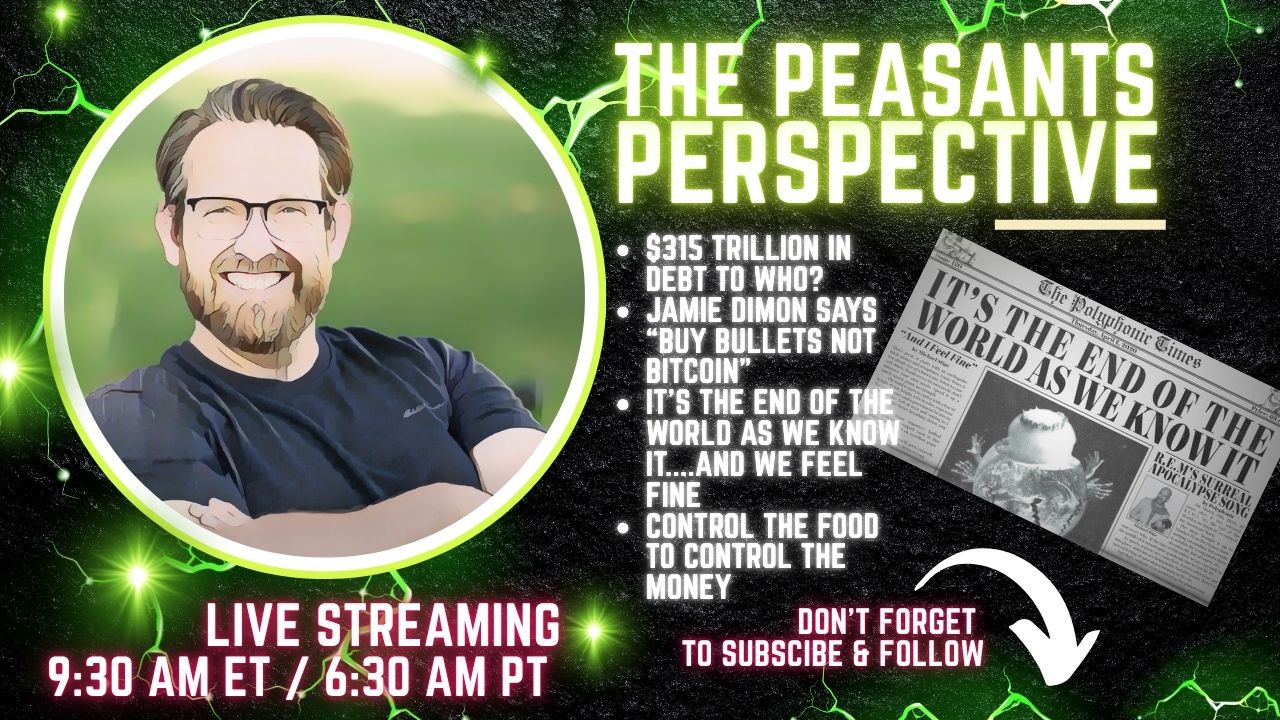

The recent Peasant's Perspective episode delves deep into the illusion of global finance and the mechanisms of control that shape our modern world. The hosts begin by questioning a fundamental concept: the global debt of $315 trillion. "Who do we owe this money to?" they ask, pointing out the absurdity of a planet that owes money when everything needed for survival exists freely in nature.
This question serves as a gateway to exploring how financial systems function as control mechanisms rather than genuine economic tools. The hosts suggest that modern currency is designed to store less value over time while technology advances, creating a paradoxical situation where productivity increases but debt grows exponentially. They argue this isn't accidental but rather a deliberate system to maintain power hierarchies and control populations.
The episode takes a fascinating turn when discussing higher education, particularly elite institutions like Harvard. The hosts question whether these prestigious universities actually deliver quality education or simply serve as networking hubs for future power brokers. They share footage of Harvard campus protests, suggesting that the student quality doesn't match the institution's reputation, with China reportedly considering Harvard more of a "party school" than a serious academic institution. This critique extends to the broader college system, which they argue has left an entire generation in debt for degrees that often don't translate to related employment.
A particularly concerning segment covers the security implications of technological dependence. The hosts discuss how Chinese-manufactured solar panels reportedly contain cellular backdoor capabilities that could potentially be used to trigger grid blackouts during international conflicts. This vulnerability represents just one example of how global supply chains create national security risks that often go unaddressed until crisis points.
The conversation shifts to artificial intelligence and robotics, citing Mark Andreessen's view that embodied AI represents the next industrial revolution. While acknowledging the potential for job disruption, they suggest this transition could revitalize American manufacturing if properly harnessed. However, they warn against Singapore-style regulatory approaches where licensing requirements create artificial barriers to technology access and ownership.
Perhaps most alarmingly, the hosts explore Catherine Austin Fitts' warning about the connection between financial control and food supply control. They outline how central bank digital currencies could potentially restrict food purchasing options, forcing consumers toward synthetic foods like lab-grown meat and insect-based products. The solution, they suggest, is supporting local farmers, growing personal food supplies, and resisting the consolidation of food production under pharmaceutical and corporate control.
The episode concludes with reflections on Ukraine-Russia tensions, particularly recent drone attacks on Russian military assets, and the broader implications for global stability. Throughout the discussion, the hosts maintain that seemingly disconnected global events—from financial systems to geopolitical conflicts to technological development—are actually interconnected aspects of larger control structures shaping our world.
https://youtu.be/kJxQaFPnebg?si=eQZLZRfMlnG2cdCf