

 From Charles losing his composure over an umbrella to William and Kate’s colonial cosplay in Jamaica, the British monarchy keeps reminding us just how out of touch it really is.
There is something comically ironic about the King of the United Kingdom being brought to the brink of despair by a spot of rain. King Charles III, a man who spent more than seven decades preparing for a position that he inherited by birth, appeared completely bewildered when the heavens opened during his latest Caribbean tour, and not even his wife, Queen Camilla, seemed particularly interested in sticking around to weather the storm with him.
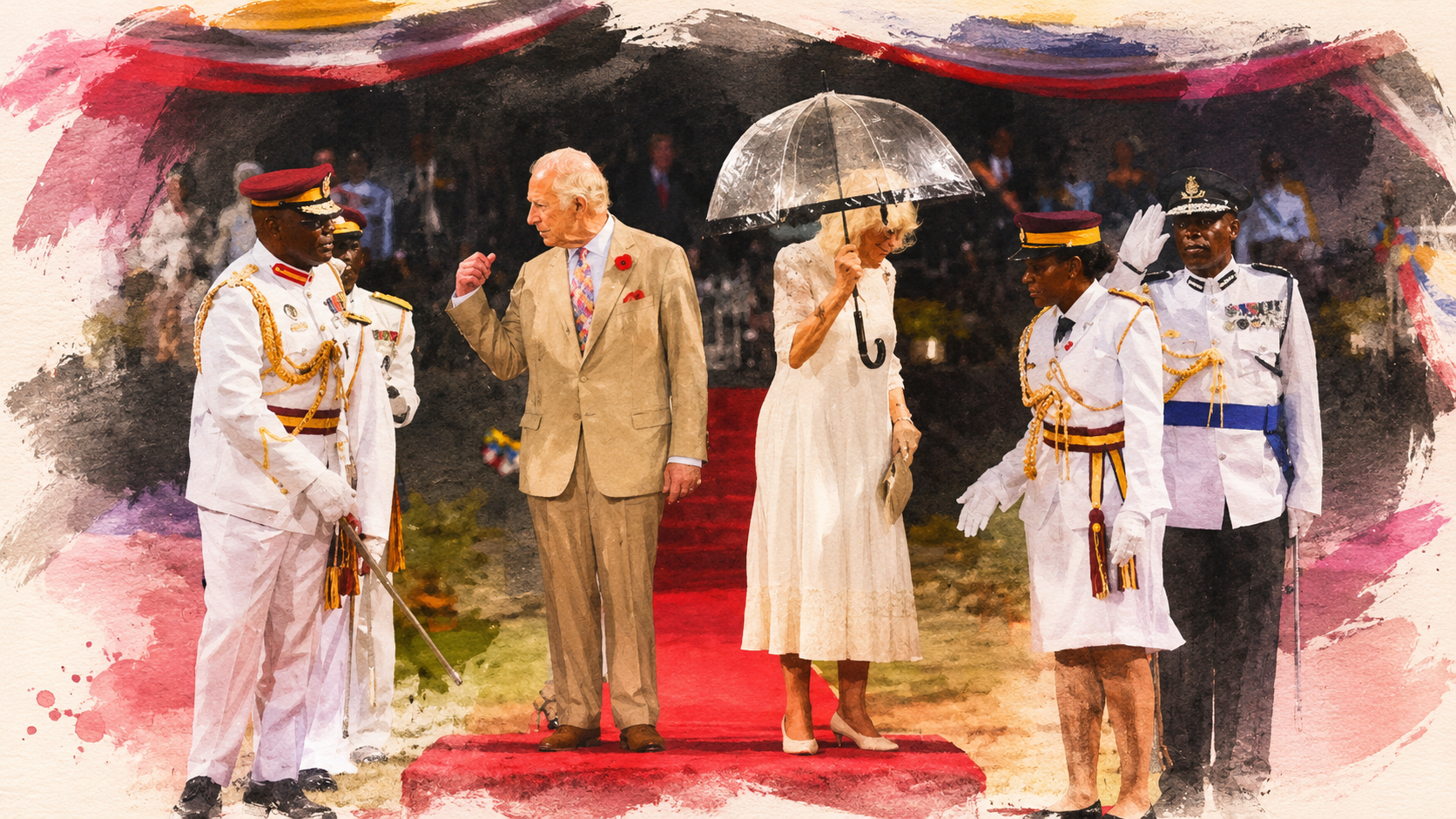
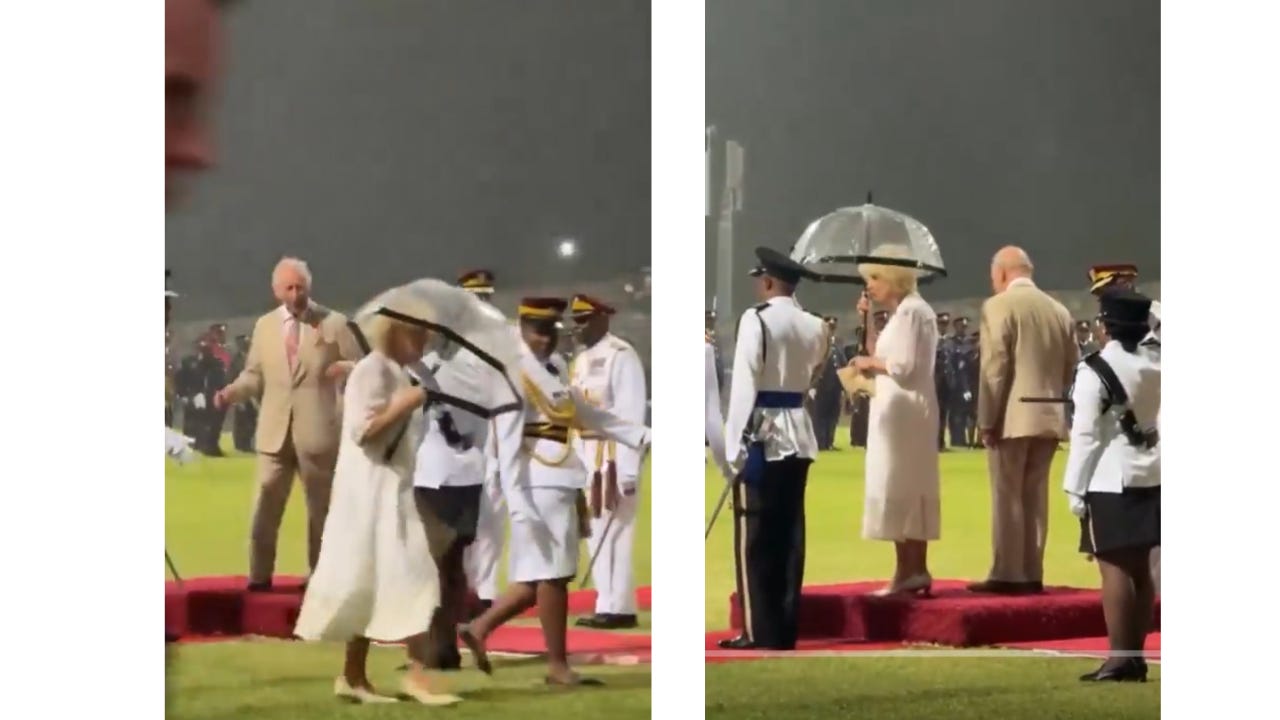
The incident took place on November 1, during Antigua and Barbuda’s 45th anniversary of independence celebrations. Charles and Camilla were attending a ceremonial parade when a sudden tropical downpour left the royal couple, and their apparently unprepared entourage, scrambling for umbrellas. Camilla was quickly provided with one and made her way towards shelter, while Charles was left standing on the platform, visibly wet and increasingly agitated, gesticulating towards his aides and repeatedly demanding to know where his umbrella was
Now, I appreciate that nobody particularly enjoys being soaked in their Sunday best, but surely it isn’t asking too much for two of the United Kingdom’s most senior dignitaries to maintain a little composure when confronted with something as ordinary as rain? You’re British, for goodness’ sake, rain is practically a national institution.
While I am certainly not in the business of applauding royals for doing the bare minimum, I couldn’t help thinking that Princess Anne would probably have stood there, accepted her fate, and carried on with the ceremony. She might even have considered the umbrella an unnecessary extravagance, although what made this particular incident so revealing wasn’t simply the weather, but the behaviour of the two people at the centre of it.
Camilla Got Her Umbrella. Charles Was Apparently On His Own.
Perhaps the most amusing part of the footage was the speed with which Camilla appeared to prioritise her own escape from the rain. Once her umbrella materialised, off she went, leaving her husband behind to contend with the elements and the apparent incompetence of his staff.
Here was the King, a 77-year-old man undergoing cancer treatment, looking increasingly irritated while his wife made her way to shelter. Harry and Meghan would never lol. One thing about Harry and Meghan is that they have each other’s hearts and will never be worlds apart; they would happily stand under one umbrella — eh-eh-eh.
We are constantly subjected to carefully curated imagery of the royal family as devoted spouses, loving parents and paragons of familial stability, yet sometimes it takes an unscripted moment to reveal how little control the palace has over the image it works so hard to manufacture. Of course, we cannot know what goes on within Charles and Camilla’s marriage from a few seconds of video, but we can certainly comment on the public performance, particularly when public performance is arguably the monarchy’s principal occupation.
Charles’s reaction wasn’t exactly a masterclass in dignity either. He appeared to become increasingly frustrated, throwing up his hands and calling for assistance, although he was eventually given an umbrella and continued with the engagement, later joking that his soaked suit might begin growing watercress.
He even referenced the episode during a subsequent Commonwealth dinner, joking that his role might be to provide an umbrella for everyone. A little self-deprecation is welcome, although it doesn’t entirely erase the spectacle that preceded it.
This is a man who has spent his entire life surrounded by staff whose job is to anticipate his needs, organise his movements and ensure that practically nothing inconvenient ever happens to him, yet confronted with a few moments without an umbrella, he looked utterly exasperated. Imagine having that level of insulation from ordinary inconvenience.
The Royal Fairytale Is Looking Increasingly Like A Nightmare
One of the monarchy’s most enduring selling points is the idea that its members represent the very pinnacle of British society. They are supposed to embody grace, decorum, restraint, sophistication and exceptional manners, held up as living symbols of national identity, tradition and continuity. These are not simply wealthy celebrities, we are repeatedly reminded; they are royalty.
Historically, the institution has even invoked the divine right of kings. Modern British monarchs no longer govern by divine right, but the religious symbolism remains woven into the coronation ceremony, where the sovereign is anointed in a sacred ritual. The result is an extraordinary mythology of inherited exceptionalism, in which we are encouraged to believe that these people are somehow uniquely suited to representing a nation because of the family into which they happened to be born, yet time after time, ordinary unscripted moments expose how absurd that proposition can be.
💕 Buy me a coffee: https://www.buymeacoffee.com/onthegowithac 💕
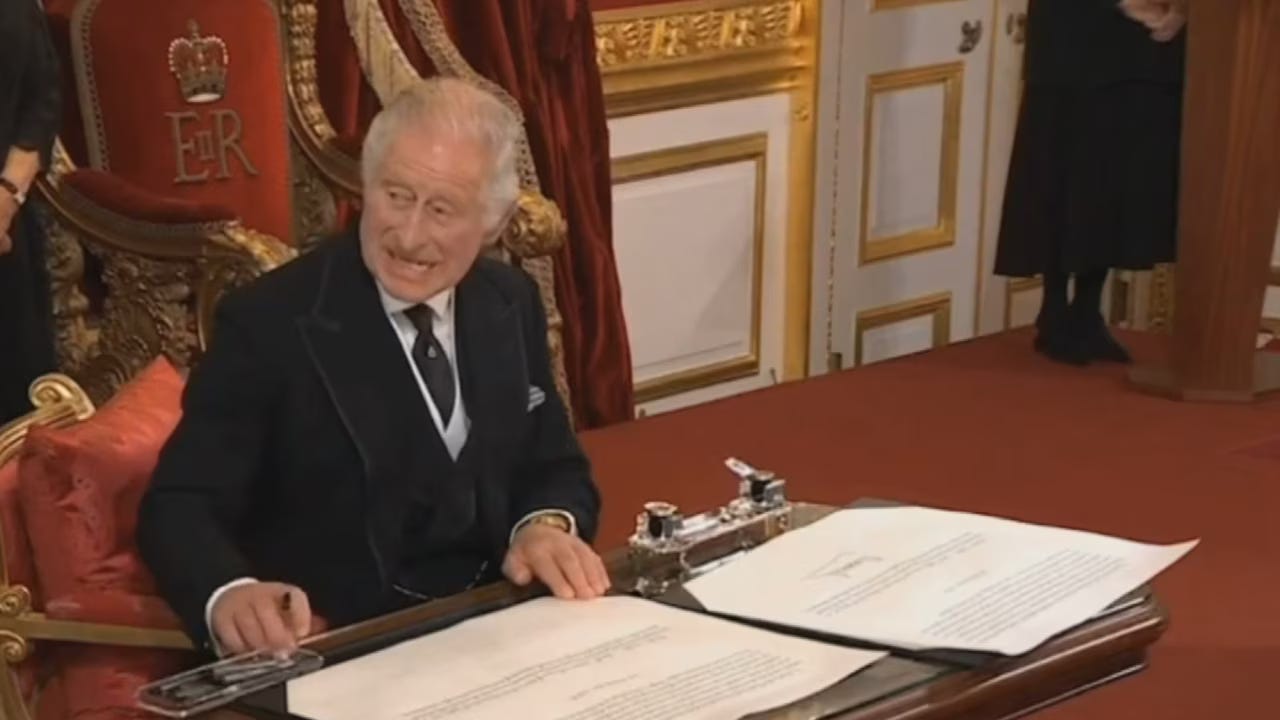
A leaking pen sends Charles into a temper, an absent umbrella apparently threatens to derail his composure, and a carefully staged overseas tour becomes a public relations disaster. For an institution so obsessed with etiquette and protocol, the royals can be remarkably poor at demonstrating either when circumstances refuse to follow the script, which is particularly extraordinary when we are talking about an organisation with private secretaries, communications teams, advisers, equerries, security personnel and dedicated event planners.
If all of that infrastructure cannot reliably produce a calm, composed public appearance in the rain, what exactly are we paying all these people to do? If we are expected to respect the monarchy because its members supposedly possess some inherited understanding of duty, dignity and service, surely their behaviour should occasionally support the claim.
The Longest Internship in British History
There is, of course, an argument that Charles deserves some consideration because of his age and health. He is 77 and has continued undertaking official engagements following his cancer diagnosis in 2024, and I don’t think anyone should dismiss the physical demands of international travel, particularly for someone undergoing medical treatment.
That, however, raises a perfectly reasonable question…….
Why insist on undertaking these exhausting, carefully choreographed tours if the demands are becoming increasingly difficult to manage? Charles has spent virtually his entire life preparing for this role, having been the longest-serving heir apparent in British history, with decades to observe how the institution operates and consider how he might modernise it. He had more preparation than perhaps any monarch before him, yet the monarchy continues to operate as though lengthy international tours, grand ceremonial appearances and colonial-era symbolism are indispensable demonstrations of its importance.
Surely there must come a point where the institution asks whether these performances are achieving anything meaningful.
Charles completed more than 40 engagements during the nine-day Caribbean visit and continued the Antigua ceremony after the downpour. That deserves factual acknowledgement, even if I’m not inclined to award a medal for fulfilling the duties of a privileged constitutional position. The question remains, however: why are we continuing to send elderly royals around the world to reinforce an institution whose relevance is increasingly being questioned by the very countries they are visiting? More importantly, what does the monarchy actually achieve through these tours beyond photographs, speeches and diplomatic pleasantries?
William and Kate’s Caribbean Disaster: Colonialism With a Fresh Coat of Paint
If the latest images of Charles and Camilla seem embarrassing, they are hardly unprecedented.
In March 2022, Prince William and Catherine, then the Duke and Duchess of Cambridge, embarked on a Caribbean tour of Belize, Jamaica and the Bahamas to mark Queen Elizabeth II’s Platinum Jubilee. It was supposed to be a celebration of the monarchy’s relationship with the Commonwealth, but instead became an extraordinary demonstration of just how disconnected the royal establishment appeared to be from the political realities of the region.
The controversy began before the couple had even properly settled into their itinerary, with an engagement in Belize cancelled following protests connected to a land dispute. In Jamaica, campaigners called for slavery reparations and a formal apology from the British Crown, while the Jamaican prime minister, Andrew Holness, told the couple that his country intended to move towards becoming a republic.
The message could hardly have been clearer, yet somehow, the palace continued producing imagery that looked as though it had been lifted directly from a royal tour in the 1950s. Perhaps the most infamous example was William and Kate standing in an open-top Land Rover during a military parade, William dressed in ceremonial tropical military uniform, with the resemblance to photographs of Queen Elizabeth II and Prince Philip touring former British colonies impossible to ignore.
That was precisely the problem, because what the palace appeared to regard as charming tradition was, to many observers, a deeply uncomfortable reminder of colonial hierarchy.
💕 Buy me a coffee: https://www.buymeacoffee.com/onthegowithac 💕
Here were two extremely privileged white British royals, elevated above the crowds in ceremonial finery, being driven through a Caribbean nation whose people were actively debating their constitutional relationship with the British Crown. It was colonial nostalgia presented as modern diplomacy, imagery that wasn’t simply unfortunate but reflected a failure to understand that symbols carry different meanings depending on who is looking at them.
For royal traditionalists, the Land Rover may have represented continuity, while for critics of the monarchy, it represented the continuation of an unequal relationship that Britain has never adequately confronted.
Then there were those photographs of William and Kate greeting Jamaican children through a wire fence. To be clear, the fence surrounded a football pitch, and the couple also interacted with people without that barrier, so the photographs did not establish that anyone had deliberately separated the royals from the children. Nevertheless, the optics were dreadful, with images of privileged white royals reaching through fencing towards Black Caribbean children inevitably evoking an uncomfortable visual hierarchy.
One might reasonably argue that the images were unfairly stripped of context, but isn’t anticipating precisely this kind of symbolism supposed to be the responsibility of highly paid royal advisers? It is extraordinary that an institution which places such enormous importance on appearances can be so consistently incompetent at understanding them.
The palace had apparently planned a celebration of royal continuity without adequately considering that, in much of the Caribbean, continuity with the British Crown is exactly what people are questioning.
William and Kate Have Hardly Been Rushing Back
Following the criticism of their 2022 Caribbean tour, William and Kate have not embarked on another comparable joint tour of the region. They have undertaken other international engagements, including their visit to Boston later in 2022, and Kate made a solo official visit to Italy in May 2026 following her cancer treatment. Nevertheless, their relative absence from major traditional overseas tours has been noticeable.
I can imagine that neither is particularly eager to repeat the public relations nightmare of Jamaica, although that is my interpretation rather than an established explanation for their scheduling. I also believe their broader approach to royal duties raises legitimate questions about how much public engagement the future King and Queen actually intend to undertake.
They have repeatedly emphasised the importance of family life and a more selective approach to engagements, something their supporters regard as sensible modernisation, particularly following Kate’s serious health difficulties. However, when an institution justifies its considerable privilege through public service, the quantity, consistency and substance of that service are reasonable subjects for scrutiny.
Yes, I deliberately hesitate to describe royal engagements as work, not because every public appearance is effortless, but because comparing ceremonial appearances, receptions and carefully managed visits with the realities faced by ordinary workers often feels faintly ridiculous.
Princess Anne and the Duchess of Edinburgh, Sophie, have continued to undertake overseas engagements and sustained programmes of public duties, yet they attract a fraction of the attention devoted to William and Kate, which reveals another problem…..
If the royals who generate the most interest are not necessarily the ones undertaking the most engagements, what are we actually measuring when we discuss royal value? Public service or celebrity appeal?
The monarchy wants us to believe it is above celebrity culture, while simultaneously relying on celebrity-style fascination to sustain public interest. It cannot have it both ways.
The Caribbean Is Not a Backdrop for Royal Public Relations
Of course, the larger issue surrounding these tours is far more serious than umbrellas, awkward photographs or questionable etiquette.
The fundamental question is whether the British monarchy has a meaningful role in the Caribbean’s political future. Charles’s 2026 tour took place amid renewed demands for Britain to confront its historical involvement in the transatlantic slave trade, including calls for formal apologies and reparations.
During the visit, Charles expressed profound sorrow over the suffering caused by slavery, but stopped short of issuing the formal apology that campaigners have demanded, an issue also shaped by the British government’s position. This is where the entire institution begins to look increasingly absurd, as the monarchy wants to celebrate historic relationships with former colonies while avoiding some of the most difficult conversations about how those relationships came into existence.
It wants to invoke shared history without necessarily accepting the full political consequences of that history, enjoying the warmth of Commonwealth solidarity without the discomfort of confronting the economic and human exploitation that helped build Britain’s imperial power. Increasingly, Caribbean nations are refusing to play along unquestioningly.
Reparations are not merely about asking contemporary individuals to apologise for events they did not personally commit; they concern the enduring institutional, economic and social consequences of historical systems of exploitation. They also raise questions about the accumulation of wealth, the development of modern economies and the responsibility of states and institutions that benefited from slavery and colonial rule.
Those are serious political questions, and they deserve considerably more than another ceremonial visit and a carefully worded expression of regret.
💕 SUPPORT THE CHANNEL 💕
➵ Donate to Pay Pal: https://www.paypal.com/paypalme/AnneMalambo
➵ Buy me a coffee: https://www.buymeacoffee.com/onthegowithac
➵ Become a channel member via buy me a coffee: https://www.buymeacoffee.com/onthegowithac/membership
➵ Become a channel member via Youtube: https://www.youtube.com/channel/UCpbm4lOq89kGbURh5XJt7gQ/join