

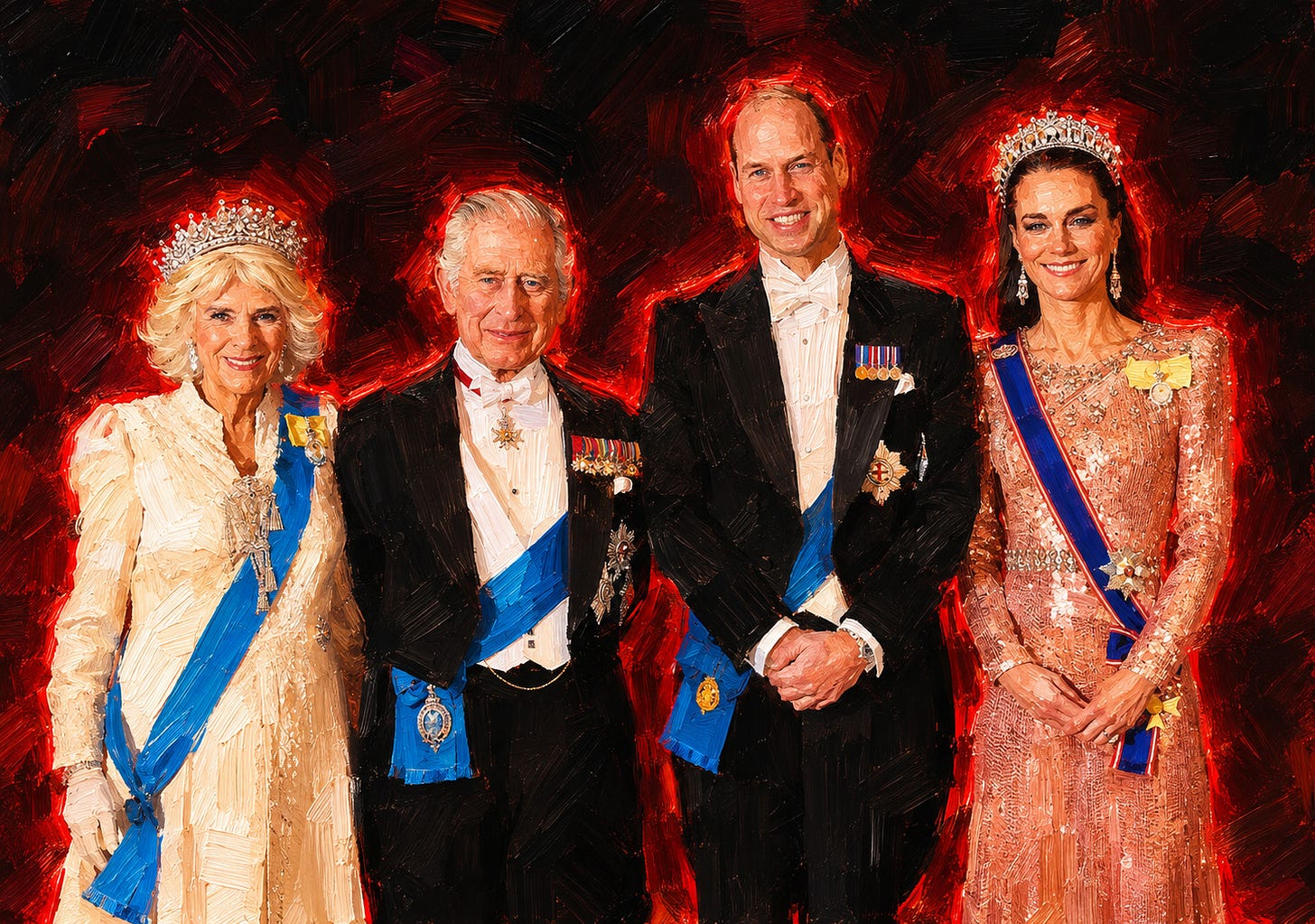
 From Charles’s tantrums to William joking about Robert Irwins python, the monarchy is getting the kind of viral publicity money can’t buy, just not for the reasons it would like.
For all the monarchy’s carefully managed public appearances, it’s often the moments that go spectacularly wrong that capture the public’s attention. As I discussed in my previous article about Charles and Camilla’s disastrous Caribbean tour, it took a missing umbrella and a visibly irritated King to generate the kind of viral attention that most of his official engagements could only dream of receiving.
Marketing and public relations agencies charge hundreds of thousands of pounds to help brands achieve widespread organic reach, with entire strategies built around capturing the public’s attention and dominating social media conversations. The royal family, meanwhile, achieves this spectacularly when Charles loses his temper over a leaking pen, Camilla appears to leave him stranded in the rain, or William and Kate unintentionally recreate scenes reminiscent of Britain’s colonial heyday.
The irony is that these are hardly the moments the palace would choose to promote, yet they are often the ones people remember.
💕 Buy me a coffee: https://www.buymeacoffee.com/onthegowithac 💕
Charles’s infamous pen incident in September 2022 is a perfect example. Having barely ascended the throne, the newly crowned monarch was filmed becoming increasingly frustrated with a leaking fountain pen during a visit to Northern Ireland, declaring that he couldn’t bear the thing before storming away. The footage spread across social media, generating enormous interest in a ceremony that most people probably wouldn’t have known was taking place otherwise.
It wasn’t his speech, his diplomatic interactions or the purpose of the visit that captured people’s attention. It was a grown man having a tantrum over stationery.
The same pattern repeated during William and Kate’s 2022 Caribbean tour, when images of the couple greeting Jamaican children through a wire fence and riding through the streets in a ceremonial Land Rover generated international headlines. The palace wanted to celebrate Commonwealth relationships, but the public conversation became dominated by colonial symbolism and questions about the monarchy’s relevance.
Even the Royal Reporters Know Where the Money Is
Perhaps the most revealing aspect of this entire spectacle is the behaviour of the royal reporting industry itself.
Princess Anne and Sophie, the Duchess of Edinburgh, regularly undertake public engagements and overseas visits, yet many receive relatively little mainstream coverage compared with the activities of the more commercially valuable royals. Tabloid journalism is a business first and foremost, and if a story isn’t generating clicks, attracting viewers or putting food on the table, how much incentive is there to cover it?
The irony becomes even more delicious when we consider Harry and Meghan. For a couple who are repeatedly described by sections of the British press as irrelevant, unpopular and supposedly finished, they certainly occupy an extraordinary amount of editorial space. Royal commentators who insist that the Sussexes have no significance appear incapable of going a week without discussing them.
If Harry and Meghan are so irrelevant, why does their every move warrant another article, another panel discussion and another outraged television segment? The answer is rather straightforward. They generate attention, and attention generates revenue.
The royal reporting industry has a vested interest in keeping the monarchy in the public consciousness, but even that industry cannot manufacture genuine public fascination with every ribbon-cutting ceremony and carefully staged engagement. Controversy, conflict and scandal provide far more compelling material, which creates the rather bizarre situation in which the monarchy’s most embarrassing moments can become its most commercially valuable.
Being Viral Isn’t the Same as Being Relevant
William’s recent appearance on The Graham Norton Show on October 23 was another interesting development, not least because it marked the first time a senior working royal had appeared as a guest on the popular BBC chat show. The Prince of Wales was there to promote his Earthshot Prize, but it was his rather cheeky interaction with 22-year-old conservationist Robert Irwin that attracted attention. After photographs of Irwin posing in his underwear with a snake draped around his neck appeared on screen, William quipped, “I’m still thinking about your python,” leaving Irwin blushing and burying his face in the sofa. While the studio audience erupted in laughter and some viewers praised William for showing a more relaxed, humorous side, others found the innuendo rather crass and unbecoming of a future king.
Personally, I find the timing of William’s sudden embrace of mainstream late-night entertainment particularly interesting, given how carefully managed and traditionally reserved his public image has been. There have already been suggestions that he is taking a leaf out of his younger brother’s book, with Harry having demonstrated how appearances on American talk shows can generate enormous publicity beyond the usual royal reporting circuit.
💕 Buy me a coffee: https://www.buymeacoffee.com/onthegowithac 💕
Whether William is deliberately following Harry’s example is impossible to establish, but the shift certainly raises questions about how the palace intends to market the future king to an audience that increasingly seems more interested in entertainment than royal engagements. After all, William appeared on the programme to discuss environmental innovation, yet it was a joke about another man’s python that generated some of the most memorable headlines. Once again, the spectacle threatened to overshadow the supposed purpose of the appearance.
Ultimately, I think the royal family is confronting a problem that no amount of palace public relations can entirely resolve. People may still be fascinated by royal scandals, marriages, feuds and embarrassing encounters, but fascination with celebrity drama is not the same thing as respect for an institution.
Someone sharing a video of Charles losing his temper over an umbrella is not necessarily expressing admiration for the monarchy. They might simply find it hilarious that a man who lives in a palace cannot cope with a minor inconvenience.
The palace can count headlines, social media impressions and television appearances, but those numbers tell us very little about whether the public actually believes the monarchy deserves its privileged position.
Even Trooping the Colour Is Facing Cutbacks
This brings me to another interesting development…..
It’s beeing reported that the Metropolitan Police will significantly reduce its policing of Trooping the Colour and other ceremonial events, transferring much of the responsibility to private security contractors.
The official explanation centres on budget pressures and the need to prioritise frontline policing, rather than a confirmed collapse in royal attendance, but the decision still raises interesting questions about the resources devoted to maintaining royal spectacle.
Trooping the Colour has long been promoted as one of the monarchy’s grandest annual occasions, with military pageantry, royal carriages, enormous public ceremony and the obligatory Buckingham Palace balcony appearance.
Yet recent images and footage have also shown protesters occupying prominent positions along The Mall, holding bright yellow anti-monarchy placards and challenging the carefully cultivated image of universal public adoration.
I remember the scenes from years gone by, when Harry and Meghan were still part of the royal institution and crowds appeared to stretch far down The Mall. At the June 2026 ceremony, William and Kate’s three children accompanied their mother in a carriage while anti-monarchy protesters booed and displayed placards. Some critics questioned the wisdom of placing the children in such a public-facing position when demonstrations were expected.
We cannot know whether their presence was intended to discourage protesters from booing, although I can certainly understand why that possibility was raised. If anything, it illustrates the increasingly uncomfortable reality of royal public appearances, where even the presence of children does not necessarily shield the institution from criticism.
For an institution whose survival depends heavily on symbolism, public perception and the willingness of people to continue accepting inherited privilege, that distinction matters enormously. The royal family may still be generating extraordinary publicity, but increasingly, it seems the public is watching for the wrong reasons.
They want to be revered as royalty, while much of the internet is treating them like reality television.