

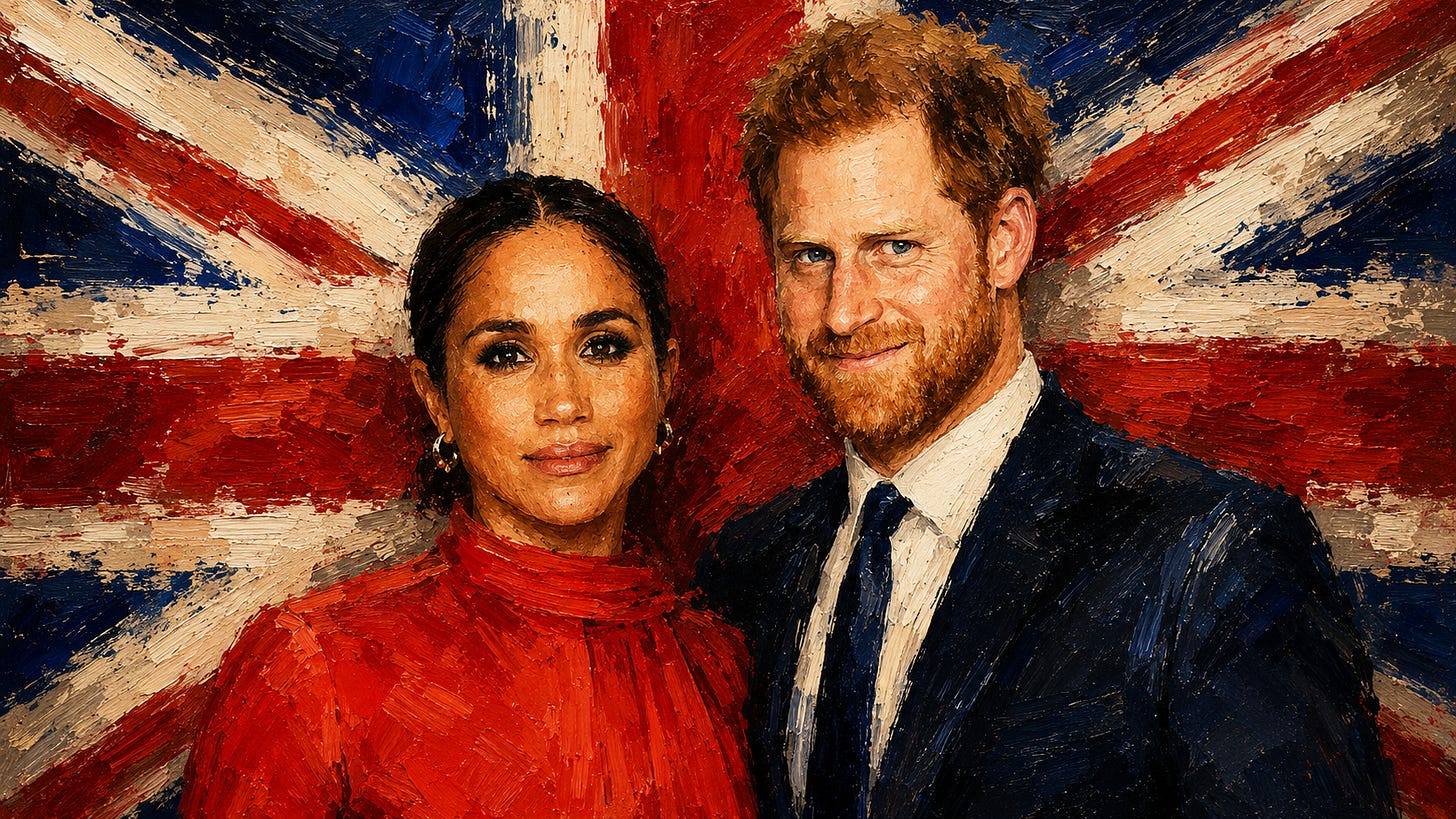
 Congratulations, Fleet Street. After six years of trying to make Harry and Meghan look foolish, you’ve only succeeded in clowning yourselves.
Well, I certainly did not have Harry and Meghan potentially returning to Britain on my 2026 bingo card. The reports have understandably sent royal watchers into overdrive, and the reaction from Sussex supporters has been particularly complicated. There is excitement, curiosity and perhaps even a little satisfaction, but there is also genuine concern, especially from people who supported Meghan through some of the darkest years of her time as a working royal. For many of us who watched what happened between 2018 and 2020, the immediate reaction is almost protective: after everything that happened to her in Britain, why on earth would she want to come back?
I completely understand that instinct. This is, after all, the country in which Meghan has said she experienced suicidal thoughts while pregnant. It is the country where she and Harry have repeatedly described feeling abandoned and unprotected by the institution that was supposed to support them, while sections of the British press subjected Meghan to a degree of obsessive scrutiny that became almost impossible to separate from cruelty. She was criticised for the smallest gestures, blamed for family dynamics she could not possibly have created alone and transformed from a woman marrying into the royal family into a national villain with extraordinary speed. There were moments when the coverage seemed less interested in anything Meghan had actually done than in finding a fresh reason to justify the hostility that had already been decided upon.
That is why I understand why some Sussex supporters are looking at these reports and thinking, Meghan, girl, are you sure? But having sat with it, I actually think there are several reasons to view this development very differently. Because Meghan would not be returning to Britain as the woman who left it. Harry and Meghan would not be returning as the defeated couple their critics spent six years predicting they would become. They would be returning having built an entire life outside the monarchy, financially independent of the institution and with the ability to enter and leave Britain entirely on their own terms. And that fundamentally changes the power dynamic.
For the Sussex Squaddies feeling nervous about Meghan returning to the country that treated her so appallingly, I understand the concern. But I also think there are some delicious silver linings here. And for everyone who spent the past six years predicting their downfall, humiliation and eventual crawl back to the royal institution? It might finally be time to eat crow.
Perhaps the most important silver lining is what Meghan’s willingness to return might represent about her own sense of agency. I do not want to make the mistake of claiming that returning to a place associated with trauma automatically proves somebody is completely healed. None of us knows Meghan personally, mental health is far more complicated than that and recovery does not arrive with a neat certificate declaring the past permanently conquered. But I do think there is something extremely significant about voluntarily walking back into an environment you once had to escape from when you now possess choices you did not have before.
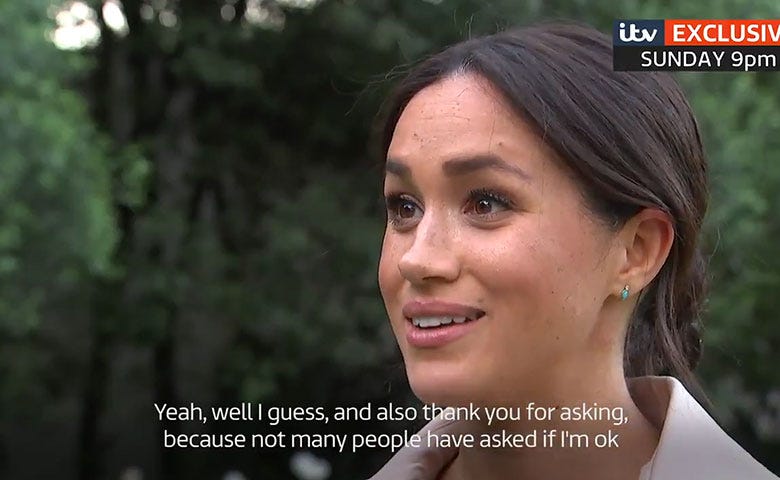
One of the most disturbing parts of Meghan’s account of royal life was the sense of powerlessness surrounding it. She entered one of the most famous institutions in the world, but also one governed by traditions, hierarchies, restrictions and relationships that had existed long before she arrived. She was suddenly operating inside an extraordinary system while being subjected to relentless outside scrutiny, and at the same time she did not appear to have complete control over how she responded publicly to that scrutiny. Imagine experiencing enormous hostility while simultaneously feeling that the normal tools available to ordinary people — defending yourself, correcting falsehoods, simply walking away — are not fully available to you. That is an incredibly different situation from returning years later because you have decided Britain can once again form part of your life.
The Meghan who could return in 2026 is financially independent from the royal institution. She has her own business interests, her own production work, her own professional network, her own employees, her own audience and a family home thousands of miles away that she can return to whenever she chooses. She would not be arriving as a newly married duchess trying to understand palace protocol while everybody around her held institutional authority she did not. She would not be dependent upon the palace for her income, accommodation, public role or identity. She would be coming back with an established life that exists perfectly well without the monarchy.
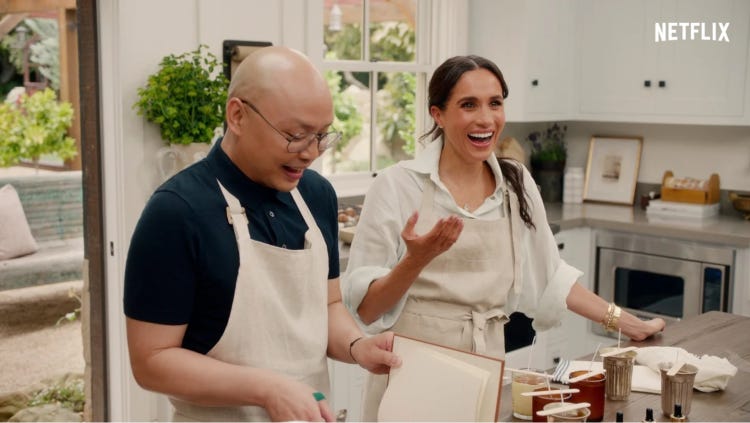
There is something powerful about revisiting somewhere that once represented your powerlessness after rebuilding yourself somewhere else. Sometimes the most satisfying form of closure is not avoiding a place forever; sometimes it is discovering that the place which once had such enormous emotional power over you no longer does. Meghan would not be returning because the palace summoned her, because Britain had become her only option or because she needed royal rehabilitation. She would be returning because she chose to. There is a substantial difference between being trapped inside the lion’s den and deciding years later that you are perfectly capable of walking past the lions without being afraid of them.
And that brings me to perhaps my favourite part of this story: Harry and Meghan would not be crawling back. They would be returning with receipts.
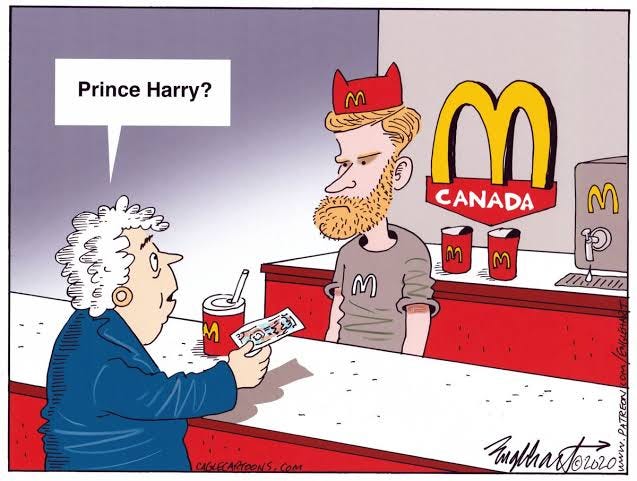
Remember what we were told when they left. Their critics did not simply predict that leaving royal life would be difficult; many of them seemed almost gleefully invested in the fantasy that it would become a spectacular disaster. We were told Hollywood would reject them, America would become bored with them, their money would eventually disappear, their marriage would collapse, their famous friends would abandon them and Harry would eventually arrive back at the palace gates looking suitably chastened after discovering that life without the monarchy was impossible. Meghan, naturally, would disappear into whatever cultural abyss her critics believed was waiting for an ambitious woman they intensely disliked.
That simply did not happen. Whatever anybody thinks of every individual Sussex project, they have spent the years since leaving royal duties creating a completely separate ecosystem around themselves. They established Archewell Productions, produced one of Netflix’s most discussed documentary series, released programmes and documentary projects, entered various commercial partnerships and built philanthropic initiatives independently of the royal household. Meghan has moved into entrepreneurship and investment, while Harry has continued building Invictus and maintaining his involvement with veterans’ causes and charitable organisations. They have undertaken international visits, cultivated relationships outside the traditional royal diplomatic network and demonstrated that their ability to attract global interest was not entirely dependent on standing on a palace balcony.
Have all of their ventures been runaway successes? Of course not. Some have performed better than others, some partnerships have ended and some ideas have failed to become what they initially appeared capable of becoming. Welcome to entrepreneurship. Nobody builds businesses, produces television, launches brands and experiments creatively for half a decade without having projects that work and projects that do not. The important distinction is between experiencing the normal successes and failures of building something and experiencing the total collapse that was confidently predicted for them. The latter never materialised.
That matters enormously because it destroys one of the most persistent fantasies surrounding a possible Sussex return: that Harry and Meghan would only ever come back because they had failed everywhere else. They have a home in California, businesses, professional relationships, international connections, personal wealth and a life that exists entirely independently of Britain. They are not trapped. They have options. In fact, the fact that they have options is precisely what makes a possible return so fascinating. Coming back because you have nowhere else to go is defeat. Coming back because you have built a life secure enough that you can now choose to have a relationship with Britain on your own terms is something completely different.
Then there is Invictus, which I think could become one of the most extraordinary pieces of symbolism in this entire story. When the Invictus Games come to Birmingham in 2027, Harry will be bringing one of the defining achievements of his adult life back to Britain. There is something almost cinematic about that. For years, Harry’s identity in sections of the British press has been reduced to the prince who left, the angry spare, the brother who abandoned royal duty or the man who supposedly threw away the extraordinary privilege of his birth. Invictus tells a far more complicated story because it is something he created, developed and helped turn into an international institution that exists far beyond the structures of palace life.
I have jokingly described Invictus Birmingham as Harry’s unofficial coronation, but there is actually something meaningful behind that phrase. Obviously it is not a royal coronation, nor would Harry presumably want it to be, but it could function as a coronation of the independent identity he has built beyond the Crown. He will be standing in Britain surrounded by veterans, competitors, families, international delegations, charities and global media because of something that exists because he helped create it. Nobody can strip him of that achievement, downgrade his place in a line of succession to diminish it or brief a newspaper into pretending it never happened. It is his legacy.
If Meghan stands alongside him at Invictus, the symbolism becomes even more potent. The couple who were repeatedly told that everything valuable about them came from royal proximity would be back in Britain at the centre of an international event that does not require them to be working royals at all. The monarchy may be part of Harry’s history, but it is no longer the sole source of his relevance. That is why Birmingham could feel less like a return to the world he left and more like the moment Britain is forced to see clearly what he built after leaving it.
There is also another uncomfortable truth that Harry and Meghan’s critics may finally have to confront: the demand for Meghan has never gone away. Whether she actually wants to make regular public appearances in Britain remains to be seen, and I personally hope she does exactly as much or as little as she feels comfortable doing. But pretending there is no appetite for Meghan is becoming increasingly absurd. The British media has spent years announcing that she is irrelevant while simultaneously generating an apparently endless stream of Meghan-related content. She posts a photograph and it becomes a story. She wears a dress and it becomes a story. She launches a product and it becomes a story. She goes quiet and her silence becomes a story. Her hairstyle becomes analysis, her friendships become analysis, her marriage becomes analysis, her business becomes analysis and at certain points even a jar of jam has managed to trigger national commentary.
This is apparently the world’s first irrelevant woman whose every move requires twelve opinion pieces.
Meghan has something the palace has never been able to manufacture through carefully choreographed engagements and polished communications strategies: she attracts extraordinary curiosity. Some of that curiosity is positive, some of it hostile and some of it simply fascinated, but the end result is attention.
That level of attention has always complicated royal dynamics because the monarchy is, among many other things, a public-facing institution whose relevance depends heavily on visibility. Meghan’s entrance into the royal family generated enormous international interest, and she often commanded front pages and global coverage that went far beyond traditional royal audiences. If she begins making appearances in Britain again — whether connected to charities, business, culture, Invictus or simply family life — that attention machine will immediately switch back on. The same newspapers that spent years insisting Britain had moved on from Meghan may suddenly discover that they cannot stop putting her on their front pages.
The British press, in particular, should perhaps think carefully about what happens next. I am not naive enough to believe Fleet Street has suddenly experienced some great moral awakening. British tabloids have survived countless controversies, scandals and accusations of excessive intrusion, and Meghan was certainly not their first target. But the wider British conversation about media pile-ons is changing, and recent events, including the disturbing debate following the death of Professor Jason Arday, have once again raised difficult questions about when legitimate scrutiny mutates into something darker. His death was not the first time Britain has been forced to consider the consequences of turning a human being into a national spectacle, and I unfortunately doubt it will be the last.
I am not suggesting Jason Arday’s death will magically transform tabloid culture, but there is a difference between accountability and an obsessive pile-on, and British media culture has repeatedly demonstrated how quickly one can morph into the other. Caroline Flack, Amy Winehouse and Princess Diana all became symbols, in very different circumstances, of what can happen when enormous sections of the press treat a person not simply as someone to report on but as a commodity whose distress generates circulation.
Editors should therefore be conscious of the public temperature if Meghan begins spending substantial time on British soil again. If the coverage immediately returns to the feverish, relentlessly hostile tone of 2019, there may now be more people prepared to look at it with fresh eyes and ask a very simple question: what exactly has this woman done to deserve this level of vitriol? Criticise her business decisions. Analyse her interviews. Question her public claims. Fine. But if every facial expression, dress, friendship, meal and family interaction once again becomes evidence in some sprawling prosecution of Meghan Markle’s character, it is going to look increasingly deranged.
And ironically, returning to Britain could give Meghan something she never really had during her brief years as a working royal: the chance for people to see her without the palace machinery sitting between them.
Distance has a strange way of freezing people into caricatures. For many Britons, Meghan is still trapped inside the character created during the royal crisis: the difficult duchess, the manipulative American, the Hollywood narcissist who somehow bewitched a grown man into abandoning his entire family and country. When somebody has been absent for years, those narratives can remain strangely preserved because there are fewer ordinary images available to contradict them.
But imagine Meghan living part of her life in Britain while not being part of the royal institution. Imagine seeing her attend charitable events, launch business projects, support Invictus, meet organisations, go out for dinner, raise her children and generally exist without every movement being framed through palace protocol. The more ordinary and competent her life appears, the more absurd some of the mythology built around her may start to look.
Perhaps people who dislike Meghan will continue to dislike her, but there is a significant difference between saying, “Meghan Markle isn’t my cup of tea,” and believing she is the uniquely destructive force parts of the British press spent years constructing. Time often exposes hysteria better than arguments do, and six years of distance may have created enough space for at least some people to reconsider their point of view.
Their return could also provoke uncomfortable questions about the monarchy itself, particularly if Harry and Meghan continue their humanitarian work while remaining financially independent private citizens. If the Sussexes can organise charitable initiatives, promote causes, attract international attention and raise money without receiving public funding for their lifestyles or official duties, people are entitled to compare that activity with the output of the working royals supported by the wider royal apparatus. It raises questions about what modern monarchy is supposed to provide in return for its enormous institutional privilege. How much attention can Harry generate for veterans through Invictus? How much money can Meghan help raise for organisations she supports? How much international visibility can the pair create without a taxpayer-funded communications machine? And if they are capable of doing those things independently, what exactly are we paying the rest of the institution to do?
Sometimes leaving somewhere does not mean you must never return. Sometimes leaving is precisely what allows you to return without fear. You remove yourself from the environment, rebuild your confidence, establish financial independence, create another home, remember who you were before everybody else started telling you who you were supposed to be and eventually discover that the door you once had to run through is now simply a door you can walk through whenever you please.
The people who wanted Duchess Meghan broken may now have to watch her walk back onto British soil beside the husband they repeatedly predicted would leave her, with the family they said would never last, the businesses they said would collapse and the international profile they insisted she would lose. For years, an entire anti-Sussex industry has operated on essentially the same promise: eventually Harry will regret leaving. Eventually Meghan will fail. Eventually America will reject them. Eventually the money will disappear. Eventually the marriage will implode. Eventually Hollywood will stop calling. Eventually Harry will crawl back to Britain and apologise for ever believing he could survive outside the royal family.
They have been waiting for a collapse for more than six years, perhaps, now, they should stop holding their breath.
Somewhere in a British newsroom, an editor who has spent six years publishing articles explaining that Meghan Markle is completely irrelevant is probably already planning tomorrow’s front page.
Congratulations, Fleet Street. After six years of trying to make Harry and Meghan look foolish, you’ve only succeeded in clowning yourselves.
💕 SUPPORT US 💕
➵ Donate to Pay Pal: https://www.paypal.com/paypalme/AnneMalambo
➵ Buy me a coffee: https://www.buymeacoffee.com/onthegowithac
➵ Become a channel member via buy me a coffee: https://www.buymeacoffee.com/onthegowithac/membership
➵ Become a channel member via Youtube: https://www.youtube.com/channel/UCpbm4lOq89kGbURh5XJt7gQ/join