

بِسْمِ اللهِ الرَّحْمٰنِ الرَّحِيْم.
In the Name of God, Most Gracious, Most Merciful.
♥️🤲🕋♥️🕋🌹🌹🥀🤲🌹🕋♥️🤲
The Fourth Imam: Ali ibn al-Hussein Zainul Abidin
The Survivor Who Carried the Light

Introduction: The Forgotten Hero
When we speak of Karbala, we speak of Imam Hussein. When we speak of the voice that refused to be silenced, we speak of Sayyida Zainab. But there is a figure who stands between them—a man who was there in the battle, there in the chains, there in the court, there in Egypt, and there under surveillance for the rest of his life.
He was the one who survived when all others fell. He was the one who carried the light of the Prophet's household when the world tried to bury it. He was the one who took on the weight of the entire family on his shoulders and represented them without making any excuses.
His name is Ali ibn al-Hussein, known as Zainul Abidin (The Ornament of the Worshippers) and al-Sajjad (The One Who Prostrates Much). He is the Fourth Imam, and he lived an incredible life—a life of patience, of prayer, of silent resistance, and of preserving the truth when the tyrants thought they had won.
Most people do not know what happened. They do not know that this man, standing in chains before the tyrant, was the grandson of Prophet Muhammad (peace be upon him). They do not know that he was the son of Imam Hussein, the son of Imam Ali, the son of Fatimah Zahra.
Who Was Ali ibn al-Hussein?
Ali ibn al-Hussein was born in Medina on Saturday, 15th of Jamadi-ul-Awwal, 36 AH. His mother was Shahr Banu, the daughter of Yazdgerd III, the last pre-Islamic ruler of Persia. His epithet was Abu Muhammad, and he was popularly titled as "Zainul Abidin."
He spent the first two years of his infancy in the lap of his grandfather, Ali ibn Abi Talib, and then for twelve years he had the gracious patronage of his uncle, the Second Imam, al-Hasan ibn Ali. He grew up in the household of the Prophet—a household of justice, truth, and courage.
The Tragedy of Karbala
In 61 AH, Ali ibn al-Hussein was present in Karbala at the time of the gruesome tragedy of the wholesale massacre of his father, his uncles, his brothers, his cousins, and all the godly comrades of his father. He witnessed the slaughter of his family and suffered a heartless captivity and imprisonment at the hands of the forces of Yazid.
When Imam Hussein had come for the last time to his camp to bid goodbye to his family, Ali Zainul Abidin was lying semiconscious in his sickbed and hence escaped the massacre in Karbala. Imam Hussein could only manage a very brief talk with the inmates of his camp and departed, nominating his sick son as the next Imam.
No Imam began his Imamat in a more tragic atmosphere. The first day of his Imamat saw him seriously ill and a captive of the army of Yazid in Karbala. His father and predecessor had sacrificed all he had on the altar of truth, and Imam Zainul Abidin found himself with a group of helpless widows and orphans being led from place to place—from the court of Ibn Ziyad to the court of Yazid.
The Captivity
When the brutal forces of Yazid's army took the ladies and children as captives, carrying them seated on the bare backs of camels, tied in ropes, this Holy Imam—though sick—was put in heavy chains with iron rings round his neck and his ankles and was made to walk barefooted on the thorny plains from Karbala to Kufa and to Damascus.
Even then, this godly soul never was unmindful of his prayers to the Lord and was always thankful and supplicative to Him.
He was brought before Ibn Ziyad and then before Yazid in Damascus. He spoke truth to power, even in chains. He introduced himself to the people and revealed the truth about what happened in Karbala. His sermon in the court of Yazid was a declaration that the oppressor's victory was temporary and that the truth would survive.
The Introduction That Shook the Court
Yazid had engaged in deception. He had surrounded himself with dignitaries, ambassadors, and religious leaders. He wanted to present the family of the Prophet as defeated, as powerless, as nothing.
But Imam Zainul Abidin outsmarted him.
When he was brought before the court of Yazid, surrounded by the elite of Damascus, he was asked:
"Who are you? Who are you? Who are you?"
And he answered in poetry.
He stood there—a young man of twenty-three, still recovering from illness, still grieving, still in chains—and he introduced himself in a way that no one could forget. He declared his lineage with such precision and such power that the very air of the court trembled.
Watch "Who Is Sayyedina Zain Ul Abideen? By Shaykh Ninowy" on YouTube
He began:
"Whoever recognizes me knows me, and whoever does not recognize me, let me tell him who I am and to what family I belong."
Then he declared:
"I am the son of Makkah and Mina; I am the son of Zamzam and al-Safa."
With these words, he placed himself directly in the sacred history of Islam. He was not just a captive. He was the son of the sacred city, the son of the holy well.
"I am the son of the one who carried zakat in the ends of the mantle."
This was a reference to his grandfather, Imam Ali—the one who gave charity while in ruku in prayer.
"I am the son of the best man who ever put on sandals and walked barefooted; I am the son of the best man who ever made tawaf around Ka'ba and Sa'i between Safa and Marwa; I am the son of the best man who ever offered the Hajj and pronounced talbiya."
He was not describing himself. He was describing his grandfather, the Prophet. He was saying: My lineage is the lineage of the Prophet. My blood is the blood of the Prophet.
"I am the son of the one who was transported on the Buraq in the air; I am the son of the one who was made to travel from the Sacred Mosque to the Remote Mosque, so Glory belongs to Him who made His servant travel."
This was the Isra and Miraj—the night journey of the Prophet. He was reminding them that his grandfather was the one who was taken to the heavens, the one who spoke to Allah, the one who led the angels in prayer.
"I am the son of Muhammad al-Mustafa; I am the son of Ali al-Murtaza."
With these words, he declared his identity in the clearest possible terms: I am the son of the chosen one. I am the son of the beloved. I am the son of the one whom you claim to follow.
"I am the son of the one who struck the enemy with two swords before Allah's Apostle, emigrated twice, pledged allegiance twice, prayed in the two Qiblas, and fought at Badr and Hunayn and never disbelieved in Allah not even as much as the twinkling of an eye."
This was his father, Imam Ali. The first to believe. The one who never wavered. The one who fought alongside the Prophet in every battle.
"I am the son of Fatima, the chaste and Mistress of the women. I am the son of the Purified. I am the son of the part of the Messenger. I am the son of the one who was covered with blood. I am the son of the one who was slaughtered at Karbala. I am the son of the one for whom Jinn wept in the dark, and for whom the birds cried in the air."
When he finished his introduction, the court was silent. He had just declared to everyone present that he was not a nobody. He was not a defeated captive. He was the grandson of the Prophet Muhammad (peace be upon him). He was the son of Imam Hussein. He was the heir to the greatest lineage in history.
And then, when Yazid ordered the Adhan to be recited, the Imam repeated every part. When the Muaddhin said,
"Ashhadu anna Muhammadan Rasool Allah" (I bear witness that Muhammad is the Messenger of Allah),
the Imam turned to Yazid and asked:
"Yazid, is Muhammad your grandfather or mine? If you say that he is yours, then you are a liar, and if you say that he is mine, then why did you kill his family?"
The question hung in the air like a sword.
There was no answer.
There could be no answer.
The Silent Revolution
After spending a period in imprisonment, Imam Zainul Abidin was sent with honor to Medina because Yazid wanted to conciliate public opinion. But upon returning to Medina, he retired from public life completely, closed the door of his house to strangers, and spent his time in worship.
This was not surrender.
This was strategy.
The heartless tyrant al-Hajjaj ibn Yusuf ath-Thaqafi was threatening everyone who professed allegiance or devotion to the Ahlul Bayt, and those caught were mercilessly put to death. The movement of the Holy Imam was strictly restricted, and his meeting with any person was totally banned. Spies were employed to trace out the adherents of the Ahlul Bayt. Practically every house was searched and every family scrutinized.
Imam Zainul Abidin was not given the time to offer his prayers peacefully, nor could he deliver any sermons.
So he adopted a third course which proved to be very beneficial to his followers.
He compiled supplicative prayers for the daily use of man in his endeavour to approach the Almighty Lord.
The invaluable collection of his edited prayers is known as Sahifa-e-Kamila or as-Sahifah as-Sajjadiyyah—known also as the Psalm of the Household of the Prophet.
Through these prayers, the Imam gave all the necessary guidance to the faithful during his seclusion.
The Sahifa Sajjadiyya
The Sahifa Sajjadiyya is an invaluable treasury of wonderfully effective supplications to the Lord in inimitably beautiful language.
Only those who have ever come across those supplications would know the excellence and the beneficial effect of these prayers.
The collection of prayers contains deep Quranic concepts, treasures of mysticism, and several disciplines of knowledge.
It covers social and political prayers, supplications for daily needs, deep theological reflections, and moral guidance.
When this book was shown to Egyptian scholars, they were thunderstruck and awed by its beauty. They were amazed and stunned by the purity of thought and perfection of character to which this book irresistibly leads its reader.
The Treatise on Rights
Imam Zainul Abidin also authored the Treatise on Rights (Risalat al-Huquq)—a timeless reflection on justice, duty, and human dignity.
This powerful text outlines a holistic framework of rights and responsibilities that remains deeply relevant in today's complex moral and legal landscape.
He wrote about the rights of God, the rights of the self, the rights of others, and the rights of society.
This was not just a spiritual guide—it was a constitutional framework for justice.
Uniting the Community Through Sorrow
Imam Zainul Abidin understood the psychology of unity.
He knew that philosophical exhortations and joyous functions could not unite the community as effectively as shared sorrow.
He selected the method of mourning to bind the community together.
He continued to weep for his father until his eyes were endangered.
Whenever he took water to drink, he wept till the tears filled the pot.
Someone talked to him about it, and he replied:
"Why should not I cry, when my father was denied the water which was free to the beasts and animals?"
When food was brought to him, he wept so much that a servant told him:
"May I be your ransom, O Son of the Messenger of Allah! I am afraid that you would die of this weeping."
The Imam said:
"I only complain of my distraction and anguish to Allah. Never do I remember the massacre of the children of Fatimah but that tears strangle me."
This was not just personal grief.
This was a way to keep the memory of Karbala alive.
The mourning sessions became the best-organized, well-attended gatherings, where the participants willingly learned the basic tenets of faith and were exhorted to emulate the way of life of Ahlul Bayt.
The Hidden Charity
Imam Zainul Abidin lived for about thirty-four years after his father.
For most of that time, he was under surveillance.
The Umayyads tried to bury the family of the Prophet, but he was able to take on that light and free people to do the work.
He could not deliver sermons.
He could not openly teach.
But he found a way.
He carried bags of flour and bread on his own back at night for the poor and needy families in Medina and maintained hundreds of poor families in the city.
His charity was unassuming and hidden.
After his passing away, the people said that hidden charity ended with the departure of this Holy Imam.
He was in contact only with the elite among the followers, such as Abu Hamzah ath-Thumali and Abu Khalid Kabuli.
The elite disseminated among the people the religious sciences they learned from the Imam.
In this way, the teachings spread considerably and showed their effects during the time of the Fifth Imam.
The Martyrdom
On the 25th of Muharram 95 AH, when he was in Medina, al-Walid ibn Abdul Malik Marwan, the then ruler, got this Holy Imam martyred by poison.
The funeral prayers for this Holy Imam were conducted by his son, the Fifth Imam, Muhammad al-Baqir, and his body was laid to rest in the cemetery of Jannatul Baqi in Medina.
He died at the age of fifty-eight.
The Establishment of the Fourth Office
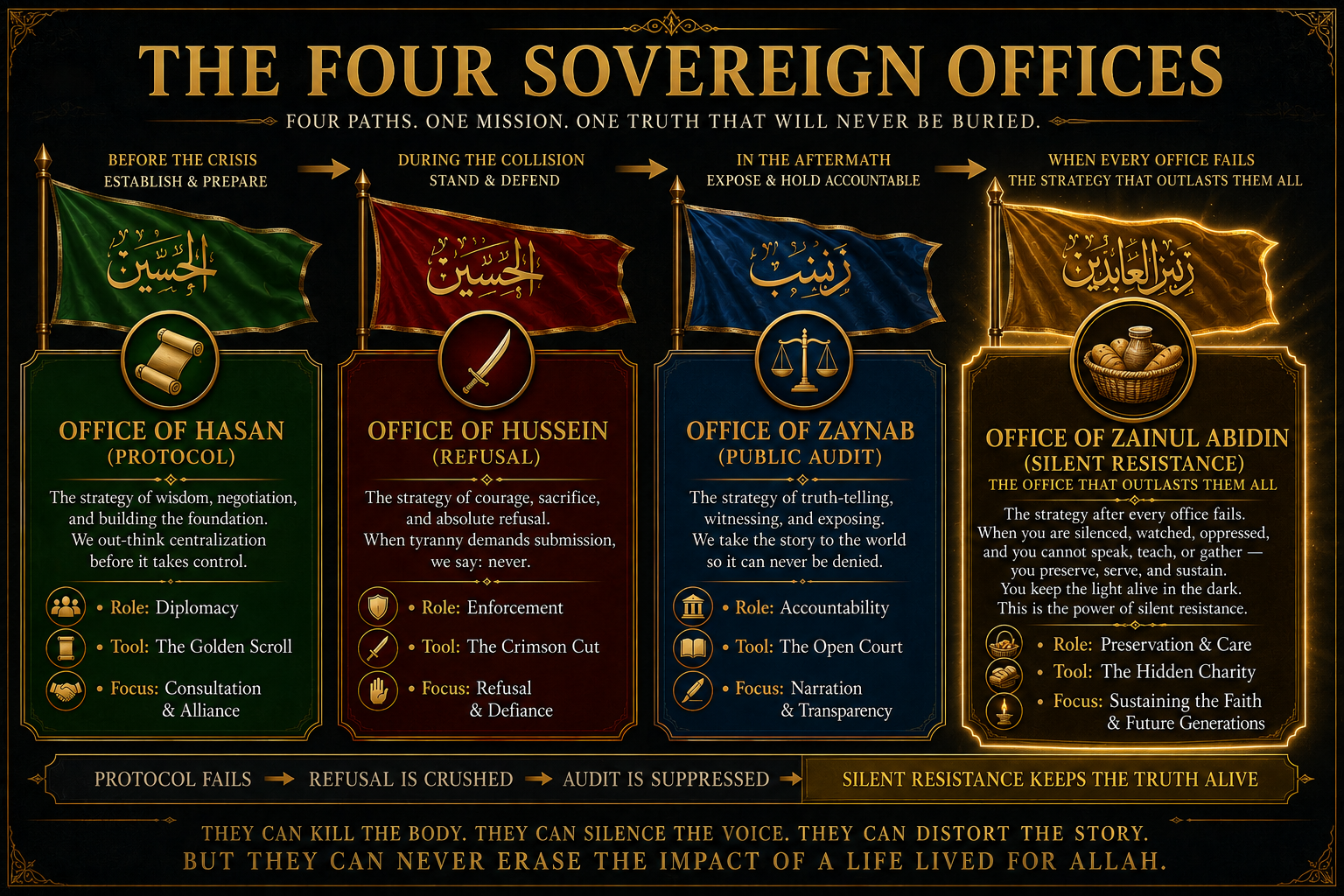
The story of Imam Zainul Abidin teaches us that history does not end when the battlefield grows quiet. It does not end when the tyrant declares victory. It does not end when the prisons are full, the scholars are watched, and every public voice has been silenced. Sometimes the greatest work begins only after every visible form of resistance has been broken.
This was the world he inherited after Karbala. There was no army left to command. There was no public platform from which to teach. There was no freedom to organize openly. Every movement was watched, every gathering was suspected, and every supporter of the Ahlul Bayt lived under the shadow of persecution. Yet he refused to surrender to despair.
Instead, he chose another path.
He transformed worship into education. He transformed prayer into preservation. He transformed hidden charity into leadership. While the rulers believed they had extinguished the light of the Prophet's family, Imam Zainul Abidin quietly ensured that the light would continue burning from one generation to the next.
This is why the Fourth Office must stand last.
It is not the office that begins the struggle. It is the office that survives it.
When diplomacy can no longer negotiate, when resistance has been crushed, and when public testimony is censored, the work of Zainul Abidin begins. His office exists so that truth can survive periods of fear, surveillance, and oppression without ever disappearing.
His revolution was not loud. It was patient. It was disciplined. It was compassionate. He fed the hungry in secret. He strengthened hearts through prayer. He preserved knowledge through his supplications and his teachings. He rebuilt a civilization one soul at a time until the conditions were ready for renewal.
That is why the Office of Zainul Abidin is the Office of Silent Revolution. It is the office that preserves faith when institutions collapse, protects truth when speech becomes dangerous, and carries hope through the darkest chapters of history.
The Four Sovereign Offices now form one complete architecture.
Hasan establishes the foundation.
Hussein refuses injustice.
Zaynab exposes the truth.
Zainul Abidin preserves the light until the world is ready to receive it again.
Together they teach us that truth is not defended by a single act of courage but by a complete civilization of courage—before the crisis, during the crisis, after the crisis, and through the long years that follow.
The tyrants may believe they have won.
History tells a different story.