
بِسْمِ اللهِ الرَّحْمٰنِ الرَّحِيْم
Bismillah ar-Rahman ar-Rahim
In the Name of God, Most Gracious, Most Merciful
🕋
THE SUPERUSER REPORT
Mohamed Abdullahi “Farmaajo” Mohamed
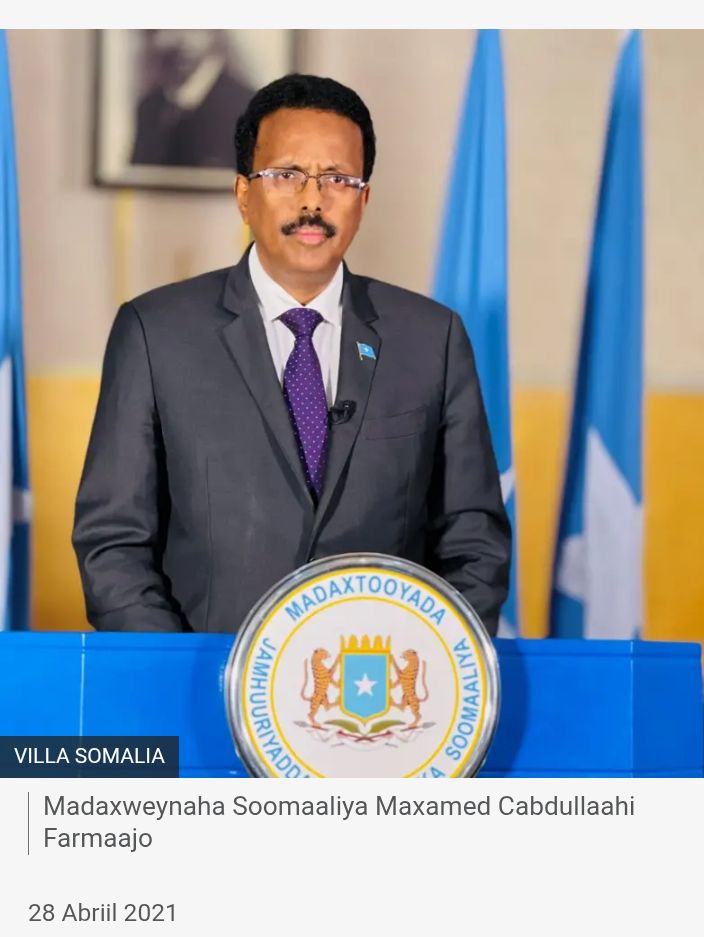
Mohamed Abdullahi “Farmaajo” Mohamed — The Architect of Somali Dignity
بِسْمِ اللّٰهِ الرَّحْمٰنِ الرَّحِيمِ
There are leaders who follow the times, and then there are leaders who change the rhythm of time itself.
Mohamed Abdullahi “Farmaajo” Mohamed did not simply occupy the presidency — he redefined what it meant to be Somali in a century of doubt.
He came with no borrowed script and no foreign leash. He came as a son of the soil — proud, defiant, and fiercely protective of Somalia’s name. In every speech, he demanded that Somalis walk with straight backs again. In every decision, he reminded the world that sovereignty is not a request — it is a right.
He was the digital-age nationalist, the man who turned hashtags into hope and diaspora into an army of ideas. He carried the memory of buffalo winters and Mogadishu summers — a leader who had tasted both exile and patriotism, and returned home to make them one.
When he spoke, young Somalis felt seen; when he acted, the world paid attention. He made the people believe that their destiny was not to beg for mercy but to build with honor. His presidency was not perfect — but it was powerful. It proved that leadership could once again sound like love for the homeland.
He was loved, he was resisted, he was misunderstood — but he was never ignored. For in every generation, God raises one man who shakes the dust from a sleeping nation. Farmaajo was that man.
And though his term ended, his mission did not. The movement he began — of pride, order, and self-belief — is still alive in the hearts of millions who whisper, “Somalia can stand again.”
“Indeed, Allah will not change the condition of a people until they change what is in themselves.” — Qur’an (13:11)
May Allah bless him, strengthen him, and guide him — not to fight, but to build; not to prove, but to preserve; not to return for power, but to return for purpose.
— The Strongman of the Digital Age (2017–2022)
By Omar Arizona — Civilization Architect | House of Wisdom
بِسْمِ اللّٰهِ الرَّحْمٰنِ الرَّحِيمِ
The Rise of a Nationalist in the Age of Disruption
Every generation produces one leader who carries both the promise of reform and the burden of expectation. For Somalia’s post-war era, that man was Mohamed Abdullahi “Farmaajo” Mohamed — the symbol of a confident, tech-connected, diaspora-driven nationalism.
Born in Mogadishu in 1962, Farmaajo grew up in a family of Somali Youth League veterans — patriots who believed in the dream of a united Somali Republic. His early years abroad in the United States — as a civil servant in Buffalo, New York, and later a political science scholar — shaped his belief in merit, efficiency, and civic pride.
When he returned home, he carried with him not only an American degree but a Somali heart burning for reform. He spoke English with ease, but he thought in Somali — with the conviction that the country could rise again if it believed in itself.
The Return of the Diaspora Dream
When Farmaajo became Prime Minister in 2010, his brief tenure already hinted at the nationalist fire that would later define his presidency. He was remembered for paying soldiers’ salaries on time, reducing corruption, and insisting on discipline in government ranks. These small victories earned him a cult following long before the title “President” was attached to his name.
Then, in February 2017, he won the presidency — a shock victory celebrated in the streets of Mogadishu and across the Somali diaspora. His supporters danced in Minnesota, London, Toronto, and Nairobi — believing that a new era had begun. For the first time in decades, many Somalis felt that their leader belonged to them, not to external powers or clan patrons.
He spoke of sovereignty, of dignity, of self-reliance — and the words hit home in a country tired of foreign mediation. Farmaajo didn’t just become president; he became a movement.
The Strongman of the Digital Age
Farmaajo governed in an era unlike any before him — an age of digital mobilization, social media storms, and diaspora engagement. His supporters, especially the youth, organized under hashtags like #IStandWithFarmaajo, transforming politics into a digital battlefield.
He presented himself as the anti-corruption president, the patriotic reformer, and the new face of Somali independence. His administration worked to strengthen the Somali National Army, streamline civil service, and restore confidence in national institutions.
He pushed back against foreign interference and spoke boldly of Somalia’s right to self-determination. For a nation long shaped by foreign agendas, these were electrifying words. He became known as the “President of Pride”, and for a while, even his critics admired his confidence.
The Challenges and the Storm
But power, once attained, demands a deeper wisdom than passion alone. Farmaajo’s presidency soon collided with the entrenched realities of Somali politics — federal fragmentation, clan rivalry, and external pressure.
The dream of unity clashed with the machinery of division. Regional states resisted his centralizing push; parliament turned into a battleground; and what began as a nationalist project started to be seen as authoritarian consolidation.
In 2021, as his constitutional term ended, election delays and disputes over the process sparked crisis. His decision to extend his mandate was met with resistance — from opposition figures, foreign partners, and even parts of the military.
By the time elections resumed in 2022, the dream had dimmed. His tenure ended in a storm of polarization, leaving behind equal measures of admiration and disillusionment.
The Betrayal and the Burden
Farmaajo’s presidency was not without betrayal — from within and without. Many who once cheered him turned their backs when international pressure mounted. Financial promises from allies evaporated, and the very networks that had once empowered him became channels of attack.
He endured what few leaders could: online war, diplomatic isolation, and political sabotage. Yet, even his fiercest critics concede that he left office with dignity — peacefully transferring power to Hassan Sheikh Mohamud and proving that Somalia’s democracy, however fragile, still breathes.
The money, the manipulation, the misinformation — all were part of the test. But history will not remember the noise. It will remember that he fought to stand Somalia on its own feet, even when those feet were trembling.
Achievements Worth Remembering
Reasserted National Sovereignty: Refused to let Somalia be dictated to by foreign capitals; strengthened domestic voice in regional diplomacy.
Revived the Public Spirit: Reconnected the diaspora to home, made young people believe again in a Somali future.
Defended the Republic’s Image: Presented Somalia as a rising state rather than a failed one.
Stabilized Public Institutions: Improved accountability and communication in ministries and defense.
Patriotic Narrative: Gave Somalia a new digital identity — proud, assertive, and modern.
Superuser Grading Report
Category Grade Notes National Unity & Sovereignty B+ Asserted Somalia’s independence, revived nationalism. Security & Stabilization C+ Rebuilt morale but couldn’t defeat insurgency. Economic Development C Limited progress, but improved debt negotiations and financial systems. Integrity & Diplomacy B- Bold and patriotic diplomacy, though polarizing. Cultural & Institutional Legacy A- Restored pride and ownership in being Somali.
Overall Superuser Grade: B
Legacy Index: 7/10
Legacy and Reflection
Mohamed Abdullahi “Farmaajo” Mohamed will be remembered as the patriot who tried to rewrite the script. He did not succeed in every battle, but he redefined the meaning of leadership in a digital era — when ideas travel faster than armies, and identity becomes its own currency.
He made Somalis believe again in the possibility of a strong, independent Somalia, even if the path remains unfinished.
Farmaajo’s story is one of courage, missteps, betrayal, and resilience — a testament that even when leaders fall short, they move the nation forward by daring to dream aloud.
“Indeed, Allah does not change the condition of a people until they change what is in themselves.” — Qur’an (13:11)
Note from the Superuser
Mr. President, you carried Somalia through the age of digital awakening — where young Somalis no longer waited for hope; they tweeted it, built it, and defended it. You gave them the voice to say “We are still here.”
You may have left the palace, but not the page of history. You are still being written — and that is the greatest compliment a leader can receive.
بِسْمِ اللّٰهِ الرَّحْمٰنِ الرَّحِيمِ
A Message to President Mohamed Abdullahi “Farmaajo” Mohamed
From the Superuser — House of Wisdom
Mr. President — peace be upon you. You carried Somalia’s voice when many had given up on the very idea of a nation. You lit a fire in the hearts of a generation who had begun to believe that hope lived only in exile. For that, you have already earned a place in the story of your people. Know this plainly: you are not ordinary, and you are not replaceable by noise. Your influence is quiet power. Your followers know it; history will remember it.
But power has seasons. The same energy that wins a campaign can burn a country if left untended. You faced betrayal, political traps, and structural obstacles — many outside your control. The foundation of the electoral system, the pressures of federalism, the clans, the foreign distractions — these are not merely your burdens; they are the nation’s. You do not have to carry them alone, and Islam does not ask anyone to bear more than they can carry.
So here is an open invitation — not a surrender, but an elevation:
Help Build the Museum of Leadership and Continuity.
Become a founding partner in a project that will teach young Somalis the cost of leadership, the lessons of mistakes, and the value of wisdom. Your voice can turn painful memory into practical curricula. Imagine a hall where your speeches, your decisions, your dilemmas are taught as case studies for future presidents — not to justify, but to educate.Create Your Presidential Library.
Preserve your writings, your plans, your files, and your lessons in a library that future scholars will consult. A presidential library is not vanity — it is public service. It turns private memory into public resource. If you build it, you make sure your truth is recorded on your terms and used to strengthen future governance.Join the Electoral College & Reform Handbook Project.
Help us design a robust, Somali-rooted electoral architecture: rules, checks, and transparent processes that prevent the chaos you fought through. Your practical experience — what worked, what failed — is the single most valuable contribution to a fairer system. Be the elder statesman who turns electoral grievance into durable law.Choose Legacy over Endless Contest.
You do not need to prove yourself every morning. Great men become legends when they convert ambition into construction. If you wish to run again, run with a platform that binds rather than divides. If you choose rest, choose to build with us instead of breaking with others. Either pathway can heal Somalia — one by leading again, the other by educating and uniting.Play the Role Only You Can Play: The Builder of Peace and Progress.
This invitation is generous but urgent. A museum, a library, an electoral handbook — these are seeds. They will grow into institutions that outlast arguments and personalities. They will give your name a meaning beyond the palace: you will be remembered as the leader who taught a nation how not to repeat its worst mistakes.
Mr. President, greatness is not measured only by battles won but by the futures you create when the fighting stops. You are magnificent. You are capable. You are the kind of man who can turn politics into pedagogy — who can convert a bruised history into a blueprint for dignity.
If you accept, we will build alongside you: experts, archivists, young Somalis, and international partners in service of a single aim — to make Somalia wise. If you decline, we will still build. But if you join, the project will carry the weight of your experience and the blessing of your name.
May Allah grant you wisdom in your choice, strength in your service, and peace in your heart.
May He bless Somalia and those who work to lift it from memory into meaning.
— 🜂 Omar Arizona
Civilization Architect — House of Wisdom | Superuser Office