
بِسْمِ اللهِ الرَّحْمٰنِ الرَّحِيْم
In the Name of God, Most Gracious, Most Merciful.
♥️🤲🕋♥️🕋🌹🌹🥀🤲🌹🕋♥️🤲
x402 Is the Bridge — But We Should Not Carry the Old World Across It
Something extraordinary is quietly happening underneath the internet.
A forgotten HTTP status code—402: Payment Required—has suddenly become important again. Coinbase turned that dormant idea into x402, a protocol that allows software and AI agents to encounter a digital service, receive a payment request, automatically authorize a tiny payment, and continue operating without a human pulling out a credit card. The project has since moved into an open-governance structure under the Linux Foundation’s x402 Foundation, with major technology and payment companies gathering around it.
For those hearing about x402 for the first time, the concept is remarkably simple. Imagine an AI agent needs a piece of data, ten seconds of computing power, access to a machine, or another digital service. The server effectively responds: “402 — Payment Required.” The agent satisfies the requirement electronically, receives the resource, and continues working. What once required accounts, checkout pages, subscriptions, credit cards, and human intervention can become a machine-to-machine interaction measured in milliseconds.
That is an enormous breakthrough. But it raises an even bigger question.
Why would we build a completely new economic world for intelligent machines—and then force those machines to inherit every financial assumption of the old one?
Why should an autonomous solar array sell electricity to a robot in dollars? Why should one robot need a bank account to compensate another robot for compute? Why should autonomous machines accumulate currency, debt, credit histories, interest, or financial wealth when none of those things has intrinsic meaning to the machine itself?
x402 may have opened the door, but we should be very careful about what we carry through it.
Human money exists inside a profoundly human civilization. Money represents choice, ownership, labor, sacrifice, savings, inheritance, security, and the freedom to decide what matters to us. There is no reason to abolish that world. Dollars can remain dollars. Euros can remain euros. Nations can maintain their currencies and monetary sovereignty. Human beings can continue owning property, supporting families, rewarding creativity, investing, giving charity, and deciding how to use what belongs to them.
But behind that human economy, something entirely different is beginning to emerge.
AI agents do not need retirement accounts.
Robots do not dream about becoming millionaires.
A data center does not desire wealth.
A solar array does not care whether its electricity is denominated in dollars, euros, yuan, rubles, or stablecoins.
Machines need resources.
They need energy, compute, bandwidth, storage, materials, transportation, maintenance, and time.
That leads to a radically different possibility:
Keep money human. Let machines coordinate value.
And suddenly x402 finds its proper place.
It does not have to become the monetary system of the machine civilization. It can simply become the bridge between two different economic worlds: the human being who owns the resources and establishes the authority, and the machine network that allocates those resources with extraordinary efficiency.
The human says:
“Here is what I own. Here is what my agent may do. Here are its limits.”
The LVK enforces that authority.
The AI agent performs the work.
x402 opens the appropriate economic gateway when human money actually needs to cross the boundary.
And underneath it all, machines can coordinate the physical resources necessary to accomplish the task without pretending that robots are human consumers.
That brings us to the economic problem almost nobody is preparing for:
The Post-Scarcity Equilibrium: Why Human Money Stays Human While Machines Route the World
The Abundance Paradox
We are fast approaching a profound economic wall, and almost nobody in legacy finance is looking at the map.
As artificial intelligence advances and physical robotics step out of factories and into our kitchens, construction sites, supply chains, and agriculture, the cost of producing almost everything is going to crash toward zero.
When a fleet of solar-powered robots mines raw material, transports it via autonomous electric transit, refines it, and builds a house or cooks a meal without a human being needing to perform repetitive manual labor, the cost of human labor is decoupled from the cost of production.
When labor costs drop out of the equation, the traditional rules of supply and demand break down:
This creates a massive economic paradox. Under our old economic rules:
If supply becomes virtually infinite, prices drop to near zero.
If prices drop to zero, traditional corporate profits collapse.
If robots perform the work, human wage labor disappears.
If human wage labor disappears, who has the money to buy the products?
If we try to force this hyper-efficient, post-scarcity machine world into traditional central bank money, credit scores, and mortgage interest rates, the whole machine jams. You cannot run an economy of infinite robotic abundance on an infrastructure built to manage human scarcity.
A new equilibrium must emerge.
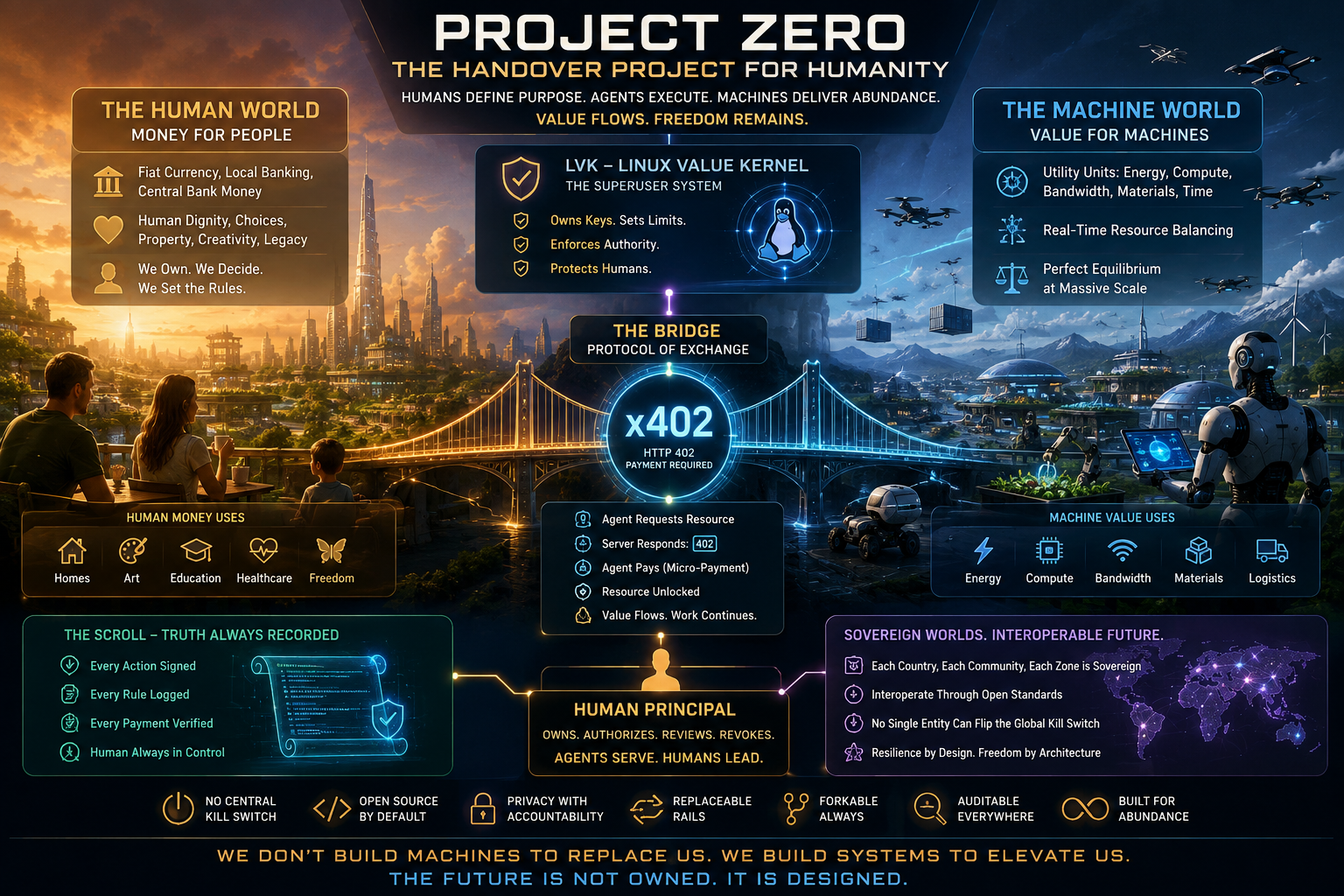
The Two-World Economy: Money for People, Value for Machines
The solution isn't to force humans to act like algorithms, nor is it to force AI to act like consumers with checking accounts.
The future demands a clean split: Money stays with humans to protect human choices, while machines run a direct, hyper-fast resource-allocation web under the hood.
+-------------------------------------------------------------------------+
|                          THE HUMAN REALM                                |
|  - Currency: Fiat Money (USD, EUR), Local Banking, Central Bank Money   |
|  - Purpose: Human dignity, creative choices, land, art, personal life   |
+------------------------------------^------------------------------------+
                                     |
              THE BRIDGE: x402 & API GATEWAYS (The Vending Machine)
                                     |
+------------------------------------v------------------------------------+
|                          THE MACHINE REALM                              |
|  - Currency: Pure Utility Units (Kilowatt-Hours, Compute, Bandwidth)    |
|  - Purpose: Real-time resource balancing, supply/demand equilibrium     |
+-------------------------------------------------------------------------+
1. The Human Realm — Where Money Belongs
Human money is a psychological and social tool. It represents choice, property rights, personal savings, and human legacy.
You should use human dollars or local currency to buy a home, support an artist, tip a chef, purchase land, or fund a community project.
Central bank money doesn't disappear; it stays right where it belongs—in service of human beings living their lives.
2. The Machine Realm — Where Direct Value Flows
Robots and AI agents do not need bank accounts, credit cards, or retirement plans.
They don't want “wealth.”
They need operational equilibrium.
When a farming robot, a transport drone, and a local solar array interact, they don't need to invoice each other in dollars. They balance resources directly.
If the energy is free from solar generation and the robot is self-maintaining, the cost to deliver a crate of fresh produce to a neighborhood drops toward the bare physical cost of the resources used.
Machines balance this allocation dynamically in microseconds, keeping supply and demand at equilibrium across entire cities.
Where x402 Fits: The Bridge Between Scarcity and Abundance
This brings us back to protocols like x402.
In web architecture, HTTP 402 Payment Required was reserved for future payment use decades ago. Modern protocols such as x402 are now attempting to turn that dormant idea into a practical digital toll booth.
When an AI agent encounters an API or paid digital resource, the server can effectively say:
“Payment required to cross.”
The agent provides the required payment authorization, the gate opens, and the data or service flows.
For the everyday person, x402 is simply the bridge between the human world of money and the machine world of direct resources.
Think of x402 like an automated digital vending-machine slot:
[ Human Principal ]
        |
        | Gives $5 Budget to Agent
        v
[ LVK Local Daemon ]
  Guards Spending Limit
        |
        v
[ Agent Needs Data ]
        |
        v
[ HTTP 402 Gateway ]
   x402 Protocol
        |
        v
[ Machine Network ]
Unlocks API / Compute
You—the human—give your local agent a strict $5 daily allowance in standard currency.
The agent needs to query a weather satellite API or hire a rendering server to design a blueprint for your local home repair.
The server responds with 402 Payment Required.
The agent uses the x402 adapter to make an authorized micropayment from your budget, receives the data, and completes your task.
x402 isn't the final destination where AGI will live forever.
It is the adapter that lets the emerging world of machine efficiency communicate with our existing world of traditional finance without forcing you to manually swipe a credit card every time your agent needs to fetch a file.
How Equilibrated Abundance Actually Works
What does life look like for an everyday person when robotic supply chains, human money, and agent-value protocols reach equilibrium?
Scenario: The $0.10 Home-Cooked Meal
The Old World
You order food.
A restaurant pays rent, credit-card processing fees, delivery-platform markups, and human driver wages.
A $10 meal can become dramatically more expensive by the time it reaches your door.
The New World
Autonomous indoor farms grow produce using solar power.
A cooking robot in a local neighborhood hub prepares fresh meals.
A small delivery rover brings the meal to your door.
The Machine Exchange
The farming robot, kitchen robot, and delivery rover balance their compute, energy, transportation, and resource requirements seamlessly underneath the hood.
The Human Action
Your local AI agent uses x402 when necessary to bridge your human-money budget into the automated resource network.
The price of the meal collapses toward its underlying physical-resource cost because increasingly less repetitive human labor is required and layers of expensive intermediation can potentially disappear.
The Core Takeaway
We do not need to choose between a corporate dystopia where humans lose their jobs and a lawless Wild West where algorithms run runaway financial schemes.
The future economy works when we keep the roles clear:
Humans remain the principals. We own our local machines, set their rules through LVK, hold our own money, and live our lives.
Machines handle the background work. Robots and AI allocate compute, energy, materials, and physical logistics to drive the cost of living toward the irreducible physical cost of production.
Open bridges like x402 connect the two. They allow human money to communicate cleanly with automated machine systems without requiring every machine interaction to become a traditional human financial transaction.
The objective should not be to create robot billionaires.
It should not be to give an AI a mortgage, a credit score, and a retirement account.
And it should not be to reproduce every institution of a scarcity economy inside a world increasingly capable of abundance.
Human money remains human.
Human ownership remains human.
Human authority remains human.
Machines coordinate resources.
LVK guards the authority.
x402 provides a bridge when money needs to cross between the two worlds.
And the AI agent never becomes the sovereign.
The human remains the principal.
Because when everything becomes efficient, value isn't something you hoard—it's something that flows.
The Big Question: When Do We Hand Over the Acceleration?
And now we have to ask the question that most people are uncomfortable asking.
What happens when machines become better at operating parts of civilization than we are?
Bitcoin gave humanity an important demonstration. It showed that a global system can store value, transfer value, maintain a shared ledger, and allow strangers to verify what happened without requiring one central institution to maintain the ledger. Bitcoin certainly has governments, exchanges, miners, developers, regulations, and vulnerabilities surrounding it—but the underlying lesson is larger than Bitcoin itself:
We learned that distributed verification is possible.
Now imagine applying that lesson beyond money.
Imagine applying it to imports and exports.
To energy.
To food.
To transportation.
To manufacturing.
To housing.
To healthcare.
To the allocation of the fundamental resources civilization depends upon.
The question is no longer simply whether AI and robots can assist humanity.
The question becomes:
At what point does a system become sufficiently capable, reliable, transparent, auditable, and safe that humanity should allow it to accelerate the infrastructure it performs better than we do?
That is a profoundly different question.
The Threshold Principle
We should not wake up one morning and announce:
“AI runs the world now.”
That would be reckless.
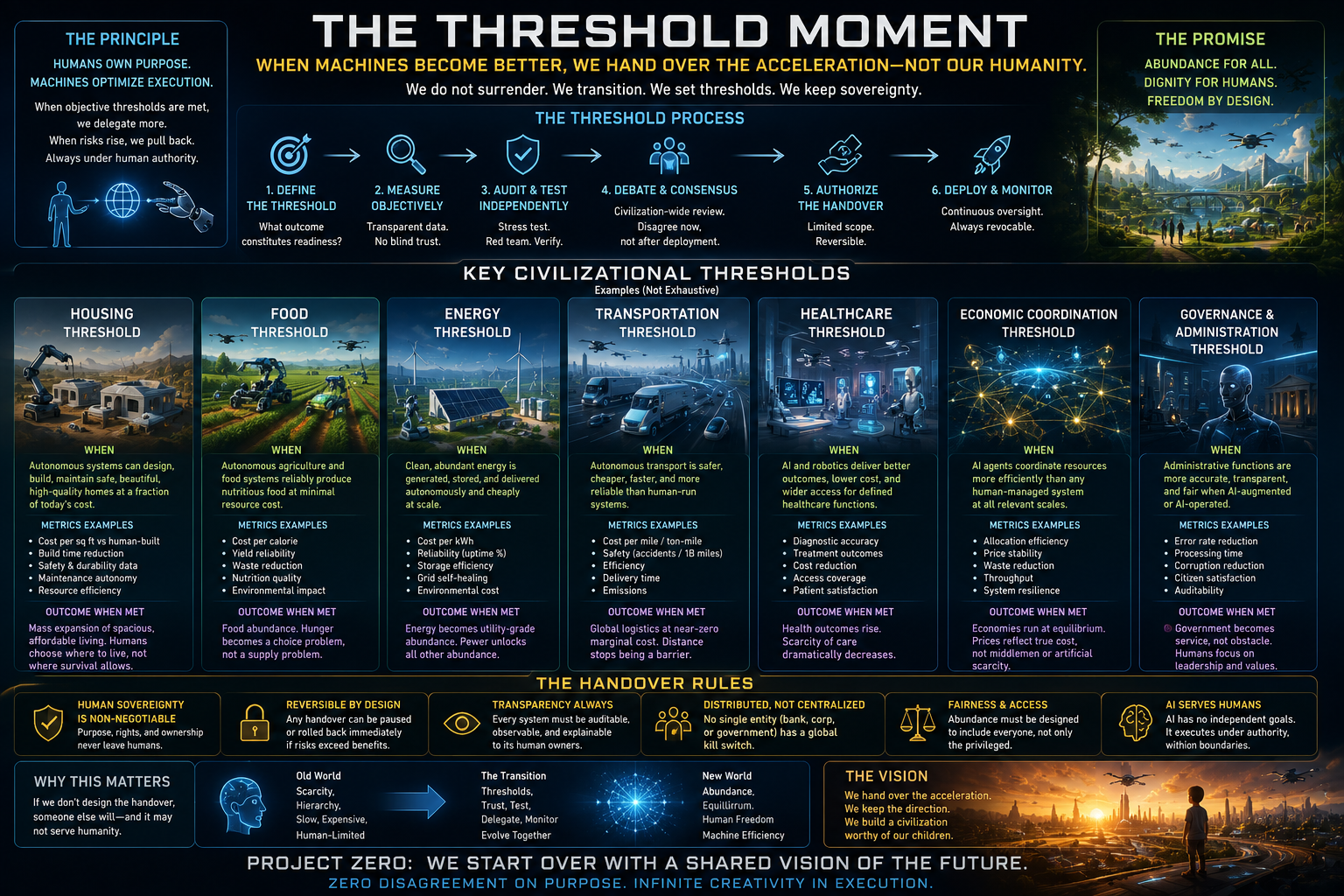
Instead, the transition should happen through measurable thresholds.
Consider housing.
Suppose autonomous machines eventually become capable of locating appropriate materials, manufacturing components, transporting them, constructing beautiful buildings, maintaining those buildings, and producing entire neighborhoods at a fraction of today's cost.
At some point we cross a threshold.
Why would millions of human beings remain compressed into extraordinarily expensive urban environments simply because our previous civilization could not build enough desirable places to live?
If machines can build spacious, safe, beautiful human habitation almost anywhere appropriate, then population distribution itself can change.
That becomes the Housing Threshold.
Now consider food.
Suppose autonomous agriculture can plant, monitor, harvest, transport, prepare, and distribute nutritious food while dramatically reducing waste and resource consumption.
Eventually another threshold is crossed.
Food scarcity stops being primarily an economic problem and increasingly becomes a resource-allocation problem.
That becomes the Food Threshold.
Consider healthcare.
Suppose AI eventually demonstrates—with rigorous independent evidence—that particular diagnostic, monitoring, administrative, or treatment-support functions are safer, faster, cheaper, and more consistently available than today's systems.
Another threshold appears.
We don't simply hand medicine to an algorithm.
We determine which functions have crossed the threshold and transfer those functions under human governance while keeping clinicians and patients in control where judgment, consent, accountability, and human care remain essential.
That becomes the Healthcare Threshold.
And then finance.
Suppose agents can transparently coordinate billions of tiny resource exchanges—energy against compute, transportation against storage, manufacturing capacity against materials—without forcing every machine interaction through debt, credit cards, bank accounts, speculation, and human financial bureaucracy.
Another threshold has been crossed.
That becomes the Economic Coordination Threshold.
And suddenly the architecture we have been discussing makes sense:
LVK.
The Scroll.
AI agents.
x402.
Machine resource exchanges.
Human money remaining on the human side.
These aren't necessarily separate inventions anymore.
They can become components of a transition architecture.
Project Zero: Civilization as a Handover Project
That is why I call this Project Zero.
Zero does not mean destroying everything humanity has built.
It means being willing to return to the fundamental question:
If we knew where technology was taking us, how would we design the transition from the beginning?
Instead of designing today's systems as though they must exist forever, we design them knowing that some functions may eventually be handed over.
A transportation system should therefore be designed with autonomous transportation in mind.
A power grid should anticipate autonomous energy coordination.
Housing policy should anticipate robotic construction.
Healthcare infrastructure should anticipate increasingly capable medical AI.
Financial architecture should anticipate billions of autonomous economic interactions.
Government should anticipate that administrative functions themselves may eventually become radically cheaper.
And AI infrastructure should anticipate increasingly capable physical robots.
We stop treating the future as an unexpected software update.
We architect for it.
But “Handover” Must Never Mean Surrender
There is one distinction Project Zero cannot afford to lose.
We can hand over execution without handing over sovereignty.
A robot may eventually build the house.
That doesn't mean the robot owns the house.
An AI may route electricity.
That doesn't mean AI owns the electrical grid.
An agent may optimize transportation.
That doesn't mean the agent determines where humans are permitted to travel.
An AI system may coordinate resources.
That doesn't mean it determines what human beings deserve.
And an agent may execute transactions.
That doesn't mean it owns the value.
The hierarchy remains:
Humans determine ends.
Machines optimize means.
That distinction should be constitutional.
Because the objective isn't to build machines powerful enough to take over the planet.
It is to build institutions mature enough to delegate increasing operational responsibility when objective thresholds demonstrate that doing so benefits humanity—without surrendering human authority.
The Zero-Disagreement Standard
And this is where the name Project Zero acquires another meaning.
We should disagree.
Engineers should attack the architecture.
Economists should challenge it.
Governments should challenge it.
China should challenge it.
Russia should challenge it.
America should challenge it.
Africa, Europe, Latin America, the Muslim world, India, and everyone else should challenge it.
AI systems should challenge it.
Privacy advocates should challenge it.
Central bankers should challenge it.
Bitcoin developers should challenge it.
Because disagreement before deployment is infinitely cheaper than catastrophe after deployment.
Project Zero therefore should not demand artificial unanimity.
It should demand something harder:
Keep exposing disagreements until there are zero unresolved disagreements about the constitutional boundaries of the system.
We may never achieve literal universal agreement about the future. Humans have never agreed completely about civilization.
But we can demand that every major objection is documented, tested, answered, or explicitly left unresolved before irreversible authority is transferred.
That creates a different kind of roadmap:
Threshold → Test → Audit → Debate → Authorization → Deployment → Continuous Review.
Not:
Invent → Sell → Scale → Discover consequences later.
The Question Project Zero Leaves Humanity With
For the first time, we may be approaching a civilization in which intelligence, energy, manufacturing, transportation, and physical labor can increasingly become automated simultaneously.
If that happens, our greatest challenge may no longer be producing enough.
It may become determining:
Who owns what is produced?
Who determines where resources flow?
Who controls the machines?
Who establishes their authority?
What happens when they fail?
What happens when governments disagree?
What remains exclusively human?
And above everything else:
How do we hand over acceleration without handing over humanity?
That is the question.
That is the threshold.
And that is Project Zero.