
بِسْمِ اللهِ الرَّحْمٰنِ الرَّحِيْم
In the Name of God, Most Gracious, Most Merciful.
♥️🤲🕋♥️🕋🌹🌹🥀🤲🌹🕋♥️🤲
Chapter 1
Why the Prophets Are the Only Safe Teachers of Politics
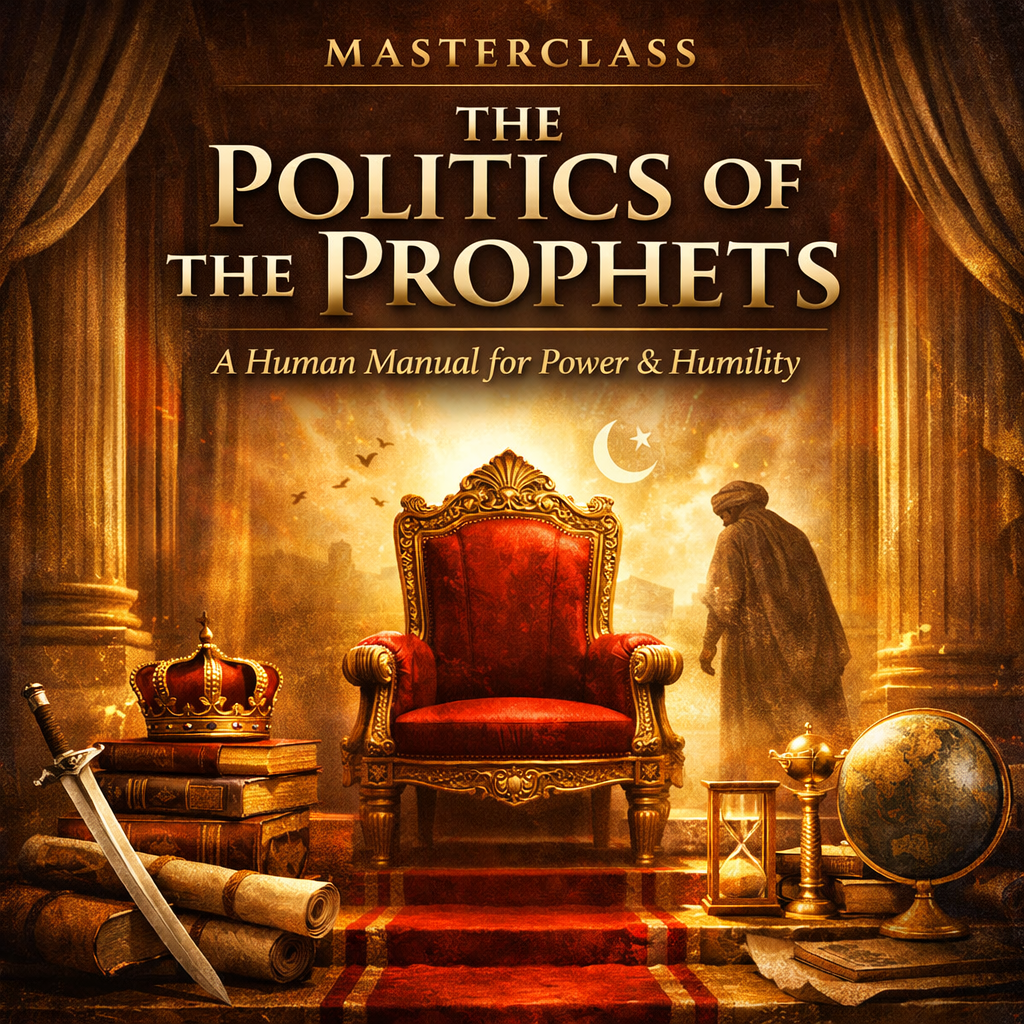
Two paragraphs to orient the reader
What you are about to read is not “politics” in the small sense—parties, elections, polling, slogans. This is politics in the original sense: the management of difference among beings who carry desire, fear, ego, love, jealousy, grief, and ambition. It is the craft of living together after innocence has ended, when blame exists, when competition exists, when people are not equal in maturity, and when power is always present—even inside a family.
And because power is always present, politics is always present. The question is not whether you do politics. The question is whether your politics is disciplined—or whether it becomes a mask for pride. That is why, before we study rulers and states, we study the only teachers who are safe to follow: the prophets, and above all, the Best of Creation, Prophet Muhammad ﷺ—because in him Allah placed the most complete living example of how power is carried without arrogance.
1) Why politics must be studied like a spiritual disease
Most people speak about politics the way they speak about weather:
“It is what it is.”
“It’s dirty.”
“It’s always been corrupt.”
“Nothing can change.”
That attitude is not wisdom. It is surrender.
Islam teaches something sharper:
Some problems are tests.
Some problems are punishments.
Some problems are openings.
Some problems are mirrors.
Politics is one of the greatest mirrors on Earth because it exposes what human beings hide in private.
Politics is the public arena where:
pride dresses as principle,
greed dresses as policy,
fear dresses as security,
envy dresses as justice,
revenge dresses as “accountability,”
weakness dresses as “humility,”
and showing off dresses as “leadership.”
So politics is not merely an external system. It is also an internal condition.
The world thinks politics is “strategy.”
Islam says politics is also the state of the heart when strategy is available.
This is why the prophets matter. They are the only leaders whose politics is not built on ego.
2) The first political disaster: arrogance refusing to bow
You already laid the foundation: the first political sentence was, “I am better than him.”
That is not just disobedience. That is a claim of rank. It is the birth of political ideology—because it attempts to justify superiority as “natural” and “deserved.”
And here is the terrifying truth:
A person can commit a sin and still be soft inside.
But arrogance makes the heart hard.
A sinner can repent.
An arrogant person argues.
A sinner may cry.
An arrogant person performs.
A sinner may admit.
An arrogant person justifies.
Politics becomes dangerous when arrogance becomes normalized, because then the political actor stops seeing himself as a servant of the people, and starts seeing himself as destiny.
This is why Islam draws a red line around pride and greatness: not because humans cannot be excellent, but because humans cannot safely claim absolute greatness. That belongs to Allah alone.
3) Why we need prophets specifically—why philosophers and kings are not enough
A philosopher can describe politics.
A king can execute politics.
A prophet purifies politics.
Because the prophets were sent with something unique:
they speak on behalf of truth, not ego,
they do not sell their message,
they are not bribed by applause,
they do not need the crowd to validate them,
and they do not “win” by any means necessary.
A prophet is the only type of leader who can look at power and say:
“I can use this for myself… but I will not.”
That is a miracle in human history.
Kings often become arrogant because they believe the throne proves their worth.
Philosophers often become arrogant because they believe knowledge proves their superiority.
Activists often become arrogant because they believe their cause excuses their cruelty.
Prophets do not get that luxury.
Prophets are tested harder than anyone:
insulted more than anyone,
resisted more than anyone,
betrayed more than anyone,
and still required to remain just.
So a prophet is the only safe political teacher because he models power under the harshest conditions without corrupting his soul.
4) Why Prophet Muhammad ﷺ is the masterclass
Among the prophets, Muhammad ﷺ is unique for political education because his life contains every stage of power:
No power in Mecca—only truth, patience, endurance
Partial power in Madinah—building community, law, unity
External threats—war, treaties, alliances, betrayal
Full authority—command, leadership, judgment
Total victory—the conquest of his own birthplace
Refusal of kingship—power without worship of power
If you want to learn politics, you must learn from someone who has passed through the entire spectrum: weakness to strength, isolation to influence, persecution to victory.
And the reason he is the master lesson is not that he “won.”
It is that he won without arrogance.
When power came, it did not inflate him.
When victory arrived, it did not intoxicate him.
When enemies fell into his hands, he did not become cruel.
This is not normal human behavior.
This is why Allah made him the example—not only in prayer, but in living.
5) What the Qur’an means when it says he is the example
When Allah tells the believer that the Messenger ﷺ is the excellent example, it is not a compliment.
It is instruction.
It means:
If you want to know how to behave when—
you are insulted and cannot respond,
you are mocked and feel humiliation,
you have power and could punish,
you are angry and could explode,
you are praised and could be arrogant,
you are obeyed and could become a tyrant,
then look at him ﷺ.
Because politics is exactly that: the behavior of humans when ego has a reason to rise.
The Prophet ﷺ is the proof that a human being can carry leadership like a trust—without claiming greatness as identity.
6) Politics is not only in the state; it is in the home
Now we bring it down to the ground.
If you cannot manage politics in your own home, you cannot manage politics in society.
The first government is the family:
leadership,
mercy,
boundaries,
rights,
responsibilities,
emotional storms,
jealousy,
forgiveness,
patience.
This is why your insight is correct:
Sometimes the people closest to you will test you most.
Sometimes family is a harder battlefield than enemies.
Not because family is evil, but because family has:
intimacy,
expectation,
history,
entitlement,
and emotional leverage.
Politics is present in family because power is present in family.
The prophets demonstrate how to remain just when emotions are strongest—because their mission demanded emotional discipline at a level normal humans rarely reach.
7) Hypocrites: the most political creature in the world
The Qur’an introduces a category that modern political theory cannot handle cleanly: hypocrisy.
A hypocrite is not just “wrong.”
A hypocrite is someone who:
uses the language of truth,
while hiding an opposite intention,
and seeks influence through appearance.
Hypocrisy is politics without sincerity.
It is power without integrity.
And the Prophet ﷺ faced hypocrites.
Why does that matter?
Because many systems collapse not from external enemies, but from internal rot:
the smiling saboteur,
the religious performer,
the ally who sells you quietly,
the politician who quotes virtue but worships himself.
This is why studying the Prophet ﷺ is essential: he demonstrates how to deal with internal enemies without becoming paranoid, without becoming unjust, and without destroying society in the name of “purity.”
That is a rare form of political wisdom.
8) The politics of the self: every emotion is a vote
Now we reach one of the deepest ideas you stated:
Every interaction brings something forth:
anger,
fear,
pride,
envy,
sadness,
longing,
humiliation,
confidence.
And that condition is political.
Because the condition becomes action.
And action becomes consequence.
And consequence becomes a new reality for other people.
So politics is not only “what leaders decide.”
Politics is also “what the heart releases into the world.”
This is why Islam treats the self (nafs) as a battlefield.
If you cannot govern the nafs, your politics will always be corrupted.
The Prophet ﷺ demonstrates the highest form of governance:
governance of the self before governance of society.
9) Life is a test, not a stage—and politics is one of the exam halls
Your chapter needs a clear Quranic frame that keeps the reader sober:
Life and death are created as a test—who is best in deeds.
That means:
every rise is a test,
every fall is a test,
every argument is a test,
every victory is a test,
every humiliation is a test,
every relationship is a test.
Politics is a major exam hall because it creates pressure:
pressure reveals truth,
pressure reveals ego,
pressure reveals sincerity.
Without pressure, people imagine they are righteous.
Politics exposes what is real.
10) Why this masterclass begins here
We begin with the prophets because the prophets teach something the world cannot teach:
How to possess authority without worshipping authority.
How to win without humiliating.
How to punish without cruelty.
How to lead without arrogance.
How to speak truth without showing off.
How to be opposed without becoming demonic.
This is not idealism.
This is survival.
Because a world that forgets prophetic politics becomes a world where:
pride is normal,
cruelty is strategic,
truth is negotiable,
and people are crushed under the ego of leaders.
Closing of Chapter 1
So Chapter 1 ends with a simple conclusion:
Politics cannot be escaped.
But arrogance can.
Power will always exist.
But tyranny is a choice.
The best political education is not found in speeches.
It is found in the lives of the prophets—because they show what happens when a human being lives under the weight of responsibility while keeping his heart clean.
And among them, Prophet Muhammad ﷺ is the greatest political teacher because his life contains every stage of power—yet his character never inflated.
In the next chapter, we begin where true political greatness begins:
Chapter 2
Muhammad ﷺ Before Power: Integrity When You Have No Leverage
This is the stage where most people fail—long before they ever touch authority.