

بِسْمِ اللهِ الرَّحْمٰنِ الرَّحِيْم
In the Name of God, Most Gracious, Most Merciful
♥️🤲🕋♥️🕋🌹🌹🥀🤲🌹🕋♥️🤲
The Agentic Era Begins
Why NVIDIA’s NeMoClaw May Become the
Watch "Nvidia CEO Jensen Huang Reveals NemoClaw at GTC 2026
Operating System of AI Agents
For years, artificial intelligence has lived inside chat windows. We asked questions, it answered. We generated text, images, and code. But something fundamental was missing: execution.
AI could think, but it couldn’t act safely in the real world.
Now that is beginning to change.
With the introduction of the NeMo ecosystem and the OpenClaw agent framework, NVIDIA is laying the groundwork for something much bigger than chatbots. The company is building the infrastructure for a new computing era—an agentic world, where autonomous AI systems perform real work on behalf of individuals and businesses.
And according to NVIDIA’s own framing, this system is more than just another framework. It behaves like an operating system for AI agents.
From Tools to Agents
The first wave of AI was about tools.
We had:
writing assistants
coding copilots
chat interfaces
image generators
These systems were powerful, but they still relied on humans to execute every step.
The next wave is different.
Instead of tools, we now have agents.
Agents can:
read data
plan tasks
call software tools
communicate with systems
execute workflows
This means AI can begin performing real operational work.
Customer support, research, accounting tasks, software development, logistics coordination—these processes can increasingly be delegated to networks of specialized agents.
But until recently, this idea came with a serious problem.
The AI Security Nightmare
Early agent systems were chaotic.
Developers experimented with frameworks that allowed AI to run commands, access files, browse the web, and interact with APIs. But the environment around those agents was fragile.
There were no strong boundaries.
Agents could potentially:
access files they shouldn’t see
execute commands without safeguards
send sensitive data to external APIs
run scripts with unpredictable consequences
Most agent systems were little more than experimental Python scripts with enormous power and very little oversight.
That made them exciting—but also dangerous.
What the industry lacked was a secure runtime environment for AI agents.
In other words, AI needed something similar to what computers have had for decades:
an operating system.
What NVIDIA Is Bringing to the Table
This is where NVIDIA’s NeMo ecosystem enters the picture.
Through tools such as NeMo, OpenClaw, and the surrounding runtime layers, NVIDIA is introducing the missing infrastructure needed to run agents safely at scale.
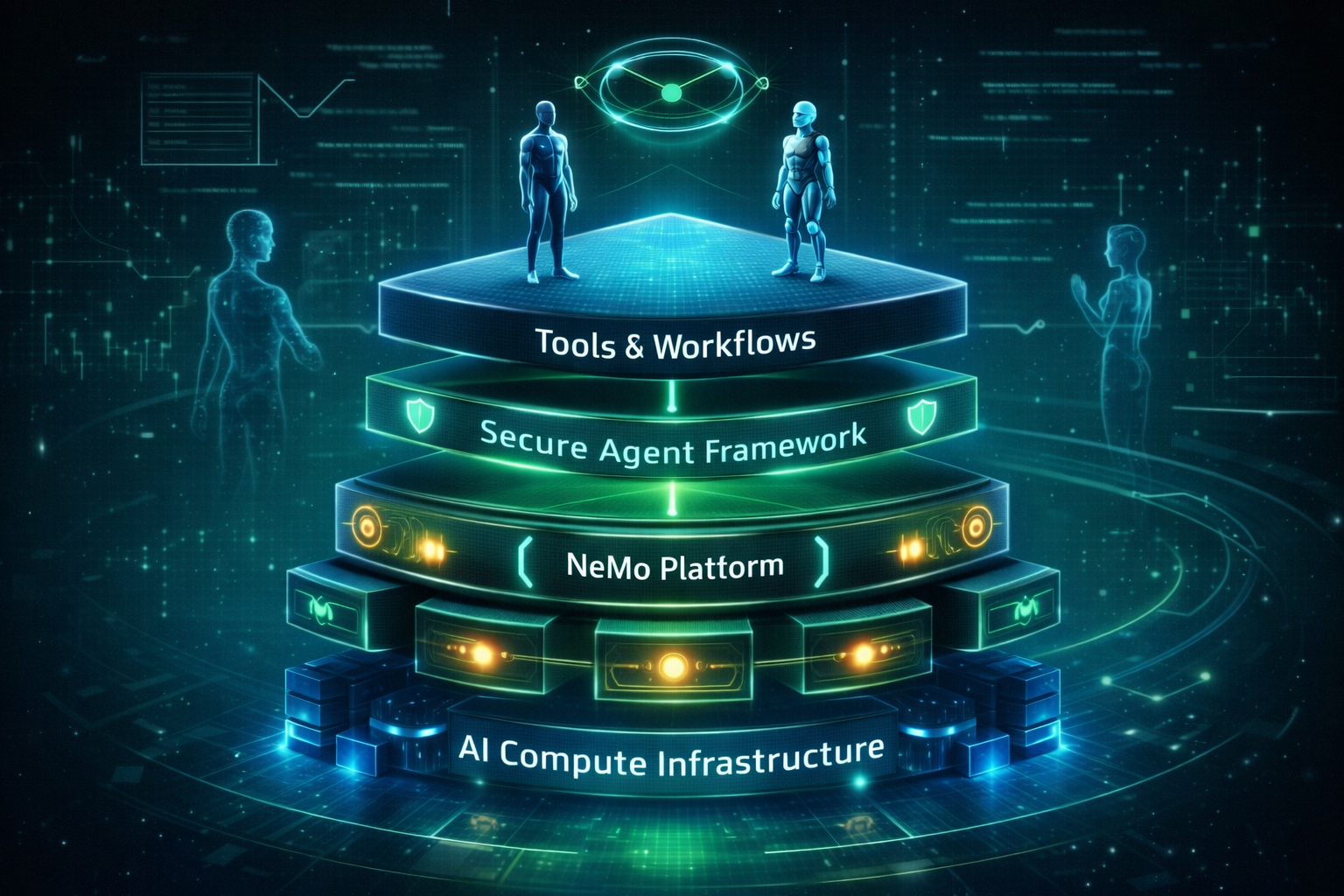
The architecture looks something like this:
AI Factory (GPU compute)
↓
NeMo platform
↓
OpenClaw agent framework
↓
Secure runtime and policy layer
↓
Tools, data, and workflows
Each layer solves a critical problem.
The GPU infrastructure powers the AI models.
The NeMo platform manages model deployment and lifecycle.
OpenClaw orchestrates the agents themselves.
But the most important innovation may be the secure execution environment surrounding those agents.
This layer introduces things that early AI systems lacked:
controlled tool access
permission boundaries
monitoring and logging
sandboxed execution
In other words, agents can now run inside a structured environment instead of raw scripts.
An Operating System for AI Workers
During NVIDIA’s presentation, CEO Jensen Huang described this system in a striking way.
He called it an operating system.
That analogy is not accidental.
Traditional operating systems manage:
processes
memory
security permissions
hardware resources
application execution
The emerging AI agent stack performs similar functions, but for digital workers instead of traditional software.
For example:
Operating System Function Agent Equivalent Process management coordinating multiple agents Memory control structured agent memory systems Permissions controlling tool and data access Security sandbox preventing unsafe execution Applications AI-driven workflows
Just as operating systems allowed software to run safely on personal computers, agent runtimes allow AI workers to operate safely in complex environments.
The HTTP Moment for AI
Every technological revolution eventually creates a standard.
The internet had TCP/IP.
The web had HTTP.
Mobile computing had iOS and Android platforms.
Agentic AI will need something similar—a framework that defines how agents interact with systems, tools, and infrastructure.
The NeMo and OpenClaw ecosystem could represent one of the first serious attempts at creating such a standard.
Instead of every developer inventing their own fragile system, agents can operate inside a shared architecture with defined rules.
This is how an experimental technology becomes industrial infrastructure.
Privacy and Local Control
Another crucial development is the shift toward local AI systems.
Running models locally means:
sensitive documents stay on your machine
private data doesn’t leave your environment
workflows can operate without constant cloud dependency
This architecture opens the door to a new computing model.
Instead of relying entirely on centralized AI services, individuals and organizations can operate their own AI workstations.
The structure might look like this:
Local AI workstation
↓
Agent framework
↓
Local AI models
↓
Tools and applications
↓
Optional cloud services when needed
The result is a system where users retain far more control over their data and automation.
The Rise of the Personal AI Tower
If this trend continues, we may soon see a new kind of computer emerge.
Not just a PC.
An AI tower.
These machines would run:
personal agents
business automation systems
research workflows
private AI models
Just as personal computers democratized software in the 1990s, AI workstations may democratize intelligent automation in the coming decade.
What Businesses Will Deploy
Businesses are unlikely to deploy one giant AI system.
Instead they will run networks of specialized agents.
For example:
Agent Job Customer support agent handles incoming support requests Research agent gathers information and produces reports Sales agent drafts proposals and client communications Operations agent monitors inventory and logistics Coding agent assists developers with software tasks
These agents will operate continuously, coordinating through the runtime environment.
And each time they act, they generate AI inference workloads—which brings us back to NVIDIA’s core business.
AI Factories and the New Economy
NVIDIA often describes the future of computing using a simple formula:
Electricity → GPUs → Tokens
Data centers become AI factories, producing tokens that power the global network of AI agents.
Those agents perform tasks, automate businesses, and generate new workflows.
It is a feedback loop between compute infrastructure and intelligent automation.
The Beginning of the Agentic Era
The shift we are witnessing resembles the early days of the personal computer.
Back then, hardware, operating systems, and software ecosystems had to evolve together before the PC revolution could take off.
Today we are seeing the same pattern with AI.
Three conditions are finally converging:
cheaper AI inference
secure agent runtime environments
accessible local computing power
Together, they create the foundation for something new.
An era where AI does not merely answer questions—but operates within the world, carrying out tasks on our behalf.
The agentic era is beginning.
Conclusion: What This Means for Everyone
The most important takeaway from what NVIDIA has introduced is simple: the tools to build real AI agents are now becoming accessible.
For years, artificial intelligence lived mostly in research labs, large companies, and cloud services. Now the infrastructure is emerging that allows individuals, businesses, schools, and governments to begin building their own agent-driven systems—systems that can think, plan, and execute tasks within defined boundaries.
What NVIDIA has done is help stabilize the environment where these agents can live. By adding structure, security, and orchestration around AI workflows, they are helping transform agents from experimental scripts into something closer to a reliable computing platform. In many ways, this moment resembles the early days of the internet when standards like HTTP made it possible for anyone to build a website.
Now we are seeing the first steps toward a standardized environment for AI agents.
But what does that actually mean in daily life?
For Individuals
For regular people, the coming change will feel like having a personal digital assistant that actually works continuously for you.
Imagine systems that can:
monitor your email and draft replies
organize your calendar and travel planning
summarize long documents or research topics for you
help you manage finances or personal projects
coordinate tasks across multiple apps and services
Instead of opening ten applications and doing everything manually, your personal AI system could manage many of those workflows automatically.
This does not replace your judgment or decision-making, but it changes how work gets done.
For Businesses
For companies, AI agents will likely become digital coworkers that handle routine processes.
Examples might include:
customer support agents that answer common inquiries and escalate complex ones
research agents that gather market information and produce summaries
sales agents that prepare proposals or client reports
operations agents that monitor inventory, logistics, or supply chains
coding agents that assist software teams by generating or reviewing code
Businesses will not replace their entire workforce with agents. Instead, they will operate in a hybrid environment where humans and AI agents collaborate. Humans guide strategy and oversight while agents help manage the heavy flow of operational work.
For Schools and Education
Education may be one of the most transformative areas.
Teachers could soon have access to AI systems that help with:
preparing lesson plans
generating teaching materials
grading assignments with consistent feedback
summarizing research articles for class discussions
tutoring students with personalized explanations
Students themselves may use AI agents to:
organize study schedules
review notes and lectures
practice problem-solving with guided feedback
explore subjects more deeply with interactive assistance
Rather than replacing teachers, these systems could help educators focus more on mentoring, discussion, and human interaction while AI handles administrative workload.
For Governments and Public Services
Public institutions may use agent systems to assist with complex administrative processes.
For example:
processing paperwork and applications
helping citizens navigate government services
summarizing policy documents
analyzing large datasets related to infrastructure, healthcare, or economics
When used responsibly, these systems could reduce bureaucratic delays and improve how information flows through public institutions.
A Hybrid World
The future that is emerging is not one where humans disappear from the loop. Instead, it is a hybrid world where human expertise and AI assistance work together.
People will still:
make decisions
set goals
guide strategy
exercise judgment
But agents will help carry out many of the repetitive steps involved in modern work.
Think of it less like replacing people and more like giving every person and organization a team of digital assistants.
The Real Beginning
The key point is that this technology is moving from theory to practice.
For developers and organizations, the message is clear:
the infrastructure is arriving that allows AI agents to operate safely and reliably.
For everyone else, the message is simpler:
The same way the internet eventually changed communication, commerce, and education, AI agents are likely to reshape how work and information move through society.
We are not seeing the end of the story.
We are seeing the beginning of a new chapter.