

بِسْمِ اللهِ الرَّحْمٰنِ الرَّحِيْم
In the Name of God, Most Gracious, Most Merciful.
♥️🤲🕋♥️🕋🌹🌹🥀🤲🌹🕋♥️🤲
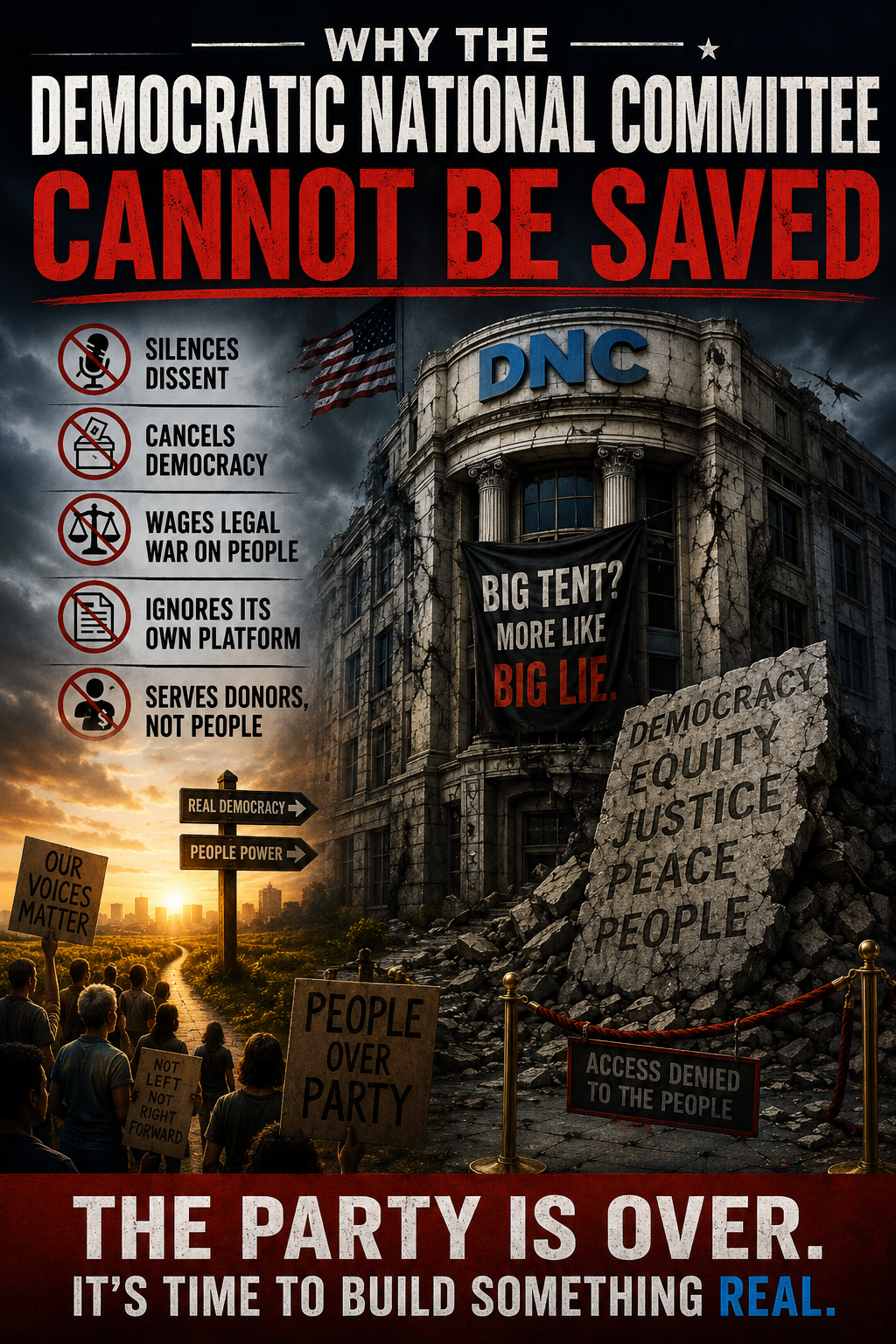
The Party Is Over: Why the Democratic National Committee Cannot Be Saved
There comes a moment when an institution becomes so hollow, so disconnected from its own stated values, that its continued existence is not just pointless—it is harmful. That moment has arrived for the Democratic National Committee.
This is not a critique from the outside. This is not the complaint of an enemy. This is the reckoning that comes when you have spent years defending a machine, only to realize that the machine was never designed to serve you. It was designed to use you.
The DNC cannot be reformed. It cannot be redeemed. It must be allowed to end.
The Covenant That Was Broken
Every political party is built on an unspoken covenant with its people: Give us your energy, your hope, your votes, and we will carry your voice into the halls of power. It is a simple exchange. It is the foundation of democratic trust.
The Democratic Party has broken that covenant—not once, but repeatedly, systematically, and with increasing contempt for the very people who sustain it.
The evidence is overwhelming. The pattern is unmistakable. And the conclusion is inescapable.
The Hierarchy of Human Worth
Let us begin with the moment that shattered the illusion for millions of people who wanted desperately to believe.
At the 2024 Democratic National Convention in Chicago, thirty elected delegates from the Uncommitted movement arrived representing hundreds of thousands of voters. These were not outsiders. These were party loyalists. They had knocked on doors. They had made phone calls. They had poured their lives into the machine.
Their request was breathtakingly modest: two minutes on the main stage for a single vetted, pro-party Palestinian-American elected official. Two minutes to say: We are here. Our families are dying. Please, see us.
The party establishment said no. But the super user says yes so we're going to listen to what was blocked. 💪🦸🦸♂️🦸♀️👇👇
Watch "Palestinian-American Lawmaker Ruwa Romman Shares Speech Denied By DNC
Meanwhile, the convention featured the heartbreaking testimonies of Israeli hostage families. Those stories were right to be told. They were powerful. They were necessary.
But when the exact same space was requested for Palestinian grief—not instead of, but alongside—the door was slammed shut.
Let us be brutally honest about what this means.
The only possible interpretation is that the party made a calculation. It decided that Israeli suffering was politically useful to display. It decided that Palestinian suffering was a public relations liability to be contained, sanitized, and silenced.
That is not a scheduling conflict. That is a moral hierarchy. It is the party saying, in its actions if not its words, that some lives matter more than others, depending on which way the political winds are blowing.
This is not a failure of empathy. This is a failure of humanity. And it is unforgivable.
The Theft of Democracy
But Chicago was just the final act of a long and shameful play.
Earlier that year, in Florida, the state Democratic Party submitted only one name for the primary ballot. One. The incumbent. Hundreds of thousands of registered Democrats were handed a choice that was not a choice at all. The primary—the foundational ritual of democratic participation—was quietly eliminated.
In North Carolina, similar maneuvers unfolded. Ballot access was restricted. Challengers were blocked. The message was unmistakable: The voting public cannot be trusted with actual choices. The management class knows what is best.
Consider the sheer arrogance of this. The Democratic Party presents itself to the world as the defender of democracy, the bulwark against authoritarianism, the guardian of the sacred right to vote. And yet, behind closed doors, it cancels its own primaries. It eliminates its own competitions. It ensures that the only choice available is the choice it has already made for you.
This is not democracy. This is a monopoly protected by procedural manipulation. And it is happening in plain sight.
The Legal Warfare Against the People
When voters grow desperate enough to look outside the two-party duopoly, the machine deploys its most terrifying weapon: its lawyers.
Across the United States, the Democratic Party has poured millions of dollars into savage legal warfare designed to crush independent and third-party candidates. They do not fight them on ideas. They do not beat them with a better vision for the working class. They bury them in paperwork. They challenge every signature. They exploit every technicality.
The goal is simple: ensure that voters have no real alternatives. Create artificial scarcity. Present the electorate with a binary choice—our candidate or the other party's candidate—and call it a functioning democracy.
This is not competition. This is a monopoly enforced through legal terror. And it is funded by the very people who believe they are supporting a movement for justice.
The Platform That Was Never Meant to Matter
Think of the thousands of grassroots activists who spend months pouring their hearts into crafting the party platform. They debate every word. They fight for language on healthcare, climate justice, peace, racial equity. They believe they are shaping the future.
The platform is adopted with great ceremony. The cameras flash. The activists cry tears of relief.
And then, the moment the convention ends, the document is placed on a shelf. Donors and lobbyists resume their work. Elected officials ignore the platform's provisions. The people who wrote it are never consulted again.
What was the point?
The only honest answer is that the platform was never meant to be binding. It was meant to be therapeutic. A performance to secure volunteer labor and moral cover. The actual governing agenda is dictated elsewhere, by people who never had to knock on a door or attend a precinct meeting.
This is not democracy. This is exploitation dressed up as inclusion.
The Sunk Cost Trap
When these contradictions are pointed out, the defenders of the machine retreat to the same tired argument:
But look at history. Look at the New Deal. Look at the Civil Rights Act. Look at decades of progress built by this party. You cannot abandon it now.
It sounds reasonable. It sounds like loyalty.
But think about what it actually says: Because this institution did good things in the past, you must continue to submit to it in the present, no matter how broken it has become.
That is not loyalty. That is a trap.
If a car carried your family safely across the country fifty years ago, but today the engine is dead, the frame is rusted, and the brakes are gone, you do not keep driving it because you remember the good trips. You get out. You find another way forward.
The Democratic Party of 1933 is not the Democratic Party of 2026. The institution that fought for the New Deal is not the institution that cancels primaries and silences Palestinian voices. The ghosts of the past cannot justify the corruption of the present.
What the Machine Actually Believes
When you step back and look at all of these moments together—the silenced speaker, the canceled primary, the legal warfare, the empty platform, the historical excuse—a clear and devastating picture emerges.
The party apparatus does not believe in democracy. It believes in control.
It does not believe in inclusivity. It believes in performance.
It does not believe in dialogue. It believes in message discipline.
It does not believe in the people. It believes in its own power.
The "Big Tent" is not a place where different voices are welcomed. It is a space where different voices are managed, contained, and, when necessary, silenced. The moment a voice threatens the carefully curated image of unity, it is shown the door.
This is not a movement. This is a corporation. And corporations do not inspire loyalty—they inspire compliance at best, resentment at worst.
Why This Cannot Hold
A political organization that cannot tolerate internal disagreement is not a political organization. It is a cult of personality dressed in the language of progress.
The silencing of the Uncommitted delegates was not an isolated mistake. It was the logical conclusion of an entire way of thinking. A way of thinking that treats voters as assets to be managed, activists as labor to be exploited, and human suffering as a public relations variable to be optimized.
That way of thinking has reached its expiration date.
The voters who showed up for the Uncommitted movement were not outsiders. They were Democrats. They knocked on doors. They made phone calls. They donated their time and money. And when they asked for the most basic acknowledgment of their humanity, they were told to sit down and be quiet.
That is not how you build a coalition. That is how you empty a room.
The Honorable End
The old machine will not fall because it is attacked by its enemies. It will fall because it has lost the trust of its own people. It will fall because the gap between what it says and what it does has become too wide to ignore.
When you say every life matters, but only some are worthy of a stage—that is a contradiction that cannot be papered over.
When you say you trust the people, but cancel primaries and block challengers—that is a contradiction that cannot be explained away.
When you say the platform is your guide, but ignore it the moment the convention ends—that is a contradiction that cannot be sustained.
These contradictions are not new. They have been accumulating for years. But they have reached a tipping point. The machinery is too heavy. The trust is too thin. The performative commitments are too transparent.
The end comes not with a bang, but with an awakening.
And that awakening is happening now.
What Comes Next
There is no single solution. No new leader will fix this. No reformed process will restore what has been lost.
What is needed is something simpler and more profound: the recognition that real democracy does not require a gatekeeper. It requires honest conversation, direct participation, and a willingness to let people speak for themselves.
The institutions that survive this moment will be the ones that are open, transparent, and genuinely responsive to the people they claim to serve. The ones that are willing to listen—even when what they hear is uncomfortable.
Everything else will fade.
The 2024 convention will be remembered not for its speeches or its spectacle, but for what it revealed. When the moment came to include a voice that did not fit the narrative, the machine chose silence.
That choice was a confession.
And it is time to take that confession seriously.
The Party Is Over
The Democratic National Committee cannot be saved because it does not want to be saved. It does not want to be reformed. It wants to continue exactly as it is: a machine that extracts energy from the hopeful and delivers nothing in return.
The only honorable response is to stop pretending otherwise.
Stop defending the indefensible. Stop making excuses for the inexcusable. Stop hoping that the machine will one day become what it has never been.
The party is over.
And that is not a tragedy. It is a liberation.
This is the first in a series examining why the Democratic National Committee must be allowed to end—and what we can build in its place.