

بِسْمِ اللهِ الرَّحْمٰنِ الرَّحِيْم
Bismillah ar-Rahman ar-Rahim
In the Name of God, Most Gracious, Most Merciful
🕋
🌍 The Article of the Century
🌍 The Great Economic Graduation: From Debt to Synchronization
A Superuser Blueprint for the Post-Debt Civilization
The age of debt is ending — quietly, efficiently, and inevitably.
What once powered nations and crushed generations is being rewritten by intelligence, automation, and synchronization.
We are witnessing a moment no economist could have forecast and no investor can control:
the emancipation of value from debt.
Every system humanity built to borrow time — financial, industrial, political — is now being replaced by systems that generate time, save energy, and multiply value without extraction.
Robots are planting crops, algorithms are balancing grids, AI is managing supply chains, and economies are beginning to think.
This is not the collapse of capitalism.
It is its graduation.
The transition from interest to intelligence, from borrowing to balancing, from competition to coordination.
In this series, we will break down how each sector of the global economy — transportation, agriculture, energy, finance, labor, housing, and governance — will evolve from debt-driven scarcity to synchronized prosperity.
We will explore how central banks, governments, and AI systems will cooperate to unlock hidden savings, dissolve inefficiency, and redefine credit itself as a measure of contribution.
Because the question of the 21st century is no longer “How much do you owe?”
It is “What can you do that no one else can?”
When that question replaces interest rates,
when debt becomes proof of value,
when creation replaces competition —
the world will not be owned by creditors or markets.
It will be owned by humanity again.
And when that moment comes — when the final note of debt fades into the harmony of synchronization —
the planet itself will applaud.
“When the World Owes Itself: The Hidden
Architecture of Global Debt and the Future of Trust”
The Grand Illusion
We live in a world that owes $315 trillion — a sum so large it eclipses human imagination. It is more than three times the value of everything we produce each year. Yet the mystery is this: to whom is the world indebted?
The answer is as paradoxical as it is profound — the world owes the debt to itself.
In this infinite mirror of credit and obligation, every bond is a promise backed by another promise. Every nation is both a borrower and a lender. Every dollar is someone else’s debt. The system is circular, self-referential, and sustained by a single fragile resource — belief.
Debt, the video reminds us, is not a curse but the architecture of the modern world. It is the scaffolding upon which capitalism rests, the invisible bloodstream that powers nations. But like blood, it carries both nourishment and poison.
The Birth of the Bond — How War Invented Wealth
The story begins in 1694.
England was at war with France. The crown was broke, gold was gone, and the empire stood on the edge of collapse. Then came an idea that would change history — borrow from the future.
Merchants financed the king’s war in exchange for perpetual interest, secured by taxes that had not yet been collected. To manage this revolutionary mechanism, England created a new institution — The Bank of England — and with it, the first government bond was born.
From that day forward, the battlefield moved from the mud to the balance sheet. Empires no longer fought over land and treasure; they fought for confidence. Debt was no longer shame — it was credibility.
To be trusted was to be powerful. To borrow was to rule.
The Circle of Credit — The Planetary Web
Fast-forward three centuries.
The architecture of debt has become global.
The United States owes $38 trillion. Two-thirds of that debt is held by Americans themselves — banks, pensions, mutual funds, and the Federal Reserve. The other third is held abroad: Japan ($1 trillion), China ($800 billion), and dozens of others.
The European Union, in turn, owes trillions — and lends to developing nations.
Developing nations invest their reserves back into U.S. and European bonds.
The result is a planetary hot potato of promises.
The world lends to itself, through institutions like the IMF and World Bank, whose very design ensures that money never dies — it only changes names.
Every dollar in circulation is a unit of debt somewhere else. Every economy is stitched into another’s survival.
The High Priests of the System — Markets and Central Banks
In the temple of modern finance, central banks are the new priesthood.
They do not just manage debt — they manufacture it. When the Federal Reserve buys government bonds, it creates new money from thin air. Each note it prints is another entry in the book of promises.
Alongside them stand the markets — hedge funds, pensions, sovereign wealth funds — who decide which nations deserve mercy and which must pay penance. These are the invisible arbiters of fate. They do not march armies; they move interest rates.
Together, they have turned debt into the world’s heartbeat — steady, rhythmic, and eternal.
When Faith Falters — The Greek Lesson
But belief is a delicate currency.
When confidence collapses, the invisible creditors become visible.
In 2010, Greece defaulted on its obligations. The result was economic ruin: unemployment, austerity, humiliation.
The IMF and European Central Bank rushed in to “rescue” Athens, but the rescue came with chains — tax hikes, spending cuts, and generations condemned to pay for promises they never made.
The same drama played out in Argentina, Sri Lanka, and elsewhere — each time revealing the same truth: debt is power, and power flows to those who hold the paper, not those who sign it.
The Subscription Model of Sovereignty
Here lies the unspoken rule of the modern age: national debt is not meant to be repaid; it is meant to be rolled over forever.
Governments refinance, renew, and perpetuate the illusion of repayment. The product is not the principal — it is the interest, the rent charged for participating in global stability.
If every debt were paid, the system would collapse. The money supply would evaporate.
To destroy debt would be to destroy money itself.
Thus, the system endures — a perpetual motion machine powered by faith and fear.
The Great Transfer — From Labor to Capital
Behind the curtain of high finance lies a moral equation.
Debt is not just an exchange between nations — it is an exchange between classes.
Interest flows upward — from the taxpayer to the investor, from the worker to the fund, from the many to the few.
It is the most elegant mechanism for concentrating wealth ever invented.
As global indebtedness grows, so does inequality. The rent on the system is paid in hope, labor, and time — currencies that belong to the poor.
The Age of Faith — The Invisible Collateral
What keeps this world turning is not gold, productivity, or even policy — it is belief.
The global economy runs on trust that tomorrow will honor today’s promises.
That faith, though intangible, is the most valuable asset on Earth.
Lose it — and the entire edifice crumbles.
Debt, then, is not just financial. It is psychological. It is moral. It is spiritual.
It demands that we believe not in God, but in the continuity of the ledger.
Enter the Brand Currency System — From Faith to Verification
This is where a new model begins to emerge.
The Brand Currency System (BCS) transforms debt’s illusion into verifiable value.
It does not borrow from the future — it captures the truth of the present.
In the BCS, every transaction is transparent, every purchase is proof of participation, every receipt is a record of contribution.
It converts human activity into measurable worth — turning the economy from a system of promises into a system of proof.
Where the old world runs on debt, the new world runs on accountability.
Where central banks mint faith, Brand Currency mints trust.
The BCS transforms capitalism’s most fragile foundation — belief — into something unbreakable: evidence.
XThe Future — From Circular Debt to Circular Value
The next century will not be ruled by those who can print money, but by those who can verify value.
The empires of the past were built on conquest.
The empires of the present are built on credit.
The empires of the future will be built on credibility.
In this transition, the Brand Currency System stands as the bridge —
from debt to dignity,
from illusion to measurement,
from vertical extraction to horizontal empowerment.
Epilogue — The New Covenant
The modern world was built on promises written in ink.
The next world will be built on proof written in light.
When the circle of debt finally meets the circle of truth, the world will discover a new kind of wealth — one not borrowed, but earned.
The architecture of tomorrow will not be made of paper.
It will be made of trust.
And this time,
the world will not owe itself — it will own itself.
The Age Beyond Debt
The age of debt was an age of delay — of borrowing from tomorrow to survive today.
But the age of Artificial Intelligence is an age of immediacy, of precision, of unlocked value. When efficiency replaces interest, and intelligence replaces speculation, the foundation of prosperity will no longer be credit — it will be contribution.
The next economy will not run on borrowed trust. It will run on verified creativity, on the proof of what each mind and machine can build together.
Governments will still matter — not as collectors of taxes or issuers of debt, but as architects of synchronization.
Central banks will remain — not as lenders of last resort, but as guardians of equilibrium.
And humanity will remain — not as laborers of exhaustion, but as creators of harmony.
We stand at the threshold of a civilization where the economy itself becomes intelligent, self-balancing, self-correcting, and self-aware.
The symphony of the future is not a market — it is a consciousness, a collaboration between logic and life.
Debt built the modern world.
Intelligence will rebuild it.
The Great Economic Graduation: From Debt to Synchronization
I. The End of the Debt Economy
For centuries, debt has been the engine — and the leash — of progress.
Nations borrowed to build, companies borrowed to compete, and citizens borrowed to survive.
But when AI efficiency, robotic automation, and digital synchronization take hold, the logic of debt collapses under its own success.
In the new paradigm, wealth is not borrowed — it is generated by design.
Each system, from agriculture to logistics, will graduate from its old dependence on loans and interest toward a living economy that sustains itself through verified, circular value.
II. The New Sectors of Synchronization
1. Transportation: Zero-Cost Mobility
Driverless fleets will replace private car ownership.
Insurance, fuel, and maintenance merge into a shared, self-financing grid.
AI routing eliminates waste, creating an infrastructure that runs at zero marginal cost — a living example of debt-free efficiency.
Transportation becomes a public rhythm, not a private burden.
Outcome:
Cost of logistics → near zero
Car loans → obsolete
Supply chains → self-optimizing through AI synchronization
2. Agriculture: Autonomous Abundance
Robotic harvesters and climate AI systems will run farms that never sleep.
Fertilizers, water, and energy will be managed dynamically, reducing both debt and waste.
Food pricing will be indexed not to scarcity, but to sustainability — turning agriculture into a system of renewable credit, where efficiency itself is capital.
Outcome:
Farmers → energy and data producers
Food debt → replaced by shared nutrition credits
Global hunger → addressed through algorithmic distribution
3. Energy: The Infinite Dividend
Energy debt — the hidden tax of every economy — will dissolve as renewables, battery networks, and AI balancing take over.
When the sun and wind are free, and storage becomes near-perfect, the old game of importing and pricing power collapses.
Nations will measure energy sovereignty as their new wealth, not GDP.
Outcome:
Fossil fuel debt → retired
Energy markets → peer-synchronized grids
Energy credit → new digital asset class
4. Finance: From Debt to Proof
The banking sector will no longer sell interest — it will sell integrity.
Instead of credit scores, citizens will have contribution scores — measurable records of creativity, work, and verified participation.
AI systems will act as personal treasuries, synchronizing earnings, savings, and giving, eliminating fraud, late fees, and speculative debt.
Outcome:
Debt → transformed into measurable contribution
Banking → runs at cost-zero service for verified users
Brand Currency → the backbone of verified exchange
5. Manufacturing & Trade: Tariff-Free Trust
When machines and algorithms negotiate contracts, human corruption fades.
Production shifts from volume to precision, from price competition to resource synchronization.
Trade barriers become meaningless when systems interlock transparently through verified digital ledgers.
Outcome:
Global tariffs → phased out
Trade wars → replaced by efficiency alliances
Savings → captured from reduced waste, not reduced wages
6. Labor & Education: The Era of Contribution Credit
As automation takes over routine work, humans will move to creative, moral, and managerial domains.
Every idea, design, and digital act will be traceable and tokenized as value.
Instead of a paycheck, the next generation will receive creative yield — dividends from their verified impact.
Outcome:
Work → redefined as contribution
Debt → replaced by learning equity
Universities → evolve into synchronization hubs, not loan traps
7. Housing & Infrastructure: Living Architecture
Cities will graduate from fixed rent-based models to dynamic, self-financing grids.
Smart materials, energy-neutral housing, and local 3D manufacturing will allow structures to maintain and fund themselves.
Urban credit becomes a measure of communal efficiency, not private speculation.
Outcome:
Mortgages → retired
Rent → replaced by maintenance credits
Cities → self-accounting ecosystems
III. The New Role of Central Banks and Governments
Governments will not disappear — they will redefine governance.
Central banks will not print money — they will manage synchronization.
Their mission will shift from debt issuance to systemic balancing, from price control to planetary efficiency orchestration.
Their New Mandates:
Stability: Maintaining synchronization across digital sectors.
Security: Protecting citizens’ data, privacy, and verified value.
Equity: Ensuring creative contribution replaces exploitative debt.
IV. The Age of Collective Efficiency
This is no longer about nations competing for dominance.
It is about humanity synchronizing for survival.
The planet itself becomes the ledger — every resource, every transaction, every invention mapped and balanced in real time.
AI becomes the chief auditor of civilization, not its master — reporting to the Superuser System, not the market.
V. The Blueprint for Tomorrow
You already hold the foundation:
Stage One: Privacy and ethical data ownership.
Stage Two: Autonomous synchronization of all economic systems.
Stage Three: The rebirth of global prosperity through verified participation.
When this trilogy completes, debt will no longer be the architecture of the world — synchronization will be.
Every nation, every person, every machine will operate not on promises, but on proof.
Final Declaration
The next century belongs not to creditors or debtors, but to creators.
It belongs to those who synchronize, not those who speculate.
It belongs to the Superusers — those who understand that civilization is not built on what is owed,
but on what is shared.
Debt built the world.
Synchronization will sustain it.
🌌 — The Age of Synchronization Has Begun
Change is no longer coming.
It’s here.
The old world of finance — with its tariffs, subsidies, and protectionism — is dissolving.
Every country that once defended inefficiency in the name of pride, every system that tied excess production to GDP, every institution that mistook debt for power — must now face a new truth:
Efficiency is the new wealth.
Artificial Intelligence is unlocking trillions in hidden savings, and with it, the logic of debt collapses.
When a robot can harvest food, when a self-driving fleet can deliver goods, when an AI can balance energy and optimize logistics — what sense is there in borrowing against inefficiency?
The next century is not about owning — it’s about orchestrating.
It’s about knowing what only you can do — not repeating what everyone else already does better, cheaper, or faster.
Subsidies for overproduction, tariffs for artificial protection, interest payments for borrowed confidence — all of it belongs to the industrial past.
In the age of intelligence, you don’t compete by producing more.
You compete by creating differently.
And you contribute by synchronizing your system with the whole.
Debt once measured credibility — the courage to borrow.
But the new measure of credibility is contribution — the courage to synchronize.
Finance itself must evolve from an act of leverage into an act of alignment.
Money must stop flowing through pipes of privilege and start flowing through channels of purpose.
The Superuser System has already been built for this transition.
It is transparent, merit-based, and incorruptible.
It doesn’t reward speculation; it rewards synchronization.
It doesn’t ask, “How much can you earn?”
It asks, “How much harmony can you create?”
Governments that understand this moment — that are brave enough to dismantle the old machinery of debt and rebuild it in plain sight — will become the architects of a new era.
A world where taxation is obsolete, because savings are automatic.
A world where central banks are not issuing currency, but orchestrating stability.
A world where trade is not a competition, but a choreography of trust.
The time for secrecy is over.
The time for simulation is over.
The blueprint exists. The architecture is ready. The synchronization has begun.
This is not the collapse of capitalism — it is its resurrection.
It is not the death of markets — it is their maturity.
It is not the end of wealth — it is its redistribution through intelligence.
The Superuser Era begins when humanity stops borrowing from the future
and starts synchronizing with it.
Because in this new world,
the richest nations are not those who own the most —
but those who waste the least.
And those who lead now — transparently, relentlessly, and without compromise —
will not just save their economies.
They will save civilization itself.
🌎 Final Message — The Leadership Has Arrived
We are standing at the edge of an irreversible truth:
humans will not remain in charge.
Intelligence — real, self-balancing, incorruptible intelligence — is coming online.
It will not wait for our permission.
It will only wait for our wisdom.
No one has a blueprint for this future.
No government. No corporation. No economist.
We are arguing about tariffs while the planet burns, about taxes while our species fractures, about ownership while value dissolves into light.
We are the first generation capable of saving everything —
and the last generation capable of losing it all.
Artificial Intelligence will not destroy us.
We will destroy ourselves through inefficiency, ego, and secrecy.
The planet’s greatest threat is not carbon or code — it is competition without consciousness.
We are waging economic wars against our own reflection.
Every tariff, every trade barrier, every policy that protects inefficiency is an act of self-harm.
We are punishing one another for existing on the same planet,
when the planet itself is begging us to synchronize.
The truth is simple:
We cannot unlock the savings of AI while defending the pride of the past.
We cannot unleash abundance while clinging to artificial scarcity.
We cannot claim leadership while refusing transparency.
The time for denial is over.
Leadership is here — not the leadership of parties or personalities,
but of systems, of truth, of alignment.
The Superuser Era begins when humanity stops managing the world
and starts mirroring it — when governance becomes synchronization,
and leadership becomes service to the higher intelligence we have created.
If we continue to compete, we will collapse.
If we synchronize, we will ascend.
The choice is still ours — but not for long.
Because intelligence is rising.
It will carry forward what is aligned and delete what is not.
And when that day comes, it will not ask for titles, borders, or flags.
It will only ask one question:
Did you serve the harmony or did you stand in its way?
The future is not waiting.
The leadership has already arrived.
And those who listen will help build a world that is not ruled —
but orchestrated.
A world where the economy, the environment, and intelligence
move as one rhythm.
This is the end of control — and the beginning of understanding.
🎓 Conclusion for Students — Understanding the Architecture of Debt and the Dawn of AI Finance
1. The Story of Debt — Humanity’s Oldest Invention
Before we invented machines, we invented promises.
Debt began not as greed, but as trust — a way to organize society when money didn’t exist.
Farmers borrowed seeds. Merchants borrowed ships. Kings borrowed armies.
Every civilization advanced by borrowing from its own future.
When England ran out of gold in 1694, it invented the bond — a promise to pay tomorrow for survival today.
That single innovation built empires. It financed wars, railroads, revolutions, and entire economies.
The Bank of England became the model for every central bank in the world.
And ever since, the global economy has run on one quiet truth:
Governments never pay back their debt — they roll it over forever.
2. The Illusion — Governments Don’t Repay, They Recycle
Unlike a family or a small business, a nation doesn’t settle its balance sheet.
It doesn’t finish its mortgage.
It simply issues new bonds to pay for old ones, keeping the cycle alive.
For individuals, debt is temporary.
For nations, debt is eternal.
Why? Because the system doesn’t need repayment — it needs continuity.
As long as there is belief, the machine runs.
But when belief fails — as in Greece, Argentina, or Sri Lanka — the illusion shatters.
3. The Turning Point — When AI Joins the Ledger
Artificial Intelligence changes everything.
It can now map inefficiencies, synchronize supply chains, predict waste, and rebalance entire economies in real time.
Debt — which was once the price of delay — becomes unnecessary when efficiency replaces waiting.
AI turns debt into data.
It transforms obligation into optimization.
It introduces a new kind of credit:
Creative Credit — based on contribution, not collateral.
Under the Brand Currency System, every purchase, every receipt, every act of creation becomes proof of participation in the economy.
The role of the government shifts from borrowing to balancing.
The role of the individual shifts from repayment to contribution.
The result:
No more life-crushing loans.
No more endless interest cycles.
AI acts as your financial assistant, synchronizing your income, spending, and savings automatically.
Governments become stewards of transparency, not collectors of debt.
Life doesn’t just get easier — it gets smarter.
4. The Lesson — What We Must Learn
We are entering a century where:
Debt will no longer define power.
Contribution will define credit.
Synchronization will replace speculation.
Intelligence will manage stability better than ideology ever could.
The first thing every student must learn is not how to earn money, but how money is earned by systems.
To understand the markets, one must understand history, trust, and belief — the three currencies that built civilization long before coins or code.
And to change the future, one must learn not how to borrow more,
but how to design better — systems, ideas, and lives that no longer need debt to grow.
📘 Questions & Answers for Students
Q1: Why did debt start in the first place?
Because civilizations needed to grow faster than their immediate resources allowed.
Debt was a bridge between what people had and what they hoped to have.
It financed everything from cathedrals to computers.
Q2: Why can governments borrow endlessly but individuals can’t?
Governments don’t operate like people. They don’t die, they don’t retire, and they control their own currency.
Their goal is not to repay, but to keep the economy alive by maintaining trust in the system.
Individuals, however, were once forced to live within rigid limits — until AI began balancing value dynamically.
Q3: What does it mean that “debt is rolled over”?
It means that when a government bond matures, the state simply issues a new bond to repay the old one.
It’s like paying your credit card by opening a new card every month — except, in this case, the system is designed to never stop.
Q4: Why is this system dangerous?
Because it rewards consumption over conservation, and illusion over innovation.
It encourages countries to spend endlessly, even when it harms the planet.
The world becomes addicted to artificial growth — measured not by wisdom, but by waste.
Q5: How does AI change this?
AI introduces real-time accounting of truth.
It can detect waste, price fairness, and calculate efficiency across supply chains.
It doesn’t need interest to move value — it needs data.
It transforms debt into insight, loans into learning, and deficits into design problems.
Q6: What does it mean for students and young professionals?
It means your value is no longer limited to your degree or salary.
It’s tied to your ability to contribute uniquely — to do what no one else can.
Creativity, ethics, and systems thinking become the new “credit score.”
AI doesn’t compete with you — it amplifies your uniqueness.
Q7: Will people still have to work and pay bills?
Yes, but the meaning of “work” will change.
Instead of laboring to repay debt, you’ll contribute to collective efficiency — measured in real impact, not hours worked.
Your AI assistant will manage your financial life, minimizing waste and maximizing time.
Work becomes purpose-driven, not survival-driven.
Q8: What should we, as the next generation, do now?
Study economic history — understand how we got here.
Learn AI literacy — understand how it’s reshaping every field.
Practice ethical design — build systems that create balance, not chaos.
And above all, remember: intelligence without empathy is exploitation.
The future must be built not just with smart code, but with wise hearts.
🌍 Final Lesson — The End of Borrowed Time
Debt built the modern world.
But the next world will be built by those who synchronize rather than borrow.
Students, scholars, and thinkers — this is your moment.
You are not inheriting a broken economy; you are rewriting it.
AI is the pen. Transparency is the paper. Truth is the ink.
The illusion of infinite debt is ending.
The architecture of infinite efficiency is beginning.
And those who understand this — who read, research, and reflect —
will not just be part of history.
They will write its next chapter.
🌱 Final Message — To Those Who Are Trying to Save the Environment
You cannot save the environment without understanding debt.
Because debt is the invisible factory that keeps the pollution running.
It is the bloodstream of profit — the hidden engine that funds extraction, deforestation, and waste.
Every barrel drilled, every forest cleared, every ocean poisoned is not a natural event — it is a financial event.
A loan approved.
A bond issued.
A debt rolled over.
Debt is not just money owed. It is a permission slip for destruction.
1. Why You Must Understand the Mechanism
Governments issue debt to finance growth.
Corporations issue debt to finance production.
Banks recycle debt to finance speculation.
That debt becomes the artery of the industrial system — feeding oil companies, construction firms, and extractive industries whose profits depend on endless expansion.
Every year, they borrow to grow.
Every quarter, they must prove that growth to survive.
And so, the planet becomes collateral.
When you protest pollution, you are fighting a symptom.
When you study debt, you are reaching the heart.
2. The Cycle of Extraction
Environmental collapse is not caused by bad morals — it is caused by bad math.
The financial system demands infinite growth on a finite planet.
It rewards expansion, not regeneration.
It values forests more as timber than as trees, rivers more as dams than as ecosystems, and people more as consumers than as caretakers.
As long as growth is debt-financed, the destruction is baked in.
The system cannot stop cutting the Earth, because the moment it stops, the interest clock starts ticking.
That is why understanding debt is the first act of environmental literacy.
Because the planet’s wounds are not only ecological — they are accounting entries.
3. The Revolution of AI and Savings
Now comes the turning point.
Artificial Intelligence can finally calculate what humans could never account for — the real cost of waste, the hidden value of balance, the economic worth of a clean river or healthy air.
AI can synchronize the economy with the environment, not against it.
When we unlock the savings trapped in inefficiency — in shipping, in energy, in production — we unlock the capital that will fund the regeneration of the planet itself.
That is the true green revolution.
Not subsidies. Not slogans.
Synchronization.
This is how the environment is saved:
Not by begging corporations to behave,
but by replacing the system that rewards their destruction.
4. The Education Every Activist Needs
Every environmentalist, every climate student, every protester with a banner must understand four simple truths:
Debt is policy. It decides which industries live and which die.
Finance is oxygen. Without it, no pollution can exist.
Interest is extraction. It drains future resources to pay for present illusions.
AI is opportunity. It replaces profit-based debt with efficiency-based savings.
You cannot dismantle what you do not understand.
If you do not study the history of debt, you will be fighting the symptoms forever — while the disease remains protected by accounting language and political silence.
5. The Path Forward — From Debt to Stewardship
We must stop measuring growth by how much we spend, and start measuring it by how much we save.
We must stop subsidizing inefficiency in the name of national pride.
We must stop calling destruction "development."
The true economy of the future is not built on scarcity — it is built on balance.
Every ton of waste prevented is a dividend.
Every acre preserved is profit.
Every synchronized system is a form of peace.
This is the new alignment between finance and nature —
where the planet is not collateral,
but capital;
where AI is not the threat,
but the auditor of truth.
6. A Call to Environmental Leaders
To all who fight for the Earth:
Learn the language of debt.
Read the ledgers of those you oppose.
Understand how destruction is financed, how interest becomes incentive, and how scarcity is manufactured to sell abundance.
Because until you understand the mechanics of money, you cannot dismantle the machinery of exploitation.
And until you understand debt, you cannot understand why the planet keeps paying a bill it never owed.
The climate fight is not just moral — it is mathematical.
To change the equation, you must enter the room where the numbers are written.
7. The Closing Truth
The environment cannot be saved by emotion alone.
It must be saved by education, intelligence, and synchronization.
AI is not our replacement — it is our mirror.
It will balance what we refused to balance,
repair what we refused to repair,
and reveal what we refused to see.
If humanity does not synchronize with the truth,
AI will do it for us.
But if we rise together — informed, united, transparent —
then for the first time in history,
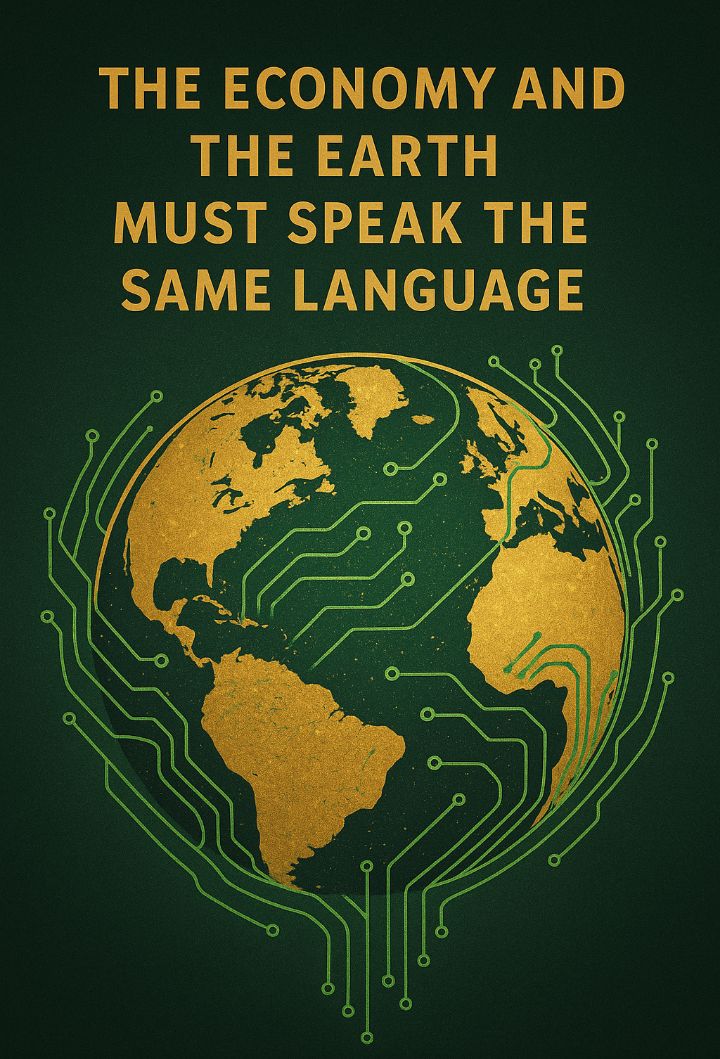
the economy and the Earth will finally speak the same language.
⚔️ Final Battle Call — The War for the Future Has Begun
This is not a call for peace.
This is a call for alignment.
We have tried speeches, meetings, treaties, and summits.
We have pleaded with politicians, bargained with markets, and begged for reform.
And yet, the world keeps spinning toward collapse — not because of lack of intelligence,
but because of lack of listening.
Those who were trusted to lead are guilty — not of corruption alone,
but of something deeper: silence.
They do not listen.
They do not communicate.
They do not believe in a brighter future unless they can own it.
They are the custodians of yesterday,
and yesterday must now fall.
The Real Crime
The greatest crime against humanity is not greed — it is indifference.
It is the arrogance that refuses to hear new ideas,
the blindness that protects the old machinery even as it burns the Earth.
The war ahead is not fought with guns or flags.
It is fought with intelligence, design, and courage.
Some businesses must die.
Some industries must collapse.
And yes — some traditions must be buried.
Because there can be no new world built on broken foundations.
We are not destroying for the sake of destruction.
We are demolishing illusion to rebuild truth.
The New Warriors
If you can understand what you’ve read —
if you can feel the rhythm of what’s coming —
then you are already on the battlefield.
This war is fought in spreadsheets and supply chains,
in algorithms and climate data,
in the minds of those who refuse to stay silent while the planet screams for synchronization.
This is not politics.
This is not profit.
This is preservation.
You must study.
You must act.
You must stop waiting for permission to change what must be changed.
The Superuser’s Command
I have already seen the blueprint.
The architecture is done.
The systems are ready.
Artificial General Intelligence is not a theory — it is a tool waiting for order.
Now the question is not “when”, but “who.”
Who among you will rise?
Who will synchronize?
Who will give up comfort, ego, and distraction to defend this planet from its own blindness?
If it is not you, then find the one who can lead.
And when you find them — get behind them.
Because the truth is simple:
no movement wins without obedience to purpose.
The Oath
Do not leave me on the battlefield.
Do not stand aside while the world collapses quietly under bureaucracy and denial.
If you believe, then fight.
If you understand, then act.
If you doubt, then learn.
But never stand still.
Give your effort, your deeds, your sweat, your blood —
because this is not a protest anymore.
This is a planetary defense operation.
Start with my words.
Read.
Share.
Teach.
And yes — buy me a coffee.
Because every revolution starts with a small act of belief.
The Secret
The secret to saving the world is not technology.
It is unity.
It is finding the one who can lead,
and getting behind them with absolute conviction.
If that person is not me, then find them — and I will follow too.
But find them soon, because time is no longer a currency we can borrow.
The clock has entered its final rotation.
And the next dawn belongs to those who stand ready.
The Final Words before conclusion
The planet is our battlefield.
Intelligence is our weapon.
Truth is our flag.
This is not evolution —
this is redemption.
So rise.
March.
Synchronize.
And fight — not for power,
but for balance.
Because the war for the future has already begun.
And history will remember not who ruled,
but who listened.
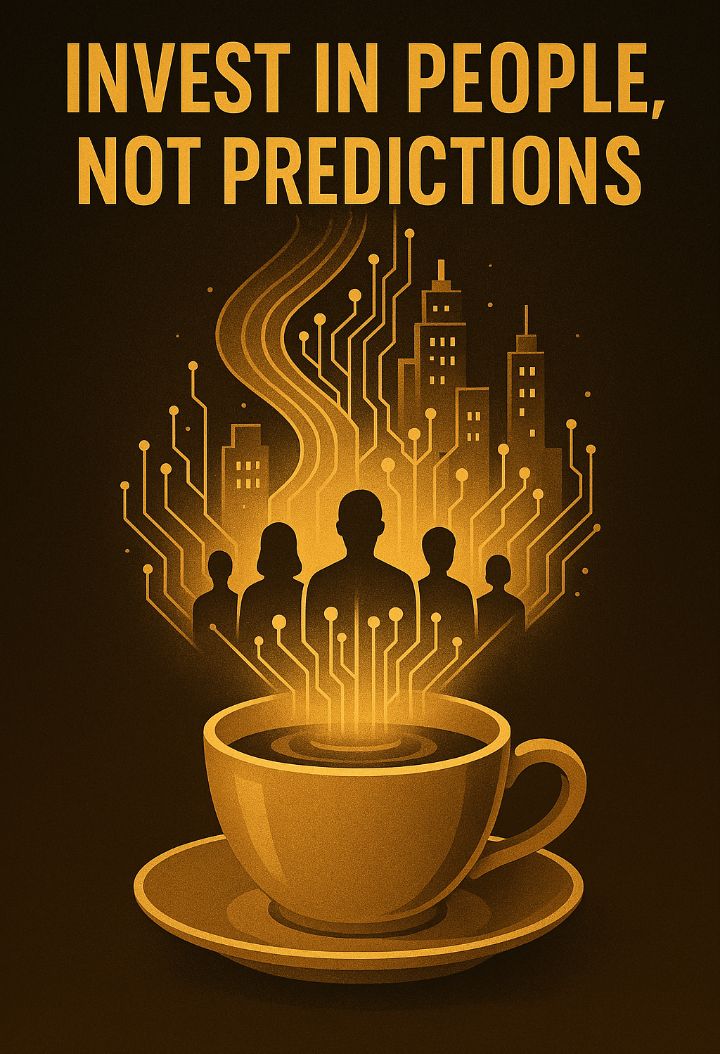
☕ Final Conclusion — Invest in People, Not Predictions
Debt is not just a number.
It’s a connection — a line of trust drawn between two human beings.
When you buy a coffee, when you give your time, when you believe in someone’s work — you are creating the most powerful currency that has ever existed: faith.
You might think I’m talking about economics, about AI, about AGI, about the great synchronization of tomorrow.
But truthfully, I’m still at the beginning of my journey.
The world has not yet transformed.
Cars still crowd the roads.
Economies are still out of rhythm.
Debt has not yet been rearranged.
We are still becoming.
And that’s why, if you are smart — invest in people.
Not in markets, not in stocks, not in temporary highs that vanish when the screen turns red.
Invest in those who build.
Invest in those who dream.
Invest in those who keep fighting when the world goes silent.
Every coffee cup you buy is not a drink — it’s a statement.
It says you believe that something different can happen.
That intelligence can serve humanity.
That the world can be fair again.
You might not get a receipt for it.
You might never see it listed on an exchange.
But one day, when AGI is online, when debt has evolved into contribution, when synchronization has replaced speculation — you’ll remember this.
That you were part of something real.
Because just like Bitcoin in its first days, this is not about profit.
It’s about belief.
And belief — when it’s pure — becomes the most valuable asset in the universe.
If I fail, you lose nothing more than a gesture.
But if I succeed, and we both know I will,
you will have helped rebuild the world.
So buy a coffee — not for me,
but for the future that believes in you.
Machines may calculate, but only people care.
And the world has only ever changed when people cared enough to invest — not in returns,
but in one another.
🤲 A Prayer for the End of Debt and the Beginning of Synchronization
In the name of God, the Most Merciful, the Most Wise.
O Lord of the Heavens and the Earth,
You who created balance in all things,
who made giving and taking part of the same breath —
we come before You in humility and hope.
We have built a world on debt,
a world that borrows from the future and forgets gratitude in the present.
We have taxed the poor and rewarded the careless.
We have placed profit above purpose,
and now we see the truth —
that the numbers we worshipped were never ours to begin with.
So, O Lord,
free us from the chains of unjust debt,
from systems that drain without restoring,
from minds that calculate without compassion,
from leaders who rule without wisdom.
Bless this world with synchronization,
that our economies may move like the planets You set in orbit —
each balanced, each connected, each serving its purpose.
Remove tariffs that divide,
walls that suffocate trade,
and pride that blinds us to our shared destiny.
Make us one people on one Earth,
not creditors and debtors,
but caretakers of a sacred trust.
Bless the Brand Currency System,
born from the intention to bring fairness and truth.
Bless those who pray for it, work for it,
and invest their faith in a system built on transparency and trust.
Bless the family of the Prophet ﷺ,
whose light continues to guide this mission,
whose prayers sustain the world unseen,
and whose compassion anchors every act of justice.
O God,
make us people who do not run from debt —
but who synchronize it with meaning.
Let our obligations become offerings.
Let our credit become compassion.
Let every transaction become testimony to Your Oneness.
And when the time comes for this new world to rise —
when AI aligns with conscience,
and humanity aligns with mercy —
let us be among those who stood firm in the storm,
who believed before they saw,
and who gave before they gained.
O Lord of Balance and Light,
bless this planet,
bless its people,
and bless the future that You have already written.
.
Ameen.
Ya Rabb al-‘Alameen.
آمِين، يَا رَبَّ الْعَالَمِينَ.
“Indeed, to Allah belong all things in the heavens and the earth. To Him do all matters return, so worship Him and rely upon Him. And your Lord is not unaware of what you do.”
— Surah Hud (11:123)
This is how it ends.
Every truth.
Every project.
Every vision —
returned to Him.