

بِسْمِ اللهِ الرَّحْمٰنِ الرَّحِيْم
The meeting between the Prophet Muhammad (PBUH) and Allah is the greatest event in human history. It is not just a story but a revelation authenticated through time, passed down by millions of Muslims through mutawatir Hadith—a narration verified by countless chains of trustworthy scholars and teachers. It is an unparalleled moment that defies the constraints of space, time, and human understanding, offering a glimpse into the limitless mercy and majesty of Allah.
Before diving into this sacred event, we must first address an essential truth: Allah, the Creator of space and time, is not confined by them. Unlike human meetings that require a location, Allah’s essence transcends all limitations. This meeting, though it occurred, does not imply a specific place or physical proximity.
---
Who is Allah? The Creator of All Things
Allah is beyond comprehension, unbound by space, time, or human attributes. The Quran emphasizes this divine transcendence:
“There is nothing like unto Him, and He is the Hearing, the Seeing.”
(Surah Ash-Shura, 42:11)
Even the pronouns we use—like “He”—are linguistic conveniences, not literal descriptions. Allah does not resemble His creation; He is the eternal, absolute reality. Before understanding the Prophet’s meeting with Allah, we must first recognize that Allah’s majesty surpasses all human constructs.
---
The Precedent: Musa’s Meeting with Allah
To appreciate the magnitude of the Prophet Muhammad’s meeting, we revisit the story of Prophet Musa (peace be upon him). Musa’s meeting with Allah at the burning bush was a moment of immense significance:
“And when he came to it, he was called, ‘O Musa, indeed, I am your Lord, so remove your sandals. Indeed, you are in the sacred valley of Tuwa.’”
(Surah Taha, 20:11-12)
This meeting was a revelation of Allah’s presence and mercy, but it occurred within the limitations of the Earth. It marked Musa as one of Allah’s chosen prophets and set the stage for his mission.
However, the meeting of the Prophet Muhammad (PBUH) transcended the earthly realm, taking place in the heavens and beyond, signifying his unparalleled status as the greatest of all creation.
---
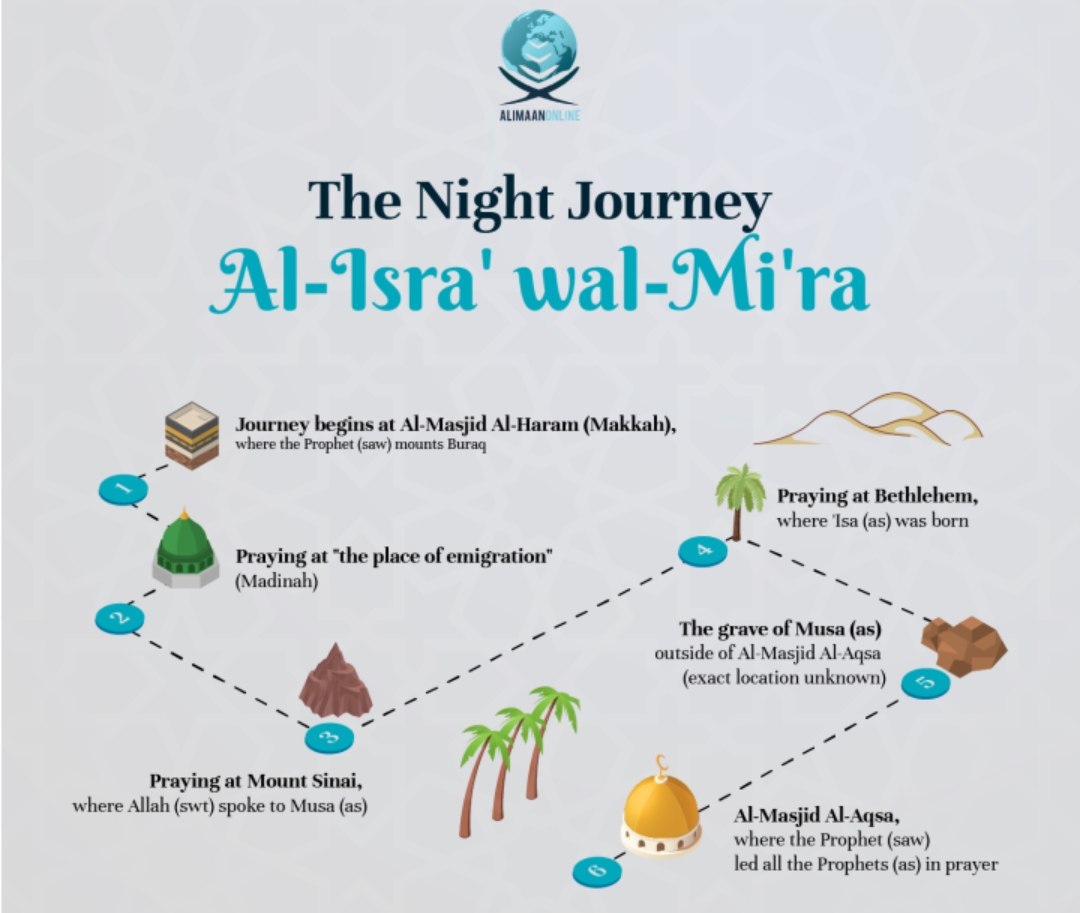
The Journey: Al-Isra’ wal-Mi’raj
The Prophet Muhammad’s (PBUH) journey was divided into two miraculous stages: Al-Isra’ (The Night Journey) and Al-Mi’raj (The Ascension).
1. Al-Isra’: The Journey on Earth
The journey began with the Prophet being transported from Masjid al-Haram (Mecca) to Masjid al-Aqsa (Jerusalem) in a single night. The Quran describes this event:
“Exalted is He who took His Servant by night from al-Masjid al-Haram to al-Masjid al-Aqsa, whose surroundings We have blessed, to show him of Our signs. Indeed, He is the Hearing, the Seeing.”
(Surah Al-Isra, 17:1)
This earthly journey connected the two holiest sites and demonstrated the unity of the Abrahamic prophets, as the Prophet Muhammad (PBUH) led them in prayer at Masjid al-Aqsa.
2. Al-Mi’raj: The Heavenly Ascension
From Jerusalem, the Prophet ascended through the seven heavens, meeting the great prophets:
Adam (peace be upon him) in the first heaven.
Yahya (John) and Isa (Jesus, peace be upon them) in the second.
Yusuf (Joseph, peace be upon him) in the third.
Idris (Enoch, peace be upon him) in the fourth.
Harun (Aaron, peace be upon him) in the fifth.
Musa (Moses, peace be upon him) in the sixth.
Ibrahim (Abraham, peace be upon him) in the seventh, leaning against the Kaaba of the heavens, Al-Bayt al-Ma’mur.
Finally, the Prophet reached Sidrat al-Muntaha (the Lote Tree), the boundary beyond which no creation can pass.
---
The Meeting with Allah
At this point, the Prophet Muhammad (PBUH) experienced what no other creation has: a direct encounter with Allah. Surah An-Najm describes this moment:
“And he was at a distance of two bow lengths or nearer. And He revealed to His Servant what He revealed. The heart did not lie [about] what it saw.”
(Surah An-Najm, 53:9-11)
This verse confirms the authenticity of the meeting and its profound nature. Unlike Musa, who could not see Allah and asked for a glimpse, the Prophet Muhammad (PBUH) experienced a unique closeness, symbolized by the distance of "two bow lengths or nearer."
It is important to note that this meeting was not confined by physical proximity or visual perception. Allah’s essence is beyond human sight, as the Quran reminds us:
“Vision perceives Him not, but He perceives [all] vision; and He is the Subtle, the Acquainted.”
(Surah Al-An’am, 6:103)
---
The Gift of Salah (Prayer)
During this meeting, the Prophet Muhammad (PBUH) received the gift of Salah, initially prescribed as fifty daily prayers. Upon descending, Musa advised the Prophet to ask for a reduction, knowing the burden it would place on the Ummah. The Prophet repeatedly returned to Allah, and the prayers were reduced to five daily, with the reward of fifty.
This gift symbolizes the mercy and accessibility of Allah’s love, as Salah remains the direct connection between Muslims and their Creator.
---
Quranic Defense of the Prophet’s Truth
The Quran defended the Prophet against skeptics who doubted this miraculous journey. Surah An-Najm eloquently recounts the event, confirming its authenticity:
“The heart did not lie [about] what it saw.”
(Surah An-Najm, 53:11)
Surah Al-Isra also emphasizes the divine nature of the journey, showcasing Allah’s power to transcend human limitations.
---
Lessons from the Meeting
1. Allah’s Transcendence:
The meeting demonstrates Allah’s limitless nature, beyond space, time, and human understanding.
2. The Prophet’s Unique Status:
As the Seal of the Prophets, the Prophet Muhammad (PBUH) was granted the ultimate honor, highlighting his unparalleled role in guiding humanity.
3. The Importance of Prayer:
Salah is a direct connection to Allah, a means of finding His love and guidance.
The meeting between the Prophet Muhammad (PBUH) and Allah is the ultimate testament to the love Allah has for His creation. It is a reminder that while Allah is beyond comprehension, His mercy and love are accessible to all who seek Him sincerely.
In the next article, we will explore how we, as individuals, can strive to connect with Allah’s love through prayer, remembrance, and the teachings
of the Prophet (PBUH).
The meeting of the Prophet Muhammad (PBUH) with Allah during the event of Al-Isra’ wal-Mi’raj was not only a spiritual milestone but also an unparalleled physical journey that defies human comprehension. In our timeline, where the challenges of traveling to space are immense—requiring advanced technology, protection against extreme temperatures, and precise calculations—this miraculous journey underscores the extraordinary nature of the Prophet (PBUH).
Unlike ordinary humans, the Prophet Muhammad (PBUH) undertook this journey without any external protection from the cold, heat, or vacuum of space. He traveled on Buraq, a heavenly creature described as faster than light, further emphasizing his unique status. This remarkable journey, encompassing both physical and spiritual dimensions, reflects his extraordinary essence as a human being whose internal state and divine connection were unmatched.
---
The Unique Nature of the Prophet Muhammad (PBUH)
The Prophet Muhammad (PBUH) was not an ordinary man. While outwardly human, his internal state and light were exceptional. A striking example of his uniqueness is that he cast no shadow, a reflection of the divine light emanating from him. This subtle sign, among many others, served to distinguish him, though he often chose to downplay his miraculous qualities.
He lived with humility, revealing his miraculous abilities only when necessary to fulfill his mission or benefit his companions. One such moment occurred during the Battle of Tabuk, when his companions were thirsty. He placed his fingers in a vessel of water, and water miraculously poured forth. Instead of openly declaring this a miracle, the Prophet (PBUH) simply allowed his companions to drink. Only those paying close attention realized the significance of what they had witnessed.
---
The Subtlety of His Miracles
Another telling moment was when the Prophet (PBUH) provided food for his companions from a seemingly limited supply. He asked them to continue serving from a pot that miraculously replenished itself. When one companion questioned him, the Prophet stopped the miracle and remarked, “If you had not questioned me, the pot would have continued to provide.”
These instances reveal his careful approach to miracles. Unlike Jesus (peace be upon him), whose public miracles were often a central part of his mission, the Prophet Muhammad (PBUH) was deliberate and subtle, ensuring his miracles served their purpose without drawing unnecessary attention. His humility and restraint reflected his profound understanding of human nature and the responsibility of carrying Allah’s message.
---
A Glimpse of His Inner Light
The journey of Al-Isra’ wal-Mi’raj also highlights the Prophet’s unparalleled spiritual state. His heart, purified during the miraculous event of his chest being opened and cleansed by Angel Jibreel (Gabriel), was the vessel through which divine light and guidance were transmitted. This spiritual purification prepared him to undertake the journey and receive the ultimate revelation without being overwhelmed.
His companions, though deeply devoted to him, often underestimated the magnitude of his inner light. They viewed him as a leader and teacher, yet only glimpsed the full extent of his connection to Allah during moments of divine intervention.
---
Building to the Next Chapter
The meeting between Allah and the Prophet Muhammad (PBUH) during Al-Isra’ wal-Mi’raj was a unique event in human history, one that solidified his role as the Seal of the Prophets. It demonstrated not only the depth of Allah’s love for His creation but also the unique nature of the Prophet, who balanced extraordinary miracles with profound humility.
In Conclusion: Understanding the Prophet Muhammad's (PBUH) Encounter with Allah
The profound question of whether the Prophet Muhammad (PBUH) saw his Lord during the Night Journey (Al-Isra’ wal-Mi’raj) has been a topic of deep discussion among Islamic scholars and believers. The Quran provides clear references to this unparalleled event:
“And he was at a distance of two bow lengths or nearer. And He revealed to His Servant what He revealed.”
(Surah An-Najm, 53:9-10)
“Are you going to dispute with him what he saw with his own eyes?”
(Surah An-Najm, 53:12)
“His sight never wavered, nor was it too bold, and he saw some of the greatest signs of his Lord.”
(Surah An-Najm, 53:17-18)
These verses vividly describe the encounter but leave room for interpretation regarding whether the Prophet (PBUH) saw Allah with his physical eyes.
---
What Do the Scholars Say?
The companions of the Prophet (PBUH) and Islamic scholars have held varying views on this subject. Aisha (may Allah be pleased with her) firmly stated:
“Whoever told you that Muhammad (peace and blessings of Allah be upon him) saw his Lord was lying. He said that no vision can grasp Him.”
(Narrated by Al-Bukhari)
Conversely, Ibn Abbas (may Allah be pleased with him) believed that the Prophet (PBUH) did see his Lord during this event. This divergence reflects the profound and transcendent nature of the encounter, which defies human comprehension and conventional perceptions.
The Quran confirms the transcendence of Allah:
“No vision can grasp Him, but His grasp is over all vision; He is the Subtle, the Acquainted.”
(Surah Al-An’am, 6:103)
---
Dreams and the Vision of Allah
Throughout Islamic history, esteemed scholars have reported seeing Allah in their dreams. These visions are deeply personal and symbolic, reflecting the spiritual state of the dreamer. One notable example comes from Imam Ahmad ibn Hanbal (rahimahullah):
Imam Ahmad saw Allah in a dream 99 times, and when he saw Allah the 100th time, he asked, ‘O My Rabb! What is the best deed that those seeking proximity to You may carry out?’ Allah replied, ‘Through My Speech [i.e., the Quran], O Ahmad.’ He further asked, ‘O My Rabb! [Does it have to be recited] with understanding or without understanding [to attain this virtue]?’ Allah answered, ‘With understanding or without.’”
This profound narration demonstrates the emphasis Allah places on His revealed word, the Quran, as the most significant means of connecting with Him.
Dreams, however, do not involve physical sight or form, as Allah is beyond all shapes, locations, and appearances. They represent an observation of the heart and are granted as a spiritual blessing to select individuals.
---
The Prophet’s Unique Encounter
The meeting during Al-Isra’ wal-Mi’raj remains distinct from any other vision or dream reported by other prophets or scholars. Unlike dreams, this encounter occurred during a conscious, physical, and spiritual journey that no other human has experienced. It emphasizes the Prophet’s (PBUH) unparalleled status as the greatest of Allah’s creation.
While the precise nature of the vision remains a divine mystery, the Quran reminds us of the significance of what the Prophet witnessed:
“And he saw some of the greatest signs of his Lord.”
(Surah An-Najm, 53:18)
---
A Lesson for Us
The meeting between the Prophet Muhammad (PBUH) and Allah serves as a reminder of the immense honor and mercy Allah bestows on His creation. For believers, it emphasizes the importance of sincerity in seeking Allah through prayer, Quranic recitation, and the purification of the heart.
As Imam Ahmad’s dream illustrates, connecting with Allah requires engaging with His speech—the Quran—whether through understanding or recitation. This is a gift accessible to every believer who seeks proximity to their Creator.
---
Conclusion
The Prophet Muhammad’s (PBUH) journey during Al-Isra’ wal-Mi’raj stands as the pinnacle of human spirituality and a moment unparalleled in human history. It reflects the depth of Allah’s mercy and the unique status of His beloved Prophet. For those seeking Allah’s love, the lesson is clear: purify your heart, engage with His speech, and approach H
im with sincerity.
In the next chapter, we will explore how this divine connection translates into our daily lives and how we can strive to emulate the Prophet’s
(PBUH) closeness to Allah through prayer, remembrance, and devotion.