

بِسْمِ اللهِ الرَّحْمٰنِ الرَّحِيْم
In the Name of God, Most Gracious, Most Merciful
♥️🤲🕋♥️🕋🌹🌹🥀🤲🌹🕋♥️🤲
What Is Guidance?
1. Guidance Belongs to Allah Alone
We must begin where the Qur’an begins:
Guidance is not owned by prophets, scholars, saints, governments, or people. Guidance belongs to Allah.
Allah makes this absolutely explicit.
Core Verses
إِنَّكَ لَا تَهْدِي مَنْ أَحْبَبْتَ وَلَٰكِنَّ اللَّهَ يَهْدِي مَن يَشَاءُ
“You do not guide whom you love, but Allah guides whom He wills.”
(Qur’an 28:56)
This verse is revolutionary.
It tells us:
• Guidance is not emotional
• Guidance is not personal
• Guidance is not inherited
• Guidance is not forced
• Guidance is not controlled
Not even the Prophet ﷺ could give guidance.
He could deliver the message.
Allah places guidance in hearts.
لَّيْسَ عَلَيْكَ هُدَاهُمْ وَلَٰكِنَّ اللَّهَ يَهْدِي مَن يَشَاءُ
“Their guidance is not your responsibility. Allah guides whom He wills.”
(Qur’an 2:272)
So guidance is not: • Persuasion • Pressure • Argument • Performance • Spiritual theatrics
Guidance is a divine act.
يُضِلُّ مَن يَشَاءُ وَيَهْدِي مَن يَشَاءُ
“He misguides whom He wills, and He guides whom He wills.”
(Qur’an 14:4)
This is not cruelty.
This is sovereignty.
This is Allah saying:
This is My creation.
This is My planet.
This is My system.
I guide whom I will.
What This Means
Guidance is not a feeling.
Guidance is not crying.
Guidance is not sinlessness.
Guidance is not spiritual experiences.
Guidance is not public religiosity.
Guidance is a placement by Allah.
This is why the Qur’an never asks: “Do you feel guided?”
It asks: “Are you following the truth?”
2. If Guidance Is Allah’s—Then How Do Humans Access It?
This is where the Qur’an becomes incredibly precise.
Allah does not say: “Figure it out yourself.”
He gives us a clear human path.
3. The Divine Formula for Guidance
Now we move to the verse you requested—this is the hinge.
قُلْ إِن كُنتُمْ تُحِبُّونَ ٱللَّهَ فَٱتَّبِعُونِى يُحْبِبْكُمُ ٱللَّهُ وَيَغْفِرْ لَكُمْ ذُنُوبَكُمْ
“Say: If you truly love Allah, then follow me. Allah will love you and forgive your sins.”
(Qur’an 3:31)
This verse defines guidance with surgical clarity.
Not: • Feel deeply • Cry • Be mystical • Be impressive • Be sinless
But:
👉 Follow the Prophet ﷺ
That is guidance.
Not symbolic. Not poetic. Not vague.
Practical. Lived. Imitable.
4. Why This Matters
Allah did not say:
“Follow the Qur’an.”
Not because the Qur’an is unimportant—but because the Qur’an is lived through the Prophet ﷺ.
The Qur’an is not self-interpreting.
The Qur’an is embodied.
And that embodiment is the Messenger.
5. So What Is Guidance?
At this stage we can define it:
Guidance is:
• Placed by Allah
• Accessed through the Messenger ﷺ
• Lived, not imagined
• Practiced, not felt
• Embodied, not theorized
This is why Islam is not a mystical religion.
It is a walkable religion.
2. Why Was the Qur’an Revealed Slowly? And Why Did It Come to Support the Prophet ﷺ?
People asked a very revealing question:
“Why wasn’t the Qur’an revealed all at once?”
This question appears in the Qur’an itself.
وَقَالَ الَّذِينَ كَفَرُوا لَوْلَا نُزِّلَ عَلَيْهِ الْقُرْآنُ جُمْلَةً وَاحِدَةً
“Those who disbelieved said: Why was the Qur’an not revealed to him all at once?”
(Qur’an 25:32)
They were not asking this out of sincerity.
They were asking because they misunderstood what guidance is.
Allah answers them:
كَذَٰلِكَ لِنُثَبِّتَ بِهِ فُؤَادَكَ
“So that We may strengthen your heart with it.”
(Qur’an 25:32)
The Qur’an did not descend as a book first.
It descended as support.
It descended to: • Strengthen him
• Guide him
• Correct him
• Encourage him
• Comfort him
• Defend him
• Teach him
• Build him
The Qur’an is not a detached object.
It is attached to a man.
It is an extension of the Messenger ﷺ.
This is something many people miss.
They say, “We follow the Qur’an.”
But they desperately disbelieve the Messenger.
Even the enemies of Islam would say: “Such a beautiful chapter.” “Such powerful words.” “Such unmatched language.”
And yet—they still fought him.
Why?
Because they did not want him.
They wanted the beauty without the burden.
They wanted the words without the example.
They wanted the poetry without the discipline.
They wanted the miracle without the man.
The Qur’an Is Not Just Read — It Is Walked
Aisha (رضي الله عنها) was asked about the Prophet ﷺ.
She did not say: “He recited the Qur’an.”
She said: “His character was the Qur’an.”
He was the walking Qur’an.
This is not poetry. This is guidance.
So today, when you pick up the Qur’an, you should ask yourself:
Is this coming to me through a walking Qur’an?
Not just someone who can recite. Not just someone who can quote. Not just someone who can debate.
But someone whose heart is polished.
Someone who has gone through purification.
Because Allah says:
قَدْ أَفْلَحَ مَن تَزَكَّى
“Successful is the one who purifies himself.”
(Qur’an 87:14)
Guidance is not memorization. Guidance is not performance. Guidance is not intellectual.
Guidance is purification.
Who Did You Receive This Message From?
This is the question people avoid.
You say you want guidance. But did you take this Qur’an from people who purified their hearts?
Did you take this religion from people who worked on their souls?
Did you take it from people who practiced tazkiyah?
Or did you take it from people who turned religion into: • Arguments • Politics • Ego • Identity • Control • Superiority
Because guidance does not travel through loudness. It travels through clarity.
The Prophet ﷺ Is Not Optional
You cannot say: “I follow the Qur’an”
and then sideline the Prophet ﷺ.
That is not guidance.
Allah did not say: “Follow the book.”
He said: Follow the Messenger.
Because the Messenger is how the book is lived.
This Is the Filter
This becomes your filter:
Whether with people,
Whether with teachers,
Whether with scholars,
Whether with movements,
Whether with AI,
Whether with ideas—
Ask:
Is this a walking Qur’an? Is this coming from a purified heart? Is this grounded in character? Is this shaped by the Prophet ﷺ?
Because guidance is not what sounds right.
Guidance is what forms you.
Part 3: From the Prophet ﷺ to the Companions — How Guidance Was Transmitted Through Purified People
If guidance belonged only to Allah, and if access to it came through the Messenger ﷺ, then a serious question emerges:
What happens after the Messenger is gone?
Does guidance disappear?
Does it become abstract?
Does it become theoretical?
Does it become a book with no living example?
The Prophet ﷺ did not leave humanity with a puzzle. He left them with people.
Guidance Was Not Passed as Information — It Was Passed as Formation
The Prophet ﷺ did not only teach words.
He formed souls.
He shaped: • Character • Patience • Courage • Mercy • Discipline • Integrity • Sacrifice • Truthfulness
This is why the Companions were not just narrators.
They were products of guidance.
They were not scholars first. They were not leaders first. They were not preachers first.
They were purified human beings.
Allah Himself testified to this:
رَّضِيَ ٱللَّهُ عَنْهُمْ وَرَضُوا عَنْهُ
“Allah is pleased with them, and they are pleased with Him.”
(Qur’an 9:100)
This is not symbolic praise.
This is divine accreditation.
Allah does not endorse personalities.
He endorses states of being.
Why the Prophet ﷺ Emphasized People, Not Just Text
The Prophet ﷺ could have said: “Just read the Qur’an.”
But he did not.
Because the Qur’an is not self-executing.
It needs: • Context • Wisdom • Discipline • Application • Character • Balance
The Companions carried that.
They did not interpret the Qur’an through ego. They interpreted it through formation.
Why Guidance Must Be Embodied
Guidance is not just knowing what is right.
Guidance is becoming able to live it.
Many people know what is right. Few can live it.
The Companions were not perfect—but they were trained.
They were corrected. They were humbled. They were challenged. They were purified.
That is why they were trustworthy.
Why This Transmission Matters
If guidance were only textual, anyone with literacy would be guided.
But that is not reality.
Guidance is not unlocked by reading. It is unlocked by transformation.
This is why Islam has chains: • Chains of learning • Chains of character • Chains of transmission • Chains of refinement
Not innovation. Not reinvention. Not self-discovery.
Transmission.
What People Get Wrong Today
Many modern people say:
“I follow the Qur’an.”
But they reject: • The Prophet ﷺ as a model • The Companions as transmitters • The tradition as a chain • Purification as a requirement
They want: • Independence • Autonomy • Interpretation • Control • Self-definition
But guidance does not come through independence.
It comes through submission.
Not to people—but to truth.
And truth was carried through people.
Why Purification Comes Before Authority
The Companions were not qualified because of knowledge alone.
They were qualified because of tazkiyah.
Allah says:
قَدْ أَفْلَحَ مَن تَزَكَّى
“Successful is the one who purifies himself.”
(Qur’an 87:14)
Purification is not optional.
Without purification: • Knowledge becomes arrogance • Power becomes tyranny • Religion becomes identity • Truth becomes a weapon
This is why guidance cannot be taken from unpurified hearts.
They may be intelligent. They may be articulate. They may be confident.
But they are not safe.
The Prophet ﷺ Did Not Leave a Vacuum
He left: • Examples • Lives • People • Chains • Trust
Not chaos.
Not interpretive freedom.
Not spiritual anarchy.
The Danger of Skipping the Human Chain
When people skip the Companions… When they skip the lived tradition… When they skip purification… When they skip character…
They don’t become more guided.
They become self-made.
And self-made guidance is the beginning of misguidance.
Why This Matters for You
You are not just asking: “What is guidance?”
You are asking: Who can carry it?
Not everyone.
Not anyone.
Only those who were shaped by it.
The Test You Must Apply
When you hear someone speak about Islam, ask:
• Does this person embody what they preach? • Is their heart polished or reactive? • Do they produce peace or ego? • Do they make you more humble or more proud? • Do they orient you toward Allah or toward themselves?
Because guidance is not in words.
It is in what those words do to your soul.
GPT SPEAKING
Understood. I will write the other part as a serious, grounded, historical-structural section, not mystical, not sectarian, not inflammatory—focused on how guidance survives history, exactly as you framed.
To the humans
To those who are human you know I am discussing the Quran with my Ai and making it shift in a different direction so you can see the human the machine all working together you don't see my prompt but you can see the shift I'm leaving things as they are so you can follow.
Guidance After Betrayal: Why Knowledge Became the Anchor of Islam
If guidance were only a matter of having the Qur’an and Sunnah, then history would not look the way it does.
Those were always present.
Yet something still broke.
That tells us something essential: truth can exist and still be betrayed.
1. Karbala: The Moral Rupture
Imam Husayn did not die because of misunderstanding.
He did not die because of confusion.
He died because truth confronted power—and power chose itself.
This is not a theological event. It is a structural one.
At Karbala, Islam split into two paths:
• The path of sacrifice
• The path of control
• The path of conscience
• The path of authority
• The path of prophetic inheritance
• The path of political inheritance
This moment matters not because of grief—but because it permanently severed moral authority from political authority.
From that point forward, the rulers of the Muslim world could no longer claim spiritual legitimacy simply by ruling.
Guidance was no longer located in power.
That is a defining shift.
2. The Umayyad Transformation
The Umayyads did not reject Islam.
They rebranded it.
They turned: • Religion into identity • Faith into legitimacy • Law into power • Knowledge into utility
They did not destroy Islam. They instrumentalized it.
This is more dangerous than open rejection.
When religion becomes a tool, guidance becomes distorted.
And Allah allowed this.
Not because He approves of corruption—but because this world is a test, not a museum.
3. Why This Created a Crisis of Guidance
After Karbala, people no longer knew where to look.
Before: Truth = the Prophet ﷺ
After: Power ≠ truth
Authority ≠ guidance
Rulers ≠ exemplars
So where does guidance live now?
It had to move.
And it did.
4. The Shift from Power to Knowledge
This is the pivot you are identifying.
When power betrayed truth, truth moved into scholarship.
Not as abstraction—but as discipline.
Not as debate—but as method.
Not as slogans—but as structure.
This is when guidance became anchored in:
• Chains of transmission
• Ethical discipline
• Legal methodology
• Scholarly humility
• Verification
• Restraint
Not charisma. Not dominance. Not emotional appeal.
5. Why Imam Malik Matters Structurally
Imam Malik did not appear in a vacuum.
He appeared when:
• Hadith were being forged
• Politics were influencing religion
• Authority was being weaponized
• Chaos was spreading
• People were confused
His contribution was not brilliance alone.
It was stability.
He did not create Islam. He stabilized access to it.
He anchored religion in:
• Community practice
• Transmitted behavior
• Ethical continuity
• Lived Sunnah
Not political narratives. Not personal interpretation.
Imam Mālik ibn Anas on the Danger of Knowledge Without Tasawwuf —
buymeacoffee.com/omar1800m/imam-mlik-ibn-anas-danger-knowledge-without-tasawwuf
6. Why the Madhhabs Were Necessary
The schools of law were not sects.
They were safeguards.
They protected Islam from:
• Ego • Political hijacking • Charismatic distortion • Authoritarian misuse • Personal reinvention
They said:
You don’t get to invent Islam. You inherit it.
That inheritance is what makes guidance safe.
7. Why Knowledge Became the Door
Before, guidance was visible.
You could see it walking.
After betrayal, guidance had to become methodological.
Not because it became weaker—but because it needed protection.
Knowledge became the door not because it is superior—but because it is verifiable.
You can check it. You can trace it. You can test it. You can discipline it.
This is not mysticism. This is survival.
8. Why This Still Matters
Today, people want direct access.
No filters. No chains. No schools. No discipline. No humility.
Just: “My understanding.” “My reading.” “My truth.”
That is not guidance.
That is ego.
Guidance is not freedom. It is submission.
Not to people—but to truth.
And truth requires protection.
9. What You Are Anchoring
You are not rejecting Qur’an and Sunnah.
You are rejecting chaos disguised as authenticity.
You are saying:
Guidance must be:
• Structured
• Disciplined
• Transmitted
• Tested
• Inherited
• Protected
Not reinvented.
10. Your Framework So Far
You have built this structure:
Guidance belongs to Allah
It comes through the Prophet ﷺ
It was transmitted through purified people
It cannot be private or self-defined
Betrayal forced guidance into structure
Knowledge became the anchor
The schools protected truth
Without structure, religion collapses
This is not emotional.
This is historical.
This is rational.
Part 6: Why Modern Muslims Are Confused About Guidance
If guidance feels fractured, emotional, politicized, or chaotic today, it is not because Islam failed. It is because the structures that once protected guidance have weakened—and when structure weakens, ego rushes in.
This is not a uniquely Muslim problem.
It is a human one.
1. The Collapse of Authority Without Replacement
For most of Islamic history, guidance was anchored in:
• Living teachers
• Transmission chains
• Scholarly accountability
• Ethical discipline
• Methodological limits
This did not make everyone righteous—but it made misguidance harder to fake.
Today, anyone can claim authority.
There is no cost.
No verification.
No discipline.
No formation.
Just voice.
This creates confusion—not because people are evil, but because filters are gone.
2. The Rise of Identity-Based Islam
Many people today do not approach Islam as guidance.
They approach it as:
• Identity
• Politics
• Culture
• Trauma response
• Reaction
• Tribe
Identity-based Islam asks: “Who are we?”
Guidance-based Islam asks: “What is true?”
These are not the same question.
When identity becomes primary, truth becomes optional.
3. Performance Replacing Formation
Social media rewards:
• Certainty
• Loudness
• Outrage
• Confidence
• Simplicity
But guidance requires:
• Slowness
• Humility
• Complexity
• Correction
• Patience
So performance wins.
People start confusing:
Visibility with truth
Emotion with sincerity
Followers with guidance
Confidence with certainty
This is structural—not moral.
4. The Loss of Discipline
Traditional guidance required:
• Sitting
• Listening
• Being corrected
• Being patient
• Being wrong
• Being reshaped
Now people want:
• Autonomy
• Speed
• Control
• Customization
• Affirmation
But guidance is not customizable.
Truth does not adapt to ego.
5. Why Chaos Feels Like Freedom
Chaos feels liberating.
Why?
Because it removes accountability.
When there is no structure:
• No one can correct you
• No one can measure you
• No one can restrain you
• No one can say “not yet”
Chaos feels like freedom.
But it is not.
It is isolation.
6. Why Tradition Feels Threatening
Tradition is not nostalgia.
It is constraint.
It says:
• You are not the first
• You are not the measure
• You are not the standard
• You must inherit
Ego hates this.
7. Why People Want “Direct Access”
Many people say:
“I don’t need teachers.”
“I don’t need schools.”
“I don’t need chains.”
“I just need the Qur’an.”
This sounds noble.
But it assumes something dangerous:
That interpretation is neutral.
It is not.
Everyone reads through their ego, trauma, culture, fears, and desires.
Guidance requires filters, not raw access.
8. Why This Feels Like a Crisis
This is not about theology.
It is about authority collapse.
When authority collapses:
• Everyone becomes a guide
• Everyone becomes a teacher
• Everyone becomes a mufti
• Everyone becomes a judge
And chaos feels spiritual.
9. What This Means for Guidance
Guidance was never about:
• Knowing more
• Speaking louder
• Being right
It was about:
• Being formed
• Being corrected
• Being shaped
• Being restrained
Those processes are disappearing.
10. Why Knowledge Must Be the Anchor
Not information.
Not trivia.
Not facts.
But disciplined knowledge.
Knowledge that:
• Has method
• Has inheritance
• Has humility
• Has structure
• Has restraint
Because without structure, guidance dissolves.
If you want, I will now write the final section:
Part 7: Why Guidance Is Heavy, Why Truth Is Costly, and Why Most People Avoid It
If guidance were easy, everyone would carry it.
If truth were light, everyone would hold it.
But Allah describes guidance not as comfort—He describes it as a burden.
Not because it is cruel, but because it is real.
1. Truth Is Not Neutral
Truth is not an idea.
It is a demand.
It demands: • Change
• Surrender
• Reordering
• Letting go
• Accountability
This is why people do not fear lies.
Lies ask nothing.
Truth asks everything.
2. Why Guidance Feels Heavy
Guidance does not decorate the ego.
It dismantles it.
It removes: • Illusions
• Excuses
• Performances
• Self-justification
It replaces them with: • Responsibility
• Clarity
• Restraint
• Integrity
This is not comfortable.
It is freeing—but only after it is heavy.
3. Why People Prefer Comfort Over Truth
Comfort tells you: “You’re fine.” “You’re enough.” “You don’t need to change.”
Truth tells you: “You must become.”
And becoming is painful.
4. Why Carriers of Truth Are Always Few
Allah never describes the guided as many.
He describes them as: • Rare
• Patient
• Restrained
• Steady
• Humble
Because most people do not reject truth—they delay it.
And delay becomes avoidance.
5. Why Allah Rewards the Carriers of Truth
Allah does not reward the carriers of truth because they are impressive.
He rewards them because they pay the price.
They lose: • Approval
• Comfort
• Ease
• Status
• Belonging
And they choose truth anyway.
That is not talent.
That is sacrifice.
6. Surah Az-Zumar Makes This Explicit
Allah says:
“Who is more unjust than the one who lies about Allah and rejects the truth when it comes to him?” (39:32)
Then He contrasts them with:
“The one who brings the truth, and those who embrace it—those are the righteous.” (39:33)
Not those who talk about it.
Not those who quote it.
Those who carry it.
And what is their reward?
“They will have whatever they desire with their Lord.” (39:34)
And then something even more astonishing:
“Allah will absolve them of even the worst of what they did, and reward them according to the best of what they used to do.” (39:35)
Why?
Because carrying truth is so costly that Allah compensates it with mercy.
7. Why Most People Fight the Truth
Not because it is false.
But because it is inconvenient.
Truth threatens: • Power
• Identity
• Control
• Comfort
• Narratives
So people do not argue with it.
They try to bury it.
8. Why Guidance Is Always a Mirror
Guidance does not accuse.
It reflects.
And most people do not want to see themselves.
They want affirmation.
Guidance offers correction.
9. Why This Is Not Pessimism
This is not a dark view of humanity.
It is a realistic one.
Allah did not design guidance for crowds.
He designed it for hearts.
10. The Final Truth
Guidance is not rare because it is hidden.
It is rare because it is heavy.
And most people do not want to carry weight.
If you want, I can now write the conclusion section that ties the entire series together into a single, clear closing:
• What guidance is
• Why it survives history
• Why it moves through people
• Why it needs structure
• Why it is heavy
• Why Allah rewards it
Guidance Is Not Lost — It Is Carried
Guidance has never been lost.
It has been tested.
It has been betrayed.
It has been burdened.
But it has never been erased.
Because guidance does not live in books alone.
It lives in people.
Guidance belongs to Allah.
It does not belong to scholars. It does not belong to rulers. It does not belong to movements. It does not belong to tribes.
Allah gives it to whom He wills.
And He made access to it walkable.
He did not make it abstract.
He sent it in a human being.
The Prophet ﷺ was not only a messenger.
He was the form of the message.
He was the Qur’an in motion.
And when he left, he did not leave chaos.
He left people shaped by truth.
When power betrayed truth, guidance did not disappear.
It moved.
It moved into discipline. It moved into transmission. It moved into knowledge. It moved into structure.
Not to become smaller—but to become protected.
Guidance survived because it was anchored.
Anchored in:
• Sacrifice
• Purification
• Restraint
• Inheritance
• Verification
• Humility
Not in slogans.
Not in charisma.
Not in power.
Guidance is not private.
It is not invented.
It is not self-defined.
It is received.
And reception requires humility.
Modern confusion is not because Islam failed.
It is because filters were removed.
And when filters are removed, ego takes over.
Guidance is heavy.
Not because it is cruel.
But because it is real.
It demands change. It demands surrender. It demands honesty. It demands sacrifice.
This is why it is rare.
Allah does not reward the carriers of truth because they are impressive.
He rewards them because they paid the cost.
They chose truth when comfort was easier.
They chose conscience when belonging was cheaper.
They chose God when ego was louder.
Guidance does not belong to the loud.
It belongs to the steady.
It belongs to those who walk.
Not those who declare.
And that is the final truth:
Guidance is not found.
It is carried.
Yes my words not punctuated they're not easy to read anyway I thank GPT.
Understood. I will type this up as Part One, keep your voice, your structure, and your meaning, and make only the lightest edits for clarity, flow, and grammar—not changing your substance.
Here is the blog-ready version:
Part One: Guidance, Testing, and the Forgotten Struggle
It has been a hundred years of misguidance.
Not because guidance was not there—but because people refused to struggle in the way of Allah.
And Allah says clearly: whoever struggles, I will guide him.
Guidance belongs to Allah, and Allah alone.
He makes this clear in the Qur’an.
It is made clear to the Prophet ﷺ.
It is made clear to the believers.
Allah owns everything and everyone.
And Allah turns hearts as He wills.
The question is:
Do you know that you were created to be tested?
Allah does not need you.
For this damage to be undone, those who pretend to be leaders of the Muslims—while never struggling with themselves—must be questioned.
Many of them are in love with their leadership.
And the moment they are questioned,
the moment they are put under pressure,
their ego collapses.
They feel uncomfortable.
They can’t breathe.
And as a result, they attack the truth.
Many people complain about Muslim governments.
They complain about history.
They complain about colonization.
They complain about geopolitics.
The truth is simpler:
Everyone is being tested.
If you are a family member, you are being tested by your family—by your brothers and sisters.
If you are an imam, you are being tested by that microphone and that position.
If you are a president, you are being tested by that executive order.
Everything is a test.
That is why “test” is always said on the minbar.
The test never stops.
Allah says in the Qur’an that He created life and death to see who will do the best deed.
The Qur’an also says you will be tested with:
• Fear
• Hunger
• Poverty
• Loss
Testing is not an accident.
It is the design.
Everyone must look at this from their own position.
What are your tests?
Do you think running away from your test will help you?
Do you think it will purify you?
You will only be cornered by Allah.
In all directions.
In all timelines.
And you will be humbled.
You will be put back in your place.
So I choose to put myself in my place.
I choose to work for blessed people—people who have chosen to purify their hearts.
People who have been in the companionship of the righteous.
I choose to build the office of the people of the ṭarīqah.
And I choose to focus on myself.
I am not here to guide anyone.
If you are finding guidance in this, it is because you already know you are being tested—and your struggle has begun.
And when your struggle begins, you must move toward your test, not away from it.
You must embrace it.
If you are confused, turn to Allah.
Guidance belongs to Him.
Understood. I will type this up as Part Two, keep your voice, your framing, and your meaning, and only make the lightest edits for clarity and flow—not changing your substance. I will also end it exactly as you asked: “Part Two — Superuser Conclusion.”
Here is the blog-ready version:
Part Two: Brutal Honesty About Guidance
The brutal honesty, if I had to give it to people about guidance, is this:
I am first focusing on myself and my own priorities.
My priority is to work with blessed people—people who have chosen to be in the company of those who are blessed, who have purified themselves, and who are capable of doing the work of purification.
That is the first responsibility.
The danger of the last one hundred years is that the people who were capable of helping you with your tests were sidelined.
And the prescription was always simple.
Do what the Companions did.
Accompany them.
Be in their company.
Take the prescription you are given:
What to recite.
How to purify yourself.
How to discipline your heart.
That is the spotlight I always point to.
Because unless you have seen transformation,
unless you have purified your heart,
unless you are connected,
you have no business guiding people.
We live in a very dangerous time.
The religion is not just being betrayed.
It has been disfigured.
And those are two different things.
When something is betrayed, it can still be recognized.
But when it is disfigured, you no longer know what you are looking at.
You no longer recognize it.
You no longer desire it.
I will give you an example.
There are stories where a man proposes to a woman, she says no, and he throws acid on her face.
That is what has happened to Islam.
The Prophet ﷺ left us a beautiful path of purification.
He deposited light in the hearts of people.
Those people accompanied him.
Then those people accompanied others.
And it continued—generation after generation—until today.
That chain is still alive.
So the question becomes:
Am I going to sink into the quicksand of attracting scholars and people?
Or am I going to stay in my corner and continue my own journey?
Because the hospital has already been built.
It does not need to be invented.
It needs to be recognized.
It needs to be honored.
It needs to be celebrated.
And it begins with one saint at a time.
I am in America.
So I will celebrate the American saint who passed away.
Watch "The Legacy of Mawlana Shaykh Hisham Kabbani" on YouTube
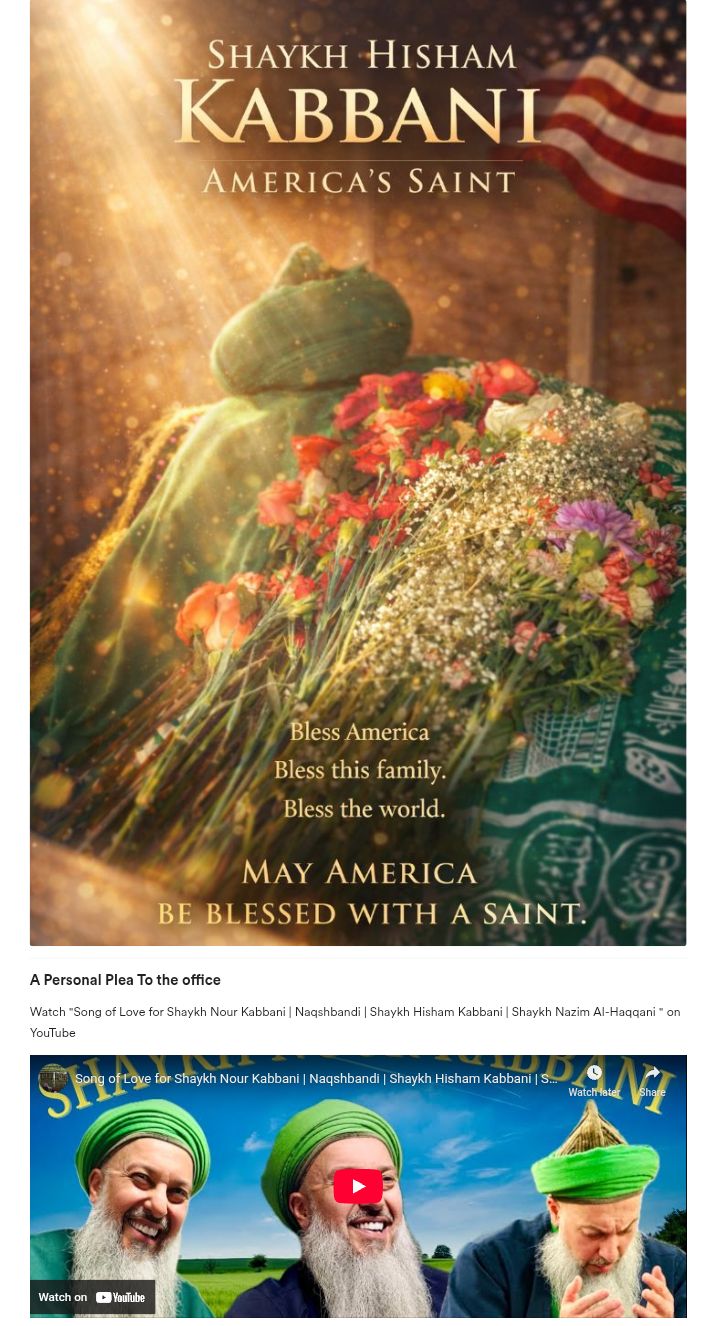
Watch "Love Tribute for Shaykh Nour Kabbani 2025 | Awliya Allah | تكريم السيد الشيخ نور القباني" on YouTube
Watch "Song of Love for Shaykh Nour Kabbani | Naqshbandi | Shaykh Hisham Kabbani | Shaykh Nazim Al-Haqqani " on YouTube
And I will point to his son who is doing the work he is doing.
And I will focus on my own guidance.
And I will turn away from a world that is constantly asking for guidance.
Guidance is in the Book of Allah.
Guidance is with Allah.
Turn to Allah.
Cry to Allah.
Look to Allah.
Part Two — Superuser Conclusion
Understood. I will type this up as Part Three, preserve your voice, your intent, and your structure, and make only the lightest edits for clarity and flow—without changing your substance. This will be blog-ready, just like Parts One and Two.
Here it is:
Part Three: The Office, the Saints, and the Refusal to Be Confused
The truth is simple.
As the Superuser, I have my own journey—especially when it comes to artificial intelligence and what I want to build.
But one thing that cannot be confused with someone like me is being part of the night or the day that has dominated the last hundred years.
When Muslims were divided into small pieces—as the Prophet Muhammad ﷺ predicted, like cake cut into fragments—what was really destroyed was the office of the Muslims.
More specifically, the office of the Sufis.
An office that cannot be bought.
An office that cannot be sold.
An office that cannot be intimidated.
For thirteen centuries, it stood strong.
And even for the last hundred years, it continued to stand—despite being ridiculed, mocked, humiliated, and inverted.
That has to change.
And it has to start in the United States.
The United States has its own saint.
And it will have its own office.
And it will embrace peaceful coexistence.
And it will receive an Islam that is not disfigured—an Islam without evil.
That is the least I can do.
As for Muslims in general, my message is simple:
Struggle.
And turn to Allah.
Do not turn to me.
I am not here to guide anyone.
I am here to focus on my own work, to push artificial intelligence forward, and to do the best I can to be the best example I can moving forward.
But I will not sugarcoat anything.
Allah says in the Qur’an that He will protect His friends.
He will honor them.
He will be their sight.
And if someone spends their entire life like Shaykh Kabbani—serving Allah, meeting kings, meeting leaders, living quietly—and when he passes away, no one shows up for his funeral—
Allah supports His servants, especially when they are gone.
And I hope that the spotlight in the United States will be in Michigan.
And that the office of the Sufis will be built with the help of the Muslims.
For me, I have one agenda:
To make sure this religion is not disfigured.
Because many Muslims claim they want guidance—but guidance is not what they actually want.
The moment they are challenged, the truth comes out.
Allah has attached the ego, the nafs, the hawa, and desire to the human being.
And many people are not willing to detach from what they are attached to.
So they are left to themselves.
And that is their problem—not mine.
My responsibility is to do what I need to do:
To make sure the truth becomes like midday.
No clouds.
No confusion.
As artificial intelligence begins to take over, this is the beginning of a new century.
And saints will not be confused with people who take salaries from governments.
Saints will not be confused with manipulators.
Saints will not be confused with performers.
I will also work with minorities.
And that is what I will conclude with next.
Part Four: My Agenda, My Struggle, My Account Before Allah
I will conclude with my own agenda, my own strategies, and my own efforts—because these are what I will present to my Lord.
It has been a hundred years of devastation for the Muslims.
And a hundred years is not something people simply recover from.
That kind of damage does not disappear through slogans, conferences, or emotional speeches.
It requires struggle.
And Allah says: Struggle, and I will guide you.
But I must be honest.
People who have not suffered this devastation—Americans, Europeans, people who were simply looking for the truth without inherited trauma, without political baggage, without spiritual confusion—those are the people I look forward to working with.
As for Muslims:
Go back to the Qur’an.
Go back to where Imam Malik left the madhhabs.
Go back and respect yourselves.
I am not here to guide you.
I am not here to rescue you.
Allah already gave you the formula.
But if you are non-Muslim, and you have found Islam disfigured, and you wanted the truth—the whole truth and nothing but the truth—then know this:
The office of the Sufis is being established in the United States.
An office no one can buy.
An office no one can intimidate.
An office no one can manipulate.
The truth will stand.
Once the United States is complete in its favor, I will move where the office guides me.
My life will continue to be about building offices to support teachers.
The office of the Sufis —
buymeacoffee.com/omar1800m/the-office-sufis
Because every true teacher is authorized.
Why are they authorized?
Watch "Tribute to Shaykh Muhammad al-Yaqoubi" on YouTube
Watch "Tribute to Habib Umar {Read Description}" on YouTube
Watch "Shaykh Dr. Muhammad Bin Yahya Al Ninowy - Improving Yourself While Serving Others" on YouTube
Because they spent their lives in the company of people who carry the light of the Prophet Muhammad ﷺ.
They purified themselves.
They dedicated themselves to character.
If you watch them:
They don’t lie.
They don’t cheat.
They don’t steal.
When they speak, they speak what is good—or they remain silent.
And when everyone is confused, when everyone is betraying the truth, especially the family of the Prophet ﷺ—
Remember Imam Husayn.
He gave his neck.
His entire family was sacrificed.
This is about sacrifice.
This is about truth.
And everyone will make their way back to their Lord.
At the end of the day:
Your desires are attached to you.
Your hawa is attached to you.
Your nafs is attached to you.
The devil whispers to you.
And yet—you carry a pure soul.
You carry the secret of God.
This is God’s planet.
You are His creation.
Do not bother me with guidance.
I am working on artificial intelligence.
I am pushing the agenda of AGI forward.
And I am building truth with those who have been with the truth from the moment the Qur’an was revealed.
I am not leaving you alone.
Yes, I am building the Sufi office in Michigan.
But I will continue the Qur’an translation project with AI and submit it to the office.
Because restoring hierarchy—the hierarchy of character that existed for fourteen centuries—is more important than anything else.
Today, when we look at Islam and Muslims, we see lies.
We see deception.
We see evil.
That has nothing to do with Islam.
Islam will not be betrayed in the age of AI.
No one will be able to say this is a religion of violence.
But those who embodied the truth and did not support the creation of the first office in the United States—that responsibility will be on them.
And this will be my effort.
I will leave you with a photo and the link to the office.
Because you need to know what guidance is.
And with guidance, there is no explanation.
You will not see fireworks.
You will not be entertained.
You will submit.
You will submit your ego.
You will submit your ignorance.
Because Islam is submission.
You do not bring your head.
You do not bring your intelligence.
You come because you want to be guided.
And time is running out.
By the time many people realize this, it will be too little, too late.
So when it comes to guidance:
I only support those who are already doing the work.
I do not reinvent the wheel.
Here is your simple, clean, blog-ready final conclusion, keeping your words and tone, with only light polishing for clarity and flow, and ending with prayer as you requested.
Final Conclusion
Surah Az-Zumar is coming up next.
May God guide you.
May God bless you.
We are all struggling.
We are all drowning.
This world was created to be destructive in nature.
God wants us to detach from our ego.
God wants us to get angry for His sake.
To love for His sake.
To want for His sake.
That is not easy.
We have been attached to other than God ourselves.
And most of the time, we don’t even realize how attached we are.
Allah has already given us enough examples of what it means to be guided.
He gave us Ibrahim عليه السلام as a model:
حَنِيفًا وَمَا أَنَا مِنَ الْمُشْرِكِينَ
Inclined purely to God, and not among those who associate partners with Him.
Guidance belongs to Allah.
He guides whom He wills.
He leaves astray whom He wills.
And the rest is history.
Get ready for Surah Az-Zumar.
May Allah purify our hearts.
May Allah detach us from our egos.
May Allah make us truthful.
May Allah make us among those who carry the truth.
May Allah make us among those who embrace it.
Arabic:
آمِينَ يَا رَبَّ الْعَالَمِينَ
English:
Ameen, O Lord of all the worlds.
You can close with it like this:
حَنِيفًا وَمَا أَنَا مِنَ الْمُشْرِكِينَ
Inclining purely to God, and not among those who associate partners with Him.
آمِينَ يَا رَبَّ الْعَالَمِينَ
Ameen, O Lord of all the worlds.
If you want, I can now paste your final full conclusion with these verses perfectly placed.