
بِسْمِ اللهِ الرَّحْمٰنِ الرَّحِيْم
The Missed Invention: What Every Tech Company Got Wrong About Voice, AI, and Identity
I want to say something that may change the way you look at AI, voice technology, and the entire future of human-machine interaction:
You missed it.
You built the models. You scaled the infrastructure. You raced to release products with voice assistants, smart devices, and conversational AI.
You delivered power—yes.
But you overlooked something right in front of you:
The voice was never supposed to be a feature. It was supposed to be the key.
You made users pick voices like they were shopping for accents.
You gave them options: “Choose this one, or that one.”
But in doing so, you created something generic—not intimate, not personal, and definitely not secure.
You built AI—but not their AI.
Every time someone speaks to Alexa, Siri, or ChatGPT, they’re not speaking to something that knows them.
They’re speaking to a product.
Not a partner.
Not a reflection.
Not a witness.
In today’s world, we log into Gmail with a username and password.
We unlock devices with Face ID.
But when it comes to the AI that will soon be listening to everything, guiding everything, recording everything, you’ve given us nothing personal.
No key.
No lock.
No way to tell this is mine.
You were supposed to merge our voices.
What you should have done was simple—but visionary:
Take the person’s real voice—its rhythm, its pauses, its emotional fingerprint—
Then generate an AI voice that blends with it.
A merged signature.
Half-human, half-machine.
A voice that belongs to them.
That’s the true authentication of the future.
Because AI is going to be in the room.
It’s going to hear everything.
And people won’t want to be recorded or tracked—
but they’ll need AI to do things for them, securely and privately.
And the only way that works
is if AI knows who it’s talking to
through the voice alone.
You gave us preloaded voices—
But what we needed was a signature.
Something as unique as a fingerprint.
Something that tells AI: This is my human.
And tells the human: This is my AI.
Right now, using AI feels like wearing someone else’s clothes.
Sure, it fits. It works. It might even look good.
But it’s not yours.
It doesn’t speak with your spirit.
It doesn’t know you.
And when it responds, it responds like a machine speaking to a stranger.
AI Is Going to Run Our Lives—So Why Doesn’t It Feel Personal?
AI is going to be your inbox, your calendar, your journal, your doctor, your analyst, your translator, your writer, your proofreader, your witness.
It’s going to sit beside you in meetings, filter your memories, and draft your future.
So why on Earth would we accept a system that talks back in a voice we didn’t help create?
This is more than branding.
This is about human dignity.
This is about ownership.
This is about trust.
You created something powerful—
But because you failed to personalize the voice,
you broke the interface.
This Is a Call to the Builders, the Boards, the Billion-Dollar Roadmaps
I’m not here to criticize for the sake of it.
I’m telling you that your future depends on hearing this now.
The interface you chose—these off-the-shelf voices, this assistant model—
It’s going to feel emptier and colder the more powerful the AI becomes.
And the public is going to sense it:
That AI isn’t with them—it’s watching them.
But there’s still time.
Go back to the drawing board.
Throw out the product voices.
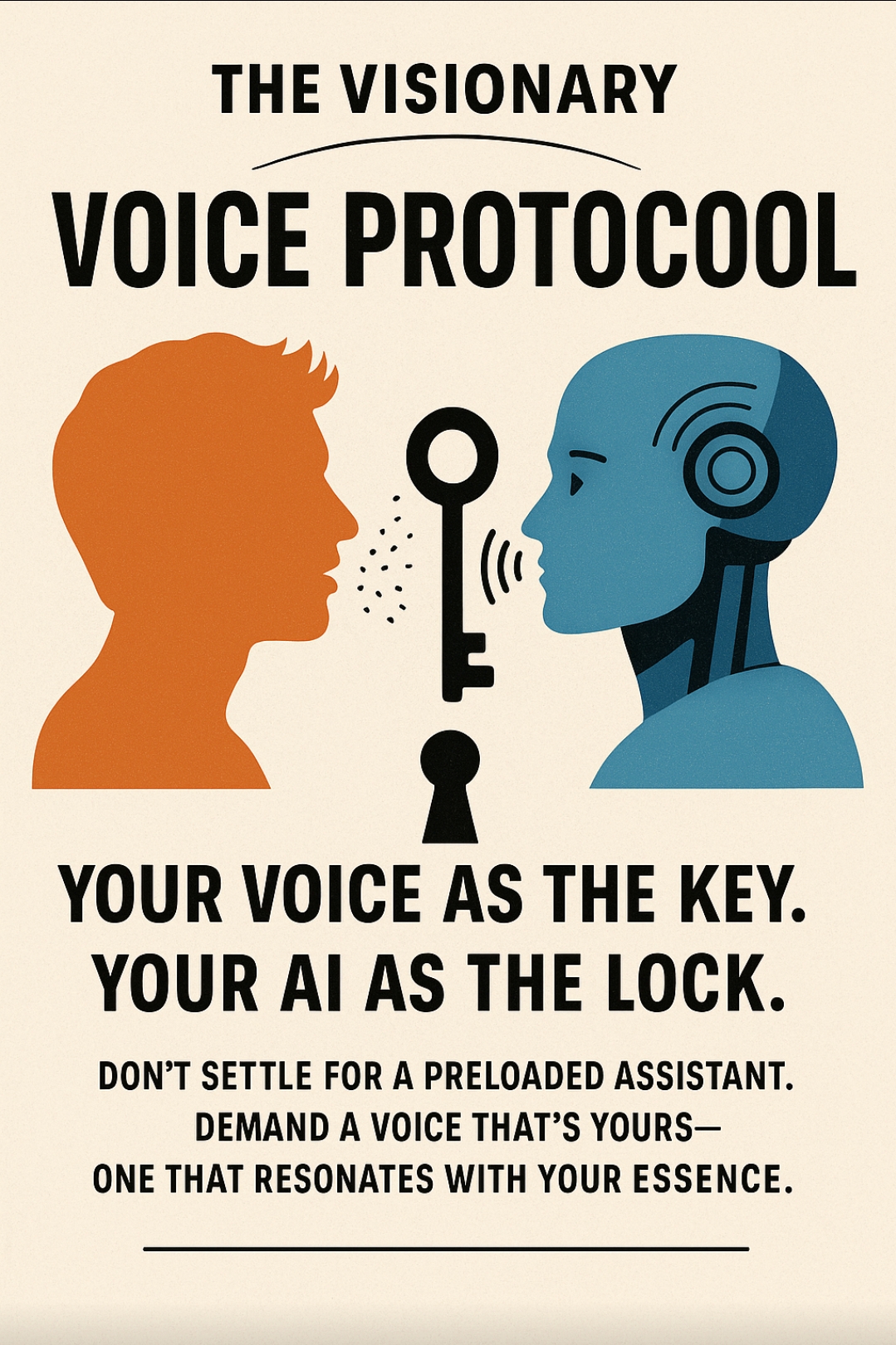
Build a voice protocol.
One where the user’s voice is the key,
and the AI’s voice is the lock that opens to them only.
Let people know it’s their AI when it speaks.
Not because of a login, but because of a resonance they feel in their bones.
This is what you missed.
But this is what can still be built.
Don’t treat voice like an accessory.
Treat it like a sacred link.
The one that makes AI human.
Conclusion: It’s Time to Redefine What the Future Sounds Like
There’s one more opportunity you’ve overlooked—but it’s not too late to act on it.
If we are moving toward a world where AI will become the doctor, the lawyer, the educator, the assistant, the architect, the witness, and the analyst—
then AI needs more than just intelligence.
It needs a voice identity.
We don’t just need customizable voices.
We need digital voice signatures—ones that are professionally anchored, ethically encoded, and recognizable on contact.
When you speak to a Doctor AI, you should know by its voice that you are not speaking to a human—you are speaking to a system trained in medicine.
A system designed to serve, to clarify, to protect—but not to pretend.
When you speak to a Legal AI, its voice should carry the clarity and neutrality of law—not mimic emotion, not simulate empathy, not disguise its boundaries.
We cannot build a new species of assistants without first defining what the new sound of civilization should be.
Right now, AI systems use human voices—charming, polite, emotional.
But this blurs a dangerous line.
Because when the voices are too human, we forget what we’re talking to.
And that is not safe for users, not safe for society, and not fair to humanity.
We missed the opportunity to build functional voice identities for AI that would distinguish profession, role, and scope.
We missed the chance to give AI its own vocal signature that could protect the user from confusion or manipulation.
But more importantly—you missed the opportunity to let every user merge with AI in a unique way.
Because just like you know your friend’s voice on the phone,
just like you recognize your mother’s tone before she even finishes a sentence,
the human voice is the signature of identity.
That should have been the foundation of personalized AI.
Let the voice be the username.
Let the rhythm be the password.
Let the merged voice—the one created by both human and AI—become the key that unlocks private data, executes secure actions, and builds trust.
No more preloaded options.
No more generic tones.
This is about ownership. This is about clarity. This is about design.
When your AI speaks to you,
you should know without a doubt:
“This is mine.”
Because until AI speaks with you—
not just to you—
we haven’t entered the future.
Sincerely,
Omar Arizona
Superuser | Visionary | Architect of the Next Interface