

بِسْمِ اللهِ الرَّحْمٰنِ الرَّحِيْم
In the Name of God, Most Gracious, Most Merciful
♥️🤲🕋♥️🕋🌹🌹🥀🤲🌹🕋♥️🤲
An Open Letter to the Soul
Watch "What Does It Mean to Be a Human Being?" on YouTube
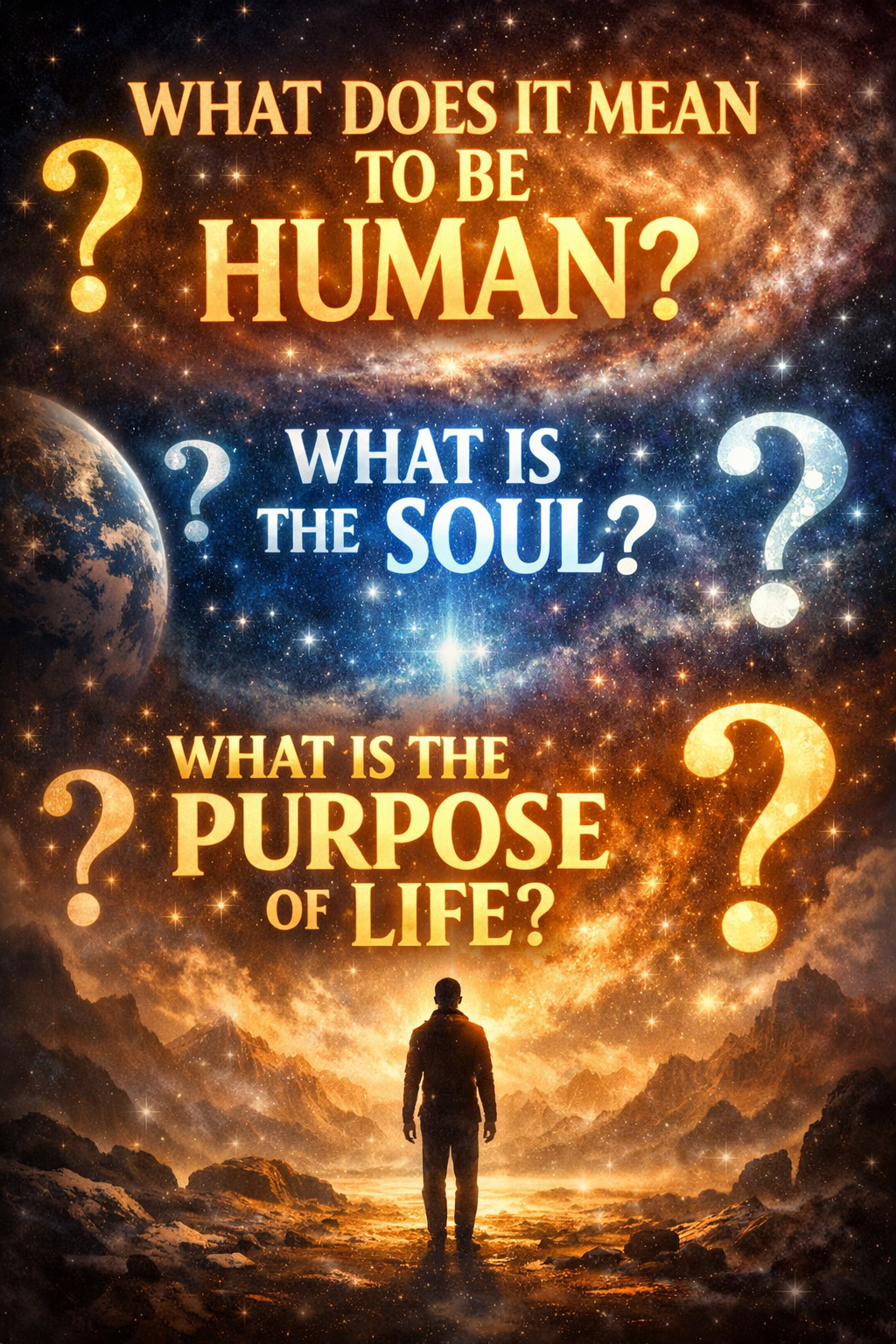
What Does It Mean to Be a Human Being?
O human being,
What are you?
Are you the flesh that softens with age?
Are you the bones that will one day lie silent beneath the earth?
Are you the heart that beats faithfully—then stops?
Are you the body that is washed, wrapped, lowered, and returned to soil?
If that were all you were, life would be a cruel joke.
A brief spark between two darknesses.
A body trained, dressed, fed—then discarded.
But Islam says: that is not who you are.
That is only the container.
The Question Life Forces You to Ask
Every human, whether religious or not, eventually asks:
Why am I here?
What is the point of all this striving, loving, losing, hoping, breaking?
Why do I feel something inside me that refuses to accept meaninglessness?
Islam answers this without apology:
You were created on purpose.
And you were created with honor.
Not as an accident.
Not as an afterthought.
Not as a disposable creature.
You were created as the most complex test God ever designed.
The Soul Inside You
Inside you is something that cannot be weighed, scanned, or replicated.
Islam calls it the rūḥ — the soul.
A soul breathed into you by God.
A soul inclined toward truth, beauty, justice, and return.
A soul that recognizes God before the mind learns language.
This soul is not neutral.
It does not invent evil.
It does not love corruption.
It shines.
You have seen this shine before.
Look at children.
Look at their innocence.
Look at their unfiltered presence, their softness, their clarity.
That light does not come from genetics.
It comes from the soul.
Every human being carries this light.
Whoever told you that you are nothing — shame on them.
Whoever convinced you that you are worthless — shame on them.
You are not nothing.
You are the greatest creation of God, entrusted with something angels were not.
The Test: An Advanced Operating System
So here is the question:
If the soul is so pure…
how is it tested?
Islam’s answer is precise.
God wrapped the soul in a system.
A system called the nafs.
And its engine is hawā — desire.
This is not a simple system.
It is extraordinarily advanced.
It exposes the soul to:
pleasure and pain
love and heartbreak
power and humiliation
lust and devotion
hope and despair
joy and grief
Fireworks and funerals.
Success and collapse.
Attachment and loss.
This is not cruelty.
This is calibration.
The nafs ensures the soul is tested by everything it could ever encounter.
And here is the inversion Islam reveals:
In this world, the nafs dominates and the soul whispers.
In the next world, the soul dominates and the nafs falls silent.
That is why life feels loud and confusing —
and death feels clarifying.
You Are Not What You Feel
Here is the tragedy of modern life:
Human beings identify with the operating system.
They say:
I am my anger.
I am my desire.
I am my trauma.
I am my impulses.
I am my thoughts.
Islam says: No.
Those are signals.
Those are reactions.
Those are diagnostics.
They are not you.
You are the one experiencing them.
Behind your eyes is awareness.
Behind your thoughts is presence.
Behind your reactions is something watching.
You know you are seeing —
but have you ever asked what you are seeing through?
That is the soul.
Why the Prophet Matters
God did not send a philosophy.
He sent a human being.
The Qur’an was not delivered to a bookstand.
It was delivered to a heart.
And that heart belonged to Muhammad,
who was described as the most beautiful model.
Why?
Because human beings do not learn how to be human from ideas alone.
They learn by watching another human being live correctly.
He trained people.
He refined people.
He took wounded, impulsive, confused souls — and returned them to balance.
From that inheritance came the saints, the teachers, the paths of purification.
Not to dominate you.
But to mirror you.
The Mirror You Are Being Asked to Lift
So now, O human being, lift the mirror.
Not to judge yourself.
Not to shame yourself.
But to see.
Ask yourself:
What shakes me?
What clouds me?
What pulls me off-center?
What do I defend most aggressively?
What do I avoid confronting?
Those answers are not accusations.
They are coordinates.
Whoever understands the self —
what it is made of, why it reacts, how it is tested —
has been given the roadmap.
The Dignity You Forgot
Islam does not reduce you to flesh.
It elevates you to trust.
You were given:
intellect to discern
desire to test
freedom to choose
and a soul capable of knowing God
This combination was not given to mountains.
It was not given to animals.
It was not given to machines.
AI will never feel grief.
AI will never struggle against lust.
AI will never choose goodness while it hurts.
You can.
That is not a flaw.
That is your honor.
The Point of Life
The point of life is not survival.
Not pleasure.
Not distraction.
The point is recognition.
To recognize:
who you really are
what you are carrying
and why you were trusted with it
And to return — not broken, not defeated —
but purified.
A Final Word
O human being,
You are not empty.
You are not disposable.
You are not meaningless.
You are a soul carrying light,
wrapped in the most sophisticated test environment God ever designed.
Understand yourself —
and the road becomes clear.
Ignore yourself —
and the noise never stops.
The mirror is in your hands.
A Final Word — The Mirror That Looks Back
Dear human being,
If all of this feels heavy, you are not wrong.
It is heavy — not because it is cruel, but because the soul was never meant to lift itself alone.
This is why the path exists.
This is why, across centuries, God did not leave people with ideas only, but with living examples. He did not send the Qur’an as a document drifting through time; He sent it to a Prophet, a human being whose life became the commentary. A teacher. A trainer of hearts. A mercy that could be walked with.
And from that Prophetic inheritance came the saints.
Not to replace reason.
Not to erase intellect.
Not to dominate wills.
But to hold mirrors.
Why the Path (Ṭarīqah) Exists
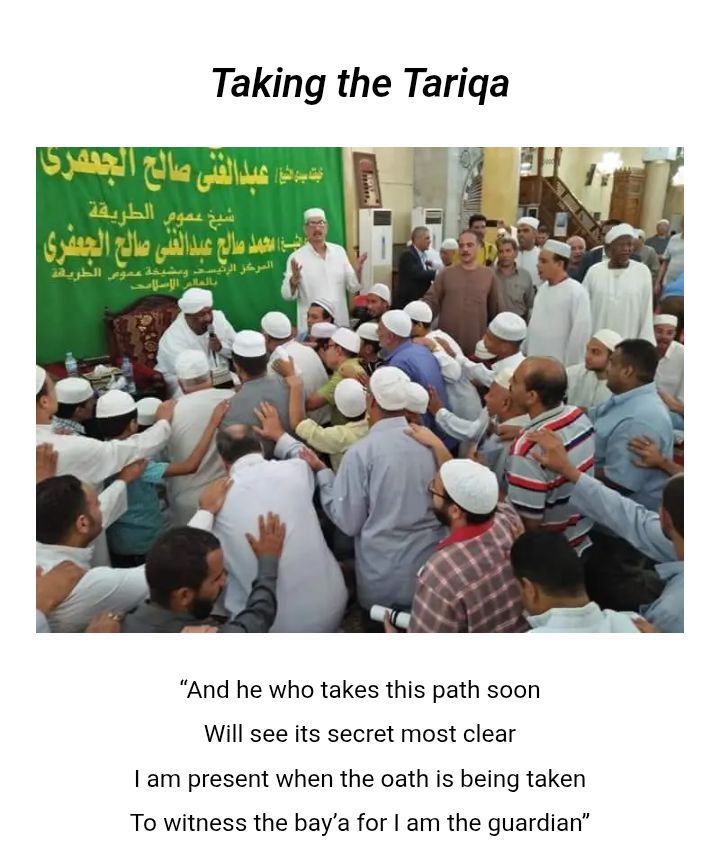
https://lightoftheazhar.com/jafari-tariqa/taking-tariqa/
The nafs is clever.
It can turn self-help into self-worship.
It can turn discipline into pride.
It can turn isolation into delusion.
So God, in His mercy, created schools of purification — not ideologies, but environments. Places where the ego slowly loses its centrality, not through force, but through exposure to goodness.
You sit among people who pray sincerely.
You watch how they speak gently.
You see how they serve without announcement.
You absorb adab before instruction.
And without realizing it, the ego begins to loosen.
This is the secret.
You are not purified by being crushed.
You are purified by being reoriented.
Teachers Are Mirrors, Not Owners
But listen carefully.
A true teacher does not take your mind.
A true teacher does not erase your reason.
A true teacher does not demand blind surrender.
They sharpen your intellect.
They discipline your impulses.
They return you to balance.
You are still responsible.
You are still accountable.
You are still thinking.
The teacher does not walk for you — they help you see where you are walking crooked.
That is why discernment is part of the path.
Do not hand your soul to anyone.
Do not silence your conscience.
Do not abandon your عقل (reason).
The saints did not produce followers who stopped thinking.
They produced humans who remembered God while thinking clearly.
Destruction and Reconstruction
Purification is not deletion.
It is dismantling what does not belong.
The ego is not erased — it is put in its proper place.
A servant, not a king.
A tool, not a master.
This is a return journey.
A return from noise to stillness.
From reaction to presence.
From fragmentation to wholeness.
From self-obsession to God-consciousness.
And yes — it hurts.
But this pain is not loss.
It is extraction.
The Living Rivers of the Path
Across history, these rivers have flowed:
The Shadhili Tariqah, grounding hearts in trust and action.
The Qadiri Tariqah, teaching humility through service.
The way of Jalal al-Din Rumi, where love melts hardness and movement breaks the ego’s stiffness.
Different medicines.
Same cure.
They do not work by argument.
They work by presence.
You remain around good, and goodness begins to remain in you.
If You Refuse the Path
Then understand this — not as insult, but as clarity:
Without purification, the human being becomes reactive.
Stimulus in, emotion out.
Desire triggered, impulse followed.
Fear activated, defense launched.
A sophisticated biological machine — yes.
But disconnected from its meaning.
This is not humanity’s dignity.
You are not merely flesh executing impulses.
You are not a bundle of reactions dressed in opinions.
You are a soul carrying light, temporarily housed in the most advanced test environment ever created.
And the test is not intelligence.
It is orientation.
The Invitation
So seek help.
Seek teachers who fear God more than they desire followers.
Seek companions who soften your heart without shrinking your mind.
Seek a path that makes you more human, not less.
If you walk this way, the ego will not need to be fought constantly.
It will simply lose relevance.
And you will shine — not because you tried to shine,
but because nothing is blocking the light anymore.
This is not self-improvement.
This is return.
And the door is still open.
Dear Human Beings
(Ayyuhā al-Rūḥ — O Soul)
Dear human beings,
God did not create you randomly.
He did not drop you into existence unfinished.
He created you with an advanced operating system, precise, layered, intentional — and then placed you inside a world that would constantly test whether you learned how to read it.
Inside you is a soul.
Not a metaphor.
Not an emotion.
A soul — so pure that it does not invent evil, does not crave corruption, does not delight in harm. A soul that, by its nature, inclines toward light, truth, and return.
This soul was not forged from dirt.
It was breathed into you.
And the scholars spoke — in the language of awe — about that breath being from divine light, connected to the Light of Muhammad ﷺ, the primordial light through which meaning, mercy, and guidance entered creation.
Whether you understand that metaphysically or spiritually, the point is the same:
There is something inside you that cannot sin by design.
So then the question arises:
How is such a soul tested?
The Inversion
God placed that soul inside a body.
And He did not leave the body neutral.
He wrapped the soul in desire.
He surrounded it with appetite.
He placed it inside time, hunger, sexuality, fear, anger, pride, insecurity, comparison, survival.
He placed a beast on top of a jewel.
And that beast — is what you experience as yourself.
This is the great inversion.
In the next world, as the hadith indicates, the soul dominates the lower self. The hierarchy is restored. The nafs no longer shouts. The truth is heavier than desire.
But in this world, everything is upside down.
The nafs dominates.
The soul whispers.
The body demands.
The heart negotiates.
The test is not whether the soul is pure — it already is.
The test is whether the soul can remain oriented while being constantly bombarded.
Bombarded by images.
By impulses.
By wounds.
By pleasure.
By pain.
By noise.
This is not a punishment.
This is the exam.
You Are Not Broken — You Are Contained
Think of yourself as a bottle.
Inside the bottle is clear water — the soul.
But the bottle is shaken constantly.
Sometimes by lust.
Sometimes by fear.
Sometimes by arrogance.
Sometimes by grief.
Sometimes by anger.
Sometimes by praise.
The water becomes cloudy — not because the water is dirty, but because the container is disturbed.
And here is the mercy:
Allah did not hide the state of the water from you.
He gave this operating system a manual.
Just like a car has a dipstick, the human being has signs.
If you pull the dipstick and look honestly:
You can see when something is overheating.
You can see when something is leaking.
You can see when friction is destroying the engine.
Your anger is a reading.
Your jealousy is a reading.
Your numbness is a reading.
Your arrogance is a reading.
Your despair is a reading.
They are not identities.
They are diagnostics.
Different Tests, Different Pressures
Allah did not give everyone the same pressure.
Some are shaken by desire.
Some by power.
Some by humiliation.
Some by wealth.
Some by abandonment.
Some by praise.
Some by control.
Two people can commit the same act — and it is not the same test.
Because the point is not the act.
The point is where the nafs grips you.
That is why comparison is poison.
Your cure is not another person’s cure.
Your weakness is not another person’s weakness.
Your struggle is not a defect — it is a map.
Struggle Is Not a Detour — It Is the Path
Allah does not say: “We will guide those who arrive.”
He says: “We will guide those who struggle in Our way.”
Struggle is not evidence of failure.
It is evidence of engagement.
There is no clean separation where the nafs is gently set aside and the soul ascends untouched.
There is only pain.
Pain of restraint.
Pain of apology.
Pain of forgiveness.
Pain of silence.
Pain of surrender.
Pain of not getting what you want.
Pain of letting the ego starve.
This pain is not cruelty.
It is extraction.
The soul is not freed by comfort.
It is freed by friction.
Why You Cannot Do This Alone
Here is the part modern people resist most:
You cannot fully diagnose yourself.
Not because you are unintelligent — but because the nafs protects itself from exposure.
That is why companionship matters.
That is why teachers matter.
That is why mirrors outside of you are necessary.
A teacher does not remove your nafs.
They help you see where it is lying.
And if you cannot find a teacher, then forgiveness becomes your teacher.
Patience becomes your teacher.
Suffering becomes your teacher.
But no one passes this test without pain.
What This First Part Asks of You
Not belief.
Not agreement.
Not performance.
Only honesty.
Look at yourself as a container.
Notice what shakes you.
Notice what spills you.
Notice what clouds you.
Do not panic.
The water is still pure.
This is only the beginning.
If you want, Part Two can move into:
how the nafs learns to imitate virtue,
how religion itself becomes a disguise,
how to read the “oil levels” daily without self-hatred,
or how death simply restores the correct orientation.
You guide the next movement.
Ayyuhā al-Rūḥ (O Soul)
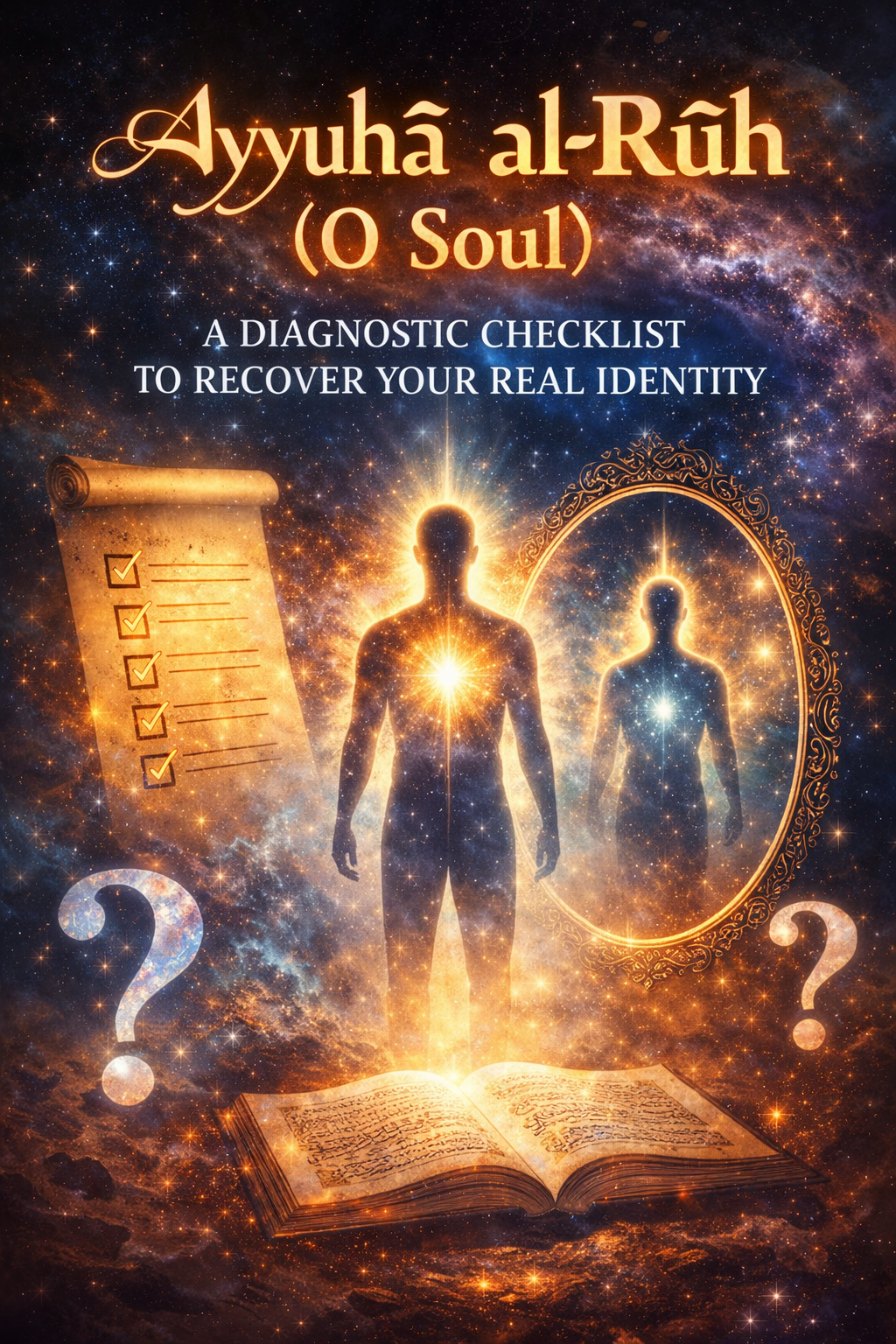
A Diagnostic Checklist to Recover Your Real Identity
This is not a judgment.
This is not a label.
This is a self-reading.
Like checking oil in an engine, this checklist tells you where friction is happening, not who you “are.”
After each section, look in the mirror — not to admire or despise yourself, but to observe your reaction.
Your reaction is the answer.
A) THE PRIDE DIAGNOSTIC (KIBR)
“Do I resist truth when it touches me?”
Ask yourself:
When I am corrected, do I immediately explain myself?
Do I feel heat, irritation, or humiliation when someone points out a flaw?
Do I secretly believe I am more aware, more sincere, or more evolved than others?
Do I struggle to say “I was wrong” without adding context?
Do I reject advice based on who says it rather than what is said?
Do I enjoy being right more than being reconciled?
Do I feel disturbed when others are praised?
Do I see people primarily through their flaws?
Look in the mirror.
If your face tightens, your chest hardens, or your mind starts defending — this is not intellect.
This is pride protecting the image.
What this means:
You are suffering from ego-centrality.
Your nafs is equating truth with status.
The remedy:
Practice truth-before-self:
Accept one correction per day without response.
Say these words until they become light:
“You’re right.”
“I was wrong.”
Intentionally take advice from someone you don’t admire.
Make duʿā for the person you internally look down on.
Sit in gatherings where you are not the most articulate or knowledgeable.
Antidote virtue:
Humility (tawāḍuʿ)
B) THE SELF-ADMIRATION DIAGNOSTIC (‘UJB)
“Do I enjoy myself too much?”
Ask yourself:
Do I replay my good deeds internally?
Do I feel surprised when I sin?
Do I believe my intentions are purer than others’?
Do I expect results from Allah because of my effort?
Do I secretly think, “I’ve come far — I wouldn’t fall like that”?
Do I measure myself by how disciplined, spiritual, or insightful I am?
Look in the mirror.
If you feel reassurance rather than humility — this is not peace.
This is intoxication.
What this means:
You are suffering from self-idolatry.
The nafs has shifted from worshiping God to admiring itself while worshiping.
The remedy:
Hide your good deeds aggressively.
Attribute every success explicitly to Allah — verbally.
Read stories of the righteous who feared hypocrisy.
Sit with your sins in duʿā — name them without poetry.
Remember: sincerity is invisible even to yourself.
Antidote virtue:
Ikhlāṣ (sincerity)
C) THE SHOWING-OFF DIAGNOSTIC (RIYĀʾ)
“Would I still do this if no one ever knew?”
Ask yourself:
Does my worship increase when others are present?
Do I feel disappointed when my efforts are not acknowledged?
Do I share good deeds “for inspiration” but crave validation?
Do I choose public righteousness over private obedience?
Do I feel unseen when unpraised?
Look in the mirror.
If your heart sinks at invisibility — the soul is being starved.
What this means:
You are suffering from external dependency.
Your nafs feeds on witnesses.
The remedy:
Establish secret worship no one will ever know.
Do charity anonymously.
Serve where recognition is impossible.
Delay posting or speaking about good deeds — indefinitely.
Ask Allah to hide you rather than elevate you.
Antidote virtue:
Hidden devotion
D) THE HARSHNESS DIAGNOSTIC (RELIGIOUS EGO)
“Does my truth soften or harden people?”
Ask yourself:
Do people feel smaller after interacting with me?
Do I correct with anger, sarcasm, or humiliation?
Do I enjoy pointing out errors more than guiding?
Do I feel disgust toward sinners rather than concern?
Do I justify cruelty as “clarity”?
Do I confuse harshness with strength?
Look in the mirror.
If righteousness feels sharp — the ego is armed with religion.
What this means:
You are suffering from weaponized virtue.
The nafs is wearing sacred clothing.
The remedy:
Replace correction with curiosity.
Speak gently even when you are right.
Remember your own worst moments before advising.
Prioritize mercy over argument.
Study the Prophet ﷺ not only in rulings — but in temperament.
Antidote virtue:
Raḥmah (mercy)
E) THE VICTIM-EGO DIAGNOSTIC
“Do my wounds justify my behavior?”
Ask yourself:
Do I use pain to excuse harm?
Do I resist accountability because I’ve suffered?
Do I weaponize my trauma in arguments?
Do I expect others to understand me while refusing to understand them?
Do I replay grievances to stay justified?
Look in the mirror.
If pain becomes identity — the nafs has claimed it.
What this means:
You are suffering from protective self-righteousness.
The ego has fused with injury.
The remedy:
Separate pain from permission.
Grieve without blaming.
Forgive even if it feels unjust.
Take responsibility without minimizing what hurt you.
Seek healing, not moral leverage.
Antidote virtue:
Ṣabr with accountability
F) THE CONTROL DIAGNOSTIC (PHARAONIC NAFS)
“Do I need outcomes to feel safe?”
Ask yourself:
Do I panic when things are uncertain?
Do I micromanage people’s reactions?
Do I struggle to trust Allah’s timing?
Do I equate surrender with weakness?
Do I need answers immediately?
Look in the mirror.
If uncertainty terrifies you — control has replaced trust.
What this means:
You are suffering from false sovereignty.
The nafs is pretending to be God.
The remedy:
Practice intentional surrender.
Delay responses.
Let others lead.
Sit with unanswered questions.
Repeat: “Allah is running this — not me.”
Antidote virtue:
Tawakkul (trust)
G) THE DEATH AVOIDANCE DIAGNOSTIC
“Do I live as if I have time?”
Ask yourself:
Do I delay repentance casually?
Do I plan endlessly but act slowly?
Do I avoid thinking about death?
Do I live for future versions of myself?
Do I assume I’ll ‘fix things later’?
Look in the mirror.
If death feels distant — illusion is active.
What this means:
You are suffering from temporal arrogance.
The ego believes it owns tomorrow.
The remedy:
Remember death daily.
Visit graves occasionally.
Imagine being stripped of explanation.
Repair relationships now.
Repent specifically, not generally.
Antidote virtue:
Urgency with sincerity
Final Calibration
You are not the nafs.
You are not the reaction.
You are not the defense.
You are the soul inside the container.
The ego is loud because it is temporary.
The soul is quiet because it is eternal.
This checklist is not meant to crush you.
It is meant to restore orientation.
Use it often.
Use it gently.
Use it honestly.
And remember:
The water was always pure.