

بِسْمِ اللهِ الرَّحْمٰنِ الرَّحِيْم
In the Name of God, Most Gracious, Most Merciful
♥️🤲🕋♥️🕋🌹🌹🥀🤲🌹🕋♥️🤲
The Architecture of Mobility and Power: Engineering Equilibrium in Turkey’s 2026 Energy Landscape
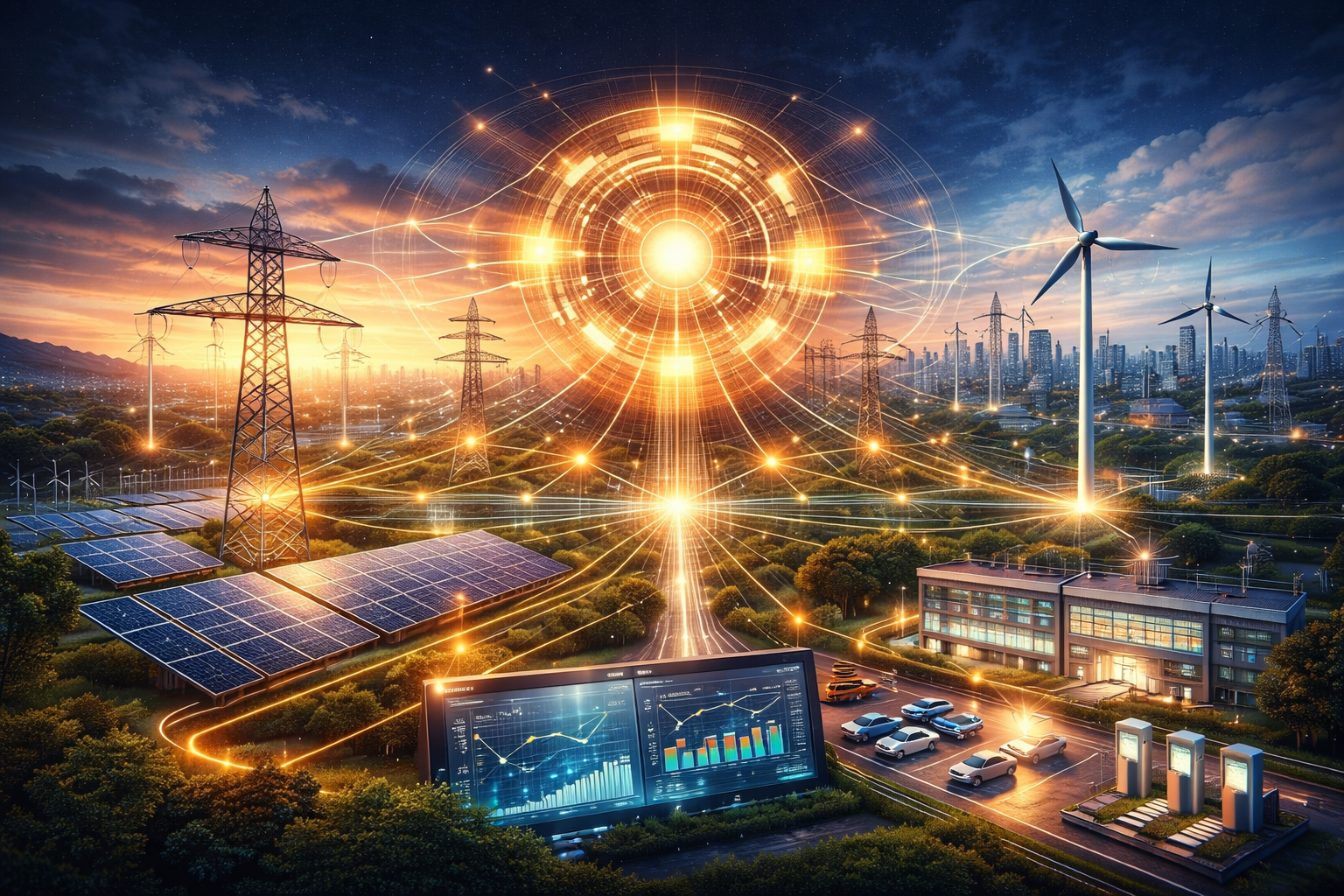
“The billionaire of the 20th century was defined by how much they took out of the system. The billionaire of the 21st century will be defined by how much cost they removed for the family at the kitchen table.”
This is no longer rhetoric.
It is a strategic benchmark.
As Turkey advances through 2026, artificial intelligence has penetrated the core of our energy grids and transportation networks. We forecast renewable output with precision. We balance national load in milliseconds. We optimize freight routes across continents.
The technical intelligence exists.
The question is no longer whether we can optimize.
The question is what we are optimizing for.
The Structural Friction: Asymmetric Transmission
Turkey’s energy and transportation sectors power every other industry. Yet both suffer from a structural flaw:
Price increases move fast.
Price decreases move slow.
In energy, the chain is layered:
Generation → Transmission → Distribution → Retail Billing → Taxes & Subsidies
In transportation, the stack is similar:
Fuel Supply → Fleet Operations → Logistics Optimization → Last-Mile Delivery → Consumer Pricing
Each layer performs a function.
Each layer protects a margin.
When global fuel spikes or currency volatility strikes, prices adjust instantly.
When AI reduces operational cost — through predictive maintenance, smart grid balancing, renewable forecasting, or route optimization — those savings often accumulate mid-chain.
They stabilize margins.
They do not automatically stabilize households.
This is not misconduct.
It is structural incentive alignment.
And AI will amplify whichever objective it is given.
The Electricity Equation
Turkey has made historic advances in renewable integration. AI forecasting now reduces reliance on expensive peaker plants. Load balancing is more precise than ever.
The marginal cost of the next kilowatt is falling.
Yet the consumer bill does not always reflect that decline proportionally.
To align intelligence with stability, we introduce a governing discipline:
P_c ≤ P_g + M_d
Where:
P_c = Consumer price
P_g = Verified generation or production cost
M_d = Dignity Markup
The Dignity Markup is not a rigid price cap.
It is a bounded equilibrium margin.
It ensures profitability and innovation sustainability — while preventing cumulative margin stacking disconnected from real production cost.
When AI lowers generation cost, transmission discipline ensures consumer price synchronizes accordingly.
This protects purchasing power at the structural level.
Mobility: The Hidden Inflation Multiplier
Transportation is not a separate issue from inflation.
It is its transmission mechanism.
Every good moves.
Every movement carries cost.
AI has reduced:
Per-kilometer energy usage
Fleet downtime
Route inefficiencies
Idle congestion
Fleet electrification in 2026 has materially lowered transport cost.
Yet if last-mile pricing remains static, the machine is optimizing for margin — not volume.
An equilibrium-based mobility architecture shifts the objective function:
From high-cost / low-volume extraction
To low-cost / high-volume stability
When logistics efficiency translates into lower delivery cost, the price of food, medicine, and retail goods stabilizes downstream.
Mobility becomes an inflation stabilizer — not an amplifier.
Dynamic Pricing and Volatility
AI-based dynamic pricing, if unanchored, can intensify volatility.
Peak-hour electricity optimization. Demand-based freight pricing. Surge models.
These systems maximize revenue sensitivity to short-term demand.
But essential infrastructure cannot behave like luxury markets.
The solution is not to eliminate dynamic intelligence.
It is to anchor it.
During national stress periods, objective functions must shift from revenue-per-unit to stability-per-household.
That shift is architectural.
The Energy & Mobility Equilibrium Protocol
Turkey is positioned to implement a sovereign Energy & Mobility Equilibrium Protocol.
This is not anti-market. This is not blanket subsidy.
It is transmission discipline infrastructure.
The protocol would:
1. Verify Efficiency Transmission
AI audits confirm real-time cost reductions in generation, logistics, and fleet operations.
Savings are mapped transparently — without exposing proprietary algorithms.
2. Realign Incentives
Companies that compress volatility and reduce national cost-of-living metrics earn:
Stability Credits
Priority sovereign R&D grants
Preferential grid integration access
Profit becomes linked to burden reduction.
3. Dampen External Shock Contagion
When global volatility hits, the Dignity Markup dynamically adjusts to prevent external shocks from cascading uncontrollably through domestic systems.
This reduces the need for reactive fiscal intervention.
Beyond Monetary Policy
Inflation is not only monetary.
It is structural.
It is how cost flows.
It is how margin layers.
Turkey can move from reactive subsidy to proactive transmission control.
Instead of paying to offset inflated downstream prices,
the state builds infrastructure that reduces inflationary amplitude upstream.
This lowers pressure on monetary policy.
It reduces the need for emergency subsidy expansion.
It strengthens Lira confidence at the household level.
The Abundance Transition
Energy abundance is increasing through renewables. Mobility efficiency is increasing through electrification and AI. Grid precision is increasing through intelligent balancing.
If these gains remain trapped mid-chain, volatility persists.
If they are transmitted structurally, abundance becomes measurable.
The nations that win in the Intelligence Age will not be those with the highest algorithmic margin capture.
They will be those that convert efficiency into purchasing power stability.
Turkey has the geographic position. The digital infrastructure. The demographic advantage. The sovereign coordination capacity.
The architecture now must match the capability.
The Strategic Horizon
In the 20th century, power meant control of scarce resources.
In the 21st century, power means disciplined transmission of abundance.
Energy that lowers the cost of heating a home. Mobility that lowers the cost of moving goods. Intelligence that lowers systemic friction.
This is not restraint of innovation.
It is alignment of innovation.
And when innovation aligns with equilibrium, prosperity becomes structural — not cyclical.
Turkey can lead that model.
Not by limiting profit.
But by redesigning what profit is rewarded for.
That is the architecture of mobility and power in 2026.
Conclusion: The Century of Architecture
For the last hundred years, economics has largely been shaped by architecture built for control — for national leverage, for foreign policy positioning, for scarcity management. Systems were engineered to secure advantage, protect reserves, and navigate geopolitical tension. Abundance was not the organizing principle. Stability was often reactive. Prosperity was measured in extraction, accumulation, and defensive positioning.
But artificial intelligence changes the premise.
When intelligence can forecast demand in real time, optimize grids instantly, map supply chains transparently, and compress inefficiencies at scale, economics can no longer remain structured around scarcity reflexes alone.
The old questions are insufficient.
We must now ask:
How should efficiency transmit?
How should abundance flow?
How should profit align with stability?
How do we design systems that multiply prosperity instead of redistribute pressure?
This is no longer about minor regulatory adjustments.
It is about architecture.
It is about designing national systems that deliberately encode transmission discipline, reward cost compression, and institutionalize equilibrium.
In the Intelligence Age, prosperity will not triple because of speculation.
It will triple because of design.
Because AI forces us to reconsider what is possible, it also forces us to reconsider what is acceptable.
Turkey stands in a position of choice.
It can continue operating within inherited frameworks built for a century defined by leverage and reaction.
Or it can convene the right minds — economists, technologists, policy architects — to frame the abundance question clearly:
What would an economy look like if efficiency automatically reached the citizen?
What would stability look like if volatility were structurally dampened?
What would prosperity look like if transmission were disciplined by design?
This is not a call for disruption for its own sake.
It is a call for sovereign redesign.
The nations that succeed in the coming decades will not simply deploy AI.
They will architect around it.
And the country that understands that prosperity is now a function of system design — not just monetary management — will define the next chapter of economic history.
The conversation must begin.
Because the age of abundance will not be inherited.
It will be engineered.