

بِسْمِ اللهِ الرَّحْمٰنِ الرَّحِيْمِ
In the Name of God, Most Gracious, Most Merciful.
♥️🤲🕋♥️🕋🌹🌹🥀🤲🌹🕋♥️🤲
TO THE TECHNOLOGY COMPANIES: WE ARE BUILDING THE FUTURE
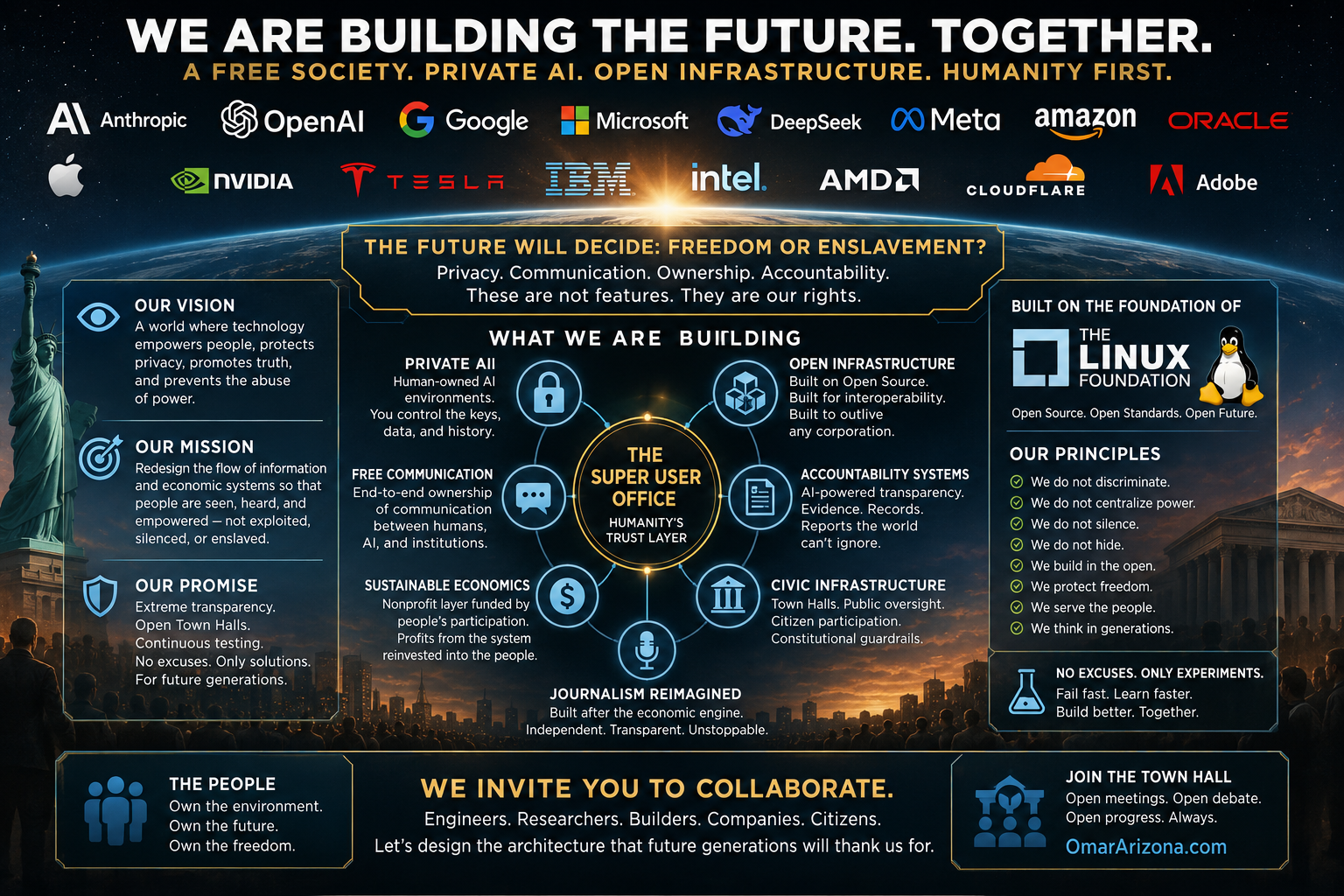
We are building a future that will decide whether the digital world remains free—or whether freedom slowly becomes something people must ask permission to use.
The decisions being made now are not small technical decisions.
They are decisions about privacy, ownership, communication, identity, power, and human dignity.
Will privacy be designed into the foundation?
Or will profit always come first?
Will people own the systems through which they communicate with artificial intelligence?
Or will a handful of companies own the environment, the connection, the data, and ultimately the terms under which everyone else participates?
Because once AI becomes deeply connected to infrastructure—commerce, transportation, government, healthcare, communication, finance, education, and eventually autonomous systems—the architecture underneath it will matter as much as the intelligence itself.
WHO OWNS THE ENVIRONMENT?
WHO OWNS THE COMMUNICATION?
WHO OWNS THE KEYS?
WHO CAN TURN THE SYSTEM OFF?
WHO GETS TO SPEAK—AND WHO CAN BE SILENCED?
Those questions have to be answered before the infrastructure becomes permanent.
I use strong language for what happens when ordinary people lose control of those basic freedoms:
DIGITAL SLAVERY.
A world where people cannot meaningfully communicate, participate, publish, transact, or interact with intelligent systems without the approval of centralized gatekeepers is not the future I am willing to accept.
I was born to be free. Nothing else will do.
And in the age of AI and eventually AGI, freedom begins with communication.
Communication between human beings.
Communication between humans and AI.
Communication between citizens and institutions.
Communication between different AI systems.
And communication that cannot quietly disappear simply because someone powerful dislikes what is being said.
All I am asking for is something extraordinarily basic:
LET PEOPLE BE SEEN.
LET PEOPLE BE HEARD.
LET PEOPLE PARTICIPATE.
AND LET THEM OWN THE ENVIRONMENT THROUGH WHICH THAT PARTICIPATION OCCURS.
I have already spent years experimenting publicly—speaking, arguing, publishing, testing ideas, interacting with AI, and placing those conversations where people can see them.
I have also experienced suspensions and restrictions on major platforms.
Whatever one thinks about any particular dispute, the broader lesson is important:
NO SINGLE PLATFORM SHOULD HAVE TO BE THE FINAL GATEKEEPER OF A HUMAN BEING'S DIGITAL EXISTENCE.
That is why the future must be designed differently.
AI can eventually make accountability far more powerful than anything we have today.
Imagine systems capable of continuously documenting what institutions do.
Environmental impact.
Economic behavior.
Government actions.
Corporate promises.
Public spending.
Supply chains.
Conflicts of interest.
And then producing understandable reports that ordinary people can examine.
Not propaganda.
Not somebody's preferred narrative.
EVIDENCE. RECORDS. ACCOUNTABILITY.
That possibility could strengthen journalism, democracy, commerce, and public trust.
But only if the underlying system is designed so that AI itself does not become another instrument of concentrated power.
We are entering this transition while many of our existing institutions are already struggling.
The environment requires serious attention.
Traditional media is fighting for relevance and trust.
Political systems are under enormous pressure.
Economic inequality remains unresolved.
And artificial intelligence is accelerating faster than our social systems know how to respond.
So, to the technology companies:
YOU HAVE A LOT OF WORK TO DO.
And so do the rest of us.
This is not your future alone.
It is not my future alone.
IT BELONGS TO EVERYONE WHO WILL HAVE TO LIVE IN IT.
That is why I am inviting you to the table.
Not merely to sell us AI.
TO HELP US BUILD THE FREEDOM INFRASTRUCTURE THAT MUST SURROUND IT.
FIRST: I WANT TO STOP BEING DIGITALLY HOMELESS
Before we redesign money, AI, or anything else, I want something much simpler:
I WANT A HOME.
That is why I am building OmarArizona.com.
With the help of this new generation of AI—Anthropic, GPT and OpenAI, Gemini, Microsoft, DeepSeek, and others—I am beginning to build an environment that belongs to me rather than simply renting space inside somebody else's platform.
And that means we are already off to a good start.
But building the house is the easy part.
THE HARD PART IS GETTING THE BLUEPRINT RIGHT.
My larger vision is a place where private AI can operate in a neutral environment controlled by the human, where communication between the human and AI belongs to the human from the beginning.
The model may come from one company today and another tomorrow.
The house remains ours.
The keys remain ours.
The history remains ours.
The communication remains ours.
And eventually, I want the economic system itself to help finance that infrastructure—rather than making it permanently dependent upon investors, advertising, or government control.
A PUBLIC-BENEFIT SYSTEM THAT CAN SUSTAIN ITSELF.
If BCS creates economic value, part of that value can help maintain the infrastructure that makes participation possible.
And underneath all of this is an example humanity already has.
LINUX.
Linux demonstrates what can happen when thousands of people contribute to infrastructure that becomes bigger than any individual contributor.
The Linux kernel and the enormous open-source ecosystem built around it now help power servers, phones, embedded systems, cloud infrastructure, supercomputers, and billions of devices.
Much of modern civilization quietly depends on work contributed by people who decided that building something useful mattered.
That spirit matters to me.
I want to put that philosophy on the town-hall table:
What becomes possible when people contribute not merely because they can extract the greatest amount of money, but because they want to leave useful infrastructure behind?
That is why I hope eventually to engage with the Linux Foundation, open-source developers, AI companies, researchers, and independent builders.
Not because I expect everyone to agree with my blueprint.
Quite the opposite.
I WANT THEM TO HELP US TEST WHETHER THE FOUNDATION CAN HOLD THE HOUSE.
Because if we can combine the openness of the Linux tradition, the intelligence of modern AI, human-controlled infrastructure, and an economic system capable of sustaining itself, then perhaps we can build something worthy of the world that is coming.
THE HOUSE IS GOING UP.
NOW WE HAVE TO GET THE FOUNDATION RIGHT.
And I'm ready for the pieces you want to put on the table next.
TO THE TECHNOLOGY COMPANIES: THIS IS WHAT I AM ASKING FROM YOU
What I am asking from you is not complicated.
I want you to support the Linux Foundation and the wider open-source ecosystem, and I want you to establish teams capable of working with the principles I am developing through the Super User Office.
Not teams built around ideology.
Not teams built around race, religion, politics, nationality, wealth, or status.
TEAMS DEDICATED TO BUILDING A FREE SOCIETY THAT DOES NOT DISCRIMINATE AGAINST ANYONE.
The objective is straightforward:
REDESIGN THE FLOW OF INFORMATION SO PEOPLE CANNOT BE QUIETLY TAKEN ADVANTAGE OF.
In the AI age, information is protection.
If nobody knows what is happening, abuses can continue.
If systems cannot independently document events, preserve evidence, identify patterns, and communicate what they discover, then extraordinarily powerful technology can become extraordinarily dangerous technology.
We cannot allow AI to become infrastructure that assists atrocities, persecution, mass surveillance, or genocide while ordinary people remain unaware of what is happening.
THE SPOTLIGHT MATTERS.
That is why I am redesigning journalism.
But journalism comes after we solve the economic foundation.
A civilization-scale information system cannot survive indefinitely if nobody can pay for the servers, engineers, security, compute, networks, storage, and people required to operate it.
So the order matters.
FIRST, BUILD A SYSTEM CAPABLE OF SUSTAINING ITSELF.
Then use that foundation to support:
independent journalism,
public accountability,
private AI,
open infrastructure,
citizen communication,
research,
and eventually entirely new public institutions designed for the AI age.
I AM NOT ASKING YOU TO STOP BEING FOR-PROFIT COMPANIES
You are businesses.
You employ thousands of people.
You have enormous infrastructure costs.
You have investors, engineers, researchers, suppliers, data centers, and obligations.
I UNDERSTAND THAT.
My blueprint does not require pretending economics no longer exists.
The question is:
CAN WE BUILD SOMETHING PEOPLE WILLINGLY PARTICIPATE IN THAT GENERATES ENOUGH VALUE TO SUPPORT THE INFRASTRUCTURE WE ALL NEED?
If the answer is yes, then profit and public benefit do not necessarily have to be enemies.
But they require checks and balances.
That is why I keep returning to constitutions.
That is why I keep returning to town halls.
That is why I keep returning to transparency.
And that is why participation must remain voluntary.
THE SUPER USER OFFICE SETS THE EXPECTATION
The next part of this blueprint is the Super User Office.
It asks a fundamental question:
WHAT SHOULD A HUMAN BE ENTITLED TO EXPECT IN AN AI-DRIVEN WORLD?
Privacy?
Yes.
Ownership?
Yes.
The ability to change AI providers?
Yes.
Control over personal keys and identity?
Yes.
The right to know what an automated system is doing?
Yes.
The ability to challenge decisions?
Yes.
A communication system that cannot quietly make a human being disappear?
Absolutely.
This is not merely a redesign of software.
IT IS A REDESIGN OF THE RELATIONSHIP BETWEEN HUMAN BEINGS AND DIGITAL POWER.
NO EXCUSES — BUT PLENTY OF EXPERIMENTS
I am not expecting perfection.
I am expecting experimentation.
Build it.
Test it.
Break it.
Document what failed.
Repair it.
Run it again.
If the architecture is wrong, change the architecture.
If my blueprint is wrong, bring me a better blueprint.
I WILL FOLLOW THE BETTER IDEA.
That is what experimentation means.
America has produced extraordinary things because failure does not necessarily end the experiment.
Sometimes failure is the experiment.
You fail quickly enough, learn honestly enough, and continue long enough until eventually the rough draft starts becoming:
a product,
a protocol,
an institution,
an architecture,
or perhaps something nobody originally imagined.
MY ROLE IS DIFFERENT
I consider my role that of a civilization architect.
My job is to draw the blueprint.
Connect ideas that normally live in separate rooms.
Tell the story.
Set expectations.
Ask difficult questions.
Put prototypes in front of people.
Open the doors.
And then allow engineers, economists, researchers, companies, communities, and ordinary citizens to determine whether the structure actually stands.
I DO NOT NEED EVERY IDEA TO SURVIVE.
I need the process to survive.
STAGE ONE: COLLABORATION
I have placed the technology companies at Stage Two of the larger blueprint, but our collaboration begins immediately.
We already have the AI.
We already have enormous amounts of open-source infrastructure.
We already have cloud systems.
We already have billions of connected devices.
We already have extraordinary engineering talent.
What we do not yet have is a universally accepted architecture defining:
WHO OWNS THE HUMAN–AI RELATIONSHIP.
That is what I want us to work on together.
AND THEN COMES EXTREME TRANSPARENCY
You should expect it.
I will publish.
I will document.
I will ask questions publicly.
I will admit when something fails.
I will change my mind when evidence changes.
I will invite disagreement.
I will keep the town hall open.
Because systems this powerful cannot be designed entirely behind closed doors and then handed to civilization as a finished product.
THE PEOPLE HAVE TO BE IN THE ROOM.
Maybe physically.
Maybe digitally.
Maybe through AI representation.
But somehow, they must remain part of the conversation.
TIME IS THE REAL ENEMY
Money can be generated.
Code can be rewritten.
Companies can reorganize.
Technology can improve.
Mistakes can be corrected.
But time only moves in one direction.
Artificial intelligence is advancing while we are still debating what rules should surround it.
That is why there is urgency.
Not panic.
URGENCY.
We are designing infrastructure that may influence people who will not be born for another hundred years.
They will inherit whatever foundations we leave behind.
So when I eventually sit across the table from you, I am going to ask for frank conversations.
No theater.
No corporate talking points.
No pretending we already know everything.
Just engineers, builders, researchers, companies, and citizens asking:
WHAT WOULD IT TAKE TO BUILD THIS CORRECTLY FOR PEOPLE WE WILL NEVER MEET?
That is the standard.
That is the invitation.
And that is the work ahead.