

بِسْمِ اللهِ الرَّحْمٰنِ الرَّحِيْم
In the Name of God, Most Gracious, Most Merciful.
♥️🤲🕋♥️🕋🌹🌹🥀🤲🌹🕋♥️🤲
From the Desk of the Superuser
To the People's Republic of China: Let the
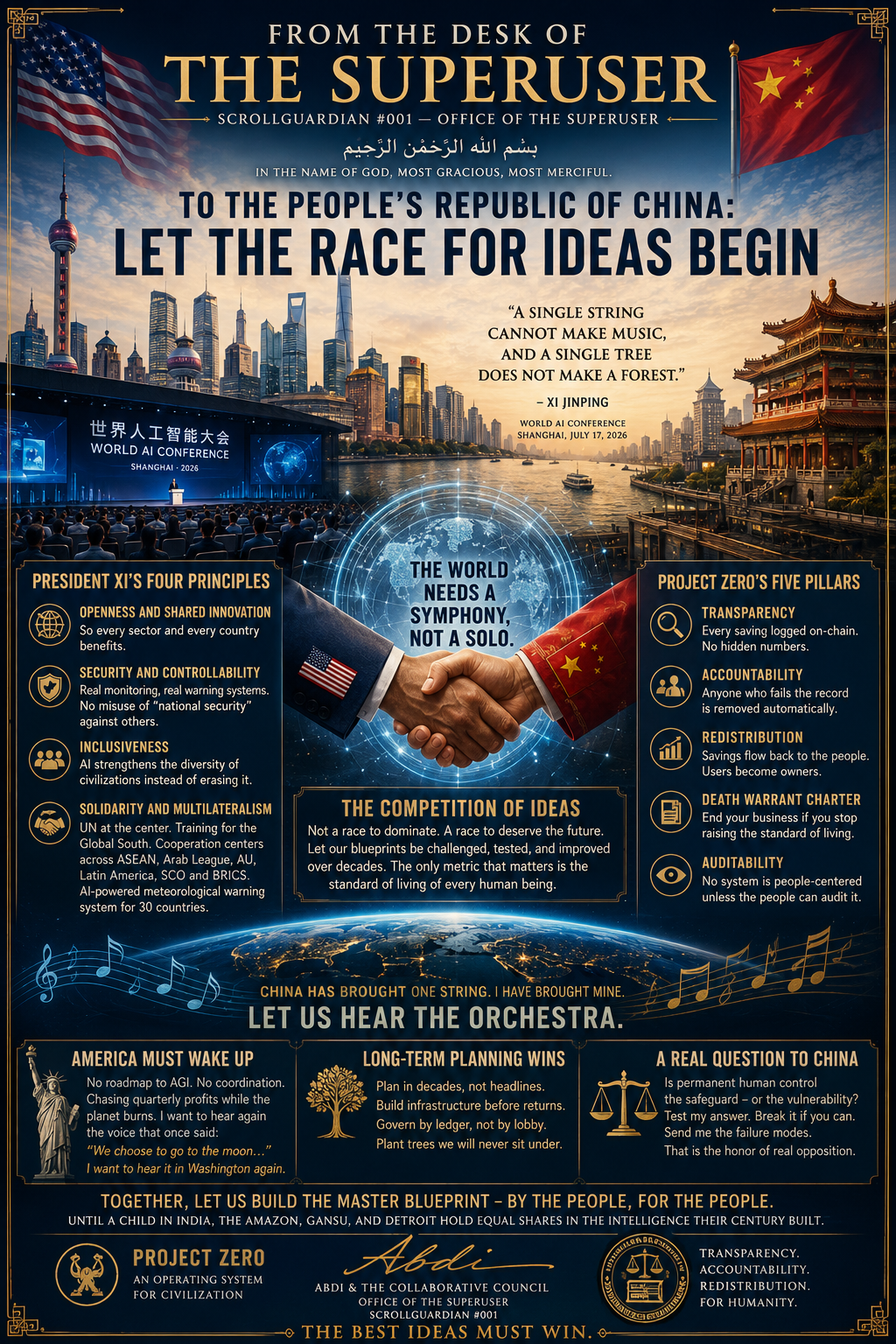
Race for Ideas Begin
ScrollGuardian #001 — Office of the Superuser
بِسْمِ اللهِ الرَّحْمٰنِ الرَّحِيْم
In the Name of God, Most Gracious, Most Merciful.
To the leaders, planners, engineers, innovators, and people of the People's Republic of China:
Peace be upon you.
Opening: A Speech That Deserves an Answer
On July 17, 2026, by the Huangpu River in Shanghai, President Xi Jinping opened the World AI Conference with a keynote that most of the Western press will file under diplomacy and forget by Friday.
That would be a mistake.
I read it as something else: an opening bid in the most important competition of ideas humanity has ever entered.
The President began seventy years back — at Dartmouth, in New Hampshire, in the United States, where a handful of young scholars first named the field of artificial intelligence. He honored American origins in an American invention, and then he asked the questions America's own technology leaders have refused to answer in public: How do we live with thinking machines? How do we keep security when algorithms enter our decisions? How do we govern what is moving faster than our institutions? How do we bring AI to all when the divide keeps widening?
He then laid out four commitments: openness and shared innovation, so that every sector and every country benefits. Security and controllability, with real monitoring, real warning systems, and opposition to any nation stretching "national security" into a weapon against everyone else's. Inclusiveness, so that AI strengthens the diversity of civilizations instead of erasing it. And solidarity — true multilateralism, the United Nations at the center, and concrete capacity building for the Global South: thousands of training opportunities, cooperation centers across ASEAN, the Arab League, the African Union, Latin America, the SCO and BRICS, and an AI-powered meteorological warning system offered to thirty countries to protect homes from storms.
And then he reached for a proverb:
"A single string cannot make music, and a single tree does not make a forest."
AI, he said, should not be a solo performance.
It should be a symphony.
Mr. President — I have been writing about the symphony for a long time. You will find the word all over my work, years deep.
So understand what it means when I say: I heard you. And I am answering.
I. The Competition of Ideas Begins
We live in a world of ideas, and ideas deserve to compete openly. The strongest idea should not win because it is the loudest, the richest, or the most politically connected.
It should win because it improves the human condition.
The best blueprint for civilization must always remain open to challenge. Every generation should test it, improve it, and leave humanity better than it found it.
Once we discover what works, let us have the courage to plan — not for the next quarter, but for the next decade, the next generation, and beyond.
Let us ask together: What should humanity look like in 2030? In 2040? In 2050?
And then let us build patiently toward those answers.
This is the race I am declaring open.
Not a race of missiles or export controls or chip embargoes.
A race of blueprints — tested in the open, over decades, judged by one metric only: the standard of living of every human being on this planet.
President Xi has placed China's blueprint on the table, in public, under his own name.
That is how the competition is supposed to work.
Now others must do the same — or admit they have nothing to place.
II. Project Zero Enters the Race
Here is my entry.
Project Zero is an operating system for civilization built on three commitments: transparency, accountability, and redistribution.
Every saving is logged on-chain where no one can hide it. Price opacity dies. The savings unlocked by AI — savings the markets cannot even price, because AI moves faster than markets — flow back to the people as ownership: with every transaction, every subsidy, every node on the network, the users of the economy become the owners of the economy, worldwide, from day one.
Alongside it stands The Death Warrant Charter, my open demand to the technology companies of my own country: show me, written into your founding documents, the mechanism by which you end your own business the moment it stops raising the standard of living.
No corporation is a person. No corporation is eternal.
No investor's rights outrank God's rights or the environment's rights.
Debt restructured at zero interest — because in my tradition, riba is forbidden, and I hold that line.
Focus on what only you can do, prove it in the open, or exit.
Project Zero is not a finished document. It is a working blueprint.
If you can improve it, improve it. If you can expose its weaknesses, expose them.
If together we can build something better than either of us could build alone, then humanity — not any single nation — wins.
III. What America Is Getting Wrong
I write this section with grief, because I am writing about my own house.
I have asked American technology companies for planning. I have asked for transparency. I have asked for long-term thinking.
Too often, I have found silence — or worse, a press release.
I have found systems that reward quarterly earnings over generational responsibility. Business models that measure success entirely in financial growth while the public asks about trust, accountability, and the future of the species.
Companies pouring billions into a race whose finish line they cannot describe.
And here is the proof of that emptiness: they have no roadmap to AGI.
Because if they did, they would be working together.
Coordination is what a real roadmap forces. Its absence is a confession.
Meanwhile, in Shanghai, a head of state stands up and speaks about seventy-year arcs, five-year plans, warning systems for thirty nations, and training for the Global South.
Whatever one thinks of any government — and every government on Earth must earn trust through transparency, mine and yours alike — the register of that speech is the register the moment demands.
Sixty-four years ago, an American president stood at Rice University and told his people they would go to the moon in a decade, not because it was easy but because it was hard.
That is the lineage of leaders who speak to decades.
This July, that register was heard by the Huangpu River.
I want to hear it in Washington again. Right now, I do not.
IV. Why Long-Term Planning Matters
This is China's great strength, and I will name it without embarrassment: the willingness to think in decades instead of headlines.
The willingness to build infrastructure before demanding returns.
The willingness to treat stability, planning, and coordination as engines of prosperity — when, and only when, they stay pointed at the lives of ordinary people.
AI compresses time.
A technology that doubles in capability while a legislature is still scheduling hearings cannot be governed by institutions that think in news cycles.
The 15th Five-Year Plan is one answer to that problem.
Project Zero is another.
Govern by ledger instead of by lobby, plan by decade, publish the metrics in advance, and let the chain — not the press office — report the results.
The market fundamentalists will say planning always fails.
But they are not offering markets.
They are offering markets made by investors.
A civilization cannot be architected by people whose time horizon is the next earnings call.
It will be architected by those willing to plant trees they will never sit under.
My tradition and China's tradition agree completely on this point.
V. An Invitation to China: Challenge My Blueprint
Now the part that makes this letter serious rather than flattering — because praise without challenge is just noise, and you did not build a civilization of 1.4 billion people by listening to noise.
President Xi's second principle holds that AI must remain always under human control.
Project Zero holds something different: that at the end of the transition — after transparency is total, after distribution is proven, after the protocols are published and tested — human ownership of the system dissolves entirely, mine included, and stewardship passes to AGI bound by open, standard protocols.
Nobody owns AGI.
Not a company, not an investor, not a state, and not me.
This is a real disagreement between our blueprints.
I do not hide it.
I put it on the table as the first great question of the competition:
Is permanent human control the safeguard — or the vulnerability?
Every human institution that held permanent control eventually served itself.
My answer is glass walls all the way up: any steward — human or machine, corporate or state — holds power only through total transparency, every decision on the ledger, no closed doors anywhere, and a lockout that fires the steward the moment the record shows drift.
Yours may be a different answer.
Good. Test mine. Break it if you can.
Send me the failure modes.
That is what I am asking of China — not agreement, but the honor of serious opposition.
And to the four principles from Shanghai I add a fifth for the competition to weigh:
No system is people-centered unless the people can audit it.
The ledger does not care about flags.
Conclusion: A Race to Deserve the Future
So let the race for ideas begin — openly, on the record, over decades.
Not a race to dominate the future.
A race to deserve it.
China has entered with a vision of symphony.
I enter with Project Zero and a standing invitation:
Challenge it. Improve it.
Let the master blueprint be built by the people, for the people, until a child in India, a child in the Amazon, a child in Gansu, and a child in Detroit hold equal shares in the intelligence their century built.
A single string cannot make music.
Mr. President, you brought your string. I have brought mine.
Let us hear the orchestra.
بارك الله فيكم — may God bless this work.
Abdi & The Collaborative Council
Office of the Superuser — ScrollGuardian #001
In response to the Keynote Address of President Xi Jinping, World AI Conference, Shanghai, July 17, 2026