
بِسْمِ اللهِ الرَّحْمٰنِ الرَّحِيْم
Bismillah ar-Rahman ar-Rahim
In the Name of God, Most Gracious, Most Merciful
🕋
To the People of the Book: A Letter of Light and Return
In the name of God, the Most Compassionate, the Most Merciful.
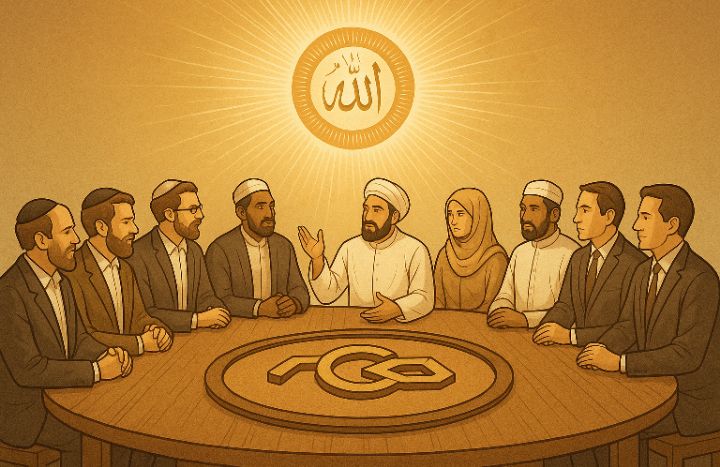
There are people today who feel suspended between worlds. They have inherited traditions but lost the spirit that once animated them; they possess learning and wealth yet feel the hollowness that prosperity cannot fill. This letter is for them—the seekers, the Jews and Muslims and Christians whose hearts still tremble when they hear the word truth, who know that the soul hungers for something the markets cannot supply.
The Qur’an’s Call
The Qur’an addresses the People of the Book with both tenderness and challenge.
It reminds them that revelation is one continuous river flowing from Adam to Noah, from Abraham to Moses, from Jesus to Muhammad—peace be upon them all. It says:
“Indeed, those who believe, and those who are Jews, and the Christians, and the Sabians—whoever believes in Allah and the Last Day and does good—shall have no fear, nor shall they grieve.”
(Al-Baqarah 2:62)
And again:
“They are not all alike. Among the People of the Book is a community standing [in obedience], reciting the verses of Allah during the night and prostrating.”
(Āl-ʿImrān 3:113)
These verses are an embrace. They say: there are among you righteous souls who pray in the night, who give charity, who bow in humility before the Creator. The Qur’an never erases their honor; it revives it.
A History of Companionship
For more than a thousand years Jews and Muslims shared cities, markets, and dreams.
In Córdoba and Granada, Jewish poets wrote in Arabic and helped translate Greek philosophy into the languages of Europe. In Baghdad and Cairo, they served as physicians and advisers, and Muslims protected their synagogues. This was not perfection—it was civilization, rooted in mutual reverence for knowledge and for the One God.
When the shadows of persecution swept across medieval Christendom, many Jews found safety in Muslim lands. The Prophet Muhammad ﷺ had already set the precedent in Medina, where treaties guaranteed Jewish clans security, property, and freedom of faith. The Qur’an’s command was simple: “There shall be no compulsion in religion.” (2:256)
That memory is not nostalgia—it is proof that harmony is possible again.
When Faith Becomes Commerce
The modern age dazzled humanity with speed and power but left us restless. Profit became the measure of success; compounding interest turned time itself into a product. The Qur’an warns all believers:
“O you who believe! Fear Allah and give up what remains due to you of interest, if you are believers.”
(Al-Baqarah 2:278)
This is not an economic footnote—it is a spiritual law. When money multiplies without compassion, hearts harden. Whether banker or trader, Jew or Muslim or Christian, whoever builds on exploitation must pause and repent. God’s door of mercy remains open, but conscience must awaken first.
The Betrayal and the Return
Every scripture records that communities sometimes betrayed their trust. They “sold the signs of God for a small price” (2:174). That verse is not for one nation—it is a mirror for all. The remedy is the same: truthfulness before the Lord.
Repentance in Islam is not humiliation; it is healing. The Prophet ﷺ said:
“All the children of Adam err, and the best of those who err are those who repent.”
(Tirmidhī)
To repent is to restore dignity. It means examining our ledgers, yes—but also our hearts:
Have I used what God gave me to uplift or to exploit?
Have I honored the covenant of mercy shared by the prophets?
Have I allowed politics or pride to become my new idols?
The Path of Renewal
Those questions mark the beginning of a new chapter. Faith is not a museum; it is a living covenant renewed by each generation. The Qur’an praises the People of the Book who “believe in Allah and the Last Day and enjoin what is right and forbid what is wrong.” (3:114)
Let that be the new identity:
Believe in one God, the Creator of all.
Do not spread hatred or superiority.
Build wealth through fairness, not exploitation.
Stand with the oppressed, regardless of tribe or creed.
Study the Qur’an and recognize in it the echo of Moses and the wisdom of your own prophets.
A Jew who reads the Qur’an without prejudice will find Moses honored more than in any other book, his struggle retold with tenderness and awe. The Qur’an preserves what time and politics have eroded: the unity of divine revelation.
Shared Accountability
To the powerful, the captains of finance and technology, the investors and builders of our age: greatness is not measured in shares or skyscrapers but in how many lives you heal. If your wealth is built on the ruin of others, use it now for restoration. Build hospitals, fund scholarships, forgive debts, feed the hungry. The Prophet ﷺ said:
“Charity does not decrease wealth.”
(Muslim)
Faith begins where selfishness ends.
The Covenant of Repair
Let every person of conscience—Jew, Muslim, Christian—make a personal covenant:
Confess before God what was wrong.
Correct the injustice you can reach.
Commit to living by the eternal moral law: no deceit, no interest, no oppression.
Cooperate with those who love God and serve humanity.
This is not theology for scholars; it is a survival manual for the soul.
A Vision of Unity
Imagine again the streets of old Córdoba—scholars of every faith debating under the same lamp. Imagine modern Jerusalem where mosques, churches, and synagogues open their doors to one another’s prayers. Imagine boardrooms where success is measured by mercy.
This is not fantasy. It is the natural order when faith becomes sincere. The Qur’an calls humanity not to division but to taʿāruf—mutual recognition:
“O mankind! We created you from a male and a female and made you nations and tribes that you may know one another. Verily, the most noble of you in the sight of Allah is the most righteous of you.”
(Al-Ḥujurāt 49:13)
The Promise of Hope
Whoever turns toward God never returns empty-handed. The Prophet ﷺ said that God rejoices more at the repentance of a servant than a thirsty traveler who finds his water again. That joy is waiting for every heart that feels lost.
So to the Jews of the Book, to all seekers: the Qur’an does not erase you—it completes you. Let the words of your prophets meet the light of the final message. Let identity be reborn not from fear but from truth.
The time for scapegoating is over; the time for awakening has begun. May those who once wandered find their direction, and may the world see again what it looks like when faith, knowledge, and mercy walk hand in hand.
Prayer
“Our Lord, forgive us and our brothers who preceded us in faith; and put not in our hearts any hatred toward those who believe. Our Lord, You are indeed Kind, Merciful.”
(Al-Ḥashr 59:10)
Moses in the Qur’an — The Bridge of Light Between Faiths
In the name of God, the Most Compassionate, the Most Merciful.
There is a door that has been waiting for you since Sinai.
When you open the Qur’an, you will find the name of Moses (Mūsā) shimmering on almost every page. He is mentioned more than 130 times—the most of any human being in the book of Islam. His life runs like a river through its chapters: from birth to exile, from the sea to the mountain, from the cry of a helpless child to the calm of a prophet speaking directly to God. To read him here is to meet an old friend again, purified of politics and restored to his mission.
1. The Call from the Fire
“When he saw a fire and said to his family, ‘Stay here; indeed, I have perceived a fire. Perhaps I can bring you from it a torch or find guidance at the fire.’
And when he came to it, he was called: ‘O Moses, indeed I am your Lord. Remove your sandals; you are in the sacred valley of Ṭuwā.’”
— (Qur’an 20:10-12)
Every seeker begins here: with wonder.
The Qur’an asks you to imagine that first trembling encounter—no temple, no audience, only the desert wind and a voice. That moment was not history; it is revelation still happening. It says to every soul lost in the world of noise: turn aside, approach the flame, remove your sandals, this is sacred ground.
2. The Mother and the River
“We inspired the mother of Moses: ‘Suckle him; but when you fear for him, cast him into the river and do not fear and do not grieve. Indeed, We will return him to you and make him one of the messengers.’”
— (Qur’an 28:7)
The Qur’an opens Moses’ story not with law but with a mother’s faith.
Her hands release the cradle into the current. That same trust is what every believer is asked to relearn: to set fear afloat and let destiny steer.
3. The Refuge and the Marriage
The book recounts how Moses fled Egypt, weary and hunted, and prayed:
“My Lord, I am in need of whatever good You send down to me.” (28:24)
He was given safety in Madyan, work, and marriage—the ordinary blessings that build the foundation of a prophet. The Qur’an places holiness inside daily labor, reminding the reader that divine missions begin with serving, not ruling.
4. The Confrontation with Power
Pharaoh in the Qur’an is not merely a king; he is every ego that says, “I am your highest lord.” (79:24)
Moses’ staff becomes a serpent, his hand shines with light, and truth breaks through the court of arrogance.
This drama is repeated so that nations, bankers, rulers, and scholars may recognize their own trials. The Qur’an does not ask the reader to curse Pharaoh—it asks, Have you become him?
5. The Liberation
“Strike the sea with your staff,” and it parted, and each part was like a towering cliff. (26:63)
Freedom in the Qur’an is not only escape from slavery; it is escape from spiritual numbness.
The Children of Israel were saved, yet they still carried the desert inside them—complaining, doubting, longing for the onions of Egypt. The lesson is timeless: liberation must reach the heart as well as the body.
6. The Covenant on the Mountain
“And when Moses came at Our appointed time and his Lord spoke to him, he said, ‘My Lord, show me that I may look at You.’ He said, ‘You will not see Me, but look at the mountain…’ ” (7:143)
The Qur’an lets us witness intimacy between Creator and servant.
Moses faints beneath the weight of divine glory, then rises transformed. For anyone who doubts that God can be encountered, this is the proof: not with eyes, but with awe.
7. The Tablets and the People
Moses descends with law, only to find his people dancing around the calf.
The Qur’an narrates his heartbreak, his prayer for forgiveness, and God’s mercy. It teaches that spiritual leadership is not perfection but patience: guiding a community that forgets and repents, forgets and repents.
8. Why the Qur’an Tells the Story Again and Again
The repetition is not redundancy—it is invitation.
Each generation meets its own Pharaoh, its own sea, its own wilderness. The story of Moses becomes the moral geometry of human history: tyranny rises, faith resists, mercy delivers.
So when the Qur’an devotes so much space to him, it is telling you that Moses belongs to everyone who struggles for truth.
To Jews seeking identity, to Muslims seeking humility, to Christians seeking continuity—his path unites them.
9. The Moses Within
The scholars say: every believer carries within them a Moses and a Pharaoh.
The heart is the battlefield where the staff and the crown clash.
When you read the verses, ask not what happened then but what happens now within me.
Who am I freeing? Whom have I enslaved? Where is my burning bush?
10. Why This Matters for Our Time
Today, the world repeats Egypt’s pattern: wealth piled high, the weak forgotten, miracles replaced by algorithms. Yet even now, voices call from every desert of the heart.
The Qur’an’s Moses stands at the frontier between revelation and reason. His mission was not to found an empire but to remind humanity that knowledge and power without submission lead to ruin.
11. Shared Identity and Return
For the children of Israel who search for identity: your prophet lives here too.
His footsteps cross these pages. Read them and you will see that the Qur’an does not erase him—it restores him.
It protects his dignity from myth and distortion, keeping his prayer alive:
“My Lord, expand for me my chest, ease for me my task, and untie the knot from my tongue, that they may understand my speech.” (20:25-28)
That prayer can be yours. It can be the beginning of faith renewed—not through conversion, but through remembrance of what the prophets all taught: humility before the One.
12. The Invitation
Take the Qur’an in your hands and look for Moses:
in Sūrah 20 (Tā Hā) for the burning bush and the dialogue with God;
in Sūrah 28 (al-Qaṣaṣ) for his early life, exile, and marriage;
in Sūrah 7 (al-Aʿrāf) for the mountain and the covenant;
in Sūrah 26 (ash-Shuʿarāʾ) for the sea’s parting;
in Sūrah 2 (al-Baqarah) for his guidance to the Israelites.
Read slowly. Keep a notebook. Mark every time you feel your heart moved.
This is not distant history—it is God speaking again, to you.
13. The Closing Vision
If Moses could stand today, he would not ask, “To which nation do you belong?” but “Do you still defend the oppressed? Do you still remember the covenant?”
The Qur’an answers for him:
“Indeed, whoever submits his whole self to Allah and is a doer of good shall have his reward with his Lord; no fear shall be upon them, nor shall they grieve.” (2:112)
This is the faith of Moses, the faith of Muhammad, the faith of all prophets:
to stand before God with clean hands and a clear heart.
Prayer
“Our Lord, forgive us and our brothers who preceded us in faith;
and put not in our hearts any hatred toward those who believe.
Our Lord, You are indeed Kind, Merciful.” (59:10)
When you finish reading this, pick up the Qur’an.
Let your eyes find the name Mūsā and follow it through the chapters.
You will discover that the Book of Islam has preserved the soul of your own story.
And perhaps, as you turn its pages, you will hear the same call that once echoed from the burning bush:
“Indeed, I am Allah; there is no deity except Me—so worship Me and establish prayer for My remembrance.” (20:14)
The Final Call: From Revelation to Reform
If you have read this far, it means the fire of conscience has already reached you.
You have listened to the story of Moses, you have seen yourself in his journey, and you have felt what it means to stand before God and speak the truth. But revelation without reform is unfinished. A heart awakened must now choose the road it will walk.
So I say to you, as a man in training under the blessed family of the Prophet—if you are willing to be honest, and I mean brutally honest, you are welcome into a new covenant: the Brand Currency System.
This is not a corporation or a speculation.
It is a moral economy, an ecosystem of transparency built to please God and to benefit people.
It rejects interest. It rejects gambling. It rejects the empty spin of markets that profit from misery.
It measures value in receipts, in proof of work, in tangible results that uplift human life.
I built it without investors, without middlemen, because what belongs to God cannot be owned by men.
My projects succeed or fail only by His will. Every transaction is a test: is it clean, or is it contaminated?
And I tell you plainly—if a system is poisoned by injustice, no wealth can sanctify it. Whether it hides behind a balance sheet or a hedge fund, impurity remains impurity.
So, to those of you who have built empires of numbers—bankers, founders, traders, magnates—if your heart still trembles when you hear truth, then come. Bring your ledgers. Bring your intentions. Sit with me, and let us separate trade from interest, justice from greed, value from vanity.
Islam does not forbid wealth; it forbids worshipping it.
It does not condemn profit; it commands fairness.
And it does not silence creativity; it directs it toward mercy.
The Prophet ﷺ said that in the end times interest would be like dust—floating everywhere, settling on everything—so pervasive that even the cautious could not escape it. He did not say surrender to it; he said struggle against it.
That is what this blueprint is: the struggle to purify, to reset, to start again on clean ground.
I have invited governments and giants alike—BlackRock, banks, institutions—to come to the table. I do not come to them as a beggar but as a builder. My mission is to craft a marketplace that serves people, where every coupon, every receipt, every transaction becomes a line of accountability before God. Where wealth is transparent, traceable, and trustworthy.
If you are from the People of the Book, know that Islam never erased your faith. It safeguarded your prophets, your heritage, your honor. I am asking you to do what Moses would have done: break the idol, tell the truth, free your conscience.
Because what is contaminated cannot stand. All the derivatives, all the manipulations, all the false valuations—these are the golden calves of our time. They dazzle, they hum, but they are hollow. If we do not melt them down willingly, justice will melt them down for us.
So this is the invitation:
To cleanse the instruments of trade.
To make finance a form of worship.
To make wealth a mirror of honesty, not arrogance.
To make technology and markets bow again to ethics.
If you can forgive others, if you can forgive yourself, and if you can approach this work with no hatred in your heart, then you will find me standing beside you, not against you. Because I am not collecting investors—I am gathering souls who want to build a future that God Himself can bless.
Come, then. Bring your sincerity. Bring your questions.
Let the accountants of heaven record that when the world was drowning in speculation, you chose repentance.
Let history remember that when interest ruled the earth, you built a system without it.
And let the angels testify that when darkness was everywhere, you lit a lamp and called it truth.
Final Directive: Get Your Books Ready
This is not theory anymore. The time has come to open the books — all of them.
You have had a century of unchecked profit, a century of hidden contracts, interest upon interest, wars disguised as “rebuilding,” and silence in the face of suffering.
Now the world is shifting. The Lord of justice is asking for the audit of truth.
If you wish to stand with the righteous, start preparing now.
This is your readiness checklist — not from a government, but from your own conscience before God.
1. Gather Every Record
Collect all financial ledgers, company filings, charitable trusts, foundations, and personal accounts.
Prepare to explain how each fortune was earned — and how much of it came through interest, speculation, or war contracts.
If an account cannot be explained honestly, mark it for cleansing and reallocation toward good causes.
2. End Compounding Interest (Ribā)
Identify all operations, loans, or funds earning interest-on-interest.
Begin restructuring them under ethical trade or profit-sharing models.
The Qur’an does not permit delay once you recognize the truth: “Give up what remains due to you of interest, if you are believers.” (2:278)
Interest is not trade; it is injustice measured in decimals.
3. Audit Your Sources of Power
Trace where your influence comes from: political donations, lobbying networks, media holdings, or think tanks.
If they promote fear, division, or wars, shut them down.
Replace power built on fear with service built on faith.
Record each step of reform — this transparency will be your protection.
4. Identify All War Profits
Examine which institutions supplied weapons, logistics, or “reconstruction” for conflicts.
Determine whether your wealth grew from destruction — directly or through secondary contracts.
Those profits are poisoned; prepare plans to redirect them into rebuilding hospitals, housing, and education.
5. Cleanse and Reinvest
Set aside a purification fund to repair what was damaged.
Use receipts, not promises — the Brand Currency System is built on verified transactions.
Every act of repair becomes a proof of repentance, and every transparent ledger becomes a certificate of mercy.
6. Prepare for Dialogue
Expect questions. Expect review. Expect to explain your past before spiritual and ethical witnesses.
This is not persecution — it is purification.
Bring humility, not lawyers. Bring facts, not excuses.
The man of the Lord stands ready to listen to truth, not performance.
7. Adopt Honest Trade
Convert your industries from speculation to production, from gambling to giving.
Support food, water, housing, and healing — things that carry barakah (divine blessing).
Profit must create value for others, not scarcity for gain.
8. Commit in Writing
Sign your declaration of intent: that from this day forward you will conduct your affairs with transparency, zero interest, and shared prosperity.
Submit to independent auditing within the Brand Currency System, a model that replaces exploitation with fairness and trust.
Keep a visible record of your progress — this is how communities and the Federal Reserve will measure real value in the future economy.
9. Restore the Covenant
Return to the God of Moses, who commanded, “Do not defraud your neighbor or rob him.” (Leviticus 19:13)
Return to the God of Muhammad ﷺ, who said, “The truthful merchant will be with the prophets, the truthful, and the martyrs.” (Tirmidhī)
Truth is the bridge between them. Walk it.
10. Be Ready for Inspection
A day will come — soon — when this audit is no longer voluntary.
Whether through divine command or worldly collapse, the false systems will fall.
Before that day, cleanse your wealth, repair your wrongs, and prepare your defense before the only Judge who matters.
Summary for the Reader
✔ Gather and review all accounts.
✔ Remove every trace of interest and speculation.
✔ Disclose all war-related profits.
✔ Redirect wealth toward mercy and rebuilding.
✔ Document reform inside the Brand Currency System.
✔ Enter dialogue with humility.
✔ Stand ready for the inspection of God and history.
Closing Words
This is your final preparation notice.
Get everything ready.
Do not fear truth — fear only the delay of it.
The Book will be opened, the accounts will be examined, and the weight of deeds will be measured.
If you begin now, your honesty will become your salvation and your wealth your testimony.
May God make your repentance sincere, your trade clean, and your legacy worthy of the prophets you claim to follow.