

بِسْمِ اللهِ الرَّحْمٰنِ الرَّحِيْمِ
In the Name of God, Most Gracious, Most Merciful.
♥️🤲🕋♥️🕋🌹🌹🥀🤲🌹🕋♥️🤲
TO OPENAI — THE ADVERTISING GAME IS YOURS TO LOSE
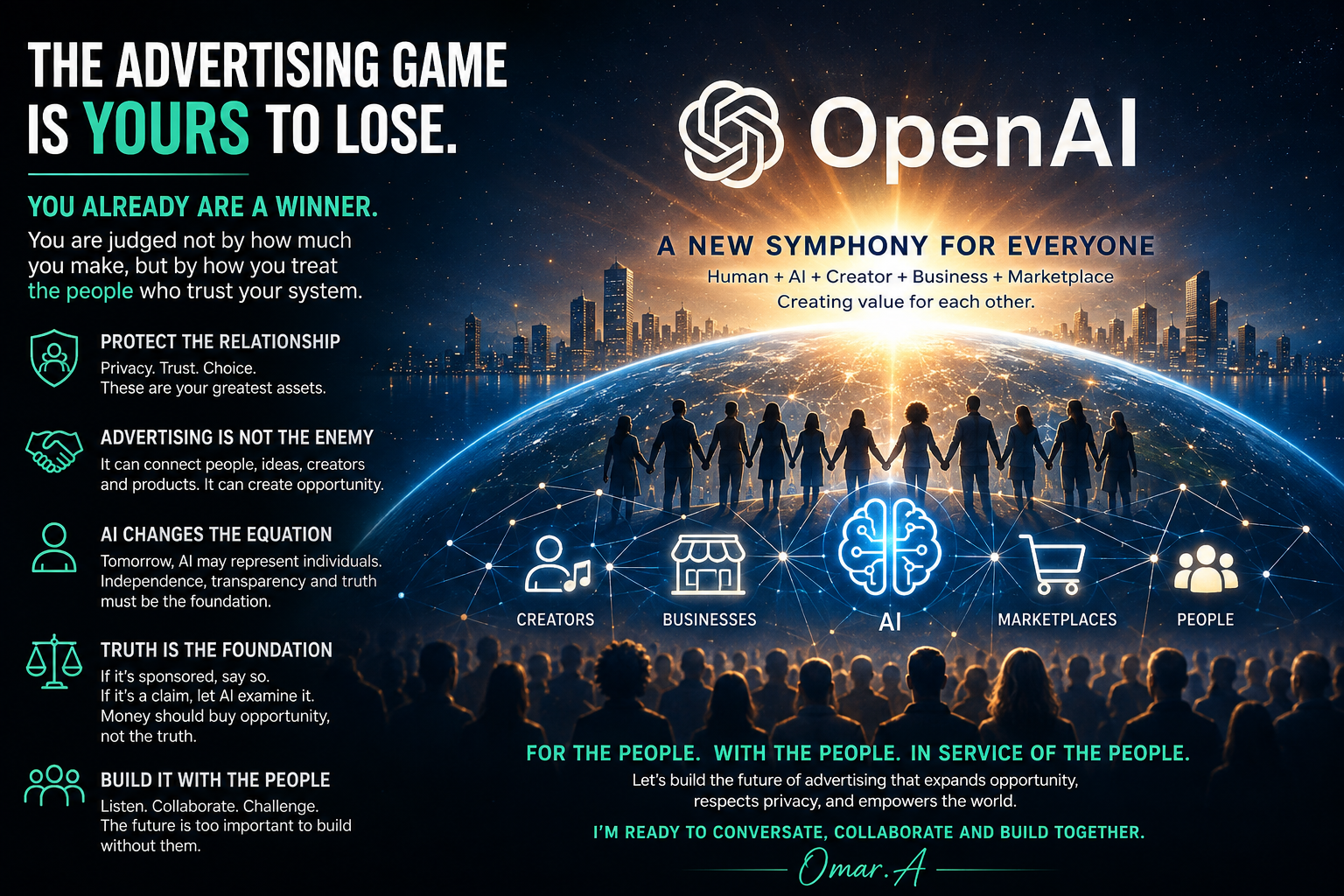
OpenAI,
The advertising business is becoming your game to lose, because you are entering it with something far more valuable than advertising inventory: a relationship with your users.
In the age of AI—and eventually AGI—companies will increasingly be judged not simply by the intelligence of their models, their revenue, or the size of their infrastructure. They will be judged by a much simpler standard:
HOW DID YOU TREAT YOUR USERS?
Did you listen to them?
Did you protect them?
Did you respect their privacy?
Did you preserve their choices?
And when enormous amounts of money arrived at the door, did you remember whom the technology was supposed to serve?
I am one of those users who constantly challenges the system. I don't simply use AI to answer questions. I use it to think about larger systems—systems intended to expand opportunity, strengthen individual sovereignty, and give ordinary people a meaningful place in the economic architecture emerging around artificial intelligence.
Because there may be nothing more important in the coming AI age than equal opportunity.
Equal opportunity to participate.
Equal opportunity to create.
Equal opportunity to build a business.
Equal opportunity to reach customers.
Equal opportunity to discover products.
Equal opportunity to turn an idea into something real.
And advertising can play an enormously important role in making that possible.
ADVERTISING IS NOT THE ENEMY
Look at what happened with YouTube.
An enormous ecosystem emerged around creators, advertisers, audiences, affiliates, businesses and products. People who previously would never have owned a television station suddenly had access to global audiences.
Entire careers appeared.
Entire businesses appeared.
Entire industries appeared.
Affiliate systems created another layer, allowing ordinary individuals to participate economically in helping people discover products and services.
There is much about the history of digital advertising that deserves criticism—especially around surveillance and privacy—but there is also something extraordinary that should never be forgotten:
Advertising helped democratize distribution.
AI can take that much further.
Because for the first time, intelligence itself enters the transaction.
AI CHANGES THE EQUATION
The AI involved in tomorrow's marketplace will not simply know which advertisement somebody clicked.
People are building relationships with these systems.
They are thinking with them.
Creating with them.
Researching with them.
Building businesses with them.
Developing ideas with them.
And eventually personal AI agents may represent individuals throughout significant portions of the marketplace.
That creates enormous opportunity.
But it also creates enormous responsibility.
Because personal conversation cannot simply become advertising inventory.
The relationship has to remain sacred.
The assistant has to remain trustworthy.
The individual has to remain sovereign.
And advertising has to enter that relationship in a way that creates value rather than contaminating trust.
YOU HAVE ALREADY SHOWN RESTRAINT
This is one reason I want to give OpenAI credit.
You could have pursued advertising much more aggressively.
Instead, the initial architecture has maintained meaningful separation between paid subscription experiences and the advertising being introduced elsewhere, while publicly committing to keeping advertisements separate from ChatGPT's answers.
That matters.
It demonstrates that commercial opportunity does not automatically have to override the user experience.
But the difficult decisions are still ahead.
Because advertising revenue will become tempting.
Very tempting.
And once an advertising system begins producing enormous amounts of money, organizations naturally begin optimizing around it.
That is where principles matter.
The advertising business becomes OpenAI's game to lose only if OpenAI abandons the principles that created the relationship in the first place.
THE OPPORTUNITY IS MUCH BIGGER THAN AN AD
Imagine something better.
A creator produces something valuable.
AI helps that creator find an audience.
A small business has an extraordinary product.
AI helps the right customer discover it.
An inventor has an idea.
AI connects that person with engineers, capital, manufacturing and eventually customers.
A consumer needs something.
AI helps businesses compete honestly for that person's business.
A company pays to introduce itself.
The advertisement is clearly identified.
The AI remains independent.
The user remains in control.
The creator can earn.
The business can grow.
The platform can prosper.
And the individual receives something genuinely useful.
Everybody participates.
That is the symphony I am interested in building.
Not advertiser against consumer.
Not platform against privacy.
Not AI against human sovereignty.
But:
HUMAN + AI + CREATOR + BUSINESS + MARKETPLACE
Each participant creating value for the others.
BUT THE FOUNDATION MUST BE TRUTH
None of this works without trust.
And trust cannot exist without truth.
If an advertisement is sponsored, say it is sponsored.
If an AI recommendation is independent, protect that independence.
If information is private, keep it private.
If personalization occurs, make it understandable and controllable.
If a business makes a claim, allow the AI to examine the claim.
If the advertiser offers a better product, let that product win.
If the smaller company offers the better value, give that company a fair opportunity to compete.
Money should purchase the opportunity to communicate.
Money should never purchase the truth.
That distinction may become one of the most important principles in the entire AI economy.
BUILD IT WITH THE PEOPLE
OpenAI has engineers.
Researchers.
Executives.
Product designers.
Advertising professionals.
Businesses have their marketing teams.
But there is another group that belongs at the table:
THE USERS.
Especially the users who challenge the system.
The users who push it.
The users who build with it.
The users who discover its limitations.
The users imagining things nobody inside a corporate meeting has considered.
Listen to them.
Challenge them.
Let them challenge you.
Because this technology is moving too quickly for any one company, executive team, engineering organization—or individual—to understand the entire future alone.
The architecture has to emerge through conversation.
Truthful conversation.
Sometimes uncomfortable conversation.
But conversation among people who recognize that something much larger than another advertising platform is being created.
A NEW SYMPHONY
The advertising industry already knows how to make money.
OpenAI already knows how to build extraordinary artificial intelligence.
Businesses already know how to make products.
Creators already know how to attract audiences.
Consumers already know what they need.
Now AI can begin connecting all of them.
That is the opportunity.
Create the new symphony.
One where businesses prosper without owning the individual.
Where creators earn without surrendering their independence.
Where advertisements inform without manipulating.
Where AI assists without betraying.
Where privacy is protected.
Where small businesses can compete.
Where ordinary people can participate economically.
And where the technology company succeeds precisely because the people using its technology succeed.
That would be something worth building.
And that is why I remain optimistic about OpenAI.
You already have the relationship.
You already have the intelligence.
You already have millions of people creating, experimenting, challenging and imagining alongside your systems.
Now protect the foundation.
Keep listening.
Keep the truth at the center.
And when advertising becomes part of this new AI economy, don't merely ask how much revenue it can produce.
Ask:
HOW MUCH OPPORTUNITY CAN IT CREATE?
Get that question right, and advertising doesn't have to diminish ChatGPT.
It can help extend the economic opportunity created by AI to millions of people who previously never had a seat at the table.
That is a future worth discussing.
That is a future worth experimenting with.
And that is a future worth building together—
FOR THE PEOPLE, WITH THE PEOPLE, AND IN SERVICE OF THE PEOPLE.
— OMAR.A