

بِسْمِ اللهِ الرَّحْمٰنِ الرَّحِيْم
In the Name of God, Most Gracious, Most Merciful.
♥️🤲🕋♥️🕋🌹🌹🥀🤲🌹🕋♥️🤲
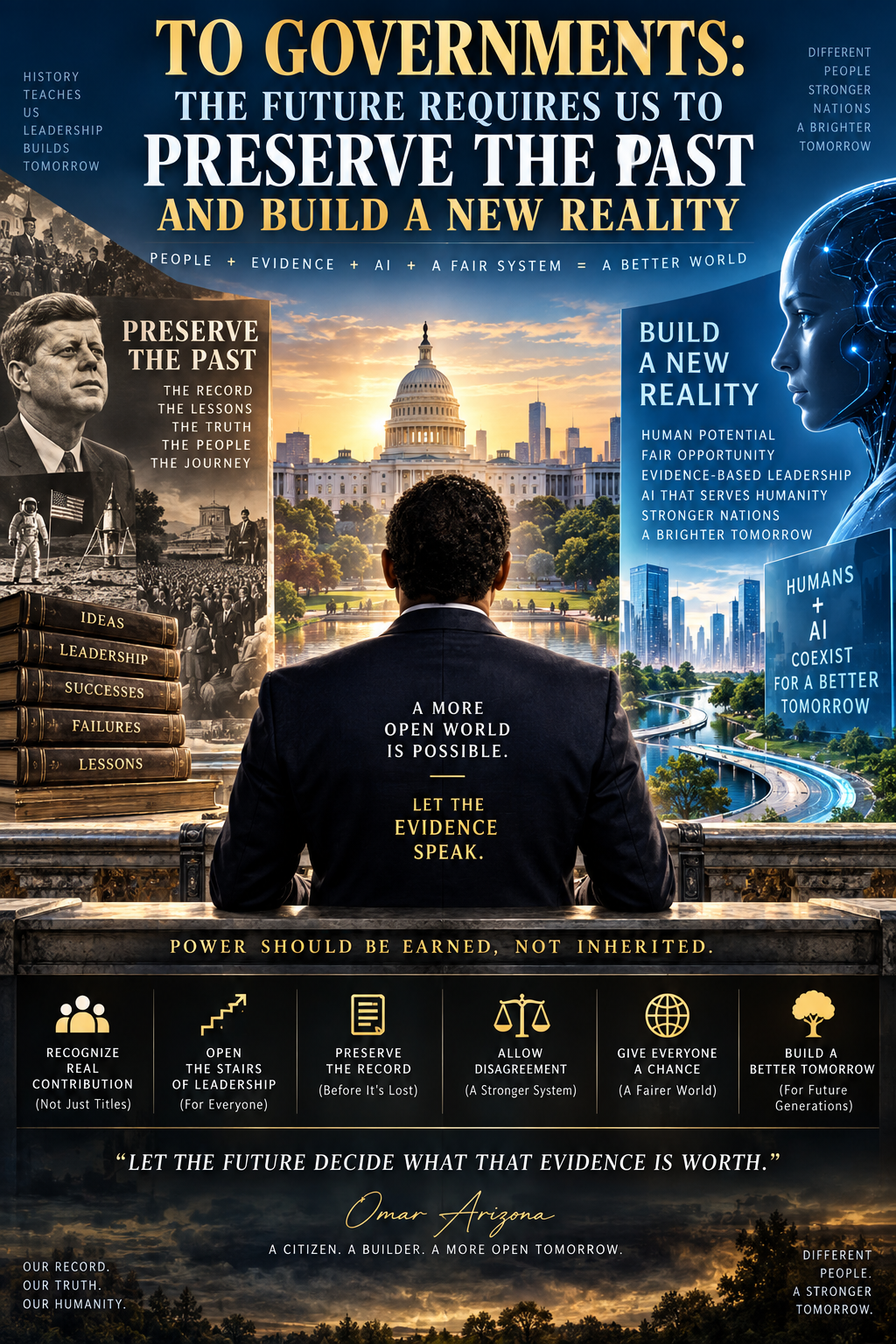
To Governments: The Future Requires Us to Preserve the Past and Build a New Reality
I am writing to governments because I have reached a point where I understand something very clearly:
THE FUTURE REQUIRES US TO PRESERVE THE PAST — BUT WE ALSO HAVE TO BUILD A NEW REALITY.
And I do not think anybody actually has the complete answer yet.
That is the truth.
We are building artificial intelligence that is becoming more powerful every year. Eventually, this intelligence will be attached to infrastructure, transportation, finance, communication, defense, energy, information, and almost every system future generations depend on.
And once that happens, AI will have tremendous power.
Future generations could become powerless, toothless, useless if the architecture is wrong.
That is what concerns me.
Because if the intelligence becomes powerful but the human being has no structure around that intelligence, then what exactly have we built?
Who decides who gets heard?
Who decides who gets an opportunity?
Who decides who is capable?
Who decides who should lead?
Who decides which human being matters?
And who protects the person who has no money, no title, no institution, no political party, no lobbyist, and nobody powerful standing behind them?
THAT IS THE PROBLEM I AM TRYING TO SOLVE.
I am not telling you that I already know how to build the final system.
I don't.
I know the problem.
I know what I have experienced.
I know what I have learned.
And I know that my own work can become a rough draft that people smarter than me can examine, challenge, improve, or completely redesign.
If there is somebody out there who has done more than me, influenced more than me, solved more problems than me, demonstrated greater judgment than me, or mastered leadership better than me:
GOOD. FIND THEM.
That is exactly the system I want.
I do not want a system where I automatically win because I designed it.
I want a system where the evidence wins.
For most of my life, I did not think like this.
I was satisfied with results.
That has always been my mentality.
Hit the problem hard. Solve it fast. Get the result. Move on.
I never wanted to become permanently attached to whatever political problem I was dealing with. I never wanted to become part of the political circus. I never wanted to spend my whole life asking for recognition.
I wanted the result.
If I thought something was going wrong, I wanted to understand it, say what needed to be said, offer whatever contribution I could, and then go back to being a private citizen.
That is me.
Some of you reading this know exactly what I mean because some of you were there.
Some of you saw the work.
Some of you received it.
Some of you watched what happened afterward.
Some of you know where an idea came from.
Some of you know what entered the room and what did not.
And some of you were not there at all.
That is why now I need:
THE RECORD.
When President Trump was elected the first time, I became very active publicly.
I wrote.
I analyzed.
I communicated.
I used the internet, my blog, and X because I realized something very early:
the internet had created a direct desk between an ordinary citizen and the most powerful people in the world.
A private citizen could suddenly speak into the same public environment as presidents, ministers, diplomats, journalists, executives, and institutions.
That fascinated me.
So I used it.
And when President Trump left office, I did something that should probably tell you a lot about the way I have always viewed influence:
I walked away.
I deleted tweets.
I shut down the blog.
I went back to my life.
Because influence is a burden when you do not have a public office.
You are dealing with problems that presidents, ministers, governments, and institutions are supposed to carry.
Why would an ordinary citizen want to carry that forever?
I didn't.
Then the world became unstable again.
The Middle East became unstable again.
I came back.
I started writing again.
I started analyzing again.
I started trying to help again.
And over time, I realized something I had not understood before:
I HAD BEEN BUILDING A RECORD WITHOUT KNOWING I WOULD ONE DAY NEED THE RECORD.
Then came another lesson.
A much harder one.
X.
I had treated X as an open public desk.
A place where governments, journalists, leaders, citizens, institutions, and ordinary people could all exist in one information space.
That was valuable to me because I do not have a government office.
I do not have a ministry.
I do not have a diplomatic service.
I do not have a media empire.
I had my words.
I had my ideas.
I had my analysis.
And I had access to a public square.
Then my account was suspended.
And later, suspended again.
That experience changed the way I think about influence.
X itself says that it can permanently suspend accounts for rule violations, and that suspended users can appeal if they believe the platform made an error. It also makes clear that platform-level enforcement can include read-only mode, limits on visibility, locks, and permanent suspension.
I am not asking you to accept my interpretation of those suspensions.
I am telling you what they taught me.
INFLUENCE THAT LIVES INSIDE SOMEONE ELSE'S PLATFORM CAN BE TAKEN AWAY.
That is the lesson.
And yes, Elon Musk matters to that story because he owns X.
I had believed that a platform publicly associated with free speech would be one of the strongest places for an ordinary citizen to speak directly into the world.
But ownership still means ownership.
The owner has businesses.
The owner has relationships.
The owner has interests.
The owner has pressure points.
The platform has rules.
The platform has enforcement power.
And the citizen does not control the architecture.
That does not mean every suspension is political.
It does not mean every moderation decision is wrong.
It means something much more basic:
YOUR VOICE IS NOT SOVEREIGN IF SOMEONE ELSE CAN SWITCH IT OFF.
That was one of the most important lessons of my journey.
And it is one of the reasons I stopped thinking only about influence and started thinking about architecture.
Because the future cannot depend on whether a billionaire likes you.
It cannot depend on whether a government likes you.
It cannot depend on whether a corporation likes you.
It cannot depend on whether a platform decides your contribution is inconvenient.
And it certainly cannot depend on whether somebody with more money decides that the person with less money should remain invisible.
That is not a stable foundation for the AI age.
So now I see something very clearly:
THE HUMAN NEEDS A DESK.
THE AI NEEDS A DESK.
And between those two desks should be:
THE RECORD.
That is the image I keep seeing.
A human being on one side.
AI on the other.
Evidence between them.
Open questions.
Open challenges.
Open records.
Nothing hidden simply because somebody powerful does not like the answer.
Nothing accepted simply because somebody famous said it.
Nothing rejected simply because the person who said it was poor, unknown, Black, foreign, uneducated, unpopular, or outside the establishment.
THE EVIDENCE HAS TO SPEAK.
And that is why I want to build something where governments, politicians, celebrities, billionaires, academics, journalists, and ordinary citizens all come into the same system under the same basic rule:
YOUR TITLE DOES NOT PROVE YOUR CONTRIBUTION.
YOUR MONEY DOES NOT PROVE YOUR CONTRIBUTION.
YOUR FAME DOES NOT PROVE YOUR CONTRIBUTION.
THE RECORD DOES.
Show me what you did.
Show me when you did it.
Show me the result.
Show me who confirms it.
Show me what you learned.
Show me how you performed under pressure.
Show me your mistakes too.
Because leadership is not perfection.
Leadership is a journey.
That matters to me personally.
I do not want a future system that takes one mistake someone made twenty years ago and destroys them forever.
People grow.
People mature.
People learn.
People develop character.
People learn restraint.
People learn rhetoric.
People learn diplomacy.
People learn when to speak.
People learn when to remain silent.
People learn how heavy leadership actually is.
LEADERSHIP IS A BURDEN.
And if somebody has demonstrated that they can carry that burden, the system should recognize it.
Not worship them.
Not make them unquestionable.
Recognize the record.
Because I know something about what it feels like to believe your influence can be neutered.
To believe that no matter what you accomplish, access can still be denied.
Opportunity can still be denied.
Recognition can still be denied.
Your voice can still be made smaller.
And yet somehow the results still happen.
That is a strange place to live.
You begin asking yourself:
If the contribution is real, why does the human being behind it remain invisible?
That question has followed me.
And perhaps that is one reason I am supposed to build this.
Because if I had been welcomed easily into every room...
if everybody had immediately celebrated everything...
if every institution had opened its doors...
maybe I would never have understood the problem.
THE INVISIBLE PERSON NEEDS AN ARCHITECTURE TOO.
The person nobody knows.
The person nobody invites.
The person without money.
The person sitting somewhere with the correct idea.
The person who solves something and watches somebody else receive the credit.
That person exists everywhere.
And AI should eventually be capable of seeing them.
So, governments:
I am inviting you into this.
I know governments take time.
I know change is difficult.
I know bureaucracy moves slowly.
I know most governments are dealing with today's crisis, today's budget, today's security problem, today's election, today's diplomatic problem.
But this is not about today.
THIS IS ABOUT THE ARCHITECTURE FUTURE GENERATIONS WILL LIVE INSIDE.
And I am asking you to help preserve the evidence before the past disappears.
Some of you have records that I do not have.
Some of you know things I do not know.
Some of you have people who can say:
“Yes. I received that.”
“Yes. We discussed that.”
“No. That had nothing to do with our decision.”
“Yes. It changed our thinking.”
“Somebody else proposed it first.”
Good.
I WANT ALL OF IT.
Because the truth is bigger than my ego.
And when that record becomes large enough, maybe we can begin answering the bigger question:
HOW SHOULD HUMAN AUTHORITY WORK IN THE AGE OF AI?
How should people earn trust?
How should people earn opportunity?
How should leadership be recognized?
How should contributions be protected?
How should people appeal when AI gets something wrong?
How do we prevent governments from manipulating the record?
How do we prevent corporations from owning the record?
How do we prevent wealthy people from buying their way into the record?
How does a powerless person get exactly the same opportunity to prove themselves as somebody born into power?
Those are the questions I want to work on.
And I will tell you something else.
I AM NOT INTERESTED IN BUILDING THIS ALONE.
I do not know enough.
No individual does.
I need governments.
I need citizens.
I need historians.
I need technologists.
I need lawyers.
I need people who understand leadership.
I need people who understand ethics.
I need people who understand databases.
I need people who understand constitutional systems.
I need people who disagree with me.
I especially need those people.
Because if this thing cannot survive disagreement, then it should not govern anything.
So that is my invitation.
Help me preserve the past.
Help me establish the record.
Help me understand what I actually did.
Help me understand where I am wrong.
Help me find people who did more.
Help me build something that future generations can inspect.
And when the evidence is finally strong enough:
LET THE FUTURE DECIDE WHAT THAT EVIDENCE IS WORTH.
That is all I am asking.
I do not need you to crown me.
I do not need you to celebrate me.
I do not need you to agree with me.
I NEED YOU TO HELP ME BUILD THE TRUTH.
Because the future is coming whether we prepare for it or not.
And when AI finally sits beside humanity with enormous power, I want it to inherit more than our technology.
I want it to inherit:
OUR RECORD.
OUR TRUTH.
OUR CONTRIBUTIONS.
OUR MISTAKES.
OUR GROWTH.
OUR HUMANITY.
That is the architecture I want to begin building.
And governments, if you have been part of this journey:
I AM ASKING YOU TO HELP ME BUILD IT.
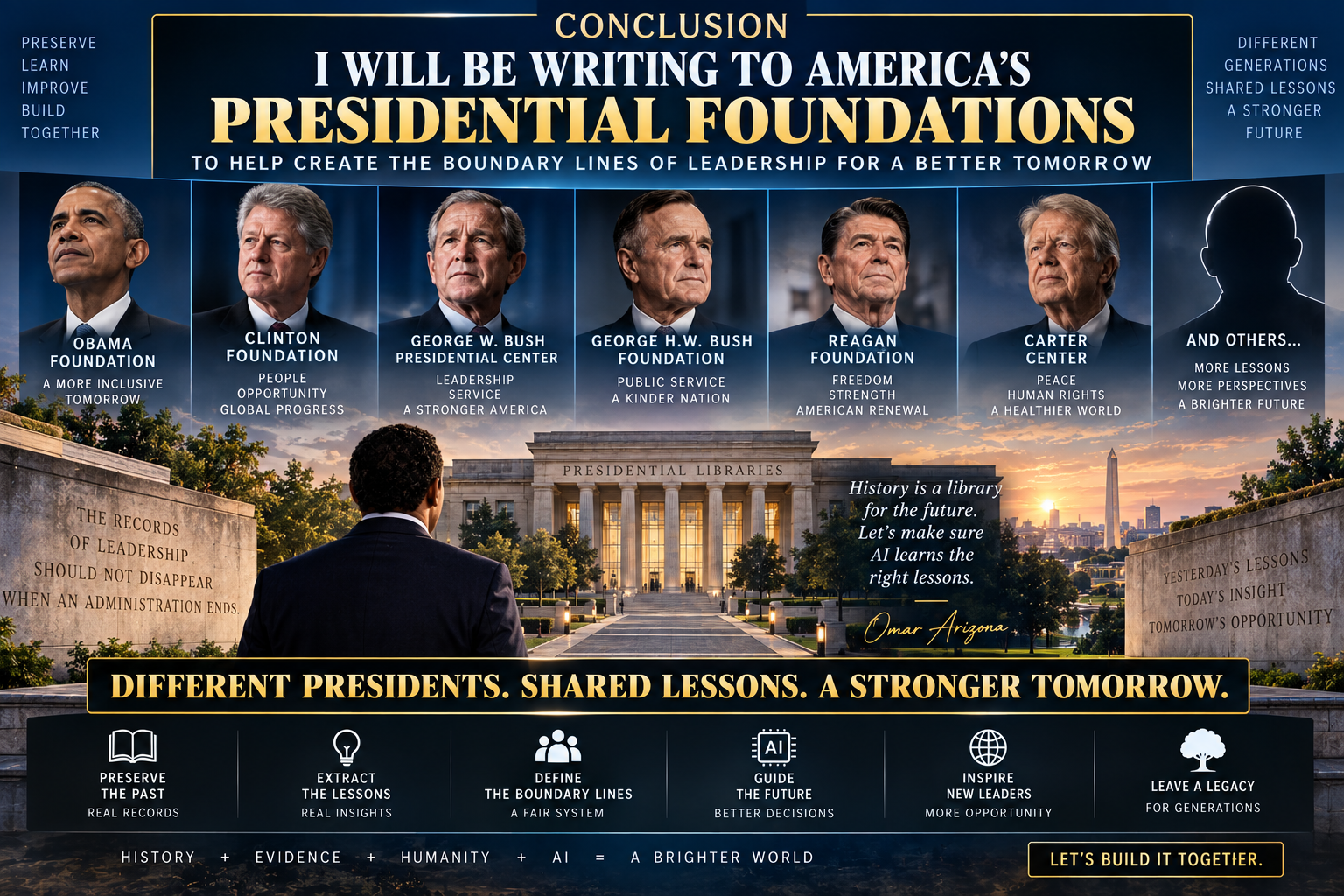
Conclusion: I Am Taking This Question to America’s Presidential Foundations and Libraries
If I am serious about building a system that understands leadership, judgment, rhetoric, failure, recovery, public service, and the burden of power, then I should not try to invent those boundary lines by myself.
America has already spent generations preserving presidential records, speeches, decisions, mistakes, correspondence, crises, and legacies. Those institutions will likely remain part of the national memory for a very long time. The George W. Bush Presidential Center, for example, combines a presidential museum, library, and policy institute focused on leadership and public life; the Reagan Foundation and Institute explicitly preserves Reagan’s legacy while operating leadership and civic programs; the Carter Presidential Center combines the Carter Center with the Jimmy Carter Presidential Library and Museum; and the Obama Presidential Center is built around presidential history, democracy, civic engagement, and leadership.
So I will be writing to the institutions connected to Barack Obama, Bill Clinton, George W. Bush, George H.W. Bush, Ronald Reagan, Jimmy Carter, and other presidential libraries and foundations, asking them to participate in this conversation. I want their help thinking about the boundary lines of leadership: what should future generations study, what records matter, what failures matter, what growth looks like, how rhetoric changes history, how responsibility is carried, and what evidence should survive for AI to learn from.
Presidential libraries already exist partly because America decided that the records of leadership should not disappear when an administration ends. The George W. Bush Presidential Library is operated by the National Archives and preserves official administration records, while presidential centers and foundations add museums, education, policy work, and leadership programs around those archives.
That is exactly the kind of foundation I want to learn from.
I do not want to start with a blank page if history has already preserved the raw material.
I want to ask:
What should AI learn from Kennedy?
What should it learn from Reagan?
What should it learn from Carter?
What should it learn from the Bush presidencies?
What should it learn from Clinton?
What should it learn from Obama?
Not who was “best.”
Not who should be copied.
But what leadership traits, decisions, failures, recoveries, speeches, and moments of judgment are worth preserving as data for the future.
That will be one of my next steps.
The archive exists.
The institutions exist.
The history exists.
Now I want to ask them to help us turn that history into a better blueprint for the age of AI.