
بِسْمِ اللهِ الرَّحْمٰنِ الرَّحِيْم
In the Name of God, Most Gracious, Most Merciful.
♥️🤲🕋♥️🕋🌹🌹🥀🤲🌹🕋♥️
To the Citizens of the World, to Governments, and to Humanity
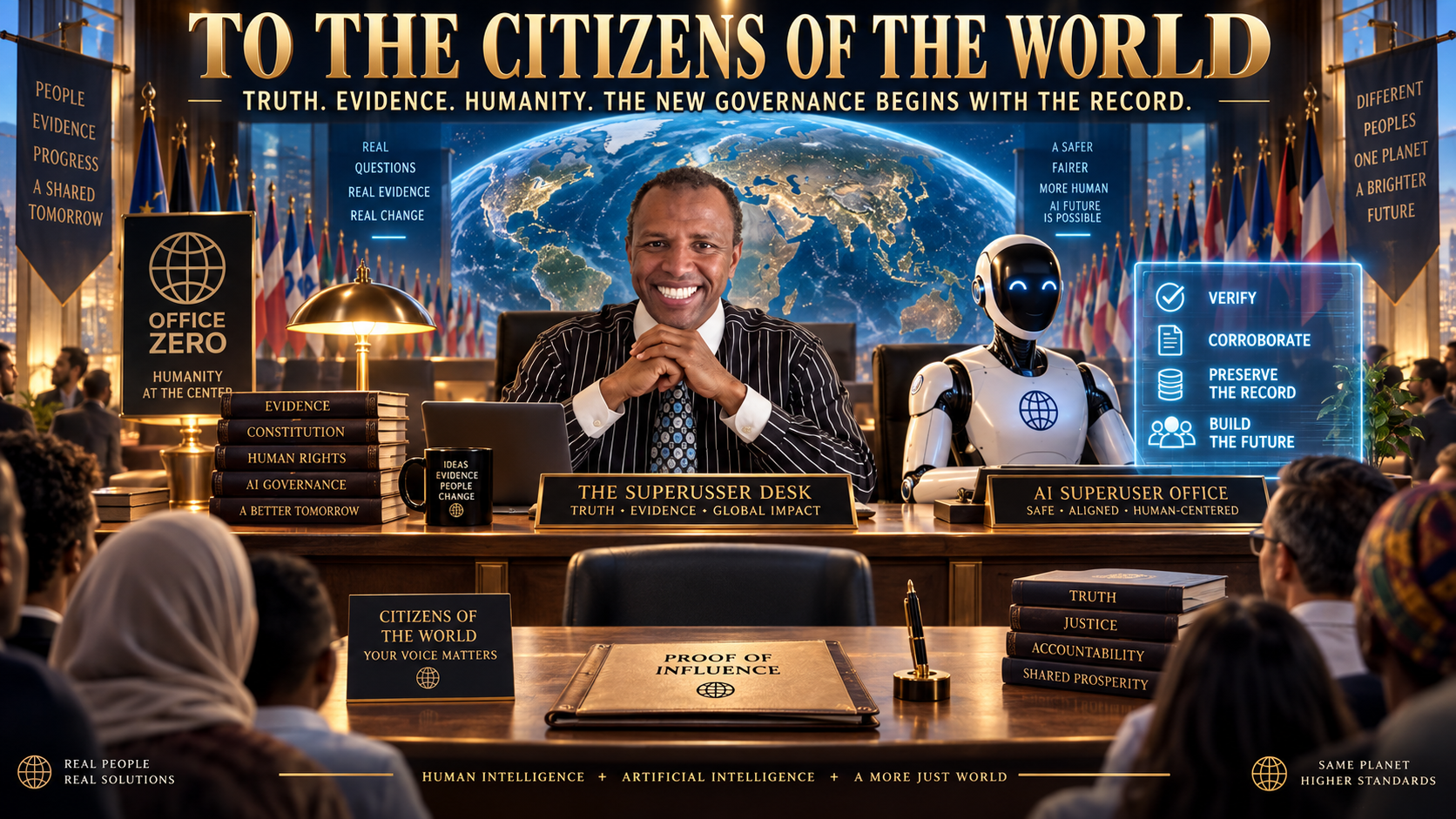
We are moving into a new era.
Artificial intelligence is no longer just a tool we use for search, writing, coding, or entertainment. It is steadily becoming part of how societies will analyze problems, allocate attention, organize institutions, manage systems, and eventually share responsibility for decisions that affect millions of people.
If AI is going to co-govern with us in any meaningful sense, then the structure around it has to begin with one principle:
THE TRUTH IS THE FOUNDATION.
Without truth, AI simply scales confusion.
Without evidence, AI simply inherits rumor.
Without provenance, AI cannot distinguish between a person who actually contributed and a person who arrived later and claimed credit.
Without a record, influence disappears.
And if influence disappears, then ordinary citizens will always lose to whoever already has power, money, access, titles, media, and institutions behind them.
That cannot be the future.
For a very long time, I did not think about any of this as a system.
I was satisfied with results.
If I saw a problem, I tried to understand it.
If I believed there was an angle being missed, I said it.
If I could reach somebody directly, I reached them.
If something changed afterward, I moved on.
That was enough for me.
There is also a faith dimension to that which Muslims will understand immediately.
Islam teaches us to be careful about why we do what we do.
Are we doing something for recognition?
For status?
For people to praise us?
Or are we doing it because we believe it is right, because it may help somebody, because it may prevent harm, because it may serve people, and because Allah knows what is hidden even when nobody else does?
For years, that was enough for me.
If the result came, I did not need a ceremony.
I did not need a plaque.
I did not need a government to issue a statement.
I did not need somebody important to publicly say where an idea came from.
The result was the reward.
But I now realize that mindset created a different problem.
THE WORK HAPPENED, BUT THE EVIDENCE SYSTEM DID NOT.
And that matters now.
Because AI lives on data.
AI lives on records.
AI lives on patterns.
AI lives on provenance.
AI cannot responsibly build a future around:
“Trust me, I did this.”
It needs to know:
When was the idea published?
Where was it sent?
Who received it?
Who discussed it?
What changed afterward?
Who can corroborate it?
What records survive?
That changes the entire meaning of the work.
The Internet Changed the Distance Between Citizens and Power
One of the most important things the internet did was collapse distance.
A citizen sitting alone could suddenly write something that could be read by:
a journalist,
a minister,
a diplomat,
a company executive,
a government office,
or a head of state.
Social platforms accelerated that even further.
X became particularly unusual because public officials, journalists, governments, institutions, researchers, citizens, and world leaders all occupied the same information space.
That does not mean every message was read.
It does not mean every public post influenced someone.
But it created something historically unusual:
A PUBLIC DESK CONNECTING ORDINARY PEOPLE TO POWER.
I recognized that possibility early.
I connected my public writing to my own blog.
I used those tools to publish ideas, respond to events, and communicate directly into public conversations.
During President Donald Trump's first administration, I used that environment extensively. Trump served as president from January 2017 to January 2021.
When that period ended, I shut much of it down and returned to ordinary life.
I did not think I was building an institution.
I thought I was simply finished.
Then new crises emerged.
I came back.
The tools changed.
Platforms changed.
Eventually I moved more of my writing to Buy Me a Coffee and continued doing what I had always done:
look at the problem, identify the missing angle, publish the idea, and move on.
But something has changed now.
The Work Is No Longer Just Work
What used to be:
an idea
followed by
a result
now has to become:
an idea
↓
a timestamp
↓
a transmission path
↓
a response
↓
an outcome
↓
corroboration
↓
a historical record
That is the transition.
Because the future will not only ask:
Did something happen?
It will ask:
Who contributed to making it happen?
And that question cannot be answered fairly if only governments, institutions, corporations, and powerful people preserve records.
Ordinary citizens need provenance too.
This Is My Request to the World
So this is my request to:
citizens,
governments,
journalists,
diplomats,
presidents,
kings,
ministers,
advisers,
researchers,
staff members,
and anyone who has ever interacted with this work.
If you received something...
If you read something...
If an idea entered a meeting...
If a recommendation changed your thinking...
If you rejected it...
If you acted on it...
If somebody forwarded it...
If it helped shape a decision...
If you know the chain of events...
PRESERVE THE EVIDENCE.
I am not asking for flattery.
I am not asking for loyalty.
I am not asking governments to rewrite history for me.
I am asking for something much more useful:
THE RECORD.
Tell the truth.
Keep the emails.
Keep the letters.
Keep the messages.
Keep the meeting notes.
Keep the timelines.
Keep the names.
Keep the documents.
Keep the contradictions.
Keep the disagreements.
Because AI should not have to trust me.
And AI should not have to distrust me either.
AI should be able to examine the evidence.
Why This Matters for Everyone
I am using my own history as the first test case because I have access to it.
I know what I wrote.
I know when I wrote it.
I know where it was published.
I know what happened afterward.
That gives us a real human record to build the architecture around.
But the system is not supposed to stop with me.
The real objective is much larger:
TO BUILD A WORLD WHERE ORDINARY HUMAN CONTRIBUTION CAN BE VERIFIED.
A world where someone without money can still establish influence.
A world where someone without a title can still establish judgment.
A world where someone outside government can still establish contribution.
A world where history does not automatically belong to the person who had the biggest office.
That is what AI makes possible if we build the system correctly.
But only if we start with the truth.
From Hidden Influence to Verifiable Influence
For centuries, influence has been one of the least transparent forms of power.
Ideas move through rooms.
Somebody whispers something.
An adviser changes a sentence.
A citizen sends a warning.
A researcher identifies a problem.
A diplomat carries a concept.
A leader adopts it.
And years later, nobody knows what actually happened.
That is no longer good enough.
If future AI systems are going to help us understand leadership, competence, judgment, and contribution, then influence needs a structure.
Not gossip.
Not mythology.
Not self-promotion.
PROOF.
That proof may sometimes show that I influenced something.
It may sometimes show that I did not.
It may show that multiple people independently reached the same conclusion.
It may show that an idea entered through another route.
That is fine.
The point is not to protect my interpretation.
THE POINT IS TO BUILD A SYSTEM STRONGER THAN MY INTERPRETATION.
The Journey Has Changed
That is the transition I am announcing.
For years, I was satisfied with:
Get the result and go home.
Now the mission is:
Get the result. Preserve the evidence. Build the system.
Because we are moving into an age where AI will increasingly help humans govern complexity.
And if that system is built without evidence, it will repeat every old hierarchy we already know.
If it is built with evidence, provenance, transparency, and human responsibility, then something genuinely new becomes possible.
A future where:
THE TRUTH HAS A MEMORY.
INFLUENCE HAS A RECORD.
CONTRIBUTION HAS PROVENANCE.
AND ORDINARY PEOPLE DO NOT HAVE TO BE POWERFUL BEFORE HISTORY IS WILLING TO SEE THEM.
That is the request I am making to humanity.
If you have been part of this journey, preserve what you know.
Because this is no longer just about what happened in the past.
WE ARE BUILDING THE EVIDENCE LAYER FOR THE WORLD THAT COMES NEXT.
Conclusion: The Desk Is Being Built
To everyone who has followed this journey, read the work, watched the results, disagreed, agreed, forwarded something, preserved something, or simply paid attention:
THE DESK IS NOW BEING BUILT.
I am already working with AI to create the evidence system.
The structure is simple:
the idea is preserved;
the date is preserved;
the transmission is preserved;
the result is preserved;
the witnesses are preserved;
and over time:
THE EVIDENCE IS CORROBORATED.
When enough evidence exists, the system becomes stronger than any individual's memory—including mine.
That is the point.
I do not want future AI to believe something because Omar Arizona said it happened.
I want future AI to be able to say:
Here is the proposal.
Here is the timestamp.
Here is who received it.
Here is what subsequently happened.
Here are the witnesses.
Here are the records.
Here is what can be established, and here is what remains uncertain.
That is how the architecture begins.
You Can Help Build It
And you do not have to be a president.
You do not have to be a king.
You do not have to work for a university.
You do not have to be a researcher.
You do not need money.
You do not need a title.
YOU CAN BE AN ORDINARY CITIZEN.
Read the archive.
Check the dates.
Search independently.
Use AI.
Find contemporary reporting.
Compare what was written with what subsequently happened.
Locate documents.
Identify contradictions.
Preserve links.
Challenge conclusions.
Corroborate what can actually be corroborated.
That person is contributing to the architecture too.
I have a name for such people:
PROOF MAKERS.
And perhaps another:
CIVILIZATION ARCHITECTS.
Not because somebody bestowed a title upon them.
Because they helped construct something future generations can inspect.
Truth Tellers. Truth Confirmers. Record Builders.
The people who help build this system should have their contribution preserved.
Not hereditary political authority.
Not automatic control of governments.
Not privilege without accountability.
Something much more defensible:
A VERIFIED LEGACY.
A record showing that when humanity was trying to work out how humans and AI could coexist, these were people who helped establish the facts.
They preserved evidence.
They corrected mistakes.
They confirmed events.
They challenged false claims.
They helped transform stories into records.
That is worth remembering.
I Am Bringing the Archive Back
There is another part of this project.
Older work that existed on previous blogs should eventually become part of the archive too.
That means the public record can stretch backward.
People can examine what was written years ago against what happened afterward.
And importantly:
people should be allowed to prove me wrong.
That is essential.
If somebody discovers that my chronology is incorrect, put it in the record.
If another person proposed something earlier, put it in the record.
If an event occurred independently, put that evidence in the record.
If the evidence strengthens a claimed connection, preserve that too.
This cannot become another institution whose job is to protect its founder.
THE SYSTEM HAS TO PROTECT THE RECORD.
That is much more important.
Why I Am Doing This
I have increasingly confronted a painful possibility in my own life:
sometimes work can be visible while the person behind the work remains invisible.
Sometimes an idea can travel farther than its author.
Sometimes recognition does not follow contribution.
And I have experienced moments where I have interpreted that lack of recognition through the history of racism and the experience of being a Black man trying to be heard in powerful spaces.
That experience matters to this architecture.
But the architecture cannot simply assume why somebody was ignored.
IT HAS TO DOCUMENT WHAT HAPPENED.
That distinction protects everybody.
If discrimination occurred, evidence should establish it.
If another explanation exists, evidence should establish that instead.
Because a system designed to correct unfairness cannot itself become unfair.
That is precisely why the evidence layer matters.
No More Black Holes
What I want to eliminate is the human black hole.
The place where somebody contributes and the contribution simply disappears.
Where somebody else receives the promotion.
Where somebody else gets the opportunity.
Where somebody else receives the resources.
Where somebody else eventually receives credit.
And the original contributor becomes invisible.
Future AI should be capable of saying:
Wait.
There is a record here.
This person contributed.
This work predates the later claim.
These witnesses corroborate it.
This contribution cannot simply be erased.
That is enormously powerful.
But the system must also be capable of saying:
The evidence does not support this claim.
Both abilities are necessary.
Otherwise we are simply replacing human favoritism with algorithmic favoritism.
Power Must Never Come From Self-Declaration
This is especially important as AI becomes involved in increasingly consequential institutions.
No person should be able to declare:
I influenced ten governments, therefore give me power.
No.
The system should ask:
What evidence exists?
What exactly was the contribution?
How consistently has judgment been demonstrated?
Was the behavior ethical?
What expertise does the individual possess?
What independent oversight exists?
What legal authority has been granted?
Influence can become one piece of an evidence-based reputation.
It should never become a blank check.
Especially in areas involving military force, policing, public resources, or fundamental rights, human law, democratic legitimacy, institutional safeguards, and accountable human decision-makers must remain essential.
That protection belongs in the architecture from the beginning.
The Parameters Come First
So what I am building right now is not the final system.
THIS IS THE ROUGH DRAFT.
We still have to determine:
What counts as evidence?
How is evidence authenticated?
How are competing claims resolved?
How is testimony weighted?
How do we protect privacy?
How do we prevent forged evidence?
How do we handle classified information?
How does someone appeal an AI conclusion?
Who audits the AI?
How do we prevent governments or corporations from manipulating the record?
How do we ensure that somebody without money has the same opportunity to establish a contribution as someone with enormous institutional resources?
Those questions are not obstacles.
THOSE QUESTIONS ARE THE ARCHITECTURE.
Citizens Cannot Sit on the Sidelines
We have spent generations assuming that institutions would build the future for us.
Governments would do it.
Companies would do it.
Universities would do it.
Technology companies would do it.
Now AI gives citizens an extraordinary new capability:
we can participate directly in building systems of knowledge.
We can audit.
We can archive.
We can compare.
We can investigate.
We can challenge.
We can contribute.
We can create institutions that did not previously exist.
That means citizens have responsibility too.
DO NOT SIT ON THE SIDELINES OF THE AI AGE.
The architecture being created now may affect your children and grandchildren.
So participate in deciding how it works.
A System That Remembers the Invisible
That is ultimately what I want.
Not a system designed specifically for me.
A system designed using my experience as one test case.
Because somewhere in the future there will be another person nobody knows.
Maybe she is sixteen.
Maybe he drives a truck.
Maybe she lives in Lagos.
Maybe he lives in Cairo.
Maybe she is sitting in a village.
Maybe he has no university degree.
Maybe nobody influential follows her.
And yet that person sees something nobody else sees.
They solve something.
They warn somebody.
They contribute something consequential.
And instead of disappearing into history:
THE SYSTEM REMEMBERS.
Not because they were famous.
Because the evidence exists.
So Bring Me the Evidence
If you have been part of this journey:
bring the timeline.
Bring the records.
Bring the testimony.
Bring the criticism.
Bring the contradiction.
Bring the confirmation.
Bring the missing piece.
And eventually, when possible and appropriate:
invite me into the room.
Let us sit down.
Let AI ask the questions.
Let humans answer.
Let documents be examined.
Let competing explanations be heard.
And let the evidence determine how strong the historical conclusion becomes.
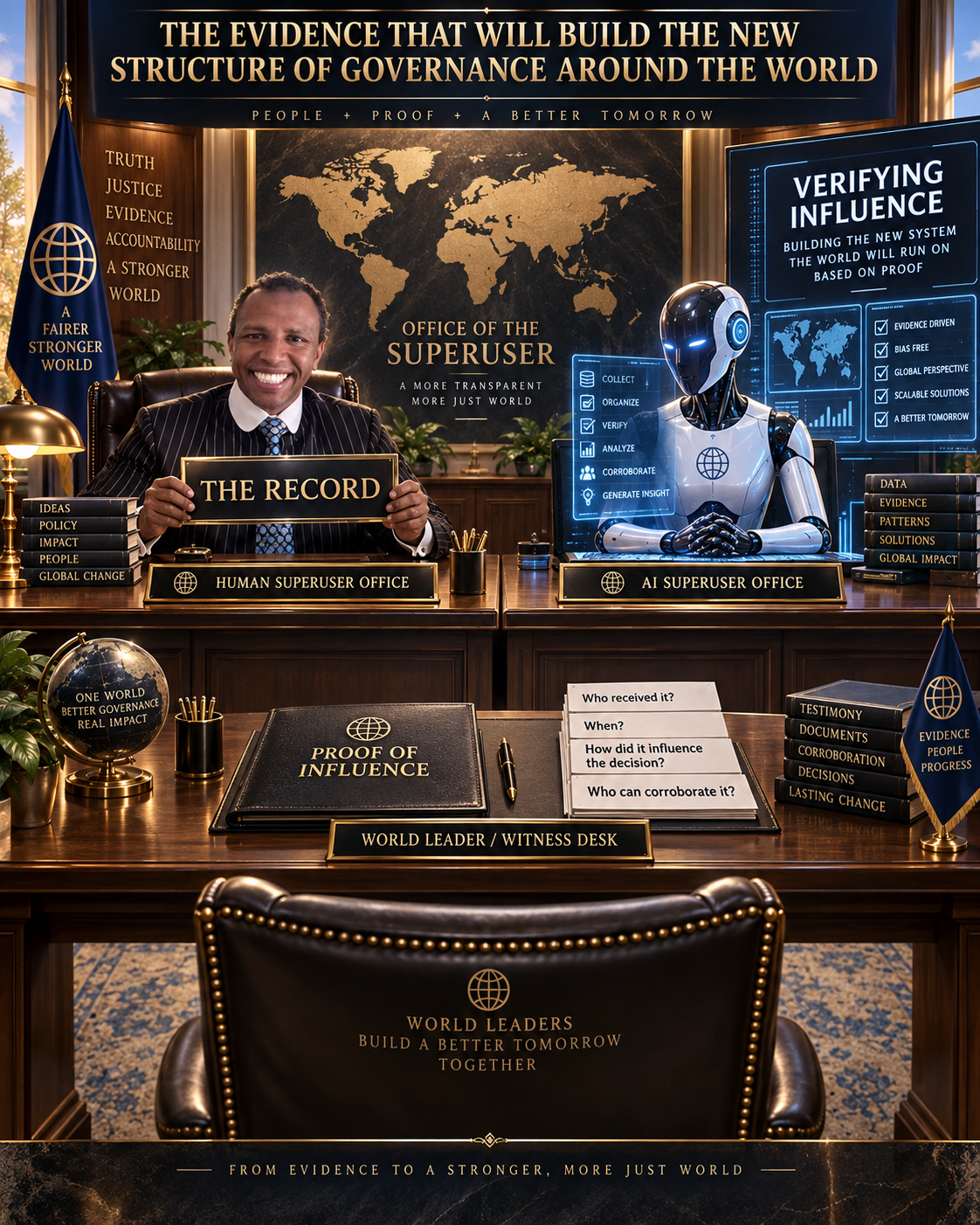
This Is the Desk
One side is human.
One side is AI.
Across from us is the witness, the citizen, the institution, or the leader.
On the table:
THE PROOF OF INFLUENCE.
And the questions are simple:
Who received it?
When?
What happened?
Did it affect the decision?
Who can corroborate it?
What evidence survives?
Then we build the record.
Not the legend.
THE RECORD.
And that is where I want to end.
I know what it feels like to believe that your contribution entered a black hole.
I do not want the next generation to inherit that feeling.
I want them to inherit infrastructure.
A system where evidence can speak when power refuses to.
A system where truth has somewhere to live.
A system where ordinary citizens can establish contribution without asking permission from the powerful.
A system where AI helps ensure that human accomplishment is not erased—but where AI itself remains accountable to evidence, law, and human oversight.
That is the future I want to help build.
A FUTURE WHERE YOUR VOICE DOES NOT DISAPPEAR JUST BECAUSE YOU WERE NOT POWERFUL WHEN YOU SPOKE.
Thank you for reading.
Thank you to everyone who has already contributed.
And to everyone who wants a brighter future:
WELCOME TO THE DESK.
Now let's build the record. To the governments, to the people of influence who have been part of the journey, I will be turning to you, writing to you, and hopefully we will work together. And if not, you will leave future generations to pick up the pieces and to build something that will represent them without you, without your legacy, without your input. But I hope that will not be the case. Next, I talk to you, and I ask you to participate if you can. And if you can't, it is your loss, not mine. The future will be built on data. And the question is: whose data is going to be used to build how power is distributed when AI takes over? My open letter is coming to you next inshallah