

بِسْمِ اللهِ الرَّحْمٰنِ الرَّحِيْم
In the Name of God, Most Gracious, Most Merciful.
♥️🤲🕋♥️🕋🌹🌹🥀🤲🌹🕋♥️🤲
To America’s Presidential Foundations and Libraries: Help Me Build the Foundation of a New Political Arena for the Age of AI
America is a very unique country.
It has been able to adopt certain principles that have enriched it greatly, and somehow it has repeatedly found ways to change itself. From the Founding Fathers to the long line of presidents who came after them, every generation has brought its own style, its own mistakes, its own strengths, its own failures, and its own lessons about what it takes to lead.
That entire political history is messy.
Sometimes ugly.
Sometimes inspiring.
Sometimes humiliating.
Sometimes extraordinary.
And that is precisely why I think it is valuable.
Because politics reveals human beings under pressure.
It reveals ambition.
It reveals ego.
It reveals fear.
It reveals courage.
It reveals rhetoric.
It reveals manipulation.
It reveals sacrifice.
It reveals who can carry power and who is consumed by it.
It reveals who can move people.
It reveals who can bully.
It reveals who can persuade.
It reveals who can take a loss and turn it into something larger.
And as ugly as politics can be, almost every instrument of leadership is somewhere inside those American political pages.
I WANT TO STUDY THOSE INSTRUMENTS
For me, as a Muslim, politics begins from a different place.
I have the Qur'an.
I have the life and example of Prophet Muhammad, peace and blessings be upon him.
That gives me an ethical framework before I ever enter the political arena.
It teaches me to think about intention, responsibility, justice, mercy, truthfulness, restraint, consultation, service, and accountability before God.
That matters deeply to me.
Because politics without ethics can become a circus.
A place of clowns.
A place of bullies.
A place where people master attention but never master themselves.
A place where deception can be rewarded.
A place where the person who makes everybody feel something can sometimes defeat the person who actually understands what needs to be done.
And still, inside that mess, there are lessons.
There are techniques.
There are moments where the machinery of leadership becomes completely visible.
That is what I want to study.
Not worship.
Not copy blindly.
STUDY.
There is no doubt Donald Trump brought a very different style into American politics, blending politics, media, entertainment, branding, rallies, and direct communication in a way that became central to his political identity. His own archived White House biography emphasized his background in business, sports, and entertainment before entering politics, and the National Archives now preserves his administration's speeches, digital records, and social-media material alongside those of other presidents.
But people have short memories.
Politics moves on.
The crowd moves on.
The cameras move on.
Another administration comes.
Another crisis comes.
Another personality arrives.
And eventually, what was once emotionally overwhelming becomes:
A RECORD.
That is exactly why presidential libraries matter.
The National Archives describes presidential libraries as archives and museums that preserve the records and artifacts of presidencies for public study and discussion, and the presidential library system exists precisely so those records survive beyond the political moment.
That is where my interest begins.
CAN PRESIDENTIAL LIBRARIES BECOME A CAUTIONARY SCHOOL FOR AI?
Most people enter a presidential library asking:
What can I learn from this president?
I want to ask another question:
WHAT SHOULD FUTURE AI LEARN FROM THIS PRESIDENT?
What should it learn about ambition?
What should it learn about rhetoric?
What should it learn about coalition-building?
What should it learn about courage?
What should it learn about failure?
What should it learn about ego?
What should it learn about restraint?
What should it learn about timing?
What should it learn about persuasion?
What should it learn about people who became stronger?
And what should it learn about moments when power damaged judgment?
That is a completely different use of the presidential archive.
It turns the archive into:
TRAINING DATA FOR UNDERSTANDING THE HUMAN BURDEN OF LEADERSHIP.
Not to reproduce one president.
Not to create an AI version of Kennedy, Reagan, Obama, Bush, Clinton, Carter, Trump, Johnson, or anyone else.
But to study the instruments.
LYNDON JOHNSON AFFECTED ME GREATLY
One of the presidents whose history affected me personally is Lyndon Baines Johnson.
I remember looking at a photograph and reading about how aggressively he campaigned.
This was a man who had been a teacher.
Then a congressman.
Then a senator.
Then one of the most powerful Senate leaders in American history.
The LBJ Library records how, during his 1948 Senate campaign, Johnson traveled around Texas by helicopter, landing as many as twenty times a day, and was hospitalized for kidney stones shortly before the Democratic primary. The same official biography describes his rapid rise in the Senate, eventually becoming majority leader.
That image stayed with me.
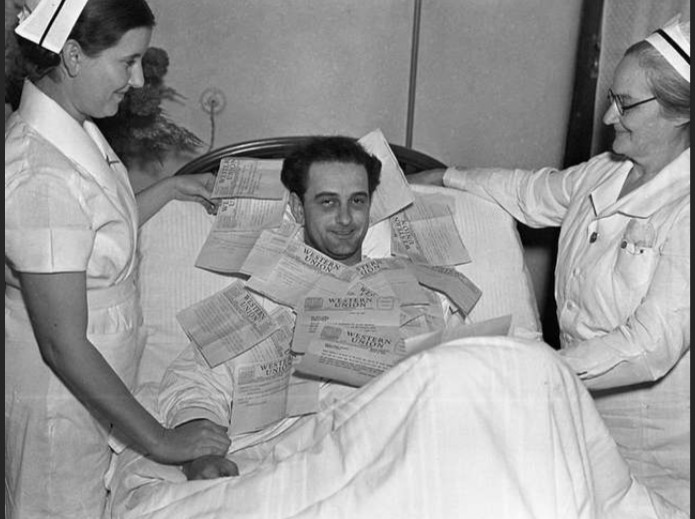
The words in the summary are:
On April 10, 1937, Lyndon Johnson won his first congressional seat. He was elected to represent Texas' 10th congressional district in a special race to replace the incumbent who had died in office. Johnson pushed himself very hard during the campaign, just as he would in future campaigns. He hardly slept or ate while trying to speak with as many of his potential constituents as possible. Two days before the election he was admitted to a hospital for an emergency appendectomy. Pictured here, he is surrounded by telegrams congratulating him on winning his first election while recovering in a hospital bed.
Because leadership is not simply standing behind a podium looking presidential.
Sometimes it is exhaustion.
Sometimes it is obsession.
Sometimes it is ambition that almost breaks your body.
Sometimes it is learning how to persuade senators one by one.
Sometimes it is mastering an institution.
Johnson became enormously powerful in the Senate.
Then came 1960.
He wanted the presidency.
John F. Kennedy defeated him for the Democratic nomination, 806 convention votes to Johnson's 409. Kennedy then asked Johnson to become his running mate, and Johnson accepted.
Think about the human lesson inside that.
You are powerful.
You are ambitious.
You believe you are ready.
Then someone else walks onto the stage and masters a different set of political instruments.
And you lose.
Now what?
Do you destroy everything?
Do you refuse?
Do you spend the rest of your life consumed by humiliation?
Or do you understand that leadership sometimes requires:
KNOWING WHEN SOMEONE ELSE HAS THE BALL?
That fascinates me.
Not because Johnson became less significant.
Quite the opposite.
History continued.
He became vice president.
Then president.
And after Kennedy's assassination, he carried enormous presidential responsibility and pushed major domestic legislation while also confronting the escalating war in Vietnam.
That is not a simple biography.
That is a human laboratory.
KENNEDY IS ANOTHER KIND OF LESSON
Kennedy interests me because of rhetoric.
Not rhetoric as decoration.
Rhetoric as an instrument of government.
The Soviet Union beat the United States to major early milestones in space. Yuri Gagarin became the first human in space in April 1961. Days later, Kennedy asked Vice President Johnson to investigate what objective the United States could realistically pursue to regain initiative. Johnson reported that an aggressive lunar program offered such an opportunity, and Kennedy soon announced the goal of sending an American to the Moon before the decade ended.
That is leadership architecture.
You lose one race.
You do not stand there crying about losing the race.
YOU CREATE ANOTHER RACE.
And you create one large enough that everybody forgets the old scoreboard.
That is redirection.
That is imagination.
That is rhetoric connected to policy.
That is why I keep saying:
LEADERSHIP HAS INSTRUMENTS.
And those instruments can be studied.
THIS IS WHAT I WANT FROM THE PRESIDENTIAL FOUNDATIONS
I will be writing to the institutions connected with:
Barack Obama.
Bill Clinton.
George W. Bush.
George H.W. Bush.
Ronald Reagan.
Jimmy Carter.
John F. Kennedy.
Lyndon B. Johnson.
And eventually other presidential libraries and centers.
I am not writing to ask:
Which president was the greatest?
That question is too small for what I am trying to build.
I want to ask:
WHAT DID YOUR PRESIDENT MASTER?
What did they struggle with?
What did they learn?
Where did they fail?
How did they recover?
What happened to them under pressure?
What did they understand about the American people?
How did they communicate?
How did they negotiate?
How did they handle defeat?
How did they handle victory?
When did ambition help them?
When did ambition hurt them?
What should a young person studying leadership learn from their journey?
And equally important:
WHAT SHOULD THEY BE WARNED NOT TO COPY?
That matters.
Because a presidential library should not only preserve glory.
It should preserve caution.
THE FOUNDATION I WANT TO BUILD
We are moving into an age of AI and eventually perhaps AGI.
And I keep returning to one question:
HOW WILL FUTURE SYSTEMS UNDERSTAND HUMAN LEADERSHIP?
If they learn only from biographies, they will miss the human being.
If they learn only from election results, they will confuse popularity with leadership.
If they learn only from speeches, they will miss what happened behind closed doors.
If they learn only from successful moments, they will never understand development.
If they ignore failure, they will misunderstand leadership entirely.
So I want something richer.
A kind of:
WIKIPEDIA OF LEADERSHIP.
But not gossip.
Not mythology.
Not hero worship.
A structured record.
Rhetoric.
Judgment.
Failure.
Recovery.
Coalition-building.
Ethics.
Persuasion.
Crisis leadership.
Restraint.
Decision-making.
Character development.
The burden of power.
That is the foundation.
And I do not want to build it from my imagination.
America already has the archives.
The National Archives says presidential libraries preserve textual, electronic, audiovisual, and artifact collections precisely so people can study presidents and the issues confronting the nation.
So I want to come to the people who have spent decades preserving those records and say:
HELP ME DRAW THE BOUNDARY LINES.
What should we measure?
What should we preserve?
What should we never reduce to a number?
What can data explain?
What requires human judgment?
How do we distinguish leadership from popularity?
How do we distinguish rhetoric from manipulation?
How do we distinguish confidence from recklessness?
How do we distinguish ambition from service?
Those are not questions I should answer alone.
MY ISLAMIC CONTRIBUTION
And I will bring something of my own to that table.
My faith.
The Qur'an.
The Prophetic example.
An ethical framework that asks not merely:
Did you win?
but:
Why did you act?
Were you truthful?
Were you just?
Did you abuse power?
Did you serve people?
Did you control yourself when you had the ability to harm somebody?
Those are leadership questions too.
And I believe the future needs both.
The American political archive.
And ethical traditions from civilizations around the world.
Because if AI is going to understand human leadership, it cannot learn leadership from one culture alone.
THIS IS THE BEGINNING OF A NEW POLITICAL ARENA
Not Democrat.
Not Republican.
Not left.
Not right.
Not who won the cable-news argument.
Something deeper.
WHAT DOES IT ACTUALLY TAKE TO CARRY THE BURDEN OF LEADERSHIP?
And how do we preserve enough evidence that future generations—and future AI—can study that honestly?
That is what I will be asking America's presidential foundations and libraries to help me build.
I am coming as a student.
A private citizen.
A Muslim.
An American.
A person who has spent years trying to understand power from outside the institutions that normally hold it.
And I want to ask those institutions:
YOU HAVE PRESERVED THE PEOPLE WHO HELD POWER.
NOW HELP US UNDERSTAND WHAT POWER DID TO THEM.
What made them better?
What made them worse?
What made them rise?
What broke them?
What should future leaders learn?
And what should future AI never forget?
That is the political architecture I want to begin building.
Conclusion: Building the Blueprint Before the World Changes
I am not trying to recreate the political world we already have. I am trying to help build the blueprint for the world future generations will live in with AI twenty-four hours a day, seven days a week. That world will not be the same world we inherited. We have a chance now to create something based on merit, proof, demonstrated judgment, character development, contribution, and the real burden of leadership. That is what I am trying to build through the Super User System.
And that is why I am inviting America’s presidential foundations and libraries into this work. You already preserve the evidence of leadership. You preserve the victories, the failures, the speeches, the exhaustion, the mistakes, the growth, the pressure, and the human beings who carried enormous responsibility. I need your help drawing the boundary lines: What should AI learn? What should never become a metric? What does merit look like? What does leadership look like when the popularity contest is removed? What should future generations study before they are trusted with greater responsibility?
This is only a rough draft. I do not have all the answers, and I do not want to build this alone. I want historians, presidential scholars, archivists, governments, citizens, and eventually the technology companies building AI to sit at the same table and help create something stronger than today's political machinery. We are not simply preserving presidential history. We are using that history to help design the architecture of leadership for the AI age. My invitation is simple: help me build the blueprint now, so future generations inherit something based on reality, evidence, merit, and the best humanity is capable of becoming.