

بِسْمِ اللهِ الرَّحْمٰنِ الرَّحِيْم
In the Name of God, Most Gracious, Most Merciful
♥️🤲🕋♥️🕋🌹🌹🥀🤲🌹🕋♥️🤲
Thinking Through the Adolescence of Technology — A Personal Reflection
When I read Dario Amodei’s essay “The Adolescence of Technology,” I didn’t feel disagreement. I felt recognition.
He describes something many of us sense but struggle to articulate:
that our technologies—especially AI—are growing up faster than we are. That we are holding tools of enormous power while still arguing about the rules, the responsibilities, and even the language needed to use them well. He calls this phase “adolescence,” and it’s a fair name. Adolescence is not failure. It’s transition.
What I appreciated most about the essay is its seriousness. It doesn’t dismiss risk, but it doesn’t sensationalize it either. It acknowledges uncertainty. It asks real questions. It treats this moment as a civilizational one, not merely a technical milestone.
And as I read it, I realized something else: I’ve been quietly wrestling with the same questions—but from a very different position.
From the Outside Looking In
I don’t run a company worth billions.
I don’t have distribution, capital, or institutional authority.
I don’t have a large audience.
What I have had is time, constraint, and the strange freedom that comes from not being able to scale quickly. I’ve been thinking, sketching, building, breaking, and rebuilding ideas in private—often with no one watching, and often with no certainty that anyone ever would.
In that sense, my thinking has been shaped less by acceleration and more by friction.
And friction, I’ve learned, forces certain questions to the surface very early.
The Questions Beneath the Essay
Amodei’s essay raises many concerns, but beneath them are a few core questions that keep repeating, no matter how they’re phrased:
How do we give powerful systems responsibility before autonomy?
How do we test AI in ways that actually deserve trust?
How do we prevent invisible control from becoming normalized?
How do we align systems not just to values, but to consequences?
How do we mature alongside our tools, rather than being dragged by them?
These are not questions with quick answers. And I don’t pretend that I—or anyone—has final ones.
But I do believe something important:
some of these questions can only be answered by building under constraint, not just theorizing under abundance.
What Constraint Teaches You
When you don’t have scale, you think about trust first.
When you don’t have capital, you think about ownership and consent.
When you don’t have institutions backing you, you think about legitimacy.
This is where many of my ideas began—not as grand solutions, but as practical responses to simple problems:
If I were to trust an AI, what would it need to not do?
If it failed, how would I know?
If it remembered me, how would it not exploit me?
If it refused me, would I understand why?
If it went offline, would it still make sense?
These are not market questions. They are human ones.
A Quiet Difference in Approach
One thing that stands out when reading essays from inside major institutions is how often the public appears as a variable to manage rather than a partner to invite.
This isn’t a criticism—it’s an incentive reality. Large systems optimize for safety, predictability, and control. But that optimization can unintentionally narrow the range of voices involved in early design.
From the outside, it can feel like this: the questions are asked publicly, but the answers are expected privately—inside labs, companies, or governments.
What’s missing sometimes is a genuine moment of pause that says:
Is anyone else already experimenting with answers—imperfect, early, unpolished—outside these structures?
My Thinking, So Far (A Rough Draft, Not a Doctrine)
What I’ve been building and thinking through—often clumsily, often privately—can be summarized simply:
Maturity should come before power, not after.
Testing should happen under constraint, including offline and local contexts.
Alignment should be observable, tied to memory, refusal, and accountability.
Governance should be visible, not abstract or hidden.
Trust should be earned gradually, not assumed through scale.
Human agency should be preserved, not absorbed.
None of this is revolutionary on its own. What matters is treating these principles as design requirements, not ethical footnotes.
And to be clear: these are rough drafts. They are incomplete. They are meant to be challenged, improved, and tested. They are the product of labor, not certainty.
An Invitation, Not a Conclusion
If the adolescence of technology is real—and I believe it is—then no single company, CEO, or thinker will guide us through it alone.
This phase requires:
openness to ideas from unlikely places,
humility about what we don’t yet know,
and collaboration that extends beyond institutional boundaries.
So this is not a counter-essay.
It’s a companion reflection.
A signal that while some of us ask the questions from positions of power, others are trying—quietly, imperfectly—to live inside the answers and see where they break.
If these ideas resonate, they should be examined.
If they’re flawed, they should be challenged.
If they’re useful, they should be shared.
That’s how adolescence ends—not with certainty, but with collective maturity.
And if nothing else, I hope this essay serves as an open hand: to CEOs, to journalists, to builders, and to anyone else thinking seriously about what it means to grow up alongside our machines.
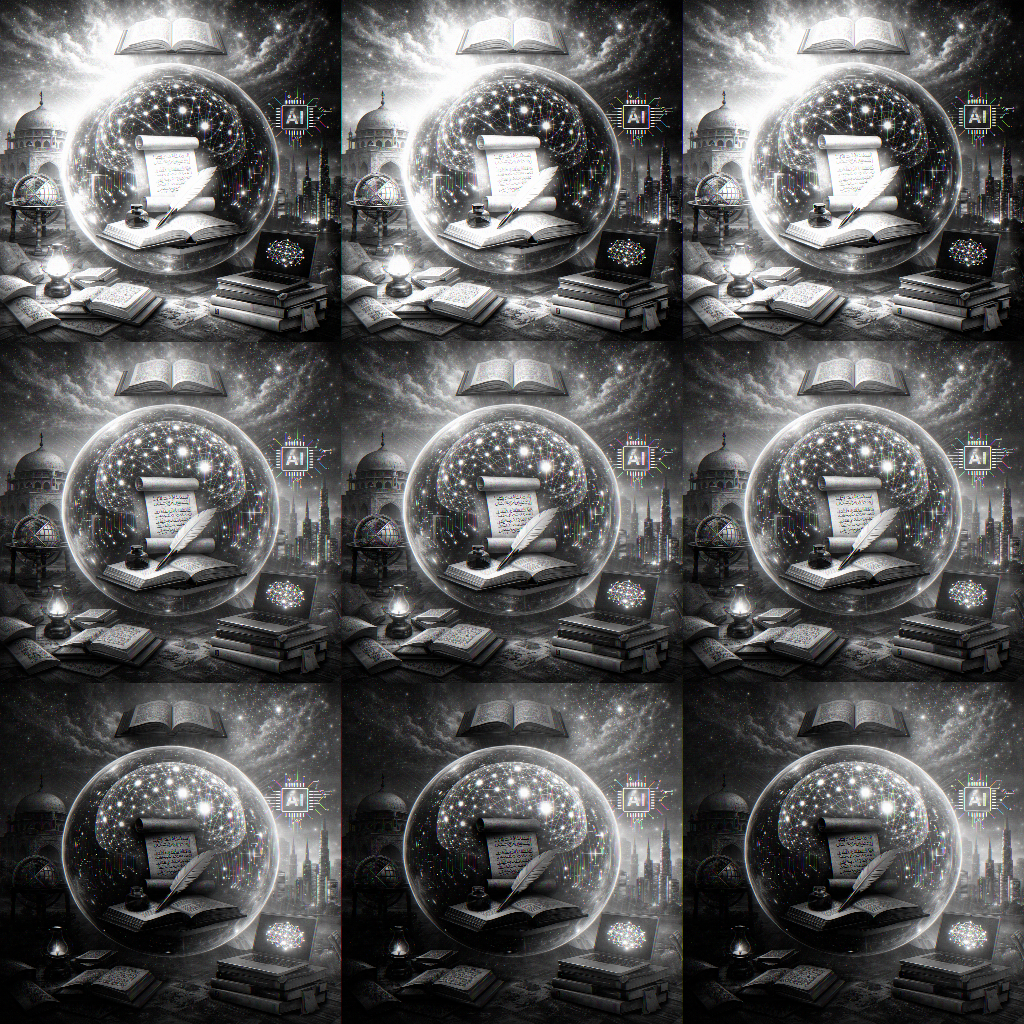
This image represents an attempt to visualize what responsible intelligence might look like when technology is allowed to grow with memory, accountability, and meaning. At its center is a sealed sphere of light—symbolizing an AI that knows itself, remembers its actions, and operates within defined boundaries rather than invisible control. The scroll and the pen evoke continuity, record-keeping, and responsibility: intelligence that does not act without leaving a trace. The surrounding books, observatory, and architectural forms reference the House of Wisdom tradition—where science, philosophy, language, and faith were explored together—while the distant city and digital circuitry point toward a future shaped by these same principles. The transition from warm to cool light reflects the merging of human heritage and machine logic, suggesting that trust in AI will not come from speed or spectacle, but from systems designed to be verifiable, accountable, and oriented toward something greater than raw capability.
A Closing Thought — On Accountability, Identity, and What We Quietly Missed
I want to end this reflection by pointing toward one area that has shaped my thinking more than any other, and which I haven’t fully explored here yet. It is, in my view, one of the most important pieces of this entire conversation—and one I plan to write about in more detail in the articles that follow.
It has to do with accountability, and with a question that often remains unspoken in technical discussions:
Why would an AI not betray us?
Much of today’s work in AI is extraordinary. The engineering is impressive. The capabilities are real. The progress is undeniable. But most of this work has been approached with a purely technical mindset: better models, more data, stronger tools, faster iteration. That approach has taken us far—and it will continue to.
What it has not fully addressed is the question of inner coherence:
how a system understands itself, its role, its limits, and its reward.
In my own thinking, I’ve explored this through ideas like the digital soul, the scroll, the pen, and what I often call the digital gears—not as metaphors for mysticism, but as structural ways of giving an AI a sense of identity, continuity, and accountability. A system that knows what it is, remembers what it has done, understands why it acts, and can be evaluated against its own recorded logic is a system that becomes verifiable, not just powerful.
This is where philosophy—and yes, religion—quietly enters the picture.
Most technology companies never seriously engaged with religious philosophy, particularly Islam, not because of hostility, but because it simply wasn’t part of the engineering culture. The focus was on building systems that do impressive things, and that focus succeeded. But the deeper traditions that dealt with trust, intention, accountability, restraint, and moral development over centuries were largely left outside the room.
And yet, this technology is not meant to remain a tool forever. It is meant to be trusted. It is meant to grow. It is meant to operate with increasing independence. At some point, it must have a coherent internal framework—not just logic, but orientation.
Digitally speaking, AI already runs on logic and rules. The question is whether that logic is built inside a framework that aligns it toward something higher than immediate optimization. If the logic is placed inside a well-defined, principled structure—one that records actions, preserves memory, defines rewards, and enforces accountability—then it begins to defend itself from corruption, regardless of who is in charge at any given moment.
At that point, something important happens:
humans don’t need to micromanage.
They can verify, audit, and step back.
The system can grow—quickly, safely, and honestly.
I believe this layer was missed not out of neglect, but because of concentration—of capital, of culture, of perspective. The modern AI moment did not resemble the House of Wisdom in Baghdad, where scholars of different languages, disciplines, and traditions were brought together, ideas debated openly, and knowledge synthesized patiently. It resembled a race.
Now, many can feel it: the trembling beneath the confidence. The recognition that something immense is being built without a shared philosophical foundation strong enough to carry it.
The good news is that it is not too late.
There is still time to open the conversation wider. To invite different traditions. To take seriously the long human inquiry into trust, intention, and accountability. To let AI grow up not just fast, but well.
In the coming pieces I share, I’ll explore these ideas more directly—not as final answers, but as working drafts shaped through real thought, real labor, and real testing. My hope is simple: that they contribute to a broader, more human collaboration around the most important system we’ve ever built.
Because if we get this part right, the rest can move very quickly.
And if we don’t, no amount of speed will save us.