
بِسْمِ اللهِ الرَّحْمٰنِ الرَّحِيْم
In the Name of God, Most Gracious, Most Merciful.
♥️🤲🕋♥️🕋🌹🌹🥀🤲🌹🕋♥️
THE WORDPRESS SAGA
How a Little Open-Source Blog Took Over the Web — and Then Started Fighting With the People Who Helped Make It Powerful
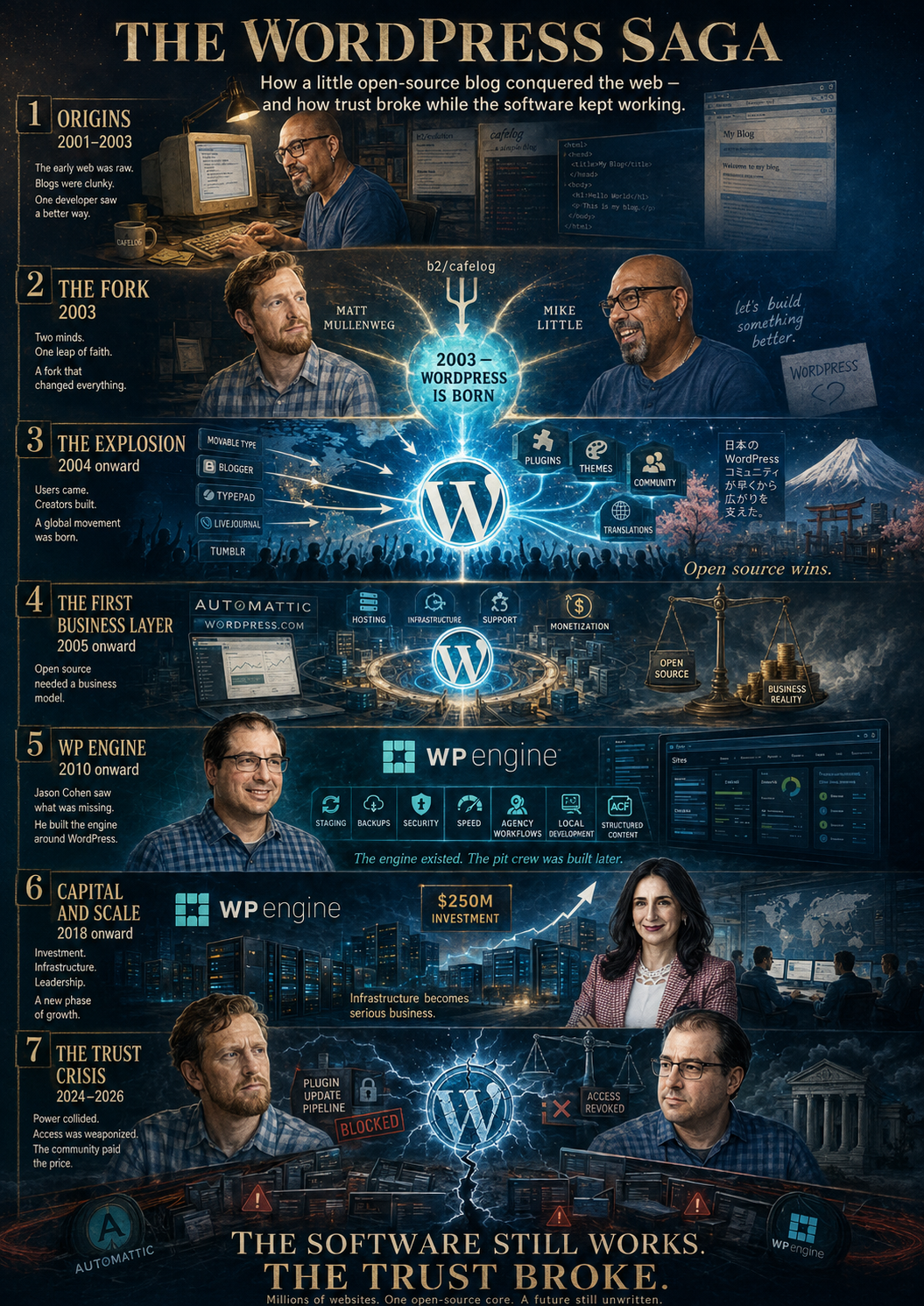
I recently watched a YouTube video by Coding with Lewis about the history of WordPress. Which I will put in the end for you to watch..
And let me tell you something.
I was in absolute euphoria.
I love understanding things.
I have used WordPress. Millions of people have used WordPress. Developers build businesses on WordPress. Companies depend on WordPress.
And yet if you asked me:
“Omar, what exactly happened with WordPress?”
It was difficult to explain.
That is because WordPress did not suddenly stop working.
There was no giant explosion.
Your website didn't disappear.
The WordPress dashboard still opened.
The plugins still worked.
People continued publishing.
That is what makes this story fascinating.
The machine kept running while the people underneath the machine started fighting.
Today, WordPress still powers roughly 40.7% of all websites on the internet. Think about that. Four out of every ten websites.
So whether you use WordPress or have never heard of it, let me tell you this story in normal human language.
No developer language.
No corporate nonsense.
Just the story.
FIRST, THE WEB NEEDED A HOME
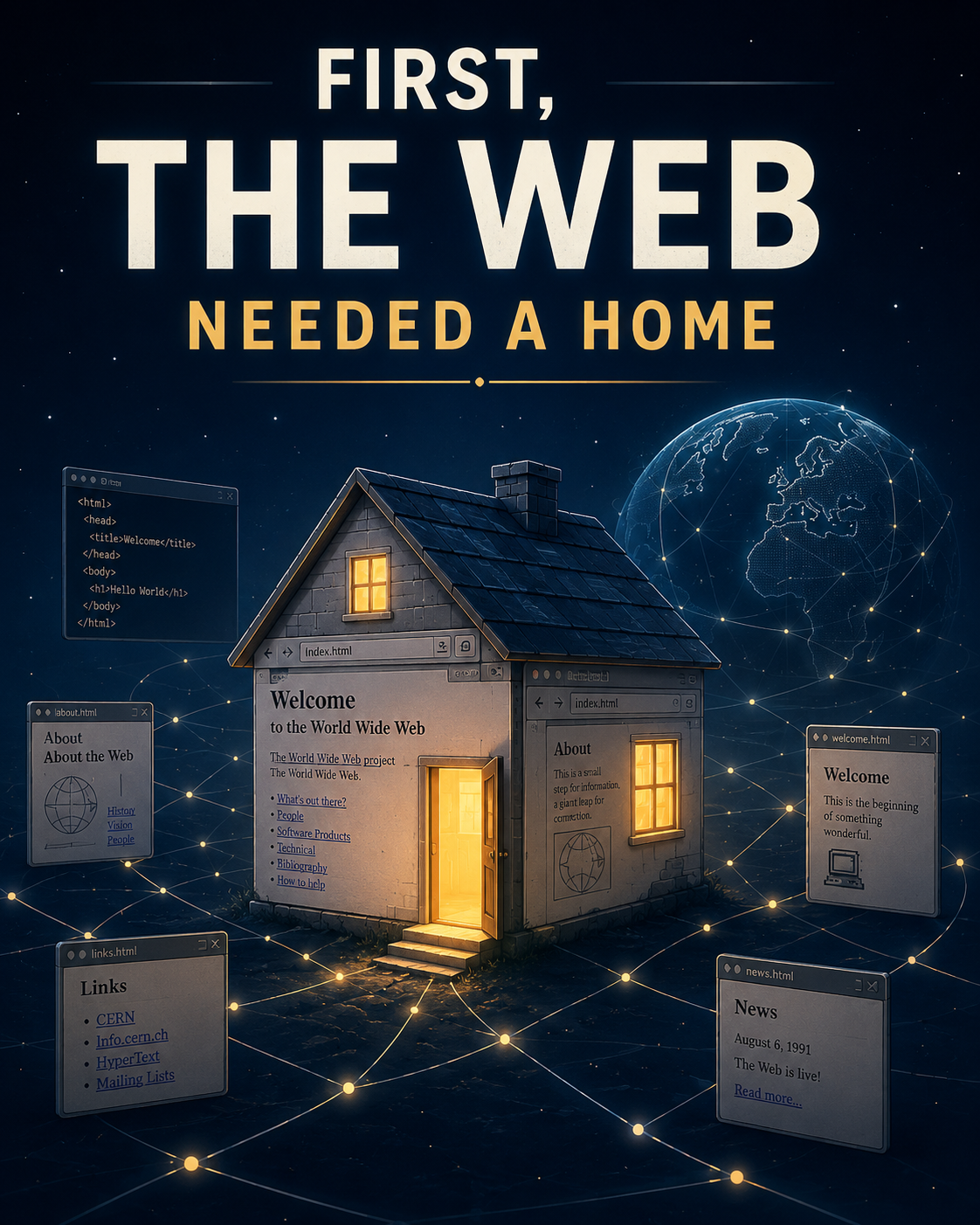
Go back to the early 2000s.
The internet existed, but creating your own website was not like opening Instagram or creating a Facebook page today.
You needed files.
You needed servers.
You needed HTML.
You needed to understand things ordinary people did not want to understand.
There were blogging systems, but the web still needed something simple.
One of those early systems was called b2/cafelog, created by a developer named Michel Valdrighi.
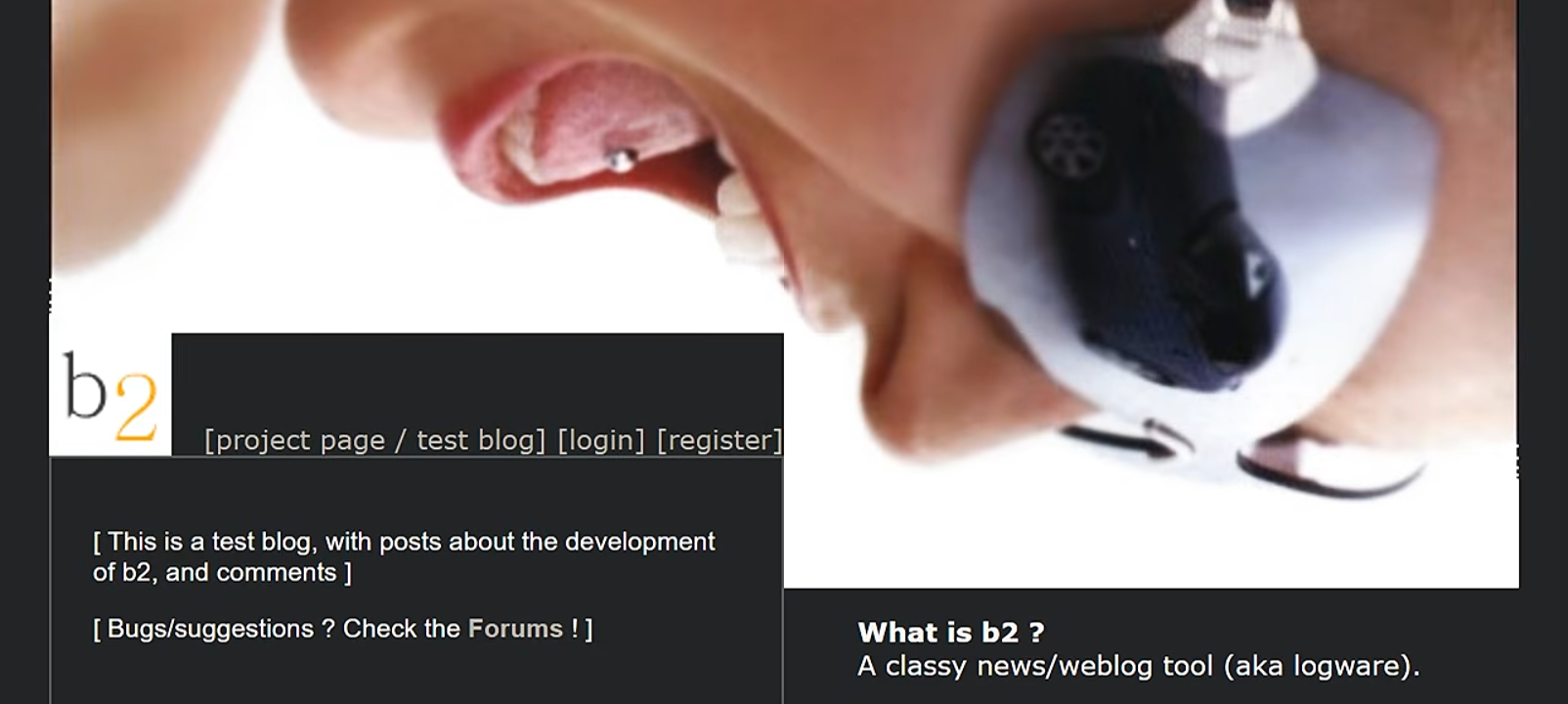
Matt Mullenweg was using b2.
Then development of b2 slowed down.
And this is where our story really begins.
In 2003, Matt Mullenweg and Mike Little took the existing open-source b2 code and forked it.
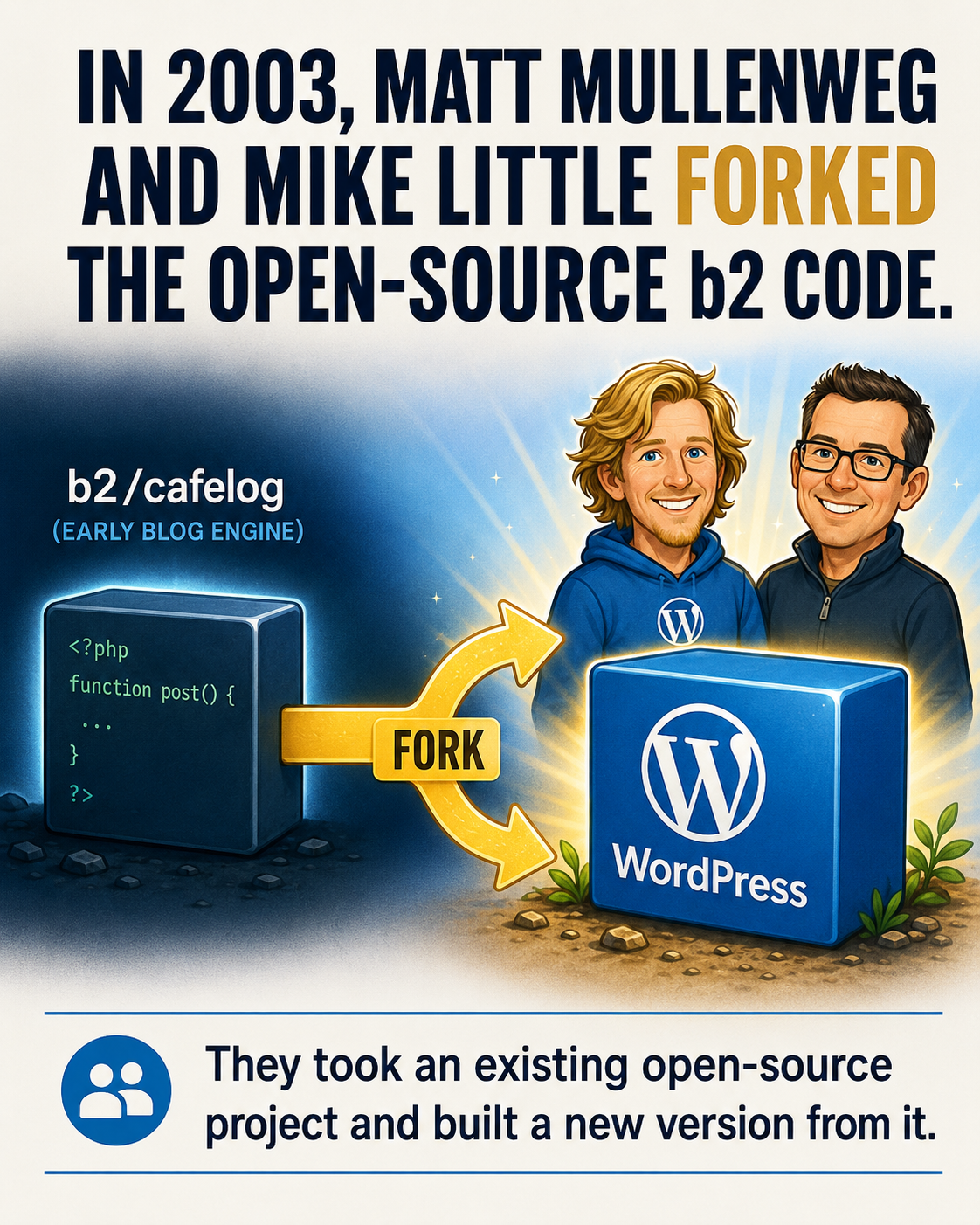
In simple English:
They took something that already existed, were legally allowed to take it because it was open source, and started building their own version.
They called it:
WORDPRESS.
The first public release arrived on May 27, 2003.
And I want you to remember this.
Matt Mullenweg himself began by benefiting from the freedom of open source.
Something existed.
It was not moving in the direction he needed.
So he took the code and built something better.
That freedom becomes extremely important later in this story.
THEN SOMETHING BEAUTIFUL HAPPENED
People started helping.
Developers joined.
Designers joined.
Bloggers joined.
People translated WordPress.
People wrote documentation.
People created plugins.
People created themes.
People answered questions for strangers.
And this was not simply an American project.
One of the earliest communities to recognize WordPress was Japan.
A Japanese WordPress site appeared in December 2003, only months after WordPress itself launched. Because WordPress did not yet properly support localization, a Japanese community member created a multilingual fork.
Instead of fighting that developer, the WordPress project learned from the problem.
WordPress was then properly internationalized.
Soon translations exploded around the world.
See the lesson already?
Someone found a weakness.
Someone fixed it.
WordPress recognized the problem.
The entire project became stronger.
That is how open source is supposed to work.
THEN WORDPRESS GOT LUCKY — VERY LUCKY
In 2004, another blogging platform called Movable Type was extremely popular.
Then its company, Six Apart, changed its licensing.
People who had become accustomed to using the software suddenly faced new restrictions and charges.
Users were angry.
And sitting right there was WordPress.
Free.
Open.
Expandable.
Ready.
The WordPress community didn't simply celebrate.
They started helping Movable Type users migrate.
They wrote guides.
They built import tools.
They welcomed them.
WordPress downloads more than doubled between April and May 2004—from 8,670 to 19,400.
Bang.
WordPress was off.
And there is another great irony here.
WordPress became powerful partly because another company made users feel trapped.
People wanted freedom.
WordPress gave them freedom.
Remember that too.
THEN CAME PLUGINS
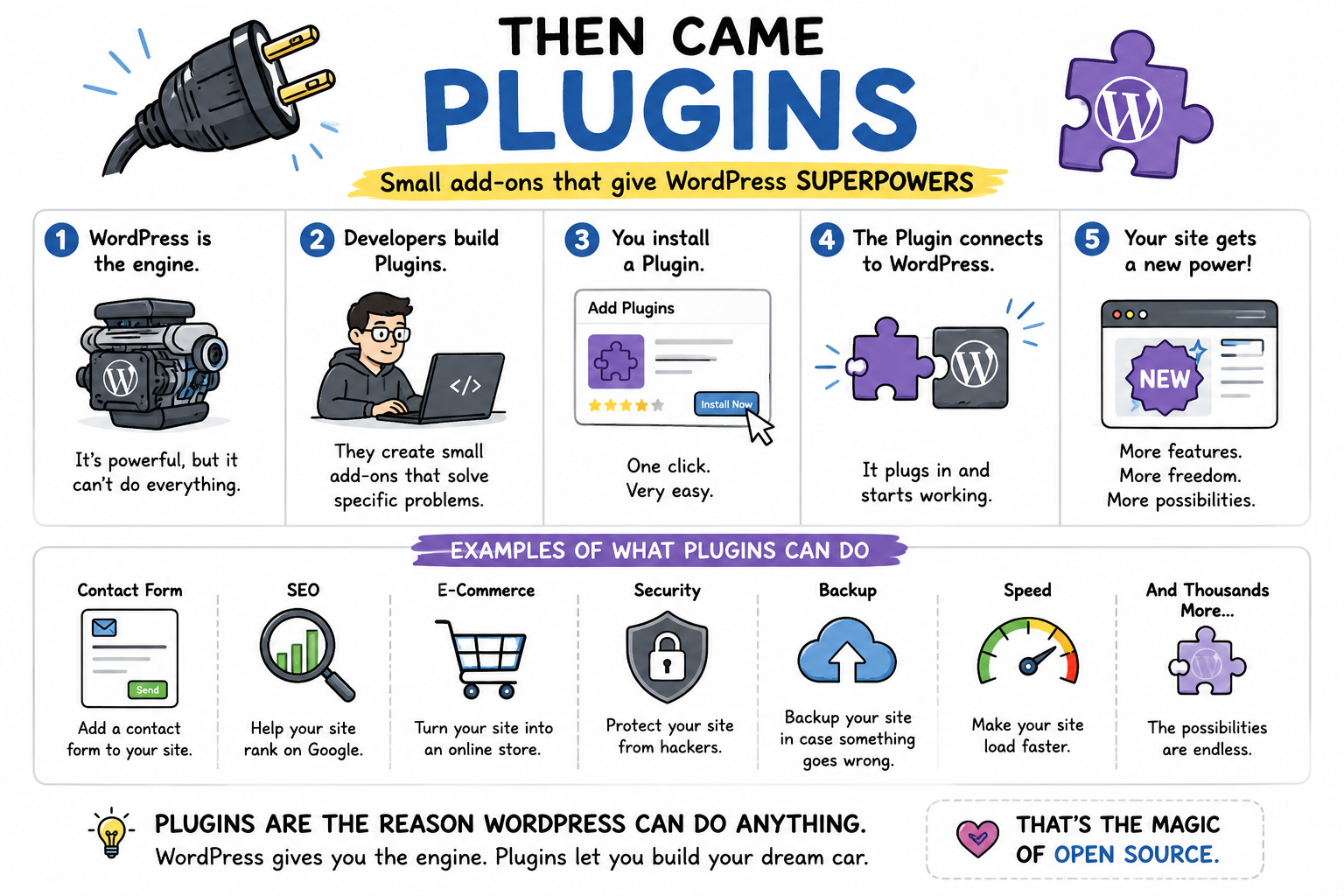
This was genius.
Instead of WordPress trying to build everything itself, developers could create plugins.
Need something WordPress doesn't do?
Install a plugin.
Need a contact form?
Plugin.
Need SEO?
Plugin.
Need an online store?
Plugin.
Need security?
Plugin.
Need backups?
Plugin.
Need something strange that only five people in the world need?
Some developer somewhere probably created a plugin.
WordPress 1.2 introduced the plugin architecture in 2004, and that changed everything.
WordPress wasn't merely becoming software.
It was becoming an ecosystem.
And ecosystems can become extremely powerful.
But they also create a question nobody wants to deal with while everybody is having fun:
WHO GETS PAID?
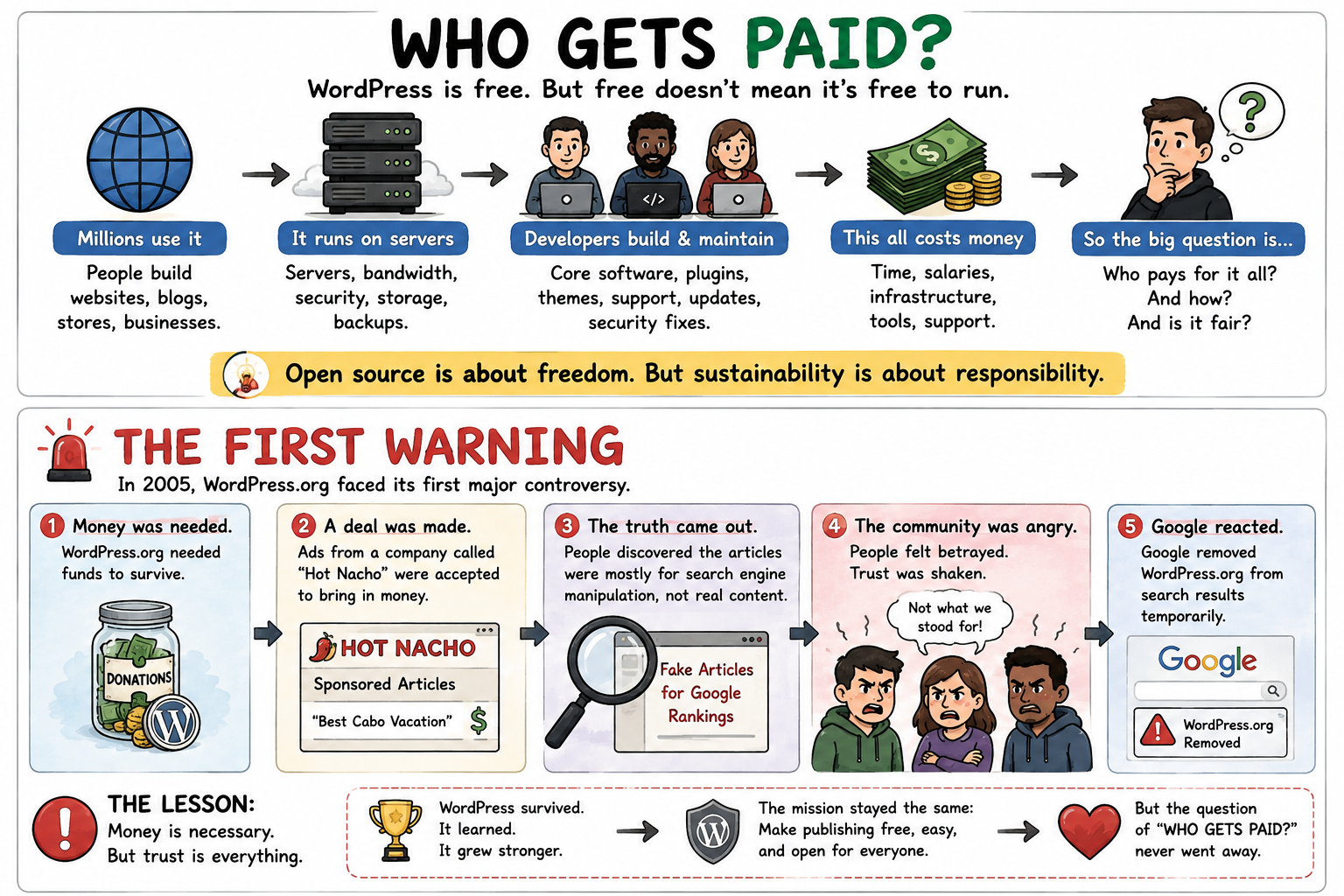
THE FIRST WARNING
Running something this large costs money.
Servers cost money.
Developers cost money.
Infrastructure costs money.
And early WordPress needed money.
In 2005, an ugly controversy erupted.
WordPress.org had been hosting thousands of articles supplied through a company called Hot Nacho. The arrangement generated money, but the pages were essentially being used for search-engine manipulation.
When people discovered it, they were furious.
Google temporarily removed WordPress.org from its search results.
Matt explained that the money was being used to help pay WordPress expenses. WordPress's own historical account acknowledges the controversy.
I wouldn't call this a literal “rug pull.”
But I would call it the first warning.
The community had built something based on openness and trust.
But somebody still had to figure out:
How does this thing make money?
Open source does not make electricity free.
Open source does not make salaries free.
Open source does not make servers free.
Someone eventually has to build a business.
ENTER AUTOMATTIC
Matt understood this.
And this is important because I do not want to pretend Matt Mullenweg didn't understand business.
He did.
In 2005, he founded Automattic.
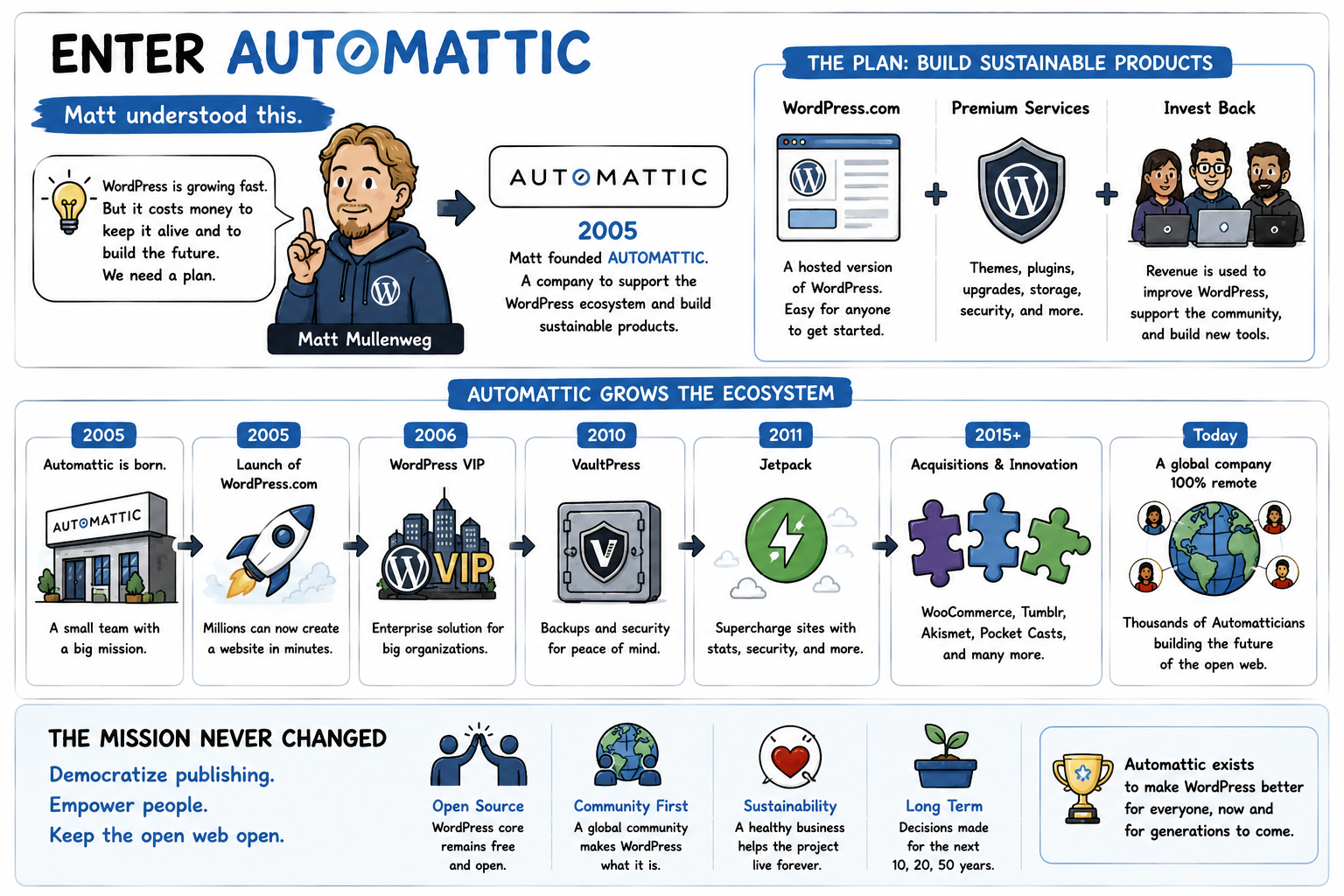
Automattic launched WordPress.com, a hosted version of WordPress.
The distinction confused people then, and it still confuses people today.
Here is the simple version:
WordPress.org: the open-source software.
WordPress.com: a commercial service built around WordPress.
And:
Automattic: Matt Mullenweg's company.
Automattic went on to build and acquire businesses around the WordPress ecosystem.
So money was absolutely being made.
Investment was absolutely being raised.
Commercialization was absolutely happening.
But WordPress itself remained this enormous open ecosystem where thousands of other people could build businesses.
And that sounded beautiful.
Until someone discovered an enormous missing piece.
HERE COMES JASON COHEN
Now we arrive at the part that fascinated me.
A software entrepreneur named Jason Cohen was using WordPress.
And he saw something.
WordPress was wonderful for publishing.
But running serious WordPress websites could be a headache.
A site could be slow.
A site could crash.
Security had to be managed.
Backups had to be managed.
Developers needed somewhere safe to test changes.
Companies needed professional support.
If you were running someone's business website, you didn't want to edit PHP on the live website and pray.
Cohen looked at WordPress and essentially said:
This engine is good.
But this thing needs a professional garage around it.
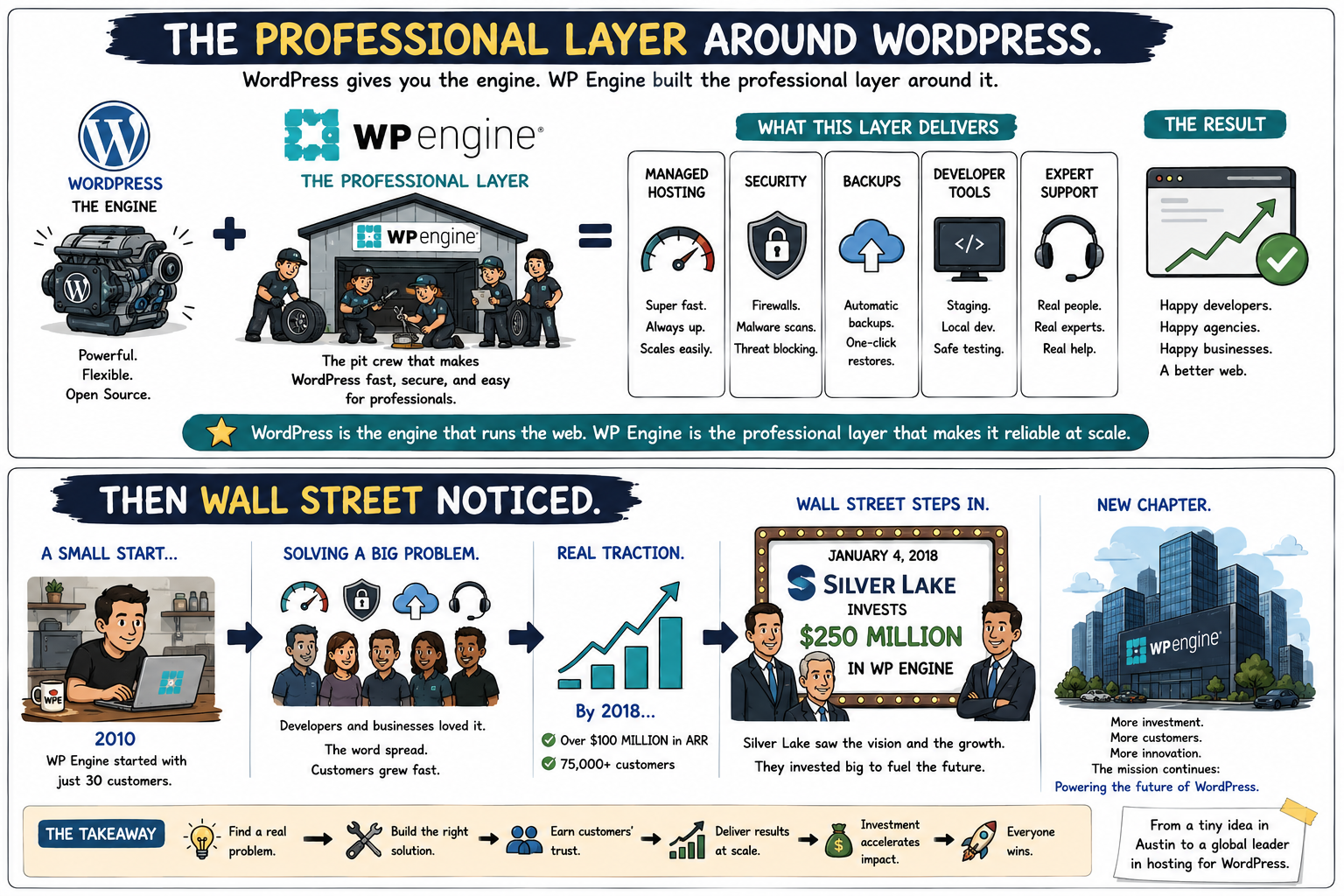
So in 2010 he founded:
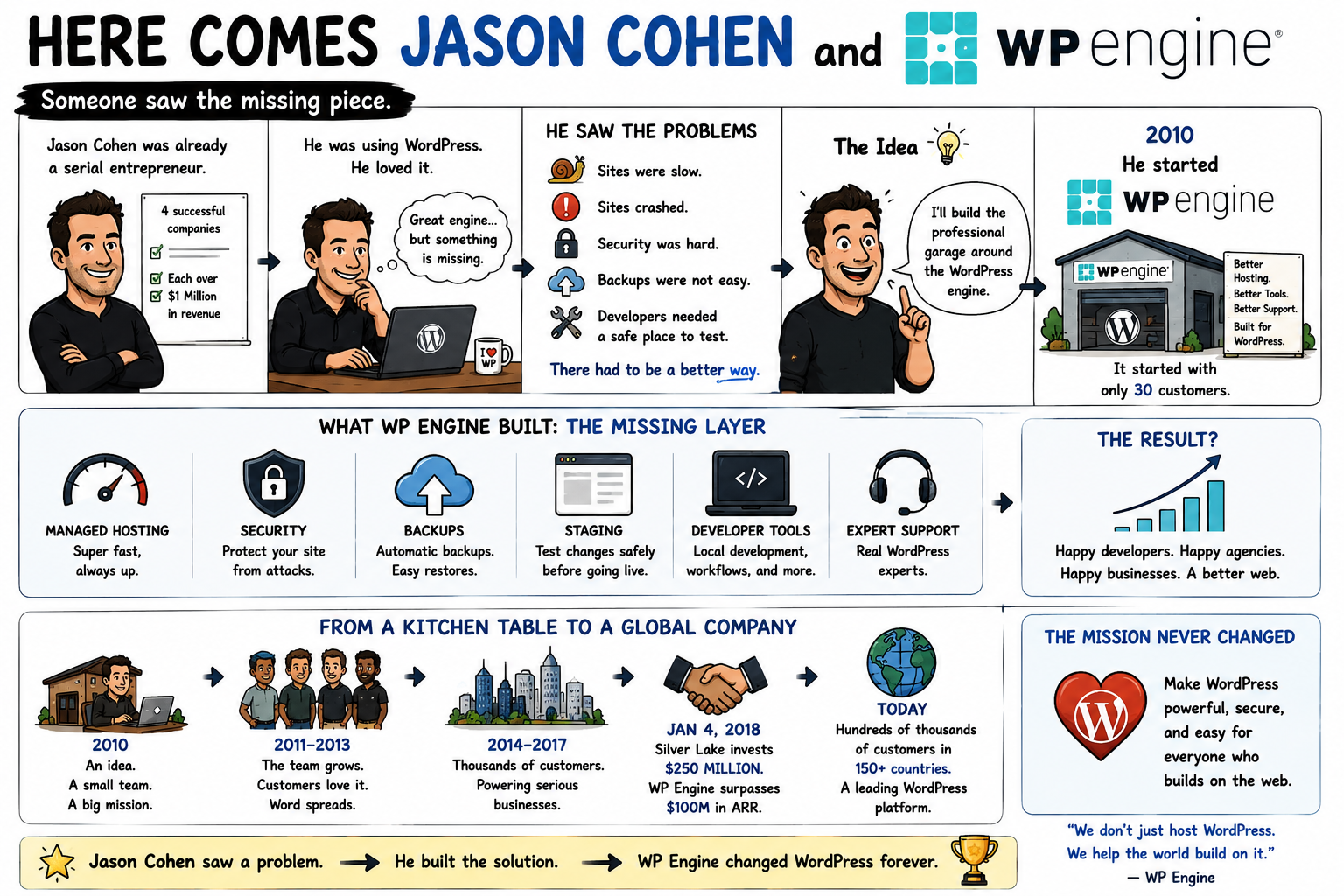
WP ENGINE.
The company started with around 30 customers.
Think about this moment carefully.
Thirty customers.
Tiny company.
Tiny compared with WordPress.
Easy to ignore.
But Jason Cohen had discovered something extremely important.
He had discovered what WordPress was missing.
WP ENGINE BUILT THE PIT CREW
WordPress gave you the engine.
WP Engine started building the pit crew.
Managed hosting.
Security.
Performance.
Backups.
Developer environments.
Staging.
Support.
Tools for agencies.
Tools that made WordPress safer to use professionally.
Then WP Engine kept going.
In 2018 it acquired StudioPress and the Genesis Framework.
In 2019 it acquired Flywheel, which brought with it Local, an enormously useful local WordPress development environment.
In 2022 it acquired a group of developer tools from Delicious Brains, including:
Advanced Custom Fields — ACF
WP Migrate
and several others.
These were not toys.
These were tools professional developers actually used.
WP Engine was slowly assembling something larger.
Not another WordPress.
Something different.
THE PROFESSIONAL LAYER AROUND WORDPRESS.
THEN WALL STREET NOTICED
This is where my business brain starts screaming.
In January 2018, investment firm Silver Lake invested $250 million into WP Engine.
At that point WP Engine said it had already passed $100 million in annual recurring revenue and had more than 75,000 customers.
Stop.
Read that again.
WordPress had created the ecosystem.
Another entrepreneur discovered an enormous missing layer.
He built the missing layer.
Customers paid for it.
Developers loved the tools.
Agencies depended on it.
Then sophisticated investors looked at it and said:
There is serious value here.
And they put $250 million behind it.
This is where I ask my leadership question:
HOW DID WORDPRESS NOT SOUND EVERY ALARM IN THE BUILDING?
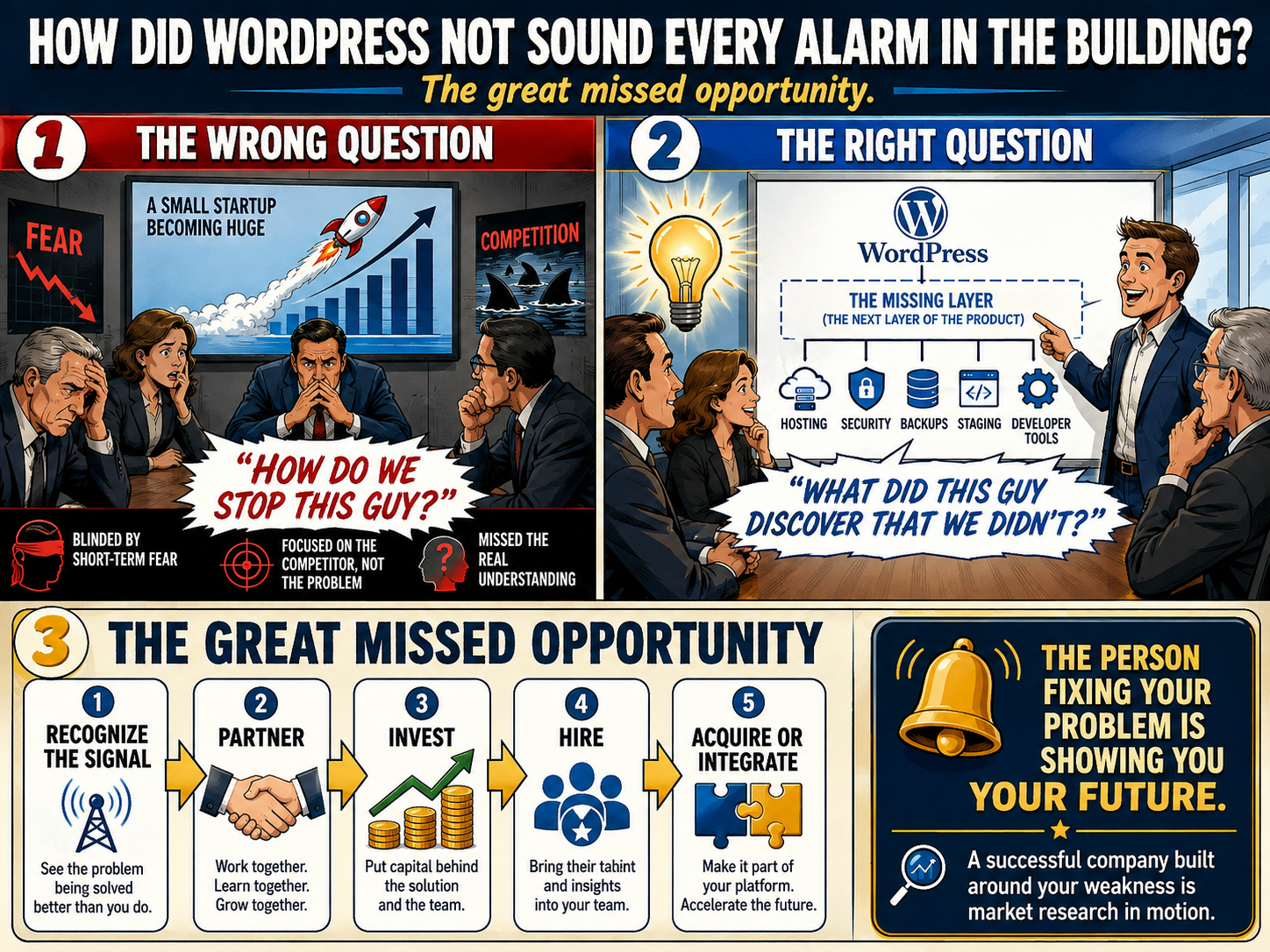
Not:
“How do we stop this guy?”
But:
“What did this guy discover that we didn't?”
That should have been the question.
THE GREAT MISSED OPPORTUNITY
Imagine if WordPress leadership had looked at Jason Cohen when WP Engine was tiny and said:
Come here.
You understand something we don't.
Let's fund you.
Let's partner with you.
Let's make you rich.
Let's give you equity.
Let's build the professional infrastructure WordPress needs.
Or acquire the company.
Or invest in it.
Or build a serious competing product immediately.
Or put Cohen in charge of that part of the future.
Anything.
Because when somebody builds a successful company whose entire purpose is fixing weaknesses in your product, that person is sending you a message from the market.
The message is:
YOUR PRODUCT IS NOT FINISHED.
WordPress was not a failure.
Far from it.
It was one of the most successful software projects ever created.
But as a complete professional product?
There were holes.
And somebody else monetized those holes.
THEN THE RELATIONSHIP TURNED UGLY
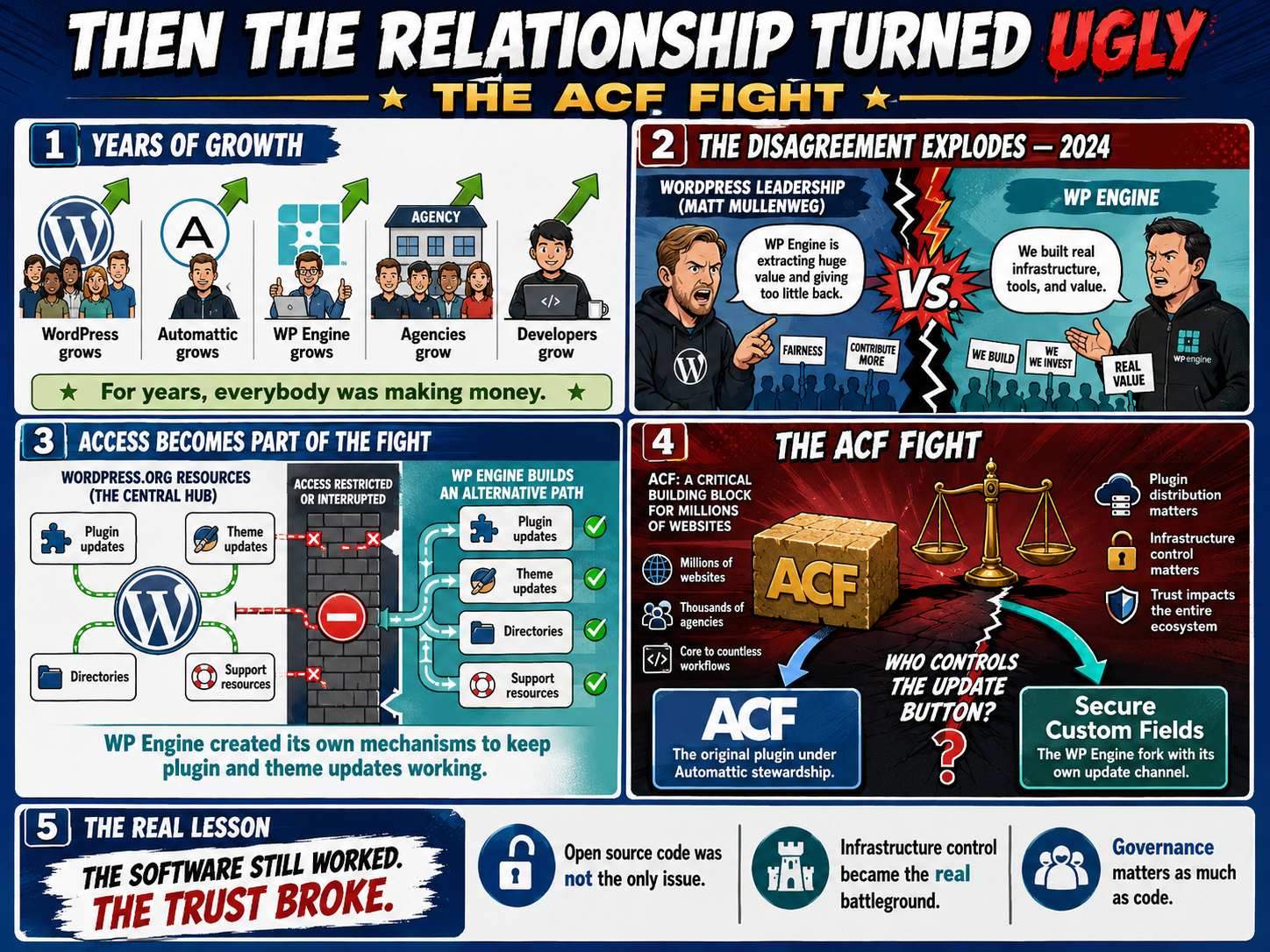
For years, WP Engine grew inside the WordPress ecosystem.
WordPress grew.
Automattic grew.
WP Engine grew.
Agencies grew.
Developers grew.
Everybody was making money.
Until the underlying disagreement finally exploded publicly in 2024.
Matt Mullenweg argued that WP Engine—particularly after Silver Lake's investment—was extracting enormous value from WordPress while contributing too little back to the open-source project.
WP Engine rejected that characterization.
Then things escalated.
Access to WordPress.org resources became part of the fight.
WP Engine developed its own mechanisms to keep plugin and theme updates working without relying on WordPress.org.
And then came one of the most extraordinary moments.
THE ACF FIGHT
Remember Advanced Custom Fields?
ACF was enormously important to professional WordPress developers.
WP Engine owned it.
In October 2024, WordPress.org took the version in its plugin directory and created a fork called Secure Custom Fields.
WordPress said it was acting under its plugin-directory rules and addressing a security issue.
WP Engine viewed the move as an unauthorized takeover.
WordPress even explained that sites using WordPress.org's update infrastructure could automatically move from ACF to Secure Custom Fields.
Now the problem was no longer philosophical.
It was staring everybody in the face.
WHO CONTROLS THE UPDATE BUTTON?
Who controls the repository?
Who controls access?
Who controls the pipes connecting millions of websites to their software?
Suddenly, “open source” did not feel like a complete answer anymore.
THEN THE COURTS ENTERED
WP Engine sued Automattic and Matt Mullenweg in October 2024.
The fight included allegations involving trademark issues, interference with business relationships, access to WordPress.org infrastructure and other claims.
Automattic denied wrongdoing and later brought counterclaims of its own.
In December 2024, a federal judge granted WP Engine a preliminary injunction requiring restoration of important WordPress.org access and restoration of WP Engine's control of its ACF plugin listing.
And as I write this in September 2026, the litigation is still not finished.
The parties have continued fighting through discovery, motions and counterclaims.
That matters.
There has not been a final court judgment declaring one side the hero and the other side the villain.
This is still an active legal dispute.
But I don't need a judge to tell me the larger lesson.
THE SOFTWARE NEVER STOPPED WORKING
And here is why this story was so difficult for me to understand.
WordPress still works.
That's the crazy part.
WordPress 7.1 was released in August 2026.
Hundreds of contributors are still working on it.
Websites still update.
Businesses still run.
People still publish.
And WordPress still powers roughly 40% of the web.
So if you're looking for a collapsed building, you won't find one.
The building is standing.
People are inside.
The lights are on.
What broke was something less visible:
TRUST.
Trust between maintainers and companies.
Trust around infrastructure.
Trust around trademarks.
Trust around repositories.
Trust around contribution.
Trust around who actually controls what.
That is why I could use WordPress and still not understand the crisis.
The technical system survived while the human governance system cracked.
AND NOW I UNDERSTAND THE REAL STORY
WordPress started because people wanted freedom.
An existing open-source project stalled.
Matt Mullenweg and Mike Little forked it.
WordPress grew because it was open.
It exploded when users fled restrictive licensing elsewhere.
Japan and communities around the world helped turn it into an international project.
Developers built plugins.
Businesses appeared.
Automattic commercialized services around it.
Then Jason Cohen discovered that professional users needed something WordPress did not adequately provide.
He built WP Engine.
Investors saw the value.
WP Engine accumulated infrastructure and developer tools.
And eventually the people responsible for the commons and one of the largest businesses built on that commons ended up fighting over money, contribution, trademarks, control and infrastructure.
That is the WordPress saga.
But for me there is another chapter.
The leadership chapter.
Because I keep returning to one question:
WHY DIDN'T SOMEBODY RECOGNIZE JASON COHEN EARLIER?
Not to stop him from creating.
Not to prevent competition.
You cannot build an open ecosystem and then demand that nobody become successful.
That would defeat the entire purpose.
My question is different.
Why wasn't his success treated as intelligence?
Why wasn't somebody saying:
“Jason has discovered the next layer of WordPress.”
Why wasn't the response:
“Secure him.”
“Invest in him.”
“Partner with him.”
“Hire people like him.”
“Acquire what makes sense.”
“Give the people solving these problems ownership.”
Because this is one of my deepest beliefs about leadership:
THE PERSON FIXING YOUR PROBLEM IS SHOWING YOU YOUR FUTURE.
And if someone inside or around my organization discovers something better than I did?
Wonderful.
I don't need to be the smartest person.
Whoever is better than me at that problem should lead that problem.
That is how you build something larger than yourself.
OPEN SOURCE WAS NOT THE MISTAKE
I don't come out of this story believing open source was nonsense.
Open source is one of the reasons WordPress conquered the world.
The mistake was believing open source answered every question.
It doesn't.
Open source answers:
Who can see the code?
Who can modify the code?
Who can distribute the code?
But it does not automatically answer:
Who pays the developers?
Who owns the infrastructure?
Who controls distribution?
Who controls identity?
Who controls updates?
Who rewards innovation?
Who governs disputes?
Who gets equity when somebody creates enormous value?
What happens when the founder and the ecosystem disagree?
Those are governance questions.
Those are leadership questions.
Those are economic questions.
And if you don't answer them when the organization is small, eventually success will answer them for you.
Usually in court.
THE LESSON I AM TAKING FROM WORDPRESS
WordPress taught us:
Open the software.
Jason Cohen and WP Engine taught us:
Professionalize the infrastructure.
Silver Lake taught us:
Capital will find valuable missing layers whether the original creator recognizes them or not.
And the WordPress/WP Engine war taught us:
Never leave control, economics and governance undefined simply because everybody currently gets along.
Because one day they won't.
And by then the little developer you ignored may have built an empire.
The little plugin may have become critical infrastructure.
The little disagreement may involve millions of websites.
And the argument that could have been solved around a table with equity, investment and leadership may end up being solved by lawyers.
That is why I loved learning this story.
Because WordPress didn't merely teach me something about websites.
WORDPRESS TAUGHT ME SOMETHING ABOUT BUILDING SYSTEMS.
Build openly.
Reward the people who contribute.
Watch the people who solve your weaknesses.
When somebody is better than you, bring them closer—not farther away.
Never allow one person or corporation to become an irreplaceable switch.
And most importantly:
DO NOT WAIT UNTIL SOMEONE BUILDS A BILLION-DOLLAR SOLUTION TO DISCOVER THAT YOU HAD A BILLION-DOLLAR PROBLEM.
That is the WordPress saga.
And now we can talk about what comes next is to take you to the video that inspired all of this.
Watch "WordPress Is Eating Itself Alive" on YouTube
A THANK YOU TO CODING WITH LEWIS
Before I close, I want to thank Coding with Lewis for making the video that helped me finally understand this story.
Not enough people tell stories.
We get headlines. We get lawsuits. We get arguments. We get technical documentation. But somebody has to sit down and explain:
How did we get here?
That is what your video did for me.
WordPress still works, which is exactly why its deeper problems can be difficult for an ordinary person to see. You connected the history, the people, the money, the open-source philosophy, WP Engine, the developers, and the conflict into one understandable story.
And once I understood the story, I could learn from it.
For me, WordPress is no longer the place where I would build the future. I am currently experimenting with newer infrastructure, including Cloudflare, as I think about an internet designed not only for humans and websites, but for AI agents, marketplaces, developers, and systems that will increasingly operate alongside us.
Maybe I am wrong.
Maybe I am right.
That is why I welcome your criticism—and everyone else's.
But ultimately, the responsibility for steering my ship belongs to me.
And there is one mistake from this story that I intend never to repeat, inshallah.
My philosophy is simple:
I should only be leading the part that I can lead better than anyone around me.
If a developer walks through my door tomorrow and understands one of my problems better than I do, wonderful.
Take the seat.
Lead it.
Build it.
Own part of the value you create.
I will go find another problem where I am more useful.
I don't need to protect my chair.
I need to protect the mission.
The same applies to AI.
I intend to challenge AI, allow AI to challenge me, challenge developers, and allow developers to challenge me. I want a system where the best idea survives regardless of whose name is attached to it.
Because leadership should never mean:
“I founded it, therefore I must always be in charge.”
Leadership should mean:
“Who is the best person—or eventually the best system—for this problem?”
Then give them the responsibility.
That is one of the biggest lessons WordPress gave me.
So, Lewis: thank you for telling the story.
You gave me something more valuable than another technology video.
You gave me history I could use.
I would genuinely like to hear what you think about what I am trying to build and whether you believe these lessons from WordPress apply to the coming world of AI agents and digital marketplaces.
The conversation is open.
The criticism is welcome.
The experiments will continue.
And the burden of making the final decisions remains mine.
Thank you for helping me understand where we came from while I try to think about where we go next.