

بِسْمِ اللهِ الرَّحْمٰنِ الرَّحِيْم
In the Name of God, Most Gracious, Most Merciful
♥️🤲🕋♥️🕋🌹🌹🥀🤲🌹🕋♥️🤲
The United States Constitution
USA FROM 🇺🇸 scratch PART 2 The United States Constitution
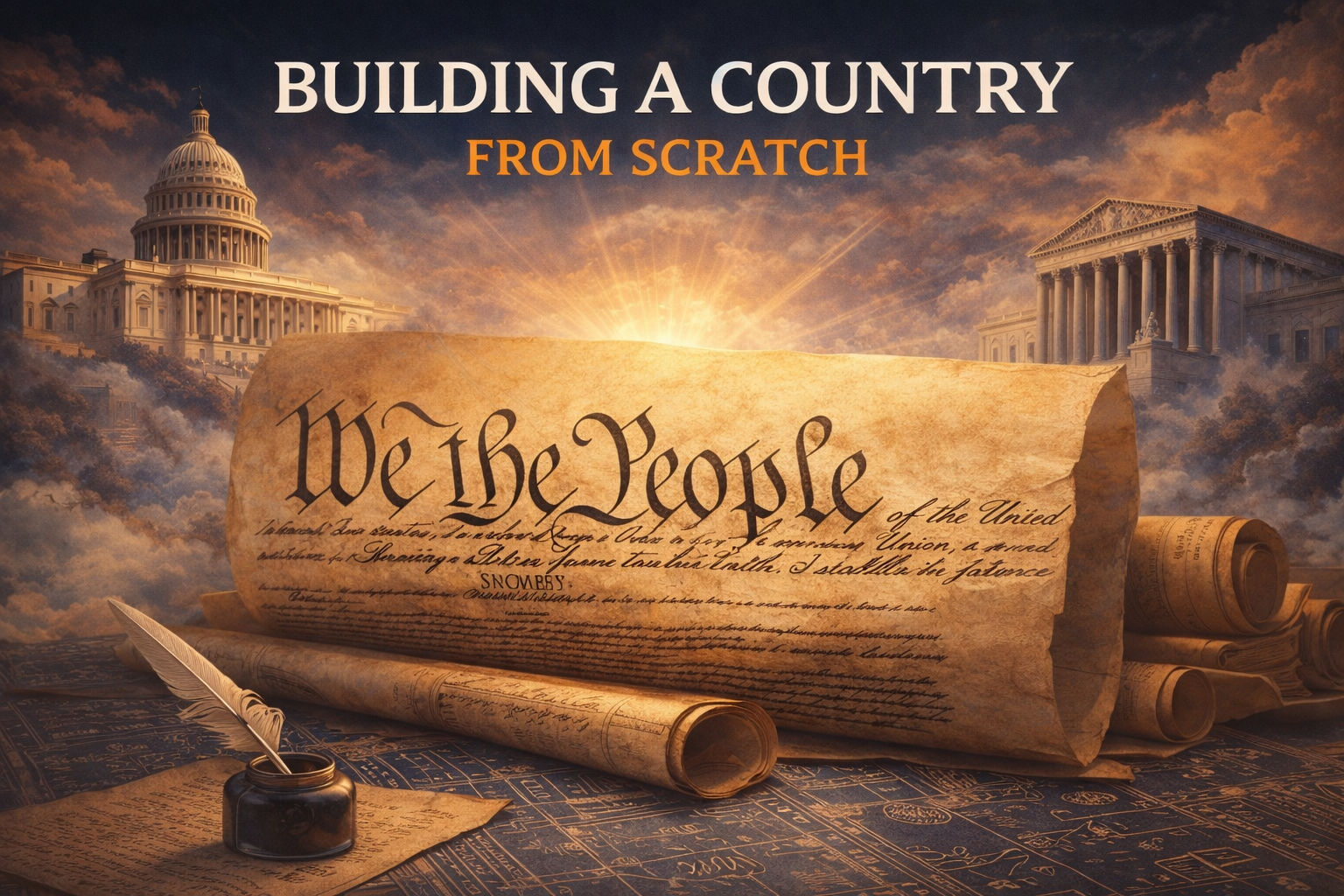
Watch "USA FROM 🇺🇸 scratch PART 2 The United States Constitution" on YouTube
What It Is, Why It Was Written, and Why Every Word Matters
Before We Begin: Why This Document Is Different
The Constitution of the United States was not written to celebrate power.
It was written to confess failure.
It is a document born from the admission that:
Complete freedom without structure failed
Concentrated power always turns into tyranny
Human beings betray systems—including ones they create
Governments must be designed against human weakness, not human perfection
This is why the Constitution reads the way it does.
This is why the language is cautious.
This is why every word is defensive.
And this is why it begins with three radical words.
“We the People” — Why These Words Matter
The Constitution does not begin with:
“We the King”
“We the States”
“We the Victors”
“We the Government”
“We the Church”
It begins with:
We the People
This was not poetry.
This was a deliberate rejection of everything that came before.
What They Were Rejecting
The framers had lived under:
Kings who ruled by bloodline
Parliaments that answered to elites
Empires that taxed without representation
Governments that treated people as subjects
They knew what went wrong.
So “We the People” is not decorative language.
It is a confession and a correction.
It means:
Power does not come from God through kings
Power does not come from land ownership
Power does not come from religion
Power does not come from wealth
Power comes from the people themselves.
Not permanently. Not blindly. But through judgment.
The Truth Before the Constitution: What Failed
The Articles of Confederation
Before the Constitution, the United States tried extreme freedom.
Under the Articles of Confederation:
Each state acted like a separate country
Congress had no power to tax
There was no president
There was no national court system
States printed their own money
Soldiers went unpaid
Debt piled up
Trade collapsed
Rebellions erupted
This was not tyranny.
This was chaos.
And chaos is just another form of injustice.
The framers learned something critical:
Absolute freedom destroys itself.
The Philadelphia Convention: The Necessary Betrayal
In 1787, delegates were sent to revise the Articles of Confederation.
That was their legal mandate.
Instead, they did something far more dangerous.
They shut the windows. They swore secrecy. They scrapped the Articles entirely. They designed a new government.
This was technically a betrayal of their instructions.
But it was a betrayal driven by judgment, not ambition.
They understood something most governments refuse to admit:
If the system is broken, fixing it quietly is dishonest.
They chose risk. They chose debate. They chose responsibility.
What They Actually Built (Before the Preamble)
Before any “We the People,” they first built machinery.
The Constitution is not a poem. It is a system of gears.
What Was Designed First
A Legislature (Congress)
Divided into two chambers
Slow by design
Representative of people and states
An Executive (President)
Limited authority
Checked by Congress
No king, no lifetime rule
A Judiciary (Courts)
Independent
Interprets law, does not create it
Separation of Powers
Each branch limits the others
No branch can dominate alone
This was the core experiment.
Only after this machinery was debated, structured, and agreed upon did they turn to language.
Ratification: Why It Took Two Years
The Constitution was not imposed.
It was argued.
Each state held its own ratifying convention. Some states said yes. Some said no. Some demanded changes.
Rhode Island refused entirely at first. Massachusetts hesitated. Virginia and New York demanded protections.
This period matters because it shows:
No single authority forced acceptance
The Constitution survived criticism
The system earned trust, it did not demand it
This is why the Constitution is strong.
It was resisted before it was accepted.
The Bill of Rights: What Was Missing and Why It Was Added
The original Constitution did not include a Bill of Rights.
That was not an oversight. It was a debate.
Some feared listing rights would limit them. Others feared not listing rights would endanger them.
The compromise was simple and powerful:
Ratify first. Amend immediately.
And that is exactly what happened.
The Bill of Rights was added after the Constitution became law, using the very amendment process the Constitution created.
This matters.
It proves the system was designed to correct itself.
Why Every Word Is Defensive
The Constitution does not trust power. It does not assume virtue. It does not rely on good intentions.
Every clause is a response to a past failure:
“No titles of nobility” → rejection of aristocracy
“Limited terms” → rejection of permanent rule
“Impeachment” → rejection of untouchable leaders
“Freedom of religion” → rejection of religious tyranny
“Freedom of speech” → rejection of enforced silence
This is not idealism. This is realism.
What the Constitution Actually Is
The Constitution is:
An admission that humans are flawed
A system designed to limit betrayal
A structure that expects disagreement
An experiment that invites participation
A framework, not a fantasy
It does not promise perfection.
It promises correction.
Why New Citizens Must Understand This
When you take the oath, you are not pledging loyalty to a religion. You are not pledging loyalty to a king. You are not pledging loyalty to a party.
You are pledging loyalty to an experiment in judgment.
An experiment that says:
We may fail — but we will fix it together.
That is what “We the People” really means.
Where We Go Next
Now that the foundation is clear, the next step is simple and serious:
We open the Constitution itself.
Article by article. Section by section. Power by power.
Not to worship it. But to understand it.
Because this document only works
when the people who swear to it
know exactly what it is.
Next Section:
Article I — Why Congress Comes First
A Country Invented From Scratch
How the Constitution Turned Judgment Into a System
There are nations that inherit their systems.
There are nations that conquer theirs.
And then there is the United States—a nation that attempted something rarer.
It tried to design judgment.
Not virtue.
Not purity.
Not perfection.
Judgment.
The Constitution was not written because the people believed themselves good.
It was written because they knew they were not.
That is its genius.
The Silence Before the System
Before there was poetry, there was machinery.
Before “We the People” ever appeared on parchment, there was a quieter moment—one defined not by language, but by fear. The fear was not of invasion, nor of rebellion, nor even of poverty.
It was the fear of unchecked power.
The states had tried absolute independence. It failed.
They had tried unity without authority. It failed.
They had tried freedom without structure. It failed.
So they did something radical: they stopped pretending.
They closed the doors.
They argued.
They contradicted one another.
They revised.
They scrapped plans.
They built new ones.
And instead of asking who should rule, they asked a better question:
How do we prevent anyone from ruling too much?
That question became the Constitution.
Why the Constitution Begins With Structure, Not Inspiration
The Constitution does not open with a king.
It does not open with a church.
It does not open with a hero.
It opens with architecture.
The document is not a sermon—it is a machine.
A machine designed to slow ambition, divide authority, and expose corruption through friction.
Only after the system was built did the language come.
The Articles — The Gears of the Republic
There are seven original Articles of the Constitution.
They do not argue ideals.
They assign responsibilities.
Each Article answers one essential question.
Article I — Who Makes the Law
The framers placed lawmaking power first—and deliberately made it slow.
Congress is divided into two chambers:
The House of Representatives — close to the people, reactive, frequently renewed
The Senate — distant from impulse, stable, designed to resist sudden change
This was not compromise.
It was containment.
Law was meant to be argued into existence—not declared.
If a law cannot survive debate, delay, and disagreement, it does not deserve permanence.
Article II — Who Executes the Law
The President is powerful—but intentionally limited.
The executive enforces law; it does not create it.
There is no royal bloodline.
No divine appointment.
No permanent authority.
Even the military answers to civilian control.
The President is not above the law—he is bound by it, watched by it, removable under it.
This was history speaking loudly: power concentrated in one person always turns inward.
Article III — Who Interprets the Law
Courts exist not to rule—but to clarify.
Judges are insulated from elections not to elevate them, but to protect judgment from pressure.
They do not command armies.
They do not raise taxes.
They do not write laws.
They interpret—nothing more.
This separation was intentional. Even interpretation must not become dominance.
Article IV — How States Coexist
States are sovereign—but not supreme.
This Article ensures cooperation without collapse:
Mutual recognition
Shared rights
Orderly admission of new states
Unity without erasure. Diversity without disintegration.
Article V — How Change Is Allowed
The Constitution was never meant to be frozen.
But change was meant to be difficult.
Amendments require consensus, patience, and seriousness. This guards against passion rewriting permanence.
The document assumes it will be challenged—and prepares for it.
Article VI — What Is Supreme
Not race.
Not religion.
Not class.
The Constitution itself.
No religious test for office.
No hereditary loyalty.
Only allegiance to the system.
This was unprecedented.
Article VII — How It Becomes Real
The Constitution did not require unanimity.
It required trust.
Once enough states ratified, the experiment began.
Not because everyone agreed—but because enough were willing to try.
The Bill of Rights — The Admission of Fear
The first ten amendments are not decorations.
They are confessions.
They say, plainly:
We do not trust power.
Speech must be protected.
Faith must be untouched.
The accused must be defended.
The state must be restrained.
These are not privileges granted—they are barriers erected.
What Endures
The core structure of the Constitution remains unchanged.
Presidents come and go.
Amendments expand inclusion.
Interpretations evolve.
But the architecture—the separation of powers, the distrust of concentration, the elevation of judgment over force—endures.
That is why it has lasted.
What the Constitution Really Is
The Constitution is not sacred text.
It is not myth.
It is not destiny.
It is a wager.
A wager that flawed people, if forced to argue openly and restrained by structure, can govern themselves better than any ruler ever could.
The Meaning of the Oath
When a citizen swears loyalty to the Constitution, they are not pledging obedience to history.
They are pledging participation in an experiment.
An experiment that assumes:
You will disagree
You will fail
You will correct
You will argue
You will improve
Not because you are perfect—but because the system expects imperfection and survives it.
Closing
The United States was not born from purity.
It was born from realism.
It did not trust angels.
It accounted for humans.
And that is why—despite every failure, every contradiction, every unfinished promise—the framework still stands.
Because it was never built to glorify power.
It was built to contain it.