

بِسْمِ اللهِ الرَّحْمٰنِ الرَّحِيْم
In the Name of God, Most Gracious, Most Merciful
The U.S. Constitution: A Product of Enlightenment Ideas and Colonial Grievances
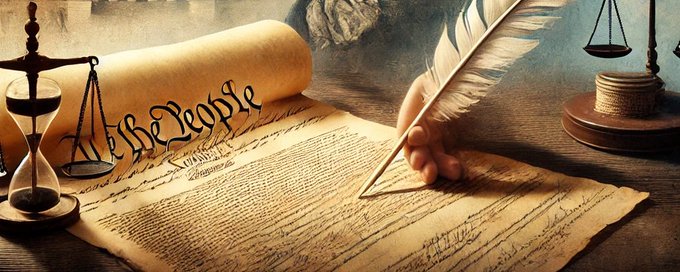
I. Introduction: A Document Built on Ideas, Not Myths
The U.S. Constitution is often revered as a groundbreaking document that laid the foundation for American democracy. However, upon closer examination, much of what it contains is deeply rooted in English political thought and the philosophical works of the Enlightenment. Rather than being a wholly original creation of the Founding Fathers, the Constitution can be seen as a collection of ideas borrowed from thinkers like John Locke, Cicero, and Montesquieu, as well as a reaction to British abuses experienced by the colonies.
II. The Influence of English Law and Colonial Grievances
The Bill of Rights, forming the first ten amendments to the Constitution, was largely inspired by the colonial experience under British rule. Many of the rights enshrined in these amendments—such as:
Freedom of speech
Protection against unreasonable searches
The right to a fair trial
Protection against cruel and unusual punishment
—are direct responses to grievances that the American colonies had against the British monarchy.
For example:
The Third Amendment, prohibiting the quartering of soldiers in private homes without consent, was a direct reaction to the Quartering Act, which allowed British troops to occupy colonists' houses.
The Fourth Amendment’s protections against unreasonable searches and seizures arose from British customs officers ransacking homes for smuggled goods.
The First Amendment’s guarantees of free speech and religion were inspired by the harsh punishment of dissent against the Crown.
Thus, the Bill of Rights reads like a catalog of complaints against British tyranny, with each right acting as a safeguard against the abuses the colonists endured.
III. The Pursuit of Happiness: John Locke’s Influence
One of the most quoted phrases in American political history—"life, liberty, and the pursuit of happiness"—is a direct evolution of John Locke’s idea of "life, liberty, and property."
In his Second Treatise of Government, Locke argued that government’s fundamental role is to protect natural rights, and that if it fails, the people have the right to revolt.
Thomas Jefferson, the principal author of the Declaration of Independence, was deeply influenced by Locke. While he replaced “property” with “pursuit of happiness,” the core principle remained: government exists to serve and protect the people, and loses legitimacy when it fails.
IV. Borrowing from Cicero and Montesquieu
The Founding Fathers also drew heavily from Cicero and Montesquieu:
Cicero, the Roman statesman and philosopher, emphasized republicanism and the rule of law. He argued that laws must stand above individuals and that the state exists to serve its citizens, not the other way around.
Montesquieu, a French Enlightenment thinker, proposed the concept of separation of powers. He argued that dividing authority into executive, legislative, and judicial branches was essential to prevent tyranny.
These principles became cornerstones of the U.S. Constitution.
V. Colonists with Access to Knowledge
The Founding Fathers were not isolated geniuses. They were educated colonists with access to the intellectual wealth of the Enlightenment. By studying the works of Locke, Montesquieu, and Cicero, they adapted existing ideas to their colonial reality.
America’s vast land and abundant resources also gave them a unique advantage. This wealth allowed them to apply Enlightenment principles on a grand scale, and without such resources, the revolution’s success might have been far less certain.
VI. Not Special — Just Fortunate
The Founders were not mythical figures; they were pragmatic revolutionaries trying to survive political upheaval. They borrowed and built upon existing knowledge, applying it creatively to their circumstances.
The Constitution’s genius lies in its synthesis of political thought and its flexibility, allowing it to adapt over centuries. It was not created from nothing — it was crafted from centuries of evolving political wisdom.
VII. Conclusion: A Testament to Knowledge
The U.S. Constitution stands as a testament to education, access to ideas, and pragmatic adaptation. Its endurance for more than two centuries is proof of its strength — not because it was entirely original, but because it merged timeless ideas into a single governing framework.
The Founders stood on the shoulders of giants, and in doing so, built a system capable of evolving with time. Understanding this truth deepens our respect for the Constitution and reminds us that great societies are built not just on innovation, but on wisdom passed down through the ages.
✅ Final Thought: The Constitution’s true legacy is not just in the document itself, but in the knowledge it carries forward — a living proof that ideas, once shared, can build nations.