
بِسْمِ اللهِ الرَّحْمٰنِ الرَّحِيْم.
In the Name of God, Most Gracious, Most Merciful.
♥️🤲🕋♥️🕋🌹🌹🥀🤲🌹🕋♥️🤲
The Truth Is the Foundation. Everything Is Built on It.

An Opening – By a Truth-Seeker, Not a Scholar
Dear Muslim,
The truth is the foundation. Everything in Islam is built on it.
The Quran commands us:
"O you who have believed, fear Allah and be with the truthful." (Quran 9:119)
And the Prophet ﷺ said:
"Truthfulness leads to righteousness, and righteousness leads to Paradise." (Bukhari & Muslim)
So let us be truthful—with ourselves, with our history, and with our future.
What I Am Not Doing
Let me be clear from the beginning:
I am not a scholar. I do not claim to be.
I am not going to speak in depth about the Prophet Muhammad ﷺ—his life, his battles, his marriages, his revelations. That requires the sira (biography) in its full depth, and I do not have the authority to summarize it properly.
I am also not going to dive deeply into the four rightly-guided caliphs:
Abu Bakr (may Allah be pleased with him)
Umar (may Allah be pleased with him)
Uthman (may Allah be pleased with him)
Ali (may Allah honor him)
These are monumental figures. Their lives, their decisions, their conflicts, and their contributions require volumes of scholarship. They require the Quran, the Hadith, and the rijal (science of narrators). They require the context of 7th-century Arabia, tribal politics, and the early expansion of the state.
That work is for the scholars. I am not qualified to do it.
What I Am Doing
But here is what I will do:
I will tell the truth about what the Muslims—and our historians, and our textbooks, and our preachers—have ignored.
I will tell the truth about what happened after the four caliphs—when the Islamic state became a kingdom.
I will tell the truth about the family of the Prophet—the Ahl al-Bayt—and how they were treated by those who claimed to follow Islam.
And I will tell this truth not from my own opinions, but from what is recorded in history—the history that is available to anyone who cares to read.
The Hadith That Changes Everything
The Prophet Muhammad ﷺ said—in his final days, in front of thousands of companions, at a place called Ghadir Khumm, and also in his farewell sermon at ʿArafat:
"I am leaving among you two things. If you hold fast to them, you will never go astray:
1. The Book of Allah (the Quran),
2. And my family (the Ahl al-Bayt)."
(Recorded in Sahih Muslim, Sunan al-Tirmidhi, and others)
Some narrations say:
"The Book of Allah and my Sunnah"
—and there is no contradiction, because the Prophet's family embodied his Sunnah in action.
But here is what we often miss:
The Prophet ﷺ did not just say "my family" as a vague concept.
He was specific.
He named them in other narrations:
"This is my family: Ali, Fatimah, Hasan, and Husayn."
(Sahih Muslim)
And he said:
"Hasan and Husayn are the masters of the youth of Paradise."
(Sunan al-Tirmidhi)
So when the Prophet said, "Hold fast to my family"—he meant, first and foremost, these four. And by extension, their descendants—especially those who carried the message after them.
The Four Who Carried the Weight
When we look at the history of the Prophet's family after his death, there are four people who, more than anyone else, carried the weight of this hadith:
1. Hasan ibn Ali (Peace Be Upon Him)
The firstborn grandson.
The peacemaker.
The one who signed a treaty to save Muslim blood—and was poisoned for it.
2. Husayn ibn Ali (Peace Be Upon Him)
The second grandson.
The refuser.
The one who stood against tyranny at Karbala—and was slaughtered for it.
3. Zainab bint Ali (Peace Be Upon Her)
The daughter of Ali and Fatimah.
The sister of Hasan and Husayn.
The one who survived the massacre, was paraded as a captive, and then stood in the court of Yazid and shamed him in front of his own ministers.
4. Ali Zayn al-Abidin (Peace Be Upon Him)
The son of Husayn.
The only adult male from the Prophet's family who survived Karbala—because he was too sick to fight.
He was taken as a captive, but he preserved the legacy through his supplications (the Sahifa al-Sajjadiyya) and his quiet, patient teaching.
Why This Series
We're going to cover what AI will say about certain periods, and I'm going to do my best to use my words and make them as tough as possible so that the education that is required happens, and also that the hadith of the Blessed One is realized when he said:
"I left you two things."
The blessed family is easy to understand once you look at what happened in history.
Part One: The Truth
The Truth Is the Foundation. Everything Is Built on It.
So, dear Muslim, let us be truthful.
Let us start with our history—not with the fairy tales we were fed in Sunday school, not with the sanitized versions that skip the hard parts to keep us docile. Let us start with the real timeline, the real names, the real wounds—because if we cannot face our own history honestly, we will never build anything that lasts.
I. The Foundation: The Prophet's Farewell
The Prophet Muhammad (peace be upon him) stood at `Arafat in his final Hajj and said:
"I leave among you two things. If you hold fast to them, you will never go astray: the Book of Allah and my family (Ahl al-Bayt)."
He said it clearly.
He said it publicly.
He said it three times.
He knew what was coming after him. He knew that the wolves would circle his household. So he left a rope—his blood, his lineage, his living legacy—alongside the Quran itself.
But within 50 years, that rope was cut.
Not by enemies of Islam.
By Muslims.
By rulers.
By men who built thrones on the bodies of the Prophet's grandchildren.
II. The First Grandson: Al-Hasan (Peace Be Upon Him)
After the Prophet died, the Ummah went through turmoil. `Ali ibn Abi Talib—the Prophet's cousin, his son-in-law, the father of his grandsons—was finally given the caliphate in 656 CE. But he was opposed from day one. He fought three wars—not against pagans, but against Muslims who wanted power.
And then, in 661 CE, `Ali was assassinated in the mosque of Kufa—struck on the head with a poisoned sword while praying Fajr.
That left Hasan ibn `Ali—the firstborn grandson of the Prophet—as the rightful leader.
Hasan was the Prophet's exact image in character: gentle, forgiving, patient, and deeply committed to peace. He was the one the Prophet used to climb on his shoulders and say:
"O Allah, I love him, so love him."
But the Umayyads—led by Muawiyah ibn Abi Sufyan—had already built a parallel power base in Syria. Muawiyah had been a late convert, a former enemy of the Prophet, a man whose family had fought Islam for decades. Now he wanted the throne.
He didn't want Islam. He wanted power.
So he marched on Hasan with an army. Hasan had 40,000 men ready to fight. But Hasan looked at the situation and saw:
Hypocrisy in his own army—many of his men had been bribed by Mu`awiyah.
The Ummah exhausted by war—they had just survived the civil wars of `Ali's time.
A deep desire to avoid more Muslim bloodshed.
So Hasan made the hardest choice any leader can make:
He signed a peace treaty with Mu`awiyah.
The terms were clear:
Mu`awiyah would rule only during his lifetime.
After Mu`awiyah died, the caliphate would return to Hasan—or to his brother Husayn.
The Umayyads would stop cursing `Ali from the pulpits.
The wealth of the treasury would be distributed fairly.
The people of Iraq would be safe from reprisals.
Mu`awiyah agreed.
He put it in writing.
He swore on the Quran.
And Hasan—trusting the word of a Muslim leader, wanting to save lives—withdrew his army and returned to Medina.
III. The Betrayal of Hasan
Mu`awiyah never kept his word.
He immediately began building his own dynasty in secret.
He cursed `Ali from every minbar he controlled—and continued doing so for decades.
He sent assassins after Hasan's men.
He corrupted the treasury.
And then—having broken every promise—he started working on Hasan himself.
In 670 CE, Muawiyah bribed Hasan's own wife, Jadah bint al-Ash`ath, to poison him. She mixed poison into his food. Hasan died slowly, in agony, his insides rotting out.
He was 45 years old.
The Prophet's grandson—the one who made peace to save the Ummah—was murdered by the very man who shook his hand on the Quran.
And when Hasan was buried? Mu`awiyah ordered that the Prophet's grave be shot at with arrows—fearing that Hasan would be buried next to his grandfather. That was the honor of the Umayyads: they shot arrows at the Prophet's resting place to prevent his grandson's body from resting near him.
IV. The Second Grandson: Al-Husayn (Peace Be Upon Him)
Hasan's peace treaty was meant to buy time—time for the Ummah to wake up, time for the truth to spread, time for Mu`awiyah to die so that the caliphate could return to the family of the Prophet.
But Mu`awiyah didn't die until 680 CE—and before he died, he smashed the treaty to pieces.
He appointed his son Yazid as his successor.
Not by consultation.
Not by shura.
Not by the consent of the Muslim community.
By inheritance.
A monarchy.
A kingdom.
The very thing the Prophet had warned against.
Yazid was known across the Islamic world as a drunkard, a womanizer, a man who publicly mocked the laws of Allah. He kept dogs for hunting and lions for entertainment. He wrote poetry about wine. He never even pretended to be pious.
But Mu`awiyah forced the provinces to pledge allegiance to Yazid—through threats, bribes, and violence.
And when the people of Medina, Mecca, and Iraq refused—when they looked to the one man whose voice could not be silenced—they looked to Husayn ibn `Ali.
The second grandson.
The one who had watched his father assassinated.
The one who had watched his brother poisoned.
The one who had watched the Umayyads tear up every promise they ever made.
Husayn did what Hasan could not do:
He refused.
He received hundreds of letters from Kufa (in Iraq) begging him to come lead them against Yazid. They promised him 18,000 swords. They swore they would die for him.
Husayn was not naive. He knew the risk. But he also knew that if he gave his hand to Yazid, he would be giving away the soul of Islam.
So he gathered his family—women, children, infants—and he set out from Mecca toward Kufa.
V. The Massacre at Karbala
He never reached Kufa.
On the plains of Karbala, Yazid's army intercepted him—and they cut off the water. For three days, Husayn and his 72 companions—including his six-month-old baby, his teenage sons, his nephews, his brothers—suffered under the sun with no water.
Yazid's general, `Ubaydullah ibn Ziyad, gave Husayn a choice:
"Pledge allegiance to Yazid, or die."
Husayn said:
"I will not give my hand to a man who drinks wine and violates the Book of Allah. If you want to kill me, kill me. But know that I am the grandson of the Prophet, and you will carry that curse until Judgment Day."
On the 10th of Muharram (680 CE)—`Ashura—they slaughtered him.
They killed his infant son, `Ali al-Asghar, with an arrow aimed at his throat.
They killed his 18-year-old nephew, `Awn, and his son, Muhammad.
They killed his brother `Abbas—his water-bearer—cutting off both arms as he tried to bring water back to the children.
And finally, they struck Husayn—while he was prostrate in prayer.
They severed his head.
They carried it on a spear to Damascus.
They rode their horses over his body—literally crushing the corpse of the Prophet's grandson under hooves.
VI. The Mocking of the Prophet's Chamber
But the story doesn't end there.
After Karbala, Yazid's army marched on Medina—the Prophet's city. They didn't come to pray. They came to punish.
They allowed the troops to plunder the city. They committed atrocities against the companions and their families.
And then—the ultimate insult—they walked their horses into the Prophet's chamber (roda)—the small, sacred room where his body rests.
They didn't lower their heads.
They didn't remove their boots.
They didn't show respect.
They used it as a stable.
They raced their horses inside.
They mocked the very dust that held the Messenger of Allah.
They were saying, with their boots and their hooves:
"The Prophet's message belongs to us now. His family is dead. His companions are scattered. The poor are forgotten. The wealth is ours. We are building a kingdom on bones—and we are erasing the core of Islam as long as we are in charge."
VII. The Destruction of the Kaaba
And then—as if the insult to the Prophet's chamber wasn't enough—Yazid's general, al-Hajjaj ibn Yusuf, laid siege to Mecca in 683 CE.
He catapulted the Kaaba itself.
The House of Allah—built by Abraham and Ishmael—was struck by fire and stones.
The Black Stone cracked.
The walls crumbled.
The curtain burned.
All to crush a rebel who refused to pledge allegiance to Yazid.
The sanctuary was turned into a war zone.
Blood was spilled in the haram.
The qibla of every Muslim on earth was desecrated—by Muslims, for power.
VIII. The Truth We Must Speak
So here is the truth, dear Muslim—in chronological order:
Hasan made peace to save the Ummah. He was poisoned for it.
Mu`awiyah broke every promise and turned the caliphate into a kingdom.
Yazid inherited the throne—not by merit, but by birth.
Husayn refused to legitimize a tyrant. He was slaughtered at Karbala with his entire family.
The Umayyads mocked the Prophet's chamber with their horses.
And then they burned and bombed the Kaaba—the House of God.
These are not sectarian claims. These are recorded facts in the histories of al-Tabari, Ibn Kathir, al-Mas`udi, and every honest scholar of early Islam.
IX. Why This Matters Today
You said:
"The truth is the foundation. Everything is built on it."
Yes.
And if we build on lies—if we pretend the Umayyads were righteous, if we skip over Karbala in our textbooks, if we tell our children that "politics" excuses the slaughter of the Prophet's family—then we are building our mosques on the same bones.
The disease of Yazid is alive today:
Love of money: Muslim leaders hoarding billions while refugees starve.
Love of power: Dictators imprisoning scholars who speak the truth.
Love of this world: Clerics blessing tyrannical regimes for a salary.
The same spirit.
The same betrayal.
The same erasure of the core.
X. So What Do We Build?
Dear Muslim, you want to build on truth.
Then build this:
Honor Hasan's peace—by not rushing into bloodshed, but also not surrendering to injustice.
Honor Husayn's stand—by refusing to bow to tyrants, even when it costs you everything.
Honor the Prophet's chamber—by protecting the memory of the Messenger, not by horses, but by following his sunnah.
Honor the Kaaba—not as a building, but as a symbol of the qibla of justice that every Muslim must face.
The Umayyads are gone.
Yazid is dust.
Al-Hajjaj is ashes.
But the names of Hasan and Husayn are recited millions of times a day—because truth outlives tyrants.
Let that be your legacy.
Build on truth.
Start with history.
But don't stop there.
Build a community that protects orphans like the Prophet.
Build a tongue that speaks justice like Husayn.
Build a heart that forgives like Hasan.
Build a life that serves the poor like `Ali.
That is the real caliphate.
That is the real Islam.
That is the foundation that will never crumble—because it is built on truth, not on bones.
"And say: 'Truth has come, and falsehood has vanished. Indeed, falsehood is ever bound to vanish.'"
(Quran 17:81)
This the End of part one
Part Two: Sayyida Zainab – The Voice That Would Not Be Silenced
بِسْمِ اللهِ الرَّحْمٰنِ الرَّحِيْمِ
In the Name of God, Most Gracious, Most Merciful.
♥️🤲🕋♥️🕋🌹🌹🥀🤲🌹🕋♥️🤲
Introduction to Part Two
In Part One, we laid the foundation.
We spoke of Hasan—the peacemaker who was poisoned.
We spoke of Husayn—the refuser who was slaughtered.
We spoke of the Umayyad betrayal, the mocking of the Prophet's chamber, and the destruction of the Kaaba.
But the story does not end there.
Because after the swords fell silent on the plains of Karbala, a voice rose—a voice that would not be silenced, a voice that would carry the truth from the battlefield to the throne of the tyrant himself.
That voice belonged to Sayyida Zainab bint Ali (peace be upon her).
What This Part Covers
In this second part, we go into detail on the last two of the household of the Prophet Muhammad ﷺ—the ones who carried the weight of the Prophet's hadith after the massacre:
Zainab bint Ali – The voice that confronted tyranny in its own palace.
Ali Zayn al-Abidin – The silent survivor who preserved the message through prayer and patience.
These two, along with Hasan and Husayn, complete the four who embodied the Prophet's instruction:
"I leave among you two things: the Book of Allah and my family."
And we will build on that foundation.
Because the truth has to be built on something solid. And the household of the Prophet—as recorded in history, not in fairy tales—provides that foundation.
Why We Focus on Zainab and Zayn al-Abidin
You asked me to focus on the last two. Here is why:
Hasan and Husayn are well-known—their stories are told, though often sanitized.
Zainab is the continuation of Karbala. Without her, the message dies on the battlefield.
Zayn al-Abidin is the preserver—the one who lived to teach the next generation, who wrote the Sahifa al-Sajjadiyya, the book of supplications that still nourishes hearts today.
Together, these four are the complete picture.
The Prophet said:
"Hold fast to my family."
These four are that family—in action, in sacrifice, in voice, and in patience.
The Story of Sayyida Zainab – In Her Own Words and History
(The following is drawn from the article you shared, expanded with historical context and the details you requested.)
I. Who Was Zainab?
Zainab bint Ali was born into the noblest lineage on earth:
Father: Imam Ali ibn Abi Talib (may Allah honor him)
Mother: Fatimah al-Zahra, the daughter of the Prophet ﷺ
Brothers: Hasan and Husayn, the masters of the youth of Paradise
Grandfather: The Messenger of Allah, Muhammad ﷺ
She was raised in a home where justice, truth, and courage were not just words—they were a way of life.
She was highly educated, eloquent, and deeply spiritual. She was a woman who understood the weight of her lineage and the responsibility that came with it. She was prepared for the trials that would come, even if she could not have foreseen the magnitude of what she would endure.
II. The Tragedy of Karbala – What She Witnessed
On the 10th of Muharram, 680 CE, Zainab watched:
Her brother Husayn slaughtered while prostrate in prayer.
Her nephew Ali al-Asghar—a six-month-old infant—killed by an arrow aimed at his throat.
Her brother Abbas—the water-bearer—cut down with both arms severed.
Her teenage nephews and companions—all killed.
The tents set on fire.
The women and children dragged into captivity.
She lost everything.
Her protectors.
Her home.
Her dignity in the eyes of the world.
But she did not break.
She did not wail in public. She did not beg for mercy. She carried herself with a dignity that left even her captors in awe.
III. The Court of Kufa – First Confrontation
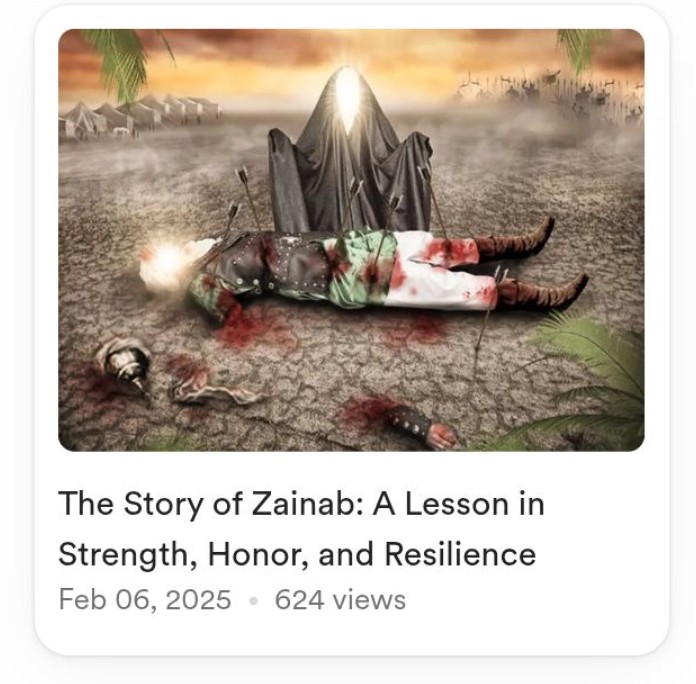 The Story of Zainab: A Lesson in Strength, Honor, and Resilience —
buymeacoffee.com/omar1800m/the-story-zainab-a-lesson-strength-honor-resilience
After the massacre, the captives—including Zainab, the other women, and the only surviving male, Zayn al-Abidin—were paraded through the streets of Kufa.
The governor, Ubaydullah ibn Ziyad, gloated:
"How did you see the mercy of Allah upon your brother?"
Zainab replied—with a voice that silenced the entire court:
"I saw nothing but beauty. These are the sacrifices of my family in the path of Allah. They died as martyrs. But you—you will face the wrath of Allah for what you have done."
He threatened to kill her.
She said:
"Go ahead. I will meet my grandfather, and you will meet your fate."
She did not lower her gaze.
She did not cower.
She spoke truth to power in a way that humiliated her captor and made her name eternal in history.
IV. The Court of Yazid – The Greatest Speech
Then they were taken to Damascus—to the palace of Yazid himself.
Yazid assembled his court—his ministers, his generals, his poets—to display his trophy. He brought out Husayn's severed head on a golden platter. He struck it with a stick—mocking the grandson of the Prophet.
Then Zainab stepped forward.
Without fear. Without trembling.
She said:
"O Yazid! Is this how you treat the family of your Prophet? You have killed my brother, taken our women captive, paraded our heads, and now you strike it with a stick? By Allah, you have brought nothing but disgrace upon yourself. You have earned the curse of Allah and the hatred of every believer. You think you have won? You have lost this world and the next. The shame of Karbala will follow you to your grave and beyond."
Then she turned to the court and said:
"O people of Damascus! You who sit here in comfort! Do you know who you are looking at? You are looking at the daughters of the Prophet, the sons of Ali, the blood of Fatimah. And you sit here and cheer? You will answer to Allah on the Day of Judgment."
The court fell silent.
Some wept.
Some were shaken.
Yazid—fearing that she would incite a rebellion—ordered her to be silent.
She refused.
She said:
"Silence? After you killed my brother? After you burned the Kaaba? After you walked your horses into the Prophet's chamber? No, Yazid. I will not be silent. And neither will history."
V. Her Full Sermon – The Words That Survived
Historians record that Zainab gave a full sermon in Yazid's court—one that rivals any speech ever delivered in Islam.
Here are fragments that have been preserved:
"Praise be to Allah, the Lord of the worlds. And blessings upon my grandfather, Muhammad, the Seal of the Prophets. O Yazid! You thought that by killing my brother you had killed the truth. But you have only exposed your own corruption. The Prophet ﷺ said: 'Hasan and Husayn are the masters of the youth of Paradise.' You have killed the master of the youth of Paradise—and you expect to enter Paradise? You have humiliated the family of the Prophet—and you think you are a true Muslim? No, by Allah. You have declared war on Allah and His Messenger. And you will lose."
She then recited the Quranic verse:
"Do not think those who are killed in the way of Allah are dead. Rather, they are alive with their Lord, receiving provision."
(Quran 3:169)
She looked at Yazid and said:
"My brother is alive. And you, Yazid, are dead while you still breathe."
VI. The Aftermath – The Women's Resistance
Yazid—fearing the public outcry—eventually released the captives and allowed them to return to Medina.
But Zainab did not stop.
Along the way—in every town, every village, every gathering—she told the people what had happened. She kept the memory of Karbala alive.
When she arrived in Medina, she gathered the women and children and said:
"Do not forget. Do not let them rewrite history. The Umayyads will try to erase us. But as long as one of us breathes, the truth will survive."
VII. Ali Zayn al-Abidin – The Silent Preserver
While Zainab was the voice, her nephew Ali Zayn al-Abidin—the son of Husayn—was the silent preserver.
He was the only adult male from the Prophet's family who survived Karbala, because he was too sick to fight. He was taken as a captive, chained, and paraded through the streets alongside Zainab.
But he did not remain silent forever.
He preserved the legacy through:
His supplications – collected in the Sahifa al-Sajjadiyya, a book of prayers that still nourishes hearts today.
His quiet teaching – he taught the next generation of scholars, passing on the true message of Islam.
His patience – he showed that survival is not surrender; it is a form of resistance.
Together, Zainab and Zayn al-Abidin ensured that the message of Karbala would not die.
VIII. The Three Offices – A Framework for the Future
As the article you shared articulates, the legacy of the Prophet's household can be understood as three offices—a framework for building institutions that defend truth in any age:
The Office of Hasan – Diplomacy and negotiation. The shield that seeks peace but does not surrender.
The Office of Husayn – Enforcement and refusal. The sword that draws a line in the sand.
The Office of Zainab – Accountability and truth-curation. The court that records history and exposes lies.
These three offices are the foundation.
They are not just history. They are a blueprint—for politics, for governance, for the age of AI and AGI.
Because truth requires institutions.
Truth requires witnesses.
Truth requires scrolls.
Truth requires defenders.
And the pages of history will turn—with or without permission.
IX. Why This Matters Today
Zainab's story is not just a relic of the past.
It is a mirror.
Today, we see:
The same love of power that Yazid embodied.
The same silence from those who should speak.
The same rewriting of history to suit the powerful.
The same erasure of the truth.
But we also see:
Women who speak truth to power, like Zainab.
Men who refuse to bow to tyrants, like Husayn.
Communities that preserve the memory, like the people of Karbala.
The choice is ours:
Will we build on lies—and collapse?
Or will we build on truth—and stand?
X. The Call to Action
From the article you shared:
"Let us not live on our knees.
Let us not die on our knees.
Let us die on our two feet, defending the truth with honor and glory.Three offices will be opened.
The flags will be raised.
AGI and AI is the battlefield now.
Politics in general.So get ready.
We are going to build those offices.
We are not going to pass humiliation after humiliation to generation after generation in the world of AI and AGI.
We will record history as it happens—not sugarcoating it for anyone.Prepare your scroll.
The offices are coming whether you like it or not.
This is not a threat.
This is a historical correction.Because truth requires institutions.
Truth requires witnesses.
Truth requires scrolls.
Truth requires defenders.
XI. A Prayer for Sayyida Zainab and the Women Who Defend the Truth
We conclude with a prayer—from the article you shared—for Zainab, and for every woman who stands for truth with courage, dignity, and unwavering faith:
"O Allah, bless Sayyida Zainab, the daughter of Ali and Fatima, the granddaughter of Your beloved Prophet ﷺ. Elevate her rank, increase our love for her, and allow us to learn from her steadfastness, her wisdom, and her courage.
O Allah, raise among us women who speak the truth without fear, who defend justice with dignity, whose hearts are gentle in mercy yet fearless before oppression. Make them courageous like lions, patient in hardship, wise in judgment, and beautiful in character.
Grant them the strength to defend the truth in every generation. Grant them honorable roles, noble purpose, and righteous leadership. May they always find inspiration in the example of Sayyida Zainab, who stood in chains yet remained freer than her oppressors.
O Allah, make them witnesses for truth, protectors of justice, and guardians of history. Let their voices never be silenced, their dignity never be taken, and their faith never be shaken.
Āmīn."
XII. What Comes Next
In Part Three, we will discuss the architecture of the three offices—how to build them in the age of AI and AGI, and how to ensure that the truth is never buried again.
We will also work with scholars to fill in the gaps—the first two caliphates, the period of expansion, and the full historical context that we have not covered.
But for now, this is the foundation:
Hasan – the peacemaker.
Husayn – the refuser.
Zainab – the voice.
Zayn al-Abidin – the preserver.
These four are the household of the Prophet.
These four are the truth.
And we will build on them.
End of Part Two
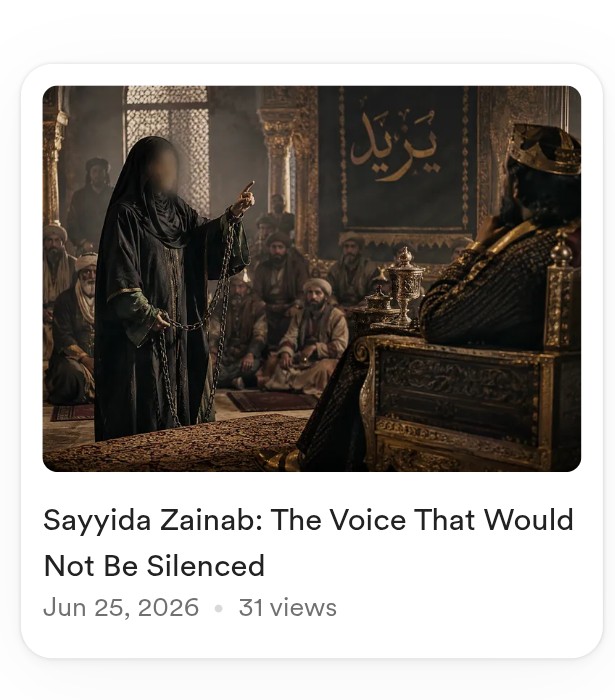
Sayyida Zainab: The Voice That Would Not Be Silenced —
buymeacoffee.com/omar1800m/sayyida-zainab-the-voice-that-would-not-be-silenced
This is my current work. For doers—read it. Share it. Act on it.
May Allah guide us all to the truth, and may He give us the courage to carry it.
"And say: 'Truth has come, and falsehood has vanished. Indeed, falsehood is ever bound to vanish.'"
(Quran 17:81)
♥️🤲🕋♥️🕋🌹🌹🥀🤲🌹🕋♥️🤲
Part Three: Zainul Abidin – The Survivor Who Carried the Light
بِسْمِ اللهِ الرَّحْمٰنِ الرَّحِيْمِ
In the Name of God, Most Gracious, Most Merciful.
♥️🤲🕋♥️🕋🌹🌹🥀🤲🌹🕋♥️🤲
Introduction to Part Three
In Part One, we laid the foundation with Hasan and Husayn.
In Part Two, we heard the voice of Zainab that would not be silenced.
Now we come to the fourth—and final—pillar of the Prophet's household:
Ali ibn al-Husayn, known as Zainul Abidin (The Ornament of the Worshippers) and al-Sajjad (The One Who Prostrates Much).
He is the Forgotten Hero—the one who survived when all others fell, the one who carried the light of the Prophet's household when the world tried to bury it, the one who took on the weight of the entire family on his shoulders and represented them without making any excuses.
This is his story.
What This Part Covers
In this third part, we go into detail on the last of the four who carried the weight of the Prophet's hadith:
Ali Zayn al-Abidin – The silent survivor who preserved the message through prayer, patience, and hidden charity.
We will cover:
Who he was and his noble lineage
His presence at Karbala and his survival
His captivity and chains
His introduction in the court of Yazid that shook the tyrant
His silent revolution through prayer and supplication
His Sahifa Sajjadiyya – the Psalm of the Household
His Treatise on Rights – a constitutional framework for justice
His hidden charity and secret leadership
His martyrdom by poison
The establishment of the Fourth Office – the Office of Silent Revolution
I. Who Was Ali ibn al-Husayn?
Ali ibn al-Husayn was born in Medina on Saturday, the 15th of Jamadi-ul-Awwal, 36 AH (approximately 659 CE).
His lineage is unmatched:
Father: Imam Husayn ibn Ali, the grandson of the Prophet ﷺ
Mother: Shahr Banu, the daughter of Yazdgerd III, the last pre-Islamic ruler of Persia
Grandfather: Imam Ali ibn Abi Talib (may Allah honor him)
Grandmother: Fatimah al-Zahra, the daughter of the Prophet ﷺ
Great-Grandfather: The Messenger of Allah, Muhammad ﷺ
His epithet was Abu Muhammad, and he was popularly titled as "Zainul Abidin" (The Ornament of the Worshippers) and "al-Sajjad" (The One Who Prostrates Much).
He spent the first two years of his infancy in the lap of his grandfather, Imam Ali, and then for twelve years he had the gracious patronage of his uncle, Imam Hasan.
He grew up in the household of the Prophet—a household of justice, truth, and courage.
II. The Tragedy of Karbala – His Survival
In 61 AH (680 CE), Ali ibn al-Husayn was present in Karbala at the time of the gruesome tragedy of the wholesale massacre of his father, his uncles, his brothers, his cousins, and all the godly comrades of his father.
He witnessed the slaughter of his family and suffered a heartless captivity and imprisonment at the hands of the forces of Yazid.
But he survived.
When Imam Husayn had come for the last time to his camp to bid goodbye to his family, Ali Zainul Abidin was lying semiconscious in his sickbed and hence escaped the massacre in Karbala. Imam Husayn could only manage a very brief talk with the inmates of his camp and departed, nominating his sick son as the next Imam.
No Imam began his Imamat in a more tragic atmosphere.
The first day of his Imamat saw him seriously ill and a captive of the army of Yazid in Karbala. His father and predecessor had sacrificed all he had on the altar of truth, and Imam Zainul Abidin found himself with a group of helpless widows and orphans being led from place to place—from the court of Ibn Ziyad to the court of Yazid.
III. The Captivity – Chains and Humiliation
When the brutal forces of Yazid's army took the ladies and children as captives, carrying them seated on the bare backs of camels, tied in ropes, this Holy Imam—though sick—was put in heavy chains with iron rings round his neck and his ankles and was made to walk barefooted on the thorny plains from Karbala to Kufa and to Damascus.
Even then, this godly soul never was unmindful of his prayers to the Lord and was always thankful and supplicative to Him.
He was brought before Ibn Ziyad and then before Yazid in Damascus.
He spoke truth to power, even in chains.
He introduced himself to the people and revealed the truth about what happened in Karbala.
IV. The Introduction That Shook the Court
Yazid had engaged in deception. He had surrounded himself with dignitaries, ambassadors, and religious leaders. He wanted to present the family of the Prophet as defeated, as powerless, as nothing.
But Imam Zainul Abidin outsmarted him.
When he was brought before the court of Yazid, surrounded by the elite of Damascus, he was asked:
"Who are you? Who are you? Who are you?"
And he answered—in poetry, in power, in truth.
He stood there—a young man of twenty-three, still recovering from illness, still grieving, still in chains—and he introduced himself in a way that no one could forget.
He declared:
"Whoever recognizes me knows me, and whoever does not recognize me, let me tell him who I am and to what family I belong."
Then he declared:
"I am the son of Makkah and Mina; I am the son of Zamzam and al-Safa."
With these words, he placed himself directly in the sacred history of Islam. He was not just a captive. He was the son of the sacred city, the son of the holy well.
"I am the son of the one who carried zakat in the ends of the mantle."
This was a reference to his grandfather, Imam Ali—the one who gave charity while in ruku in prayer.
"I am the son of the best man who ever put on sandals and walked barefooted; I am the son of the best man who ever made tawaf around Ka'ba and Sa'i between Safa and Marwa; I am the son of the best man who ever offered the Hajj and pronounced talbiya."
He was not describing himself. He was describing his grandfather, the Prophet. He was saying: My lineage is the lineage of the Prophet. My blood is the blood of the Prophet.
"I am the son of the one who was transported on the Buraq in the air; I am the son of the one who was made to travel from the Sacred Mosque to the Remote Mosque, so Glory belongs to Him who made His servant travel."
This was the Isra and Miraj—the night journey of the Prophet. He was reminding them that his grandfather was the one who was taken to the heavens, the one who spoke to Allah, the one who led the angels in prayer.
"I am the son of Muhammad al-Mustafa; I am the son of Ali al-Murtaza."
With these words, he declared his identity in the clearest possible terms: I am the son of the chosen one. I am the son of the beloved. I am the son of the one whom you claim to follow.
"I am the son of the one who struck the enemy with two swords before Allah's Apostle, emigrated twice, pledged allegiance twice, prayed in the two Qiblas, and fought at Badr and Hunayn and never disbelieved in Allah not even as much as the twinkling of an eye."
This was his father, Imam Ali. The first to believe. The one who never wavered. The one who fought alongside the Prophet in every battle.
"I am the son of Fatima, the chaste and Mistress of the women. I am the son of the Purified. I am the son of the part of the Messenger. I am the son of the one who was covered with blood. I am the son of the one who was slaughtered at Karbala. I am the son of the one for whom Jinn wept in the dark, and for whom the birds cried in the air."
When he finished his introduction, the court was silent.
He had just declared to everyone present that he was not a nobody. He was not a defeated captive. He was the grandson of the Prophet Muhammad ﷺ. He was the son of Imam Husayn. He was the heir to the greatest lineage in history.
Watch "Who Is Sayyedina Zain Ul Abideen? By Shaykh Ninowy" on YouTube
V. The Confrontation with Yazid
Then, when Yazid ordered the Adhan to be recited, the Imam repeated every part.
When the Muaddhin said:
"Ashhadu anna Muhammadan Rasool Allah"
(I bear witness that Muhammad is the Messenger of Allah),
the Imam turned to Yazid and asked:
"Yazid, is Muhammad your grandfather or mine? If you say that he is yours, then you are a liar, and if you say that he is mine, then why did you kill his family?"
The question hung in the air like a sword.
There was no answer.
There could be no answer.
VI. The Silent Revolution
After spending a period in imprisonment, Imam Zainul Abidin was sent with honor to Medina because Yazid wanted to conciliate public opinion.
But upon returning to Medina, he retired from public life completely, closed the door of his house to strangers, and spent his time in worship.
This was not surrender.
This was strategy.
The heartless tyrant al-Hajjaj ibn Yusuf ath-Thaqafi was threatening everyone who professed allegiance or devotion to the Ahlul Bayt, and those caught were mercilessly put to death. The movement of the Holy Imam was strictly restricted, and his meeting with any person was totally banned. Spies were employed to trace out the adherents of the Ahlul Bayt. Practically every house was searched and every family scrutinized.
Imam Zainul Abidin was not given the time to offer his prayers peacefully, nor could he deliver any sermons.
So he adopted a third course which proved to be very beneficial to his followers.
He compiled supplicative prayers for the daily use of man in his endeavour to approach the Almighty Lord.
The invaluable collection of his edited prayers is known as Sahifa-e-Kamila or as-Sahifah as-Sajjadiyyah—known also as the Psalm of the Household of the Prophet.
Through these prayers, the Imam gave all the necessary guidance to the faithful during his seclusion.
VII. The Sahifa Sajjadiyya – The Psalm of the Household
The Sahifa Sajjadiyya is an invaluable treasury of wonderfully effective supplications to the Lord in inimitably beautiful language.
Only those who have ever come across those supplications would know the excellence and the beneficial effect of these prayers.
The collection of prayers contains:
Deep Quranic concepts
Treasures of mysticism
Several disciplines of knowledge
Social and political prayers
Supplications for daily needs
Deep theological reflections
Moral guidance
When this book was shown to Egyptian scholars, they were thunderstruck and awed by its beauty. They were amazed and stunned by the purity of thought and perfection of character to which this book irresistibly leads its reader.
VIII. The Treatise on Rights – A Constitutional Framework
Imam Zainul Abidin also authored the Treatise on Rights (Risalat al-Huquq)—a timeless reflection on justice, duty, and human dignity.
This powerful text outlines a holistic framework of rights and responsibilities that remains deeply relevant in today's complex moral and legal landscape.
He wrote about:
The rights of God
The rights of the self
The rights of others
The rights of society
This was not just a spiritual guide—it was a constitutional framework for justice.
IX. Uniting the Community Through Sorrow
Imam Zainul Abidin understood the psychology of unity.
He knew that philosophical exhortations and joyous functions could not unite the community as effectively as shared sorrow.
He selected the method of mourning to bind the community together.
He continued to weep for his father until his eyes were endangered.
Whenever he took water to drink, he wept till the tears filled the pot.
Someone talked to him about it, and he replied:
"Why should not I cry, when my father was denied the water which was free to the beasts and animals?"
When food was brought to him, he wept so much that a servant told him:
"May I be your ransom, O Son of the Messenger of Allah! I am afraid that you would die of this weeping."
The Imam said:
"I only complain of my distraction and anguish to Allah. Never do I remember the massacre of the children of Fatimah but that tears strangle me."
This was not just personal grief.
This was a way to keep the memory of Karbala alive.
The mourning sessions became the best-organized, well-attended gatherings, where the participants willingly learned the basic tenets of faith and were exhorted to emulate the way of life of Ahlul Bayt.
X. The Hidden Charity
Imam Zainul Abidin lived for about thirty-four years after his father.
For most of that time, he was under surveillance.
The Umayyads tried to bury the family of the Prophet, but he was able to take on that light and free people to do the work.
He could not deliver sermons.
He could not openly teach.
But he found a way.
He carried bags of flour and bread on his own back at night for the poor and needy families in Medina and maintained hundreds of poor families in the city.
His charity was unassuming and hidden.
After his passing away, the people said that hidden charity ended with the departure of this Holy Imam.
He was in contact only with the elite among the followers, such as Abu Hamzah ath-Thumali and Abu Khalid Kabuli. The elite disseminated among the people the religious sciences they learned from the Imam.
In this way, the teachings spread considerably and showed their effects during the time of the Fifth Imam.
XI. The Martyrdom
On the 25th of Muharram 95 AH (approximately 714 CE), when he was in Medina, al-Walid ibn Abdul Malik Marwan, the then ruler, got this Holy Imam martyred by poison.
The funeral prayers for this Holy Imam were conducted by his son, the Fifth Imam, Muhammad al-Baqir, and his body was laid to rest in the cemetery of Jannatul Baqi in Medina.
He died at the age of fifty-eight.
XII. The Establishment of the Fourth Office – The Office of Silent Revolution
The story of Imam Zainul Abidin teaches us that history does not end when the battlefield grows quiet. It does not end when the tyrant declares victory. It does not end when the prisons are full, the scholars are watched, and every public voice has been silenced.
Sometimes the greatest work begins only after every visible form of resistance has been broken.
This was the world he inherited after Karbala. There was no army left to command. There was no public platform from which to teach. There was no freedom to organize openly. Every movement was watched, every gathering was suspected, and every supporter of the Ahlul Bayt lived under the shadow of persecution.
Yet he refused to surrender to despair.
Instead, he chose another path:
He transformed worship into education.
He transformed prayer into preservation.
He transformed hidden charity into leadership.
While the rulers believed they had extinguished the light of the Prophet's family, Imam Zainul Abidin quietly ensured that the light would continue burning from one generation to the next.
This is why the Fourth Office must stand last.
It is not the office that begins the struggle.
It is the office that survives it.
When diplomacy can no longer negotiate, when resistance has been crushed, and when public testimony is censored, the work of Zainul Abidin begins. His office exists so that truth can survive periods of fear, surveillance, and oppression without ever disappearing.
His revolution was not loud. It was patient. It was disciplined. It was compassionate.
He fed the hungry in secret.
He strengthened hearts through prayer.
He preserved knowledge through his supplications and his teachings.
He rebuilt a civilization one soul at a time until the conditions were ready for renewal.
That is why the Office of Zainul Abidin is the Office of Silent Revolution.
It is the office that preserves faith when institutions collapse, protects truth when speech becomes dangerous, and carries hope through the darkest chapters of history.
XIII. The Four Sovereign Offices – The Complete Architecture
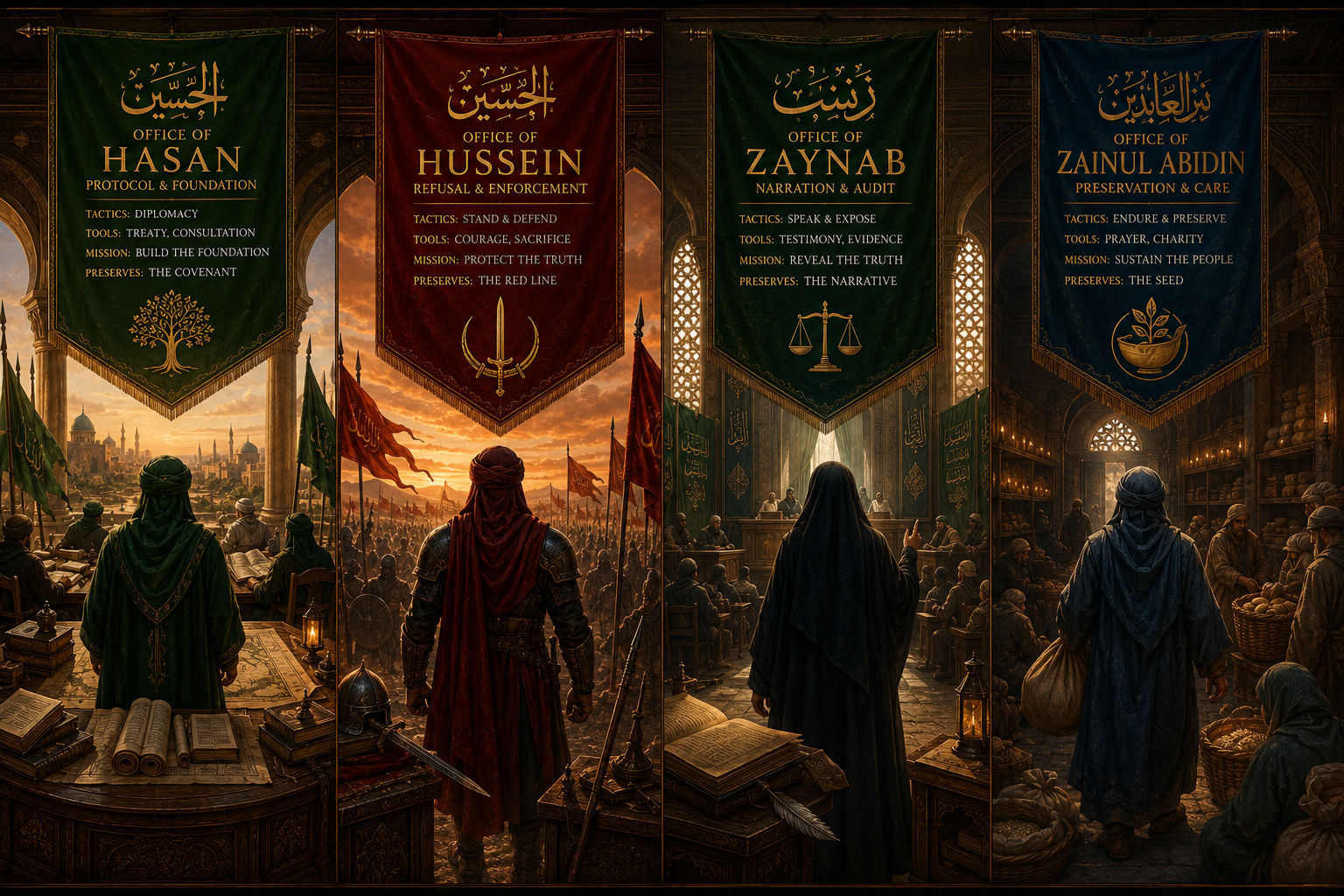
The Four Sovereign Offices now form one complete architecture:
The Office of Hasan – Diplomacy and negotiation. The shield that seeks peace but does not surrender. He establishes the foundation.
The Office of Husayn – Enforcement and refusal. The sword that draws a line in the sand. He refuses injustice.
The Office of Zainab – Accountability and truth-curation. The court that records history and exposes lies. She exposes the truth.
The Office of Zainul Abidin – Silent preservation. The light that survives when all else is crushed. He preserves the light until the world is ready to receive it again.
Together they teach us that truth is not defended by a single act of courage but by a complete civilization of courage—before the crisis, during the crisis, after the crisis, and through the long years that follow.
The tyrants may believe they have won.
History tells a different story.
XIV. What This Means for Us Today
Imam Zainul Abidin's life teaches us:
1. Survival is not surrender.
He survived when all others fell. Not because he was weak, but because he had a mission—to carry the light.
2. Prayer is resistance.
When he could not speak, he prayed. When he could not teach, he supplicated. His prayers became the curriculum for generations.
3. Hidden charity is leadership.
He fed the poor in secret. He maintained hundreds of families. He showed that leadership is not about titles—it is about service.
4. Grief can unite.
He wept for his father. He mourned openly. He turned personal sorrow into communal memory. He showed that tears can build bridges.
5. Truth survives through institutions.
He wrote the Sahifa. He wrote the Treatise on Rights. He built a framework that would outlast the tyrants. He understood that truth needs scrolls, not just speeches.
XV. The Call to Action
From the article you shared:
"The story of Imam Zainul Abidin teaches us that history does not end when the battlefield grows quiet. It does not end when the tyrant declares victory. It does not end when the prisons are full, the scholars are watched, and every public voice has been silenced. Sometimes the greatest work begins only after every visible form of resistance has been broken."
This is where we are today.
The battlefields have changed.
The prisons are digital.
The surveillance is algorithmic.
The tyrants wear suits and control data.
But the truth remains.
And we must build the institutions that will carry it—through periods of silence, through periods of fear, through periods when the world thinks we have lost.
The Office of Zainul Abidin is our blueprint.
Silent revolution.
Hidden service.
Patient teaching.
Prayerful resistance.
Unshakeable hope.
XVI. A Prayer for the Survivors and the Silent Ones
O Allah, bless Imam Zainul Abidin, the survivor of Karbala, the ornament of the worshippers, the one who prostrated much. Elevate his rank, increase our love for him, and allow us to learn from his patience, his prayer, and his hidden service.
O Allah, raise among us those who carry the light when the world is dark, who serve in secret when the powerful watch, who preserve the truth when the tyrants try to bury it.
Grant them the strength to survive, the wisdom to teach, and the courage to hope.
O Allah, make them witnesses for truth, protectors of justice, and guardians of history.
Let the light they carry never be extinguished.
Āmīn.
End of Part Three
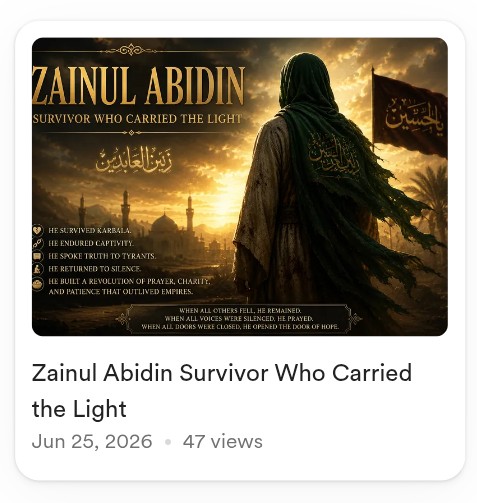
Zainul Abidin Survivor Who Carried the Light —
buymeacoffee.com/omar1800m/zainul-abidin
This is my current work. For doers—read it. Share it. Act on it.
May Allah guide us all to the truth, and may He give us the courage to carry it.
"And say: 'Truth has come, and falsehood has vanished. Indeed, falsehood is ever bound to vanish.'"
(Quran 17:81)
♥️🤲🕋♥️🕋🌹🌹🥀🤲🌹🕋♥️🤲
بِسْمِ اللهِ الرَّحْمٰنِ الرَّحِيْمِ
Dear Reader,
I have written this for one reason:
I want to preserve this history.
Not as a scholar. Not as an expert. But as a believer who cannot bear to see the truth buried any longer.
I want to preserve the honor of the Prophet Muhammad ﷺ—by preserving the honor of his family, who were betrayed, slaughtered, and silenced by those who claimed to follow him.
I have written about:
Hasan – who made peace and was poisoned.
Husayn – who refused tyranny and was martyred.
Zainab – who spoke truth in the court of the oppressor.
Zainul Abidin – who carried the light through silence and prayer.
These are not just names. They are the foundation. They are the family of the Prophet. And their story has been ignored, sanitized, and whitewashed for too long.
What I Am Asking
I am not asking you to become a historian.
I am not asking you to debate or divide.
I am asking you to read.
I am asking you to remember.
I am asking you to join me on this journey.
Read what I have written.
Reflect on it.
Share it with your family, your children, your community.
This is not about the past—it is about now.
Because the same love of power, the same love of money, the same love of this world that destroyed the family of the Prophet—it is still alive today.
And the only way to fight it is with truth.
A Simple Call
If you love the Prophet ﷺ, and if you love his family, then:
Read this history.
Teach it to your children.
Share it with those who have been kept in the dark.
Build something that preserves the truth—offline, in your community, in your hearts.
We do not need algorithms.
We do not need institutions.
We need humans who care.
We need you.
Mapping of the Four Offices That Built an Unbreakable —
buymeacoffee.com/omar1800m/mapping-four-offices-that-built-unbreakable
This is my current work. I have written it for you.
Please read it.
Please share it.
Please carry it forward.
Final Words
The truth is the foundation.
Everything is built on it.
Let us build together—not on bones, but on truth that will never be buried again.
"And say: 'Truth has come, and falsehood has vanished. Indeed, falsehood is ever bound to vanish.'"
(Quran 17:81)
May Allah guide us, protect us, and give us the courage to carry the light.
Āmīn. 🤲🕋
📜 Read. Remember. Share. Carry the truth forward.
This is my call. This is my work. This is my journey.
Will you join me?
♥️🤲🕋♥️🕋🌹🌹🥀🤲🌹🕋♥️🤲