

بِسْمِ اللهِ الرَّحْمٰنِ الرَّحِيْم
In the Name of God, Most Gracious, Most Merciful
♥️🤲🕋♥️🕋🌹🌹🥀🤲🌹🕋♥️🤲
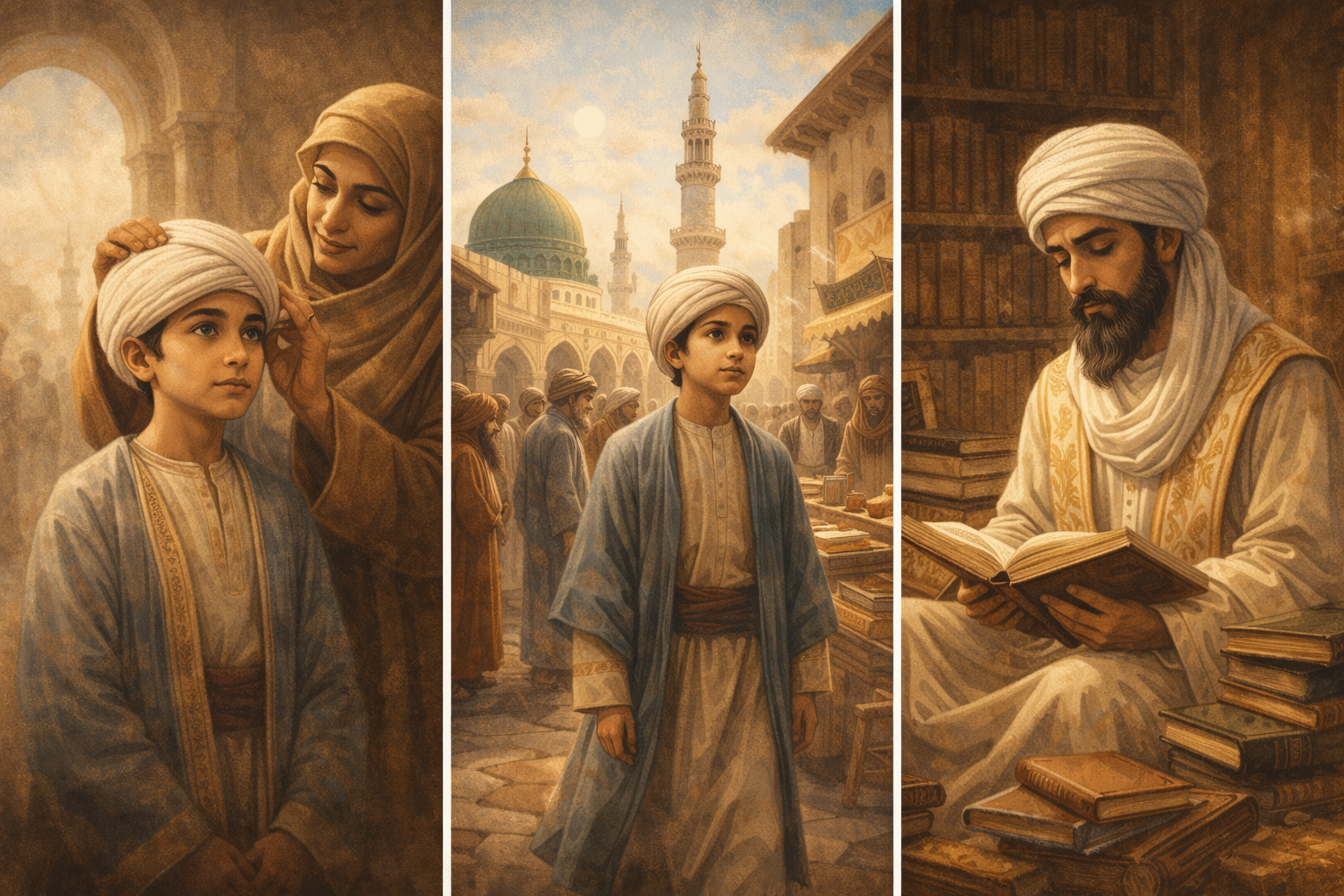
Imam Mālik ibn Anas — The Architect Who Preserved the Living Religion
I. The Tree Before the Fruit: Teachers, Education, and Formation
Imam Mālik did not emerge from bookshelves or institutions.
He emerged from Medina—the only city where the religion was still alive.
Medina in the first century was not symbolic. It was operational. The Qur’an was still heard the way it had been heard. The Sunnah was still practiced the way it had been practiced. The city itself functioned as a living archive of Prophetic behavior. Mālik’s education was not merely academic; it was environmental.
The Mother Who Set the Compass
Mālik’s mother recognized early that knowledge without character is danger. She dressed him properly, prepared him with dignity, and sent him to learn how scholars behave before learning what scholars know. This single decision shaped everything that followed.
The Teachers Who Shaped the Mind
Nāfiʿ, the freed slave of ʿAbd Allāh ibn ʿUmar, was Mālik’s most decisive teacher. Through him, Mālik inherited the Golden Chain: Mālik → Nāfiʿ → Ibn ʿUmar → the Prophet ﷺ. This was not only a chain of narration; it was a chain of embodied practice—precision, restraint, and fear of speaking without certainty.
Rabīʿah al-Raʾy taught Mālik how to reason without ego. Rabīʿah showed him that intellect must serve truth, not dominate it. Mālik learned that disagreement is not chaos—and that silence is sometimes the highest form of knowledge.
Ibn Shihāb al-Zuhrī exposed Mālik to documentation, compilation, and the risks of political proximity. From him, Mālik learned why filters matter more than volume.
Through these teachers, Mālik stood one generation away from the Companions—especially Ibn ʿUmar and ʿĀʾishah—whose caution, discipline, and refusal of power defined his moral inheritance.
Ahl al-Bayt Without Politics
Medina was also home to descendants of the Prophet’s family. Mālik honored Ahl al-Bayt not by slogans or factionalism, but by preserving the Sunnah they lived. Reports connect him to Jaʿfar al-Ṣādiq among others, but Mālik refused to turn reverence into politics. He preserved unity by preserving practice.
This is the apple and the tree: restraint, humility, and fear of Allah transmitted through living teachers.
II. Medina as Evidence: The Genius of Parallel Transmission
Most jurists studied texts as isolated data points. Mālik studied a city.
He realized something revolutionary:
a single report is serial data, but a city’s daily behavior is mass-parallel transmission. If thousands pray, trade, measure, and fast the same way—generation after generation—that practice becomes evidence stronger than any solitary narration.
This is why Mālik prioritized ʿAmal Ahl al-Madīnah (the practice of the people of Medina). It was not conservatism. It was probabilistic certainty. You can mishear a sentence; you cannot misremember a civilization.
III. Al-Muwaṭṭaʾ: Not a Book, a Filter
Mālik’s masterpiece, Al-Muwaṭṭaʾ, was refined for nearly forty years. He reportedly memorized tens of thousands of narrations but selected only a fraction—rejecting over ninety-eight percent.
Why?
Because law collapses when noise overwhelms signal.
Al-Muwaṭṭaʾ integrates:
Prophetic narrations
Companion verdicts
Tabiʿin practice
Medinan consensus
Mālik’s own restrained synthesis
It is not a collection. It is a curated system—a living operating manual designed to stabilize society.
IV. The Classroom: The Architecture of Awe
Mālik taught in the Prophet’s Mosque, but he transformed the act of teaching itself.
Before narrating Hadith, he would:
Perform ghusl
Wear his finest clothing
Apply perfume
Sit with composure and silence
This was not vanity. It was cognitive design. Mālik understood that reverence shapes memory. If knowledge is treated casually, it is absorbed casually. His classroom trained the soul before the intellect.
He forbade loud debate. He discouraged performance. And he said “I do not know” more often than he spoke.
False certainty corrupts law faster than ignorance.
V. Law That Thinks Forward: Maslahah and Sadd al-Dhara’i
Mālik did not freeze Islam in the past. He designed it for the future.
Maslahah (Public Interest): When no explicit text existed, Mālik allowed rulings that preserved the objectives of the law—life, dignity, justice—so long as no principle was violated. This gave the law an auto-update mechanism.
Sadd al-Dhara’i (Blocking the Means): If a permissible act reliably leads to harm, Mālik blocked it. He judged systems by outcomes, not appearances—anticipating downstream effects centuries before modern systems theory.
VI. The Beating That Drew the Line
When political authority attempted to coerce scholars into legitimizing forced oaths, Mālik refused. He ruled that such oaths were invalid. For this, he was publicly beaten.
He did not revolt.
He did not flatter power.
He absorbed the pain—and in doing so, drew the permanent line between religious authority and political coercion.
Later, when rulers offered to impose Al-Muwaṭṭaʾ as the single law of the empire, Mālik refused again. He understood that centralized monoculture breeds fragility. Diversity within orthodoxy is strength.
This refusal preserved Islam from becoming a state-owned ideology.
VII. Students, Legacy, and Continuity
From Mālik’s circle came giants—most famously Imam al-Shāfiʿī, who called Mālik “the star of the scholars.” Through students and institutions, the Mālikī school spread across North and West Africa and Andalusia—anchoring societies that valued continuity, public order, and ethical governance.
Today, hundreds of millions still follow his school. Not because it shouts, but because it stabilizes.
VIII. Why He Matters Now
Imam Mālik teaches us that:
Knowledge without teachers becomes arrogance
Text without living tradition becomes distortion
Scholarship without independence becomes propaganda
Silence can be more faithful than speech
He preserved the religion not by novelty, but by architecture—spaces where light could pass from heart to heart with dignity.
Conclusion: The Line That Saved the Religion
Revelation was light. Hearts were illuminated.
Mālik knew that those hearts were departing.
He did not claim prophecy.
He did not claim power.
He built structure—schools, filters, classrooms—so that light would still be recognized when it appeared.
Knowledge was never meant to live in books alone. Books humble us; teachers carry light; tradition preserves trust.
By humbling himself, Mālik became unmatched.
By refusing power, he protected the faith.
By honoring knowledge, he preserved the future.
Without him, Islam would not have vanished—but it could have fractured beyond recognition.
May Allah reward Imam Mālik, elevate his rank, bless his students, and return dignity to knowledge and its people.
Āmīn.