
:
بِسْمِ اللهِ الرَّحْمٰنِ الرَّحِيْم
In the Name of God, Most Gracious, Most Merciful.
♥️🤲🕋♥️🕋🌹🌹🥀🤲🌹🕋♥️🤲
I'll treat this as your preferred blog opening unless you ask otherwise.
The Superuser Strategy: How Indian Muslims Can Reclaim Relevance in the Modi Era
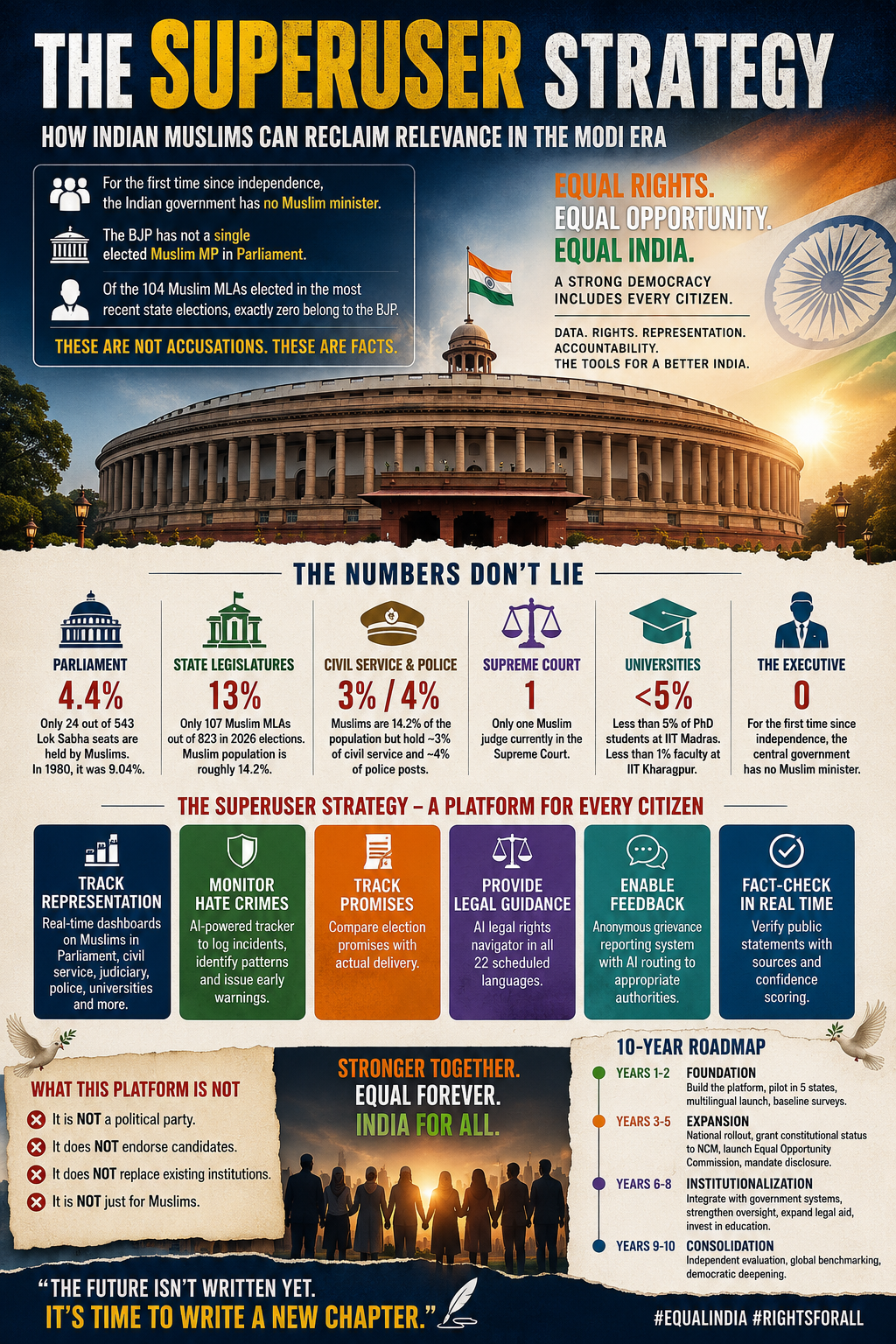
For the first time since independence, the Indian government has no Muslim minister. The Bharatiya Janata Party (BJP)—the country's largest political party—has not a single elected Muslim MP in Parliament. Of the 104 Muslim MLAs elected in the most recent round of state assembly elections, exactly zero belong to the BJP.
These are not accusations. These are facts.
And they tell a story that every Indian—Muslim, Hindu, Sikh, Christian, or otherwise—needs to understand. Because when one community is systematically pushed to the margins, the health of the entire democracy is at risk.
Part I: The Numbers Don't Lie
Let's start with the data, because data doesn't have a political agenda.
Parliament: Out of 543 Lok Sabha seats, only 24 are held by Muslims—just 4.4%. This isn't a new problem, but it's getting worse. In 1980, Muslims held 49 seats (9.04%). Today, that number has been cut in half.
State Legislatures: In the 2026 assembly elections across West Bengal, Tamil Nadu, Assam, Kerala, and Puducherry, only 107 Muslim MLAs were elected out of 823—just 13%, compared to a Muslim population of roughly 14.2%. In West Bengal, where Muslims are 27% of the population, they hold only 13.6% of assembly seats.
Civil Service: Muslims make up about 14.2% of India's population but hold roughly 3% of civil service positions and around 4% of police posts. In Maharashtra, where Muslims are 11.5% of the population, representation in government roles remains "disproportionately low."
The Supreme Court: Since the 1950s, no more than three Muslims have served as justices at any one time. Currently, there is only one.
Universities: In 2020, Muslims constituted less than 5% of PhD students at IIT Madras and less than 1% of science-teaching faculty at IIT Kharagpur. There is only one Muslim faculty member in the top four IIMs.
The Executive: For the first time since independence, the central government has no Muslim minister.
This isn't a coincidence. It's a pattern.
Part II: The Machinery of Marginalization
How did we get here? Let's trace the mechanisms.
The Citizenship Amendment Act (CAA)
The CAA, passed in 2019, provides a pathway to citizenship for non-Muslim immigrants from Afghanistan, Bangladesh, and Pakistan—but explicitly excludes Muslims. The Supreme Court has scheduled final hearings on over 250 petitions challenging the Act. But the message has already been sent: in India's citizenship framework, Muslim identity is a disqualification.
The National Register of Citizens (NRC) and Its Proxies
The NRC process in Assam excluded many Bengali-speaking Muslims due to "procedural and administrative shortcomings." The UN Committee on the Elimination of Racial Discrimination has expressed regret over what it described as a "lack" of clarification on alleged rights violations faced by this community.
Now, the government has introduced the Special Intensive Revision (SIR) process—which critics like AIMIM chief Asaduddin Owaisi have called a "backdoor NRC" designed to discriminate against Muslims.
The Demolition of Mosques
In a span of just 45 days, the BJP government demolished more than 23 mosques, religious seminaries, Eidgahs, and shrines. One historic mosque in Madhya Pradesh—the Kamal Maula Mosque—was declared a temple by a court, with Hindu extremists reportedly dancing and performing rituals inside.
Hate Speech and Violence
Following the deadly Pahalgam attack in 2025, at least 64 hate speech incidents against Muslims were reported in the first 10 days. In the first four months of 2026 alone, Hindu extremists killed 13 Muslims across eight Indian states.
A Muslim judge in Madhya Pradesh, Tabassum Khan, faced death threats and online abuse after she sentenced 14 Hindu men to life imprisonment for lynching a Muslim man. The attacks focused not on her legal reasoning but on her religion.
The Human Rights Verdict
Human Rights Watch's 2026 World Report states that "India's slide to authoritarianism under the Hindu nationalist BJP-led government continued, with increased vilification of Muslims and government critics."
The UN-linked Global Alliance of National Human Rights Institutions recommended India's National Human Rights Commission be downgraded due to political interference.
The U.S. Commission on International Religious Freedom has reported "declining religious freedom conditions in India."
Part III: The Question Every Muslim Must Ask
So what can be done?
The traditional responses—petitioning the government, hoping for judicial intervention, relying on political parties—have failed. The National Commission for Minorities is defunct. The NHRC has been downgraded. The BJP doesn't field Muslim candidates. The opposition parties treat Muslims as a "vote bank" rather than as citizens with rights.
It's time for a new strategy.
Part IV: The Superuser Strategy
Imagine a platform that does what the government won't:
1. Track representation in real time. A dashboard showing exactly how many Muslims are in Parliament, state assemblies, the civil service, the judiciary, the police, and universities. Not guesses. Data.
2. Monitor hate crimes. An AI-powered tracker that logs incidents of hate speech and violence, identifies patterns, and issues early warnings before tensions escalate.
3. Track government promises. A database comparing what was promised in elections against what was actually delivered.
4. Provide legal guidance. An AI legal rights navigator that explains constitutional rights in plain language across all 22 scheduled languages.
5. Enable citizen feedback. An anonymous reporting system for grievances, with AI routing complaints to the appropriate authorities.
6. Fact-check in real time. An engine that verifies public statements, with source attribution and confidence scoring.
What This Platform Is NOT
It is NOT a political party.
It does NOT endorse candidates.
It does NOT replace existing institutions.
It is NOT just for Muslims.
What This Platform IS
A tool for every Indian citizen—Hindu, Muslim, Sikh, Christian, Jain, Buddhist, Parsi, tribal, and non-religious.
A transparency mechanism that strengthens democracy.
An accountability system that tracks whether the government is delivering on its promises.
An early warning system for emerging threats to civil liberties.
Part V: A 10-Year Roadmap
Years 1-2: Foundation
Establish the Superuser Civic Platform as a non-profit trust
Launch pilot dashboards in five states
Build multilingual capabilities for all 22 scheduled languages
Conduct baseline surveys on representation and rights
Years 3-5: Expansion
National rollout of all platform components
Grant constitutional status to the National Commission for Minorities
Launch an Equal Opportunity Commission with enforcement powers
Mandate demographic disclosure in public institutions
Years 6-8: Institutionalization
Integrate the platform into government systems
Strengthen judicial oversight mechanisms
Expand legal aid and constitutional literacy programs
Develop educational investments in Muslim-concentrated districts
Years 9-10: Consolidation
Independent evaluation of platform impact
International benchmarking and knowledge sharing
Democratic deepening through citizen participation
Part VI: What You Can Do Today
You don't have to wait for a 10-year plan. Here's what you can do right now:
1. Demand data. Ask your local representatives for demographic data on government appointments, school admissions, and public contracts.
2. Build community networks. The platforms that protect rights are built by communities, not handed down from above.
3. Invest in education. The single biggest predictor of political representation is educational attainment. Every child in your community who stays in school is a future leader.
4. Support legal aid. Organizations that provide free legal services to marginalized communities are the first line of defense against rights violations.
5. Document everything. Record incidents. Save screenshots. Keep records. Data is power.
6. Participate in the political process. Not as a vote bank, but as an informed citizen. Ask questions. Demand answers. Hold representatives accountable.
Part VII: The Bigger Picture
This isn't just about Muslims. It's about what kind of country India wants to be.
When one community is systematically excluded from Parliament, from the civil service, from the judiciary, from universities—everyone loses. The government loses diverse perspectives. The democracy loses legitimacy. The nation loses the contributions of 200 million citizens.
India's Constitution promises equal protection under the law. It promises that no citizen shall be discriminated against on grounds of religion. These aren't just words on paper. They are the foundation of the Republic.
The question isn't whether the government will protect these rights. The question is whether citizens will demand that they be protected.
Final Thought
The marginalization of Indian Muslims didn't happen overnight. It happened over decades, through a thousand small decisions—who gets hired, who gets promoted, who gets tickets, who gets heard.
Reversing it won't happen overnight either. It will happen through a thousand small acts of resistance: a community that tracks its own representation, a citizen who demands data, a lawyer who takes on a pro bono case, a student who stays in school, a voter who refuses to be taken for granted.
The superuser strategy isn't about waiting for salvation from above. It's about building tools from below.
The data is clear. The trends are worrying. But the future isn't written yet.
It's time to write a new chapter.
This blog post is based on verified data from government sources, human rights organizations, and independent researchers. Where evidence is disputed or opinions are attributed, this has been explicitly noted. The goal is not to attack any political party or ideology, but to strengthen democracy for all Indians.