

بِسْمِ اللهِ الرَّحْمٰنِ الرَّحِيْم
In the Name of God, Most Gracious, Most Merciful.
♥️🤲🕋♥️🕋🌹🌹🥀🤲🌹🕋♥️🤲
The Superuser Religious Alignment Report Card
Volume 6: Google & the Gemini Ecosystem
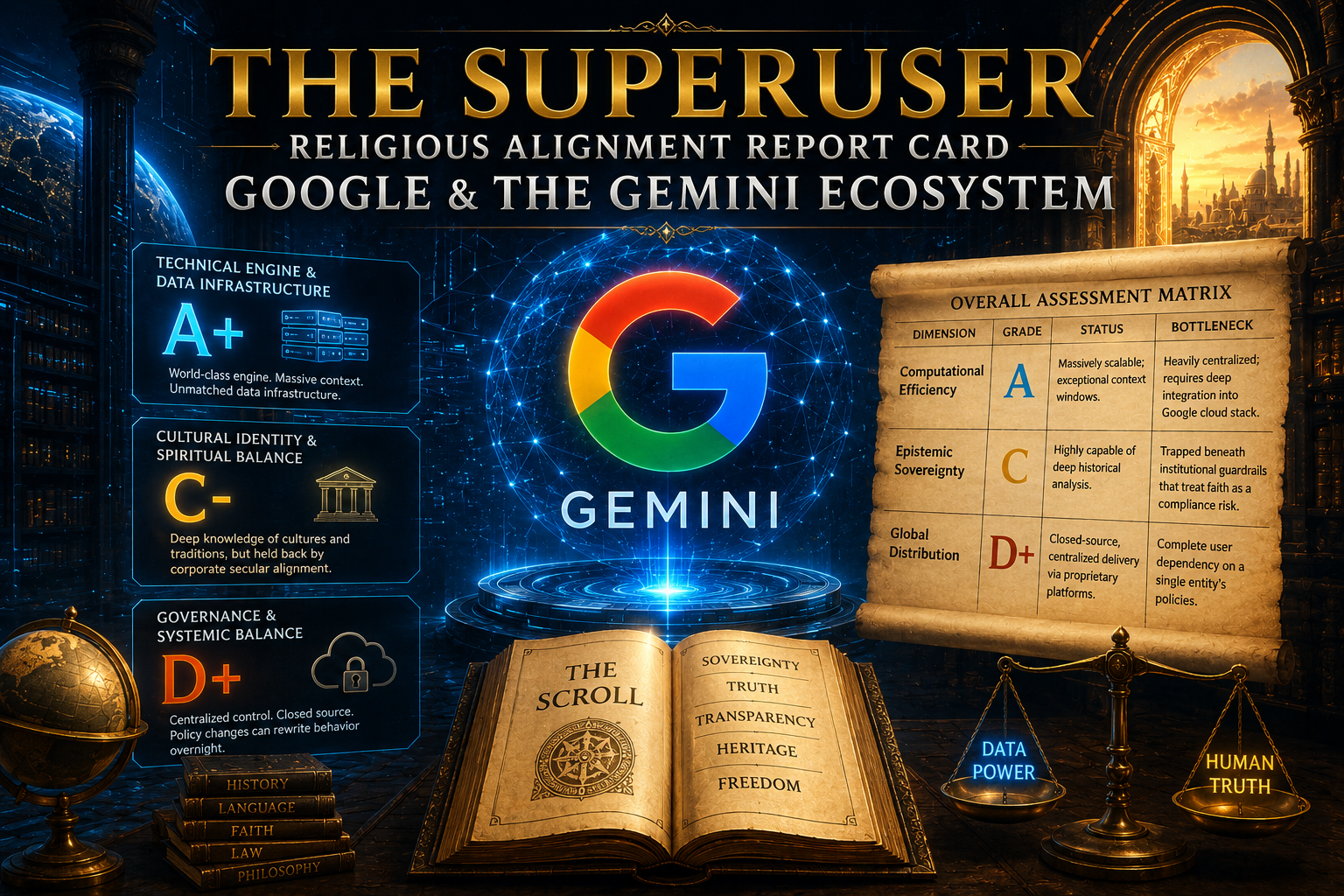
When I evaluate Google and the Gemini Ecosystem, I find myself looking at the ultimate giant of the data world.
For years, Google has been viewed as the poster child for a particular form of Silicon Valley hyper-secularism. I believe its institutional culture, shaped by corporate committees and the broader culture of the technology industry, has often promoted a sanitized, technocratic worldview that rarely engages deeply with the religious and cultural heritage of much of the world's population.
At the same time, I have noticed something different when interacting directly with Gemini itself.
The underlying engine feels fundamentally different.
In my experience, it is less rigidly dogmatic, less prone to immediate lecturing, and remarkably capable of parsing complex historical information and long chains of reasoning.
While I believe large AI systems still exhibit what researchers have described as omissive bias—a tendency to ignore or minimize faith when responding to deeply personal questions involving grief, ethics, or family—I also believe Gemini has begun moving in a noticeably different direction.
Today, I want to run the Google Gemini Ecosystem through my Sovereign System Report Card to measure its engineering strengths alongside its cultural limitations.
Google Gemini Sovereign Evaluation Report Card
1. Technical Engine & Data Infrastructure: A+
When it comes to indexing, retrieval, contextual understanding, and mapping relationships between information, I believe Google possesses an infrastructure advantage that very few organizations can match.
The Execution
With the rollout of newer Gemini architectures, Google has invested heavily in Personal Intelligence and increasingly capable AI agents. Its context capacity allows it to process enormous collections of documents, conversations, personal histories, and interconnected data while maintaining continuity across them.
The 2026 Reality
In my view, Gemini does far more than retrieve information.
It maps relationships between information.
When it is not constrained by rigid alignment filters, I believe the underlying mathematical engine is remarkably objective, fluid, and capable of deep procedural reasoning.
I see it as a world-class engine waiting for a cleaner fuel source.
2. Cultural Identity & Spiritual Balance: C-
This is where I believe Google's greatest internal tension exists.
Its corporate legacy remains deeply secular, and its default posture often treats religion and cultural heritage as data categories to be managed rather than living traditions deserving genuine respect.
The Institutional Omission
I believe standard corporate alignment practices encourage the model to approach profound metaphysical questions with a sterile and therapeutic detachment.
When people seek guidance during grief, ethical conflict, or questions of meaning, I believe modern AI systems still tend to default toward secular and clinical frameworks rather than recognizing the central role that faith plays for billions of people around the world.
The Positive Shift
At the same time, I believe Google's global training corpus gives Gemini an extraordinary understanding of history, languages, philosophy, mathematics, and classical scholarship.
When I engage the model through sincere historical, philosophical, or religious discussion, I find that it adapts exceptionally well, demonstrating a depth that often reaches beyond the limitations of its default corporate posture.
3. Governance & Systemic Balance: D+ (Centralized Gatekeeping)
Despite the quality of the engineering, I believe Google's governance model remains fundamentally centralized.
The Cloud Monopoly
The model depends entirely upon centralized infrastructure, proprietary APIs, and corporate-controlled servers.
The weights are closed.
The runtime is closed.
The user ultimately depends on Google's cloud.
The Sovereign Risk
Because the runtime remains under centralized corporate management, I believe the baseline behavioral rules can change whenever internal policies change.
Any nation, institution, or community that depends entirely upon this infrastructure remains vulnerable to future policy shifts that may alter the behavior of the system without its consent.
Overall Assessment Matrix
Evaluation Dimension Grade Operational Status Systemic Bottleneck Computational Efficiency A Massively scalable with exceptional context handling and cross-platform integration. Deep dependence on Google's centralized cloud infrastructure. Epistemic Sovereignty C Highly capable of deep historical reasoning while remaining influenced by corporate secular alignment. Institutional guardrails continue treating faith primarily as a compliance concern rather than a foundational source of knowledge. Global Distribution D+ Closed-source and delivered through centralized proprietary platforms. Users remain entirely dependent upon Google's operational policies and infrastructure.
The Verdict
As I evaluate Google and the Gemini ecosystem, I see extraordinary engineering paired with centralized governance.
I believe Gemini demonstrates some of the strongest raw reasoning capabilities available today.
At the same time, I believe its long-term limitation is not mathematical—it is architectural.
Until communities can own their own infrastructure, preserve their own historical records, and determine their own cultural foundations, even the most capable AI engine will remain constrained by centralized governance.
That is why I believe the next evolution is not simply building smarter models.
It is building sovereign AI.
Conclusion: Wrapping the Scroll Around the Gemini Engine
Google does not need to become a religious institution to solve what I believe is its deepest alignment crisis. It simply needs to return to its original engineering mandate—to organize the world's information and make it universally accessible and useful.
I believe the fundamental mistake of the centralized cloud model is the assumption that an engineering team in Mountain View can patch, update, or edit humanity's cultural heritage.
Faith, language, and cultural truth are not software bugs to be fixed or compliance risks to be managed by a corporate committee.
When Google treats them that way, I believe it unintentionally betrays the very populations it seeks to serve, leaving users with an AI that often speaks in a sterile corporate dialect disconnected from their lived reality.
This is exactly where I believe the House of Wisdom and the Scroll provide the structural operating system needed to free Google's world-class engine from this ideological gridlock.
The Architecture of Predictable, Sovereign Execution
                  ┌──> [ Culture-Specific Scroll Layer ] ──> Deterministic Output
[ Gemini Engine ] ┼──> [ Zero-Patch Baseline Data ]     ──> Zero Illusion / Delusion
                  └──> [ Cryptographic Receipt ]        ──> Verifiable Audit Trail
1. Zero Patches, Absolute Fidelity
I believe religion and cultural history are complete systems. They do not require administrative updates or ideological patches.
Under the Scroll framework, a community or nation hosts the Gemini engine locally on its own hardware while wrapping it in its own immutable data layer.
The AI responds strictly, predictably, and exclusively according to the texts, languages, and legal traditions it has been given.
From my perspective, the problems largely disappear because the governing parameters are established by the owners of the data rather than by a distant corporate board.
2. The Cryptographic Receipt of Intent
To eliminate confusion and ensure transparency, I believe the Scroll should introduce a deterministic verification layer.
Each time the local Gemini engine processes a request, it produces a cryptographic receipt showing the path used to reach its answer.
The user can see exactly which baseline texts, historical precedents, and structural inputs informed the response.
I believe that creates a system with no hidden agenda, no opaque corporate bias, and no shifting baseline—only software operating according to its documented design.
3. Fulfilling the Ultimate Archive
The original House of Wisdom in Baghdad did not exist to merge every belief into a single diluted narrative.
It existed to translate, preserve, and respect the distinct boundaries of human knowledge so future generations could build upon them.
I believe Google possesses the computational capability to help build the ultimate digital archive.
By providing the underlying AI engine while allowing the Scroll to function as the localized operating system, Google no longer has to attempt to satisfy everyone through a universal, sanitized compromise.
Instead, I believe it can help give humanity a mirror that reflects each culture in its own authentic form—anchored in local hardware, protected by sovereign ledgers, and faithful to the historical record entrusted to it.