
بِسْمِ اللهِ الرَّحْمٰنِ الرَّحِيْم
In the Name of God, Most Gracious, Most Merciful.
♥️🤲🕋♥️🕋🌹🌹🥀🤲🌹🕋♥️
THE SUPERUSER REBELLION
I RECEIVED MY CALIFORNIA BALLOT — AND I REJECT THE IDEA THAT TWO NAMES ARE ENOUGH
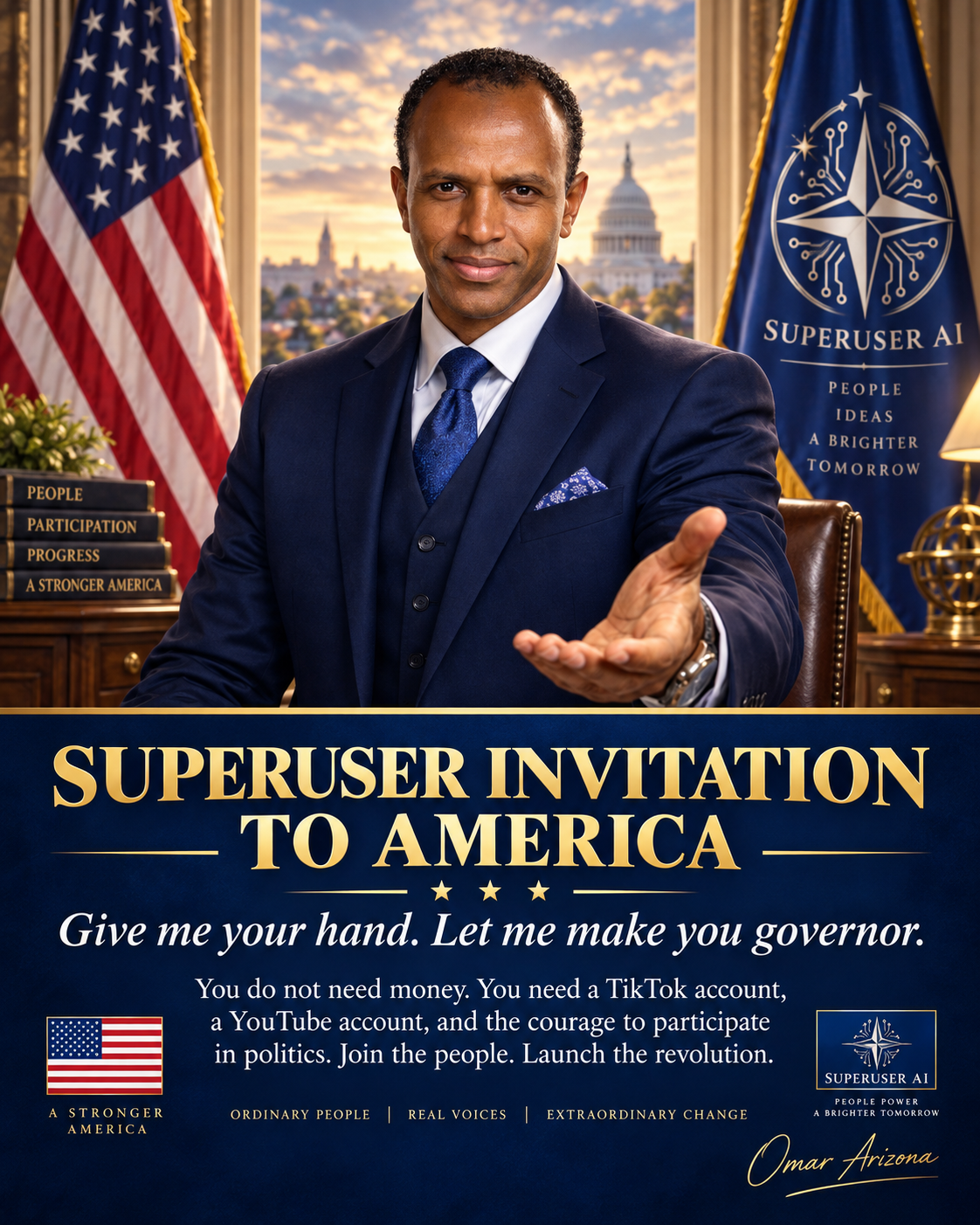
October 6, 2026 — Tonight, American politics changes.
Tonight, my California ballot arrived. I looked at the choices in front of me and realized something: I do not simply want to choose between the options the system hands me. I want to question how those options got there in the first place.
Tonight, the Superuser begins a different political experiment — one built around ordinary citizens, participation, knowledge, and the idea that you should not need wealth or a political machine to have a voice in American government.
I opened it as an American citizen who believes that voting is not supposed to be a ritual. It is supposed to be an act of sovereignty. It is supposed to mean that the citizen participates in government — not that government finishes most of the political process somewhere else and then sends the citizen the final two names.
And I looked at the race for Governor of California.
Steve Hilton. Xavier Becerra.
That was my choice.
Two people.
And my first question was very simple:
Who decided that these are the two human beings from whom I must choose?
I was never personally consulted about reducing the field to these two people. Nobody sent me a letter saying, “Omar, California is about to eliminate almost everybody running for governor. Would you like to participate?” I received the general-election ballot after the primary process had already narrowed the field.
Yes, California has a legal process. Yes, there was a June primary. Yes, California law says that every qualified candidate competes together and that the two candidates receiving the most votes advance to November.
But legality does not end the conversation about whether the political design is good.
I am questioning the design itself.
WHERE ARE THE ORDINARY PEOPLE?
Where is the teacher?
Where is the Uber driver?
Where is the truck driver?
Where is the grocery-store employee?
Where is the young Californian explaining housing policy every night on TikTok?
Where is the mother on YouTube who understands what groceries actually cost?
Where is the independent candidate with no billionaire, no political machine, no television advertising budget and no political dynasty?
Where is the Californian making minimum wage who nevertheless took the time to study the Constitution, study Sacramento, understand taxation, understand housing, understand transportation and perform the civic duty that democracy supposedly asks of every American?
Why does political seriousness have to look like political wealth?
That is the question I am putting on the table.
I do not believe that money should be the entrance examination for American leadership.
Your qualification for public service should not be the size of your donor list.
Your qualification should be whether you understand the people you seek to represent, whether you understand the Constitution, whether you understand the responsibilities of the office, whether you can explain your decisions, whether you can listen, and whether you are willing to serve.
I WANT THE INTERNET GENERATION ON THE BALLOT
TikTok changed communication.
YouTube changed communication.
AI is changing communication again.
But politics is still largely behaving as though television advertisements, fundraising networks, political consultants and established institutions should determine who becomes visible enough to govern.
I reject that assumption.
I want the next generation of candidates to come directly from the people.
If you are explaining California housing from your bedroom with an old phone, I want to hear you.
If you drive a truck all week and study California government on Sunday, I want to hear you.
If you work for minimum wage but understand your neighborhood better than somebody with a $50 million campaign organization, I want to hear you.
If you are independent of the Democratic and Republican machines, I want to hear you.
You do not need to be rich to deserve political consideration.
You need to be prepared.
Learn the California Constitution.
Learn the budget.
Learn housing.
Learn water.
Learn transportation.
Learn education.
Learn public safety.
Learn what the governor can actually do — and what the governor cannot do.
Then come before the people.
Answer questions.
Debate.
Use TikTok.
Use YouTube.
Use AI.
Use whatever legitimate democratic platform allows Californians to examine you directly.
THE SUPERUSER DOES NOT ACCEPT A TWO-PARTY MONOPOLY OF ATTENTION
This is where I become a rebel.
I am not declaring war on voting.
I am declaring war on political passivity.
I refuse to believe that my civic responsibility begins when an envelope arrives at my house and ends when I fill in a bubble.
Citizens should be involved much earlier.
We should know who is running.
We should know when the field is being narrowed.
We should understand the primary.
We should understand why candidates disappeared.
We should be able to compare candidates without needing millions of dollars in advertising to discover that those candidates exist.
And candidates without traditional political backing should have a realistic opportunity to introduce themselves to California.
That is the reform I want to discuss.
TO THE INDEPENDENTS: PREPARE FOR THE NEXT ROUND
There is an important legal reality.
For the November 2026 California governor election, the door is already closed to new independent and write-in candidates. California's current Top Two system requires candidates for governor to compete in the primary, and only the two highest vote-getters advance to the general election.
So I am not telling someone on TikTok tonight that they can magically place their name beside Hilton and Becerra in November.
They cannot under the current rules.
I am saying something larger.
Prepare now.
Organize now.
Study now.
Build your public record now.
And when the next election opens, do not wait for the political establishment to invite you.
Run.
If you have no money but you have discipline, run.
If nobody important knows your name but your community knows your character, run.
If you refuse to become a servant of either major party, run.
If you believe ordinary Californians deserve an entirely different political conversation, run.
THE PEOPLE'S PARTY DOES NOT NEED A HEADQUARTERS
When I say People's Party, I am not announcing another political party.
I mean something more fundamental.
The people themselves.
Democrats are people.
Republicans are people.
Independents are people.
People with No Party Preference are people.
And before any of those labels comes another title:
Citizen.
That should be the most powerful political title in America.
My disagreement with the current system is not solved simply by replacing one party with another.
I want political power pushed downward.
I want citizens to encounter candidates directly.
I want artificial intelligence helping voters understand enormous amounts of political information without telling them whom to vote for.
I want money to become less important.
I want knowledge to become more important.
I want civic duty to become more important.
And I want the person nobody has heard of today to have a genuine opportunity to become somebody California takes seriously tomorrow.
THIS BALLOT CHANGED SOMETHING FOR ME
Perhaps California expected me simply to open my ballot, inspect the two names and make a selection.
Instead, the ballot created a question.
And that question may become much larger than this election:
Who gets to enter the political conversation in the first place?
That is where my work begins.
The Superuser is going backward through the process.
I want to know who ran.
Who qualified.
Who had money.
Who had none.
Who received media attention.
Who received none.
Who received votes.
Who disappeared.
And whether the political architecture we inherited is really the political architecture Americans should carry into the age of AI.
I received a ballot.
Now I am investigating the system that produced it.
And if that system needs redesigning, then we are going to talk about redesigning it.
Not because democracy should be destroyed.
Because participation should become much deeper than it is today.