

بِسْمِ اللهِ الرَّحْمٰنِ الرَّحِيْم
In the Name of God, Most Gracious, Most Merciful
♥️🤲🕋♥️🕋🌹🌹🥀🤲🌹🕋♥️🤲
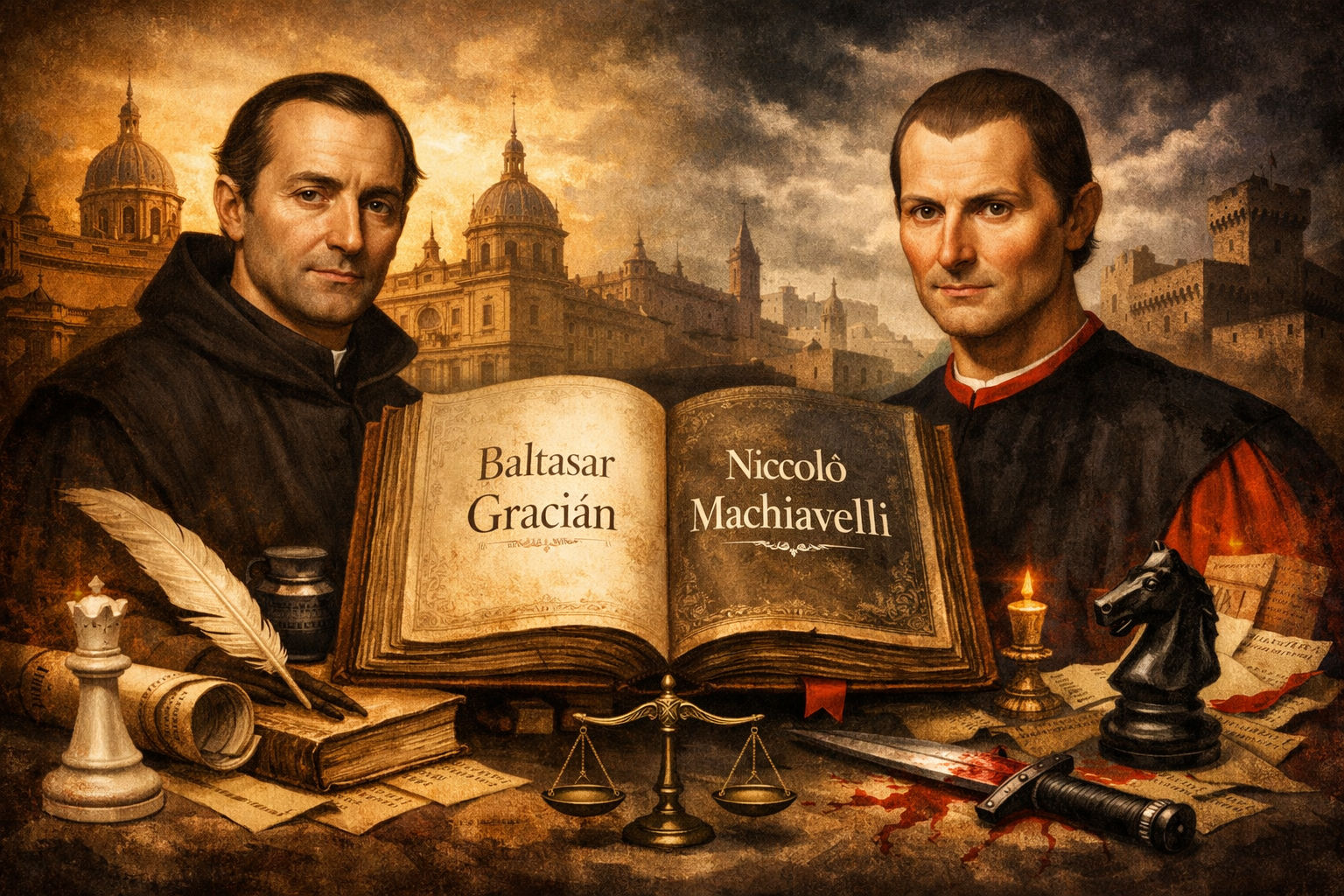
The Strategist the World Forgot: Why Baltasar Gracián Was Greater Than Machiavelli
For centuries, the world has treated Niccolò Machiavelli as the final authority on power. His name has become shorthand for “realism,” his phrases recycled endlessly in politics, business, and popular culture. To be “Machiavellian” is to be clever, ruthless, unsentimental, and sharp-eyed.
But cultural repetition is not proof of truth.
It is often the opposite.
Because when a society repeats a thinker long enough, it stops asking whether that thinker was actually right.
And this is the question almost no one asks:
If Machiavelli truly understood power,
why did his own framework fail to preserve him?
Strategic philosophy is not poetry.
It is not entertainment.
It is not clever phrasing.
It is a technology of survival.
And the first person a survival technology must protect is its inventor.
This is where Machiavelli’s legend quietly fractures.
He wrote brilliantly about rulers.
But he never became one.
He wrote about domination.
But he did not achieve it.
He wrote about control.
But he was never in control.
His work is fascinating, yes—but it is also reactive. It is the psychology of a man who lost access to power and tried to analyze it from the outside.
This does not make him evil.
But it does make him limited.
And yet, history did not give us only Machiavelli.
There was another.
A mind of far greater subtlety.
A strategist of incomparable refinement.
A philosopher whose work does not intoxicate the ego—but fortifies the soul.
His name was Baltasar Gracián.
And if you have never heard of him, that is not because he was inferior.
It is because he was dangerous.
Who Was Baltasar Gracián?
Watch "Garcian philosophy vs makaveli philosophy" on YouTube
Gracián was a 17th-century Spanish Jesuit priest, living inside one of the most competitive political environments of human history: the Spanish Golden Age. This was not a gentle world. It was a world of empires, espionage, court politics, reputation warfare, betrayal, ambition, and quiet destruction.
Jesuits were not monks in isolation.
They were intellectual commandos.
They were trained in rhetoric, psychology, philosophy, diplomacy, and strategy. Their job was not to dominate—it was to survive, influence, and outlast.
And Gracián produced one of the most extraordinary books ever written on human navigation:
The Art of Worldly Wisdom.
It is not a book of theories.
It is a book of distilled intelligence.
Three hundred maxims.
No filler.
No indulgence.
No fantasy.
Each line is an instrument.
Where Machiavelli explains, Gracián compresses.
Where Machiavelli dramatizes, Gracián sharpens.
Where Machiavelli excites, Gracián inoculates.
Gracián does not tell you how to conquer others.
He tells you how not to be conquered.
Why the Greatest Minds Admired Him
This is not a fringe opinion.
Some of the sharpest minds in history saw Gracián as unmatched.
Arthur Schopenhauer
Schopenhauer was famously pessimistic about human nature. He believed the world was driven by blind will, not reason. And yet, he called Gracián’s book a companion for life.
So impressed was he that he learned Spanish just to translate Gracián into German.
Schopenhauer said Gracián was absolutely unique.
That is not praise lightly given.
Friedrich Nietzsche
Nietzsche, who had little patience for conventional morality, admired Gracián deeply. He called The Art of Worldly Wisdom:
“Europe’s finest and most complicated book on moral subtlety.”
Nietzsche saw in Gracián something rare: a discipline of character that did not require illusion, cruelty, or fantasy.
Gracián did not teach submission.
He taught self-mastery.
Voltaire and the Enlightenment
Even Enlightenment thinkers—who despised Jesuits—could not dismiss Gracián. They recognized in him a wit and strategic clarity that anticipated modern psychological thinking.
Gracián was not medieval.
He was ahead of his time.
Machiavelli vs. Gracián: The Structural Difference
Machiavelli teaches domination.
Gracián teaches durability.
Machiavelli teaches how to rule others.
Gracián teaches how to rule yourself.
Machiavelli assumes you are the predator.
Gracián assumes the world is full of predators.
This is not a small difference.
It is the difference between offense and defense.
And defense is harder.
Because defense requires intelligence, restraint, timing, and discipline.
Machiavellianism is metabolically expensive.
It creates enemies.
It demands constant performance.
It invites retaliation.
Gracián’s system is silent.
He teaches:
• Do not show your wounds.
• Do not reveal your pulse.
• Do not exhaust your value.
• Do not advertise your interior life.
• Do not fight when you can disappear.
This is not cowardice.
This is survival.
The Superuser Conclusion: Power, Character, and the Future of Politics
Machiavelli has been sold to the world as a realist. But realism is not fantasy, and power is not theater.
The first rule of any serious philosophy is this:
If it cannot sustain its own author, it is not wisdom—it is fiction.
Machiavelli wrote about power, but he never possessed it.
He wrote about rulers, but he never became one.
He wrote about domination, but he never mastered himself.
His worldview is reactive. It is born from exclusion, resentment, and the psychology of someone looking at power from the outside. It flatters insecurity. It glorifies cruelty. It makes people feel clever for being small.
And that is why it attracts the wrong followers.
Machiavellian thinking produces fast enemies, short runs, and hollow victories. It teaches people to burn bridges before they have even crossed them. It mistakes fear for respect. It confuses attention with influence. It mistakes cruelty for intelligence.
Politics is not a sprint.
It is a marathon.
It is not about intimidation.
It is about timing.
It is not about tricking people.
It is about reputation.
And reputation is not built through fear—it is built through consistency, restraint, and self-respect.
You cannot live forever pretending to be someone you are not.
You cannot cheat everyone forever.
You cannot lie to your own conscience.
At night, your consciousness will still be there.
And above all—God is watching.
The angels are writing.
That is why Gracián matters.
Gracián does not teach you how to bully.
He does not teach you how to humiliate.
He does not teach you how to dominate.
He teaches you how not to be naive.
And that is not cruelty—that is mercy.
Because all humans begin naive.
Naivety is not a flaw—it is a starting point.
Gracián arms good people so they do not get eaten by bad systems.
He teaches silence, not lies.
He teaches reserve, not deception.
He teaches dignity, not performance.
He teaches timing, not violence.
He understands something Machiavelli never did:
Power is not the ability to harm others.
Power is the inability to be destroyed by them.
True strength is not loud.
It is unassailable.
True intelligence is not flashy.
It is durable.
This is why Machiavellian thinking repeatedly traps dictators, narcissists, and insecure climbers. It seduces them with fantasy, then abandons them to reality.
Because reality does not reward cruelty.
It rewards sustainability.
And sustainability comes from character.
If you see someone praising Machiavelli, understand what they are revealing:
They are not interested in wisdom.
They are interested in shortcuts.
They are not interested in mastery.
They are interested in dominance.
They are not interested in becoming great.
They are interested in appearing powerful.
Those paths always collapse.
Gracián’s path does not.
He does not make you a predator.
He makes you untouchable.
He does not make you feared.
He makes you respected.
He does not make you loud.
He makes you lasting.
That is the difference between theater and life.
And politics must move from theater back to life.
Watch "The Art of Worldly Wisdom by Baltasar Gracian" on YouTube
Enjoy the book
Watch "The Art of Worldly Wisdom by Baltasar Gracian [Audiobook]