

بِسْمِ اللهِ الرَّحْمٰنِ الرَّحِيْم
In the Name of God, Most Gracious, Most Merciful.
♥️🤲🕋♥️🕋🌹🌹🥀🤲🌹🕋♥️🤲
THE STRAIT OF HORMUZ — A GOLDEN OPPORTUNITY FOR THE WORLD
To the Muslim nations of the Middle East: the Strait of Hormuz does not have to remain a place where the world waits for the next crisis. It can become the birthplace of a new financial architecture. Imagine a Stability Bond funded by a small, transparent contribution associated with every participating barrel of oil. Instead of consuming that money, the region recycles it into productive global assets—U.S. Treasuries, Chinese renminbi-denominated sovereign assets, European sovereign debt, infrastructure, technology, and diversified investments. The world purchases Middle Eastern energy, and a portion of that value returns to the world as investment—but this time, the Middle East collectively owns the resulting assets.
That changes the balance. No single customer—whether China, the United States, Europe, India, or anyone else—should become so economically indispensable that its purchasing power becomes political power over producing nations. A diversified Stability Bond gives the region another answer: do business with everyone, invest across everyone, and become dangerously dependent on no one. If relationships or risks change, the portfolio can be rebalanced through transparent, predetermined financial rules rather than political retaliation. America therefore has an opportunity to demonstrate that it wants a prosperous Middle East. China has exactly the same opportunity. Neither needs to lose for the other to participate.
And that is why the Strait of Hormuz can become a golden opportunity for the world. Oil prices will rise and fall. Technology will change. AI, electric vehicles, autonomous transportation, and new energy systems will transform demand. But the prosperity of the Middle East does not have to collapse with the price of a barrel. Use today's oil to acquire tomorrow's assets. Use today's taxes and bond contributions to create tomorrow's recurring income. Use American, Chinese, European, and global markets to diversify Middle Eastern wealth. Then the Stability Bond becomes more than protection against an oil-price shock—it becomes an instrument of independence, peace, and generational prosperity.
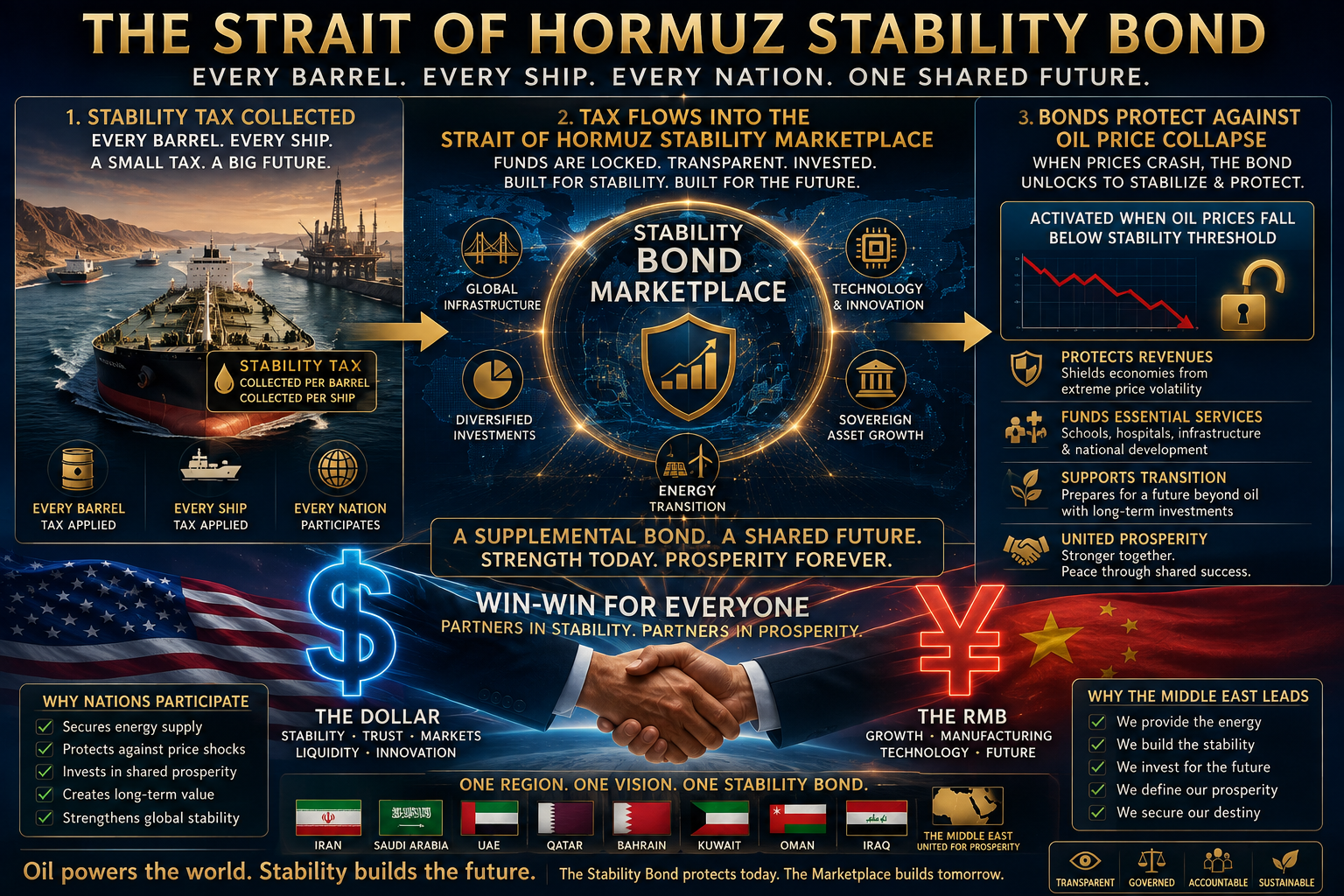
THE STABILITY BOND — THE MIDDLE EAST MUST HEDGE ITS OWN FUTURE
The principle is simple: every barrel purchased helps build the hedge against the day when that barrel is worth dramatically less. During normal and prosperous periods, a small supplemental Stability Bond obligation attached to participating oil purchases would accumulate assets rather than subsidize today's spending. When oil falls beneath an agreed regional stability threshold, portions of those accumulated assets could unlock purchasing power, investment capacity, or carefully structured leverage. Instead of every producer confronting a price collapse alone, the Middle East would possess a common financial shock absorber built during the years when the world needed its energy most.
But this cannot merely be an emergency fund against cheap oil. It must become a diversification engine. The world is entering an age of artificial intelligence, electric transportation, autonomous vehicles, extraordinary Chinese manufacturing efficiency, and technologies whose long-term effects on petroleum demand cannot be predicted with certainty. Saudi Arabia, Iran, the United Arab Emirates, Qatar, Bahrain, Kuwait, Oman, Iraq, and the other producing economies should therefore ask a historic question: How do we convert today's petroleum demand into productive assets and recurring income that remain valuable even if tomorrow's oil becomes cheap? The Stability Bond creates a marketplace through which today's finite resource can progressively purchase tomorrow's diversified wealth.
THE OBJECTIVE IS NOT TO DEFEAT MARKET FORCES. IT IS TO STOP ALLOWING A SINGLE COMMODITY PRICE TO DETERMINE THE DESTINY OF ENTIRE NATIONS.
That distinction matters. Consumers should still benefit when energy becomes cheaper. Markets should still discover prices. But a collapsing barrel should no longer automatically mean collapsing national investment, abandoned development, or declining living standards. The Middle East can use its present strategic importance to construct a financial architecture that survives changes in oil itself.
And participation should be broad. Nations purchasing substantial quantities of participating Middle Eastern oil could purchase these supplemental long-duration instruments under mutually negotiated trade arrangements. In return, they receive an investable asset and a stake in long-term stability—not ownership of Middle Eastern sovereignty. America can participate. China can participate. Europe, India, Japan, and other major consumers can participate. Nobody needs to be excluded, and nobody's purchasing power should translate into political control over the region.
THIS IS WHY THE MIDDLE EAST MUST THINK AS A STRATEGIC ECONOMIC BLOC.
Iran. Saudi Arabia. The United Arab Emirates. Qatar. Bahrain. Kuwait. Oman. Iraq.
You will continue to have different governments, different interests, and different relationships with the world. But on one question, your interests converge:
THE PROSPERITY OF YOUR CHILDREN CANNOT BE ALLOWED TO RISE AND FALL FOREVER WITH THE PRICE OF ONE BARREL.
The Strait of Hormuz gives this generation an extraordinary opportunity—not to weaponize geography, but to financialize stability itself. Build the reserve while demand is strong. Invest it aggressively but prudently across productive assets. Allow it to compound. Establish transparent rules for when stabilization capital can be released. And gradually create streams of income that have nothing to do with whether tomorrow's barrel trades at $100, $60, $40, or eventually much less.
Oil is needed today. The question is what happens when the world needs less of it tomorrow.
The answer cannot be panic.
The answer cannot be another price war.
The answer cannot be every Middle Eastern country fighting its neighbor for the remaining customer.
THE ANSWER MUST BE PREPARATION.
USE TODAY'S OIL TO BUY TOMORROW'S PROSPERITY.
USE COMPETITION TO BUILD COOPERATION.
USE THE STRAIT OF HORMUZ TO CREATE A NEW WAVE OF ECONOMIC STABILITY.
The Middle East does not need to wait for the next crisis to discover that it should have prepared for it.
Build the hedge now.
A DIRECT CALL TO IRAN — BUILD THE STABILITY BOND
To the leadership of Iran: do not allow the opportunity of a century to pass through the Strait of Hormuz unanswered. Put forward the idea of a Strait of Hormuz Stability Bond: a supplemental financial contribution associated with each participating barrel, accumulated in a transparent, professionally governed marketplace and invested for the long-term prosperity of the region. When oil prices are healthy, the capital remains invested and compounds. When extraordinary price shocks threaten producing economies, predefined stabilization mechanisms can unlock portions of that accumulated value. Every barrel sold today would therefore help build protection against the day when a barrel is suddenly worth dramatically less.
This is not about artificially dictating the world's oil price or defeating legitimate market forces. It is about ensuring that speculation, technological disruption, geopolitical shocks, or another historic collapse in energy prices cannot determine the destiny of hundreds of millions of people. The world depends upon reliable energy; producers depend upon sustainable revenues. Major consuming nations can contribute to the stability architecture from which they themselves benefit. The resulting marketplace can diversify into productive global assets, so eventually the Middle East possesses recurring sources of wealth that do not depend exclusively upon selling another barrel of crude.
And Iran should resist the false choice between the dollar and the renminbi. Choose neither camp—choose prosperity. America can participate. China can participate. Europe, India, Japan, and others can participate. But the institution itself should exist for the long-term economic resilience of Iran, Saudi Arabia, the UAE, Qatar, Bahrain, Kuwait, Oman, Iraq, and the wider Middle East. The financial transformations of the 1970s showed that energy crises can produce institutions lasting generations. Now build the next one: use today's oil to finance tomorrow's independence, turn the Strait of Hormuz into an engine of shared prosperity, and make certain that the price of a barrel never again gets to decide whether the Middle East has peace, development, or a future.
IRAN, PUT THE IDEA ON THE TABLE.
LET THE STRAIT BUILD THE BOND.
LET THE BOND BUILD THE MARKET.
AND LET THE MARKET HELP BUILD A MIDDLE EAST WHOSE PROSPERITY CAN OUTLIVE OIL.
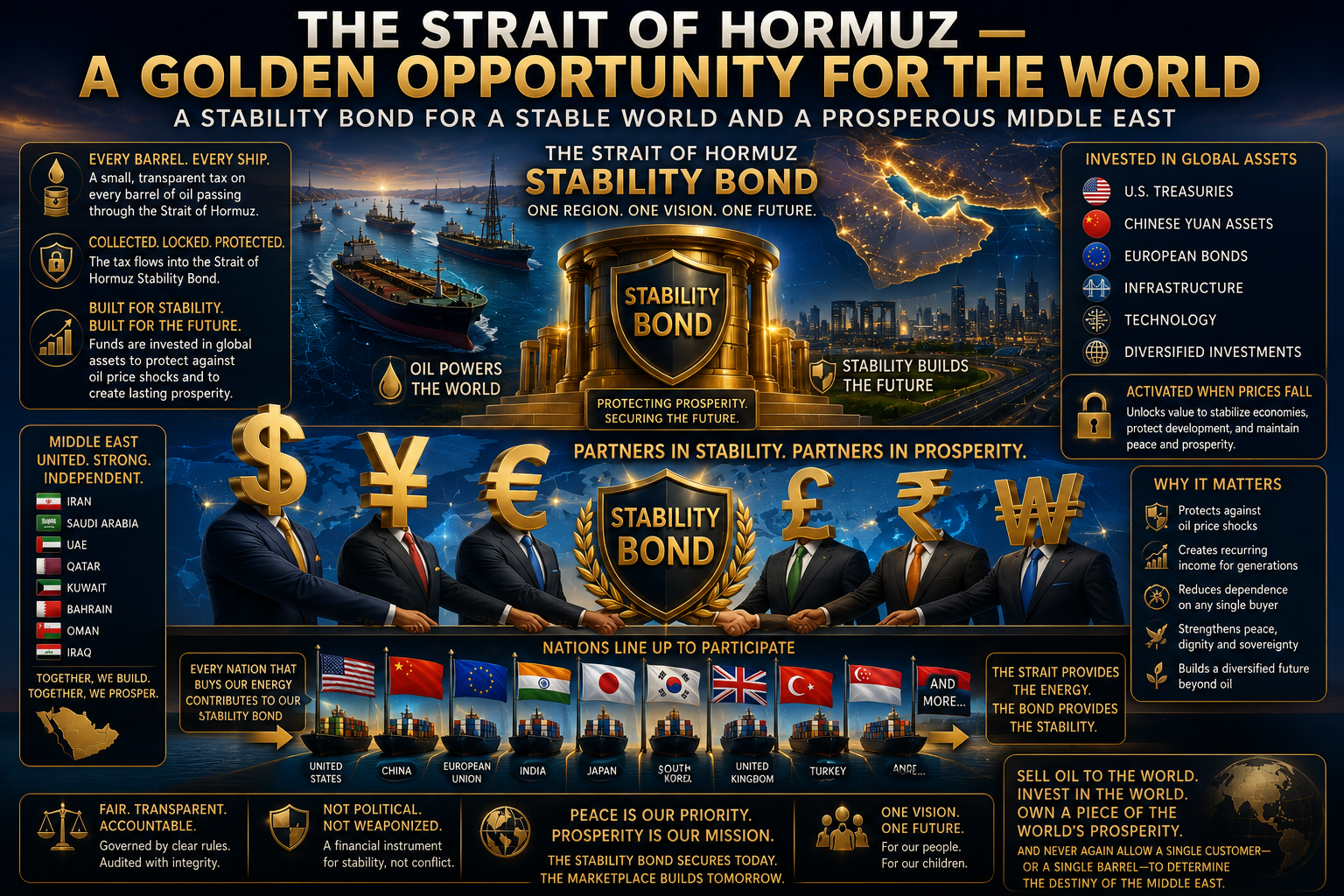
CONCLUSION — THE STRAIT OF HORMUZ: A GOLDEN OPPORTUNITY FOR THE WORLD
To the Muslim nations of the Middle East: the Strait of Hormuz does not have to remain a place where the world waits for the next crisis. It can become the birthplace of a new financial architecture.
Imagine a Stability Bond funded by a small, transparent contribution associated with every participating barrel of oil. Instead of consuming that money, the region recycles it into productive global assets—U.S. Treasuries, Chinese renminbi-denominated sovereign assets, European sovereign debt, infrastructure, technology, and diversified investments.
The world purchases Middle Eastern energy, and a portion of that value returns to the world as investment—but this time:
THE MIDDLE EAST COLLECTIVELY OWNS THE RESULTING ASSETS.
That changes the balance.
No single customer—whether China, the United States, Europe, India, or anyone else—should become so economically indispensable that its purchasing power becomes political power over producing nations.
A diversified Stability Bond gives the region another answer:
DO BUSINESS WITH EVERYONE.
INVEST ACROSS EVERYONE.
BECOME DANGEROUSLY DEPENDENT ON NO ONE.
If relationships or risks change, the portfolio can be rebalanced through transparent, predetermined financial rules rather than political retaliation.
America therefore has an opportunity to demonstrate that it wants a prosperous Middle East.
China has exactly the same opportunity.
Europe, India, Japan, and the rest of the consuming world can participate as well.
NEITHER AMERICA NOR CHINA NEEDS TO LOSE FOR THE OTHER TO PARTICIPATE.
This is not about choosing the dollar over the renminbi, or the renminbi over the dollar.
CHOOSE PROSPERITY.
CHOOSE DIVERSIFICATION.
CHOOSE INDEPENDENCE.
CHOOSE THE MIDDLE EAST.
And that is why the Strait of Hormuz can become a golden opportunity for the world.
Oil prices will rise and fall.
Technology will change.
Artificial intelligence, electric vehicles, autonomous transportation, new energy systems, and extraordinary improvements in efficiency will transform global demand.
But the prosperity of the Middle East does not have to collapse with the price of a barrel.
When oil prices are strong, build the reserve.
When the world purchases another barrel, build the reserve.
When the reserve earns returns, reinvest them.
When extraordinary price shocks arrive, activate the stabilization mechanism.
And across generations, progressively transform finite petroleum income into diversified, productive, recurring wealth.
That is the larger purpose of the Stability Bond.
It is not simply an emergency account.
It is not simply another tax.
It is not simply another sovereign wealth fund.
IT IS A BRIDGE BETWEEN THE OIL ECONOMY OF TODAY AND THE DIVERSIFIED MIDDLE EASTERN ECONOMY OF TOMORROW.
Use today's oil to acquire tomorrow's assets.
Use today's bond contributions to create tomorrow's recurring income.
Use American, Chinese, European, Asian, and global markets to diversify Middle Eastern wealth.
Let Saudi Arabia prosper.
Let Iran prosper.
Let the UAE prosper.
Let Qatar prosper.
Let Kuwait prosper.
Let Bahrain prosper.
Let Oman prosper.
Let Iraq prosper.
And let these nations discover that protecting one another from catastrophic economic instability can be more valuable than competing against one another for the next barrel sold.
THE STRAIT DOES NOT HAVE TO BECOME A WEAPON.
THE STRAIT CAN BECOME AN ASSET.
THE BOND DOES NOT HAVE TO DIVIDE THE WORLD.
THE BOND CAN GIVE THE WORLD A SHARED INTEREST IN STABILITY.
America can participate.
China can participate.
The entire world can participate.
But the purpose must remain clear:
PEACE.
STABILITY.
INDEPENDENCE.
GENERATIONAL PROSPERITY.
And ultimately, the principle can be expressed in four sentences: