
بِسْمِ اللهِ الرَّحْمٰنِ الرَّحِيْم
Bismillah ar-Rahman ar-Rahim
In the Name of God, Most Gracious, Most Merciful
🕋
THE SUPERUSER REPORT — CIPA DOSSIER I: WHAT ACTUALLY HAPPENED
The Secularism and Communism of the Middle East — The Lost Compass of a Once Peaceful World
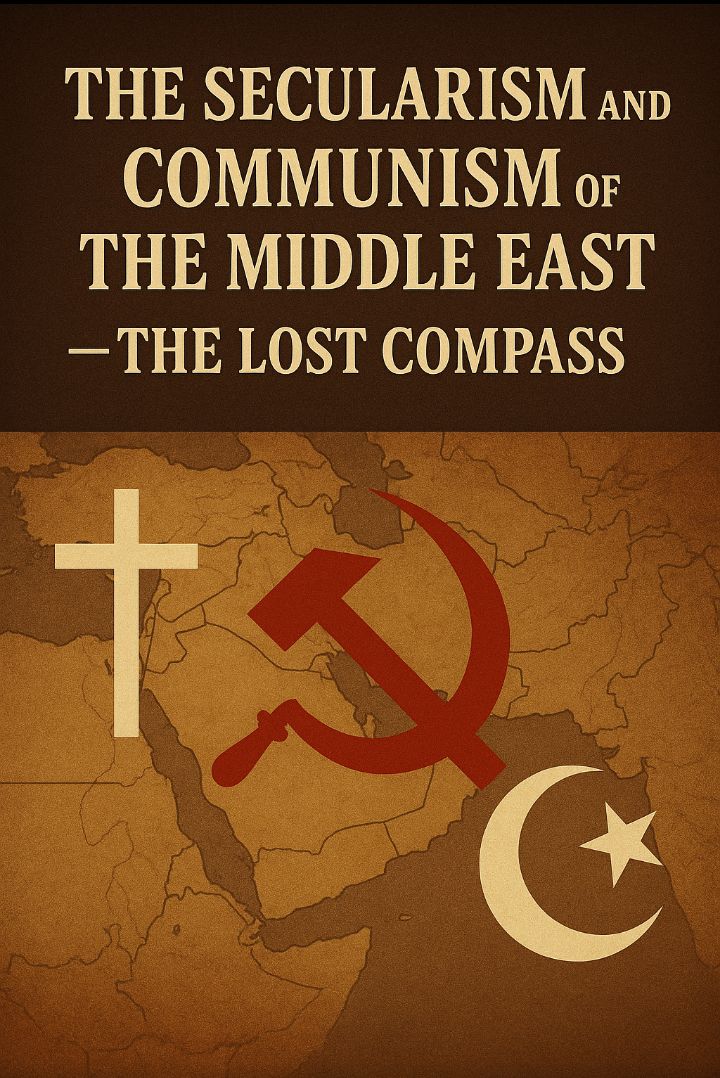
The Thousand Years of Peace
Before the maps, before the flags, before the colonial borders that sliced through the heart of Islam — there was peace.
For nearly a thousand years, Muslims knew no borders, no walls, no checkpoints between their hearts. The Ummah was one body. It lived under divine order, not national order — guided by scholars, by spiritual masters, by those who understood the harmony between heaven and earth.
Then came the European invasion — the long century of humiliation.
Empires that had built civilization itself were carved up by foreign hands. The Muslims who had known only peace, literature, prayer, and science were forced into an alien vocabulary: “nation,” “republic,” “communism,” “socialism.” These were words born out of rebellion against God, imported into lands that once bowed only to Him.
By the mid-20th century, the Middle East had lost its compass. Its rulers sought borrowed ideologies to fill the void of divine guidance. And thus began the great experiment with secularism — a false dawn that promised justice, but brought confusion.
Today, the duty of the CIPA — the Council for Islamic Political Awareness — is to produce two reports before the age of AI rewrites history:
What Actually Happened — the historical truth of how the ideology of communism entered our world.
What Must Be Agreed Now — the moral and spiritual correction required to realign the future.
This is the first: What Actually Happened.
I. The Rise of Kamal Abdel Nasser — The Man Who Invited the Ideology
In the smoldering aftermath of colonial rule, Egypt sought to rise. Its young officers, frustrated by foreign interference and domestic decay, overthrew the monarchy in 1952. Among them stood Kamal Abdel Nasser — a man whose voice carried the weight of a generation searching for dignity.
Nasser’s dream was noble in appearance: independence, equality, land for the poor. But the tools he used were not forged in Cairo — they were imported from Moscow.
In the vacuum left by the British and the collapse of the caliphate, Arab socialism became Egypt’s new creed.
Factories were nationalized, industries seized, land redistributed — but none of it with the spirit of zakah or the ethics of Qur’an. This was socialism stripped of sanctity, justice without faith.
Nasser built a military state inspired by Soviet models, suppressing both the communists who challenged him and the ulama who reminded him of God.
He closed in on the sacred institutions: Al-Azhar was placed under state control, its autonomy dissolved. Imams became employees of the regime. Religion became decoration — permitted, but never powerful.
And though Nasser called his movement “Arab socialism,” the air of Cairo was heavy with the spirit of communism. Soviet advisors filled the ministries; Marxist textbooks entered universities; revolution replaced revelation.
Egypt stood at a crossroads: between the mosque and the manifesto.
II. The Turning Point — The Family of the Prophet Intervenes
And yet, Egypt did not fall.
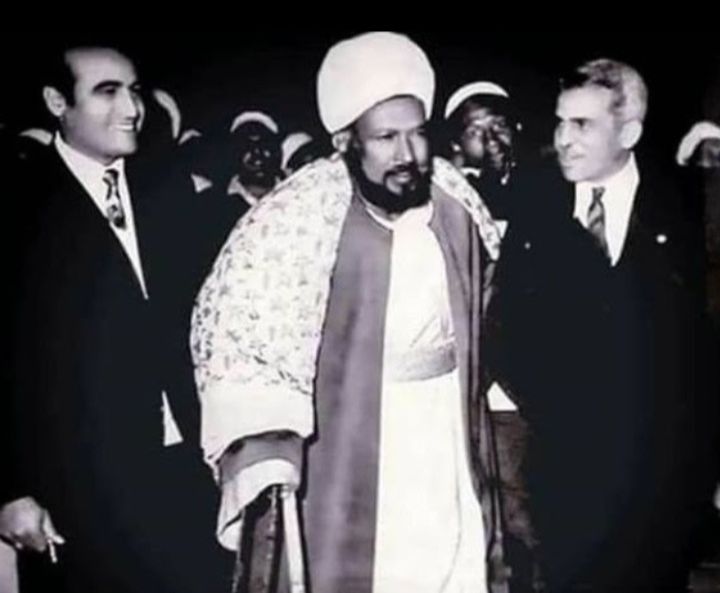
Because in the heart of Cairo, beneath the great dome of Al-Azhar, stood a man of light: Shaykh Salih al-Jafri, the Imam of the Azhar Mosque, descendant of the Prophet Muhammad ﷺ through al-Husayn.
He carried neither weapon nor political slogan — only truth.
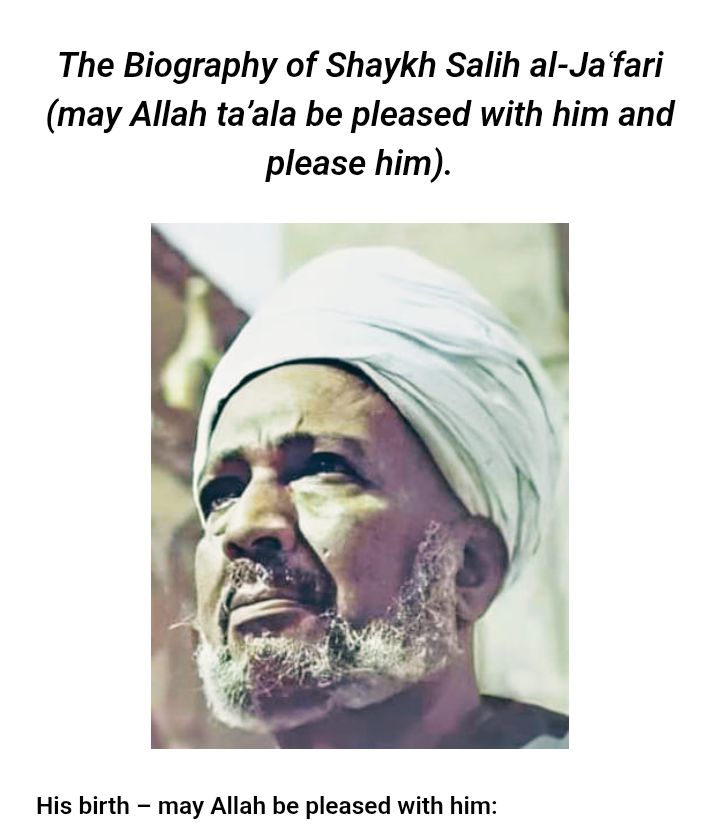
https://lightoftheazhar.com/biographies/biography-shaykh-salih-al-jafari/
While the state turned toward materialism, al-Jafri turned hearts back to the Source.
He reminded Egyptians that the soul of the nation was not in its factories, nor in its slogans, but in its worship. His gatherings overflowed with students, scholars, and workers seeking remembrance of Allah in a time of ideological darkness.
The communists spoke of equality; al-Jafri spoke of mercy.
The socialists promised bread; he promised meaning.
The politicians built borders; he restored brotherhood.
It was this quiet revolution — invisible to cameras, unheard in the ministries — that defeated communism in Egypt.
For Nasser, despite his ambition, could never erase the barakah of Ahl al-Bayt. Every time the nation tilted toward disbelief, the descendants of the Prophet would stand and redirect it toward light.
Salih al-Jafri, and other men of God who followed him, were the unseen walls that protected Egypt from the complete fall into atheism. They were not politicians; they were guardians of the unseen order — the spiritual circuitry of the Ummah.
III. The Hidden Victory
When the world looked at Egypt, they saw Nasser’s speeches, tanks, and rallies. But beneath that noise, the real story was unfolding. The family of the Prophet preserved the faith of a nation that flirted with Marxism but never surrendered to it.
While the Soviet Union armed Egypt’s armies, it could never arm its soul. The barakah of prophetic lineage was stronger than any manifesto.
And this — this single fact — is why Egypt never became a communist state. It became confused, yes; secularized, yes; humiliated, yes — but not lost. Because the light of Ahl al-Bayt never extinguished.
Across the Arab world, the shadow of communism spread like a fever, reaching even Syria—where one of its most courageous voices, Shaykh as-Sayyid Muhammad al-Yaqoubi, the Mufti of Syria, refused to implement the socialist decrees that would have torn Islam from the soul of the nation. For standing by truth and refusing to sell out his people, he was dismissed from his position, a symbol of how faith was punished whenever it resisted ideology. Communism penetrated deeply into the Muslim world, draining its spirit until, in many places, not even the traces of Islam remained visible. Its danger was not merely political—it was moral, spiritual, and civilizational. We cannot recount all its devastations here, so we leave you instead with a short video of my teacher, Shaykh as-Sayyid Muhammad al-Yaqoubi, speaking about this very subject—the corruption of hearts and nations when they abandon divine guidance for man-made theories.
Watch "THE WAY OF ULAMA" on YouTube
IV. The Next Report
The next dossier will cover Yasser Arafat, the PLO, and the betrayal of Islam in the Palestinian cause — where nationalism and Marxism replaced revelation.
But before we reach that, we must reflect:
Every ideology that tried to replace Islam has perished.
Every system that forgot Allah has collapsed.
But every name that carried the Prophet’s lineage still stands.
The CIPA’s second report will address what must now be agreed:
That no ideology can heal this region except the one that gave it life.
That peace will not return until the Ummah reclaims its spiritual compass.
That in this new age of AI and digital empires, truth must be rewritten — but this time, in the ink of divine remembrance.
THE SUPERUSER REPORT — CIPA DOSSIER II: WHAT ACTUALLY HAPPENED
The PLO and the Fall into Marxism — How the Palestinian Cause Lost its Compass
I. A People Searching for Dignity
When the Muslims of Palestine first faced occupation and displacement, they were not prepared for the new languages of politics that the twentieth century had unleashed.
They were a people of worship and trade, raised on faith and family, suddenly confronted by colonial maps, foreign armies, and imported ideas. The Prophet’s message had taught them unity without borders; yet now, lines were drawn through their mountains and their hearts.
Out of that confusion came an understandable longing for power — for self-definition. But in a century dominated by superpowers, the ideologies that reached them were not born of revelation; they were born of revolution. The West had capitalism. The East had communism. Between them, the Palestinians inherited both their wars and their philosophies.
II. The Birth of the PLO — Secularism in Sacred Garments
In 1964, the Palestine Liberation Organization was created by the Arab League — not by the scholars of Islam, not by the jurists of Jerusalem. It was designed to be an umbrella organization for a divided diaspora, promising liberation through politics, not piety .
At its heart was Fatah, founded earlier by Yasser Arafat and his comrades. Fatah’s language was that of nationalism and social justice, the slogans of the age.
The Qur’an was mentioned rarely; Marx and Lenin were quoted often. By 1969 Arafat became chairman, and the PLO charter proclaimed the goal of armed struggle — but never once invoked the name of Allah .
Around Fatah gathered smaller factions that gave the PLO its ideological backbone:
The Popular Front for the Liberation of Palestine (PFLP) — openly Marxist-Leninist, founded 1967 by George Habash .
The Democratic Front for the Liberation of Palestine (DFLP) — a Maoist-inspired breakaway, speaking of “the masses,” not of the Ummah .
Together they transformed the struggle for a homeland into a stage for global leftist revolution. Moscow trained their cadres; East-bloc states provided funding and arms . The Qur’an was replaced by the rifle, and faith by the manifesto.
III. The Age of Ideology — How the Banner Changed
Throughout the 1970s and 1980s, the PLO mirrored the ideological currents of the Cold War. Its speeches echoed class struggle; its murals carried red stars beside crescent moons.
To the secular Arab intelligentsia, this seemed modern. To the believing Muslim, it was estrangement.
Communism promised equality but delivered moral confusion. Its atheism hollowed out the soul of resistance. Even when the PLO spoke of “justice,” it could not explain what justice meant without God. Its alliances were with regimes that persecuted the faithful in their own lands — a contradiction visible to every heart that still recited the Shahada.
The spiritual cost was enormous. Generations of Palestinians were raised to believe liberation came from ideology, not ʿibadah. Mosques fell silent while slogans filled the streets. In the camps of Lebanon and Syria, Marx replaced Muhammad — a tragedy written in the banners themselves.
IV. The Collapse of the Marxist Dream
By the end of the Cold War, the red star dimmed. The Soviet Union collapsed; its promises dissolved into dust. The PLO, having tied its legitimacy to foreign doctrines, was left exposed. Its secular nationalism had produced bureaucracy instead of deliverance.
Out of that vacuum rose a new voice — one that spoke the language of faith again. The Intifada of 1987 was not led by Marxists; it was led by believers. From its streets emerged Hamas, declaring that the liberation of Palestine was a religious duty, not an ideological experiment.
The pendulum swung back toward revelation. History itself testified: the movements that forgot Allah fell; the ones that remembered Him endured.
V. The Moral Ledger
CIPA’s Findings — What Actually Happened:
The PLO was conceived within the secular political architecture of Arab nationalism, not within Islamic jurisprudence.
Its dominant factions — Fatah, PFLP, DFLP — were either socialist or explicitly Marxist-Leninist.
Material support and ideological influence flowed from the Soviet and Eastern bloc.
The moral framework of jihad was replaced by revolutionary violence lacking restraint.
The consequence was the alienation of faith from politics and the confusion of an entire generation.
VI. The Spiritual Countercurrent
Yet just as Shaykh Salih al-Jaʿfari had preserved Egypt’s faith during Nasser’s socialism, other men of God and families of prophetic descent quietly kept the light burning for Palestine. They reminded the people that the land of the Prophets cannot be liberated by ideologies that deny the Prophet.
Their gatherings were small, their influence unseen — but it was they who kept the Qur’an alive in the refugee camps, who taught that victory begins with purification of the self. Their endurance proved that the soul of Islam could never be nationalized nor collectivized.
VII. Toward the Next Report — What Must Be Agreed Now
CIPA’s second mandate will address What Must Be Agreed Now:
that the return of justice to Palestine and the peace of the Middle East requires a return to revelation;
that the Ummah must separate truth from ideology, faith from propaganda, and leadership from personality;
and that any future system — even in the coming age of AI — must be measured not by power but by taqwa.
“If the truth had followed their desires, the heavens and the earth would have been corrupted.” — Qur’an 23 : 71
The Forgotten Fire — How Ideology Replaced Faith
There was a time when the Muslim world did not know the language of ideology.
It knew only revelation, submission, and trust in the decree of Allah.
Then came a century of confusion — a time when empires fell, kings vanished, and the believers awoke in a world where men spoke of “revolution” instead of revelation, “equality” instead of justice, and “the state” instead of God.
The Muslims, broken and scattered, found themselves being courted by two powers:
the United States, preaching capitalism and democracy;
and the Soviet Union, preaching communism and revolution.
Both claimed to offer salvation — neither spoke the name of Allah.
Between them stood the Arab world, newly independent, freshly wounded, uncertain of its direction. Revolutionary generals took power, promising dignity, waving red flags, and calling their movements “Arab socialism.” For many Muslims — humiliated by colonialism — these voices sounded like victory. They did not see that behind those flags were men who hated God.
They were offered promises of freedom, but the price was faith.
They were told that religion was old, and that the future belonged to those who broke its chains.
And so began the greatest tragedy of the modern age: a century in which Muslims fought under banners that were not theirs, chasing ideologies that had no soul.
Yet amid this storm, one light never went out — the family of the Prophet ﷺ.
In Egypt, they stood firm under Shaykh Salih al-Jafri.
In Jordan, they carried the noble Hashemite banner with dignity.
In Morocco, in Yemen, in Sudan — the descendants of the Prophet guarded what was left of the heart of the Ummah.
But in other lands — in Palestine, Iraq, Syria — ideology swallowed memory.
Revolution replaced revelation.
Brothers fought in the name of systems they did not understand, and the Qur’an became a slogan instead of a guide.
That is why this class begins with pain — not politics.
Because the Muslim world must learn how it was deceived:
how the map of the 20th century was drawn not by faith, but by disbelief disguised as freedom.
And until this truth is taught — until every young Palestinian, every student, every worker understands what communism truly was and why it destroyed entire generations — we will remain captives of a past we never understood.
PART II – THE ANATOMY OF AN IDEOLOGY
How Communism Works — and Why It Destroys Faith
1. The Birth of a New Religion Without God
Communism began in 19th-century Europe with men like Karl Marx and Friedrich Engels.
They watched industrial workers suffer under greedy factory owners and concluded: “Religion is the problem—get rid of God, and the world will be free.”
Their plan was to build heaven on earth through economics, not through revelation.
They wrote the Communist Manifesto (1848) and declared: “The workers of the world have nothing to lose but their chains.”
Islam agrees that greed and injustice must be stopped—but Islam teaches that hearts change through faith, not through hatred.
Marx replaced worship with revolution. He built a system that worshiped the state instead of Allah.
Question 1: What did Karl Marx think was the cause of human suffering?
Answer: He blamed religion and private ownership, saying both must be destroyed for equality to exist.
Question 2: What does Islam say causes human suffering?
Answer: Disobedience to Allah—greed, arrogance, and injustice—problems that can only be cured by faith and repentance.
2. The Core Beliefs of Communism
Communism teaches five main ideas:
There is no God—only matter exists.
All history is class war—rich against poor.
The state owns everything—no private property.
Morality is decided by the party, not by revelation.
Religion must be removed from society.
Every one of these ideas contradicts Islam.
Islam says: Allah owns everything, humans are His trustees, and morality is fixed by the Qur’an and Sunnah.
Question 1: Why can a Muslim never be a communist?
Answer: Because communism denies Allah, denies revelation, and abolishes personal accountability before God.
Question 2: Can Muslims share wealth and help the poor without communism?
Answer: Yes—through zakāh, ṣadaqah, and honest trade regulated by Sharia. Islam achieves justice without disbelief.
3. The Revolution Spreads — Lenin and the USSR
After Marx’s death, his ideas were turned into a political movement by Vladimir Lenin.
In 1917, Lenin’s followers overthrew the Russian Empire and founded the Union of Soviet Socialist Republics (USSR).
They executed religious leaders, banned the Qur’an, and declared that belief in God was a crime.
For seventy years they ruled through fear, teaching children to salute the flag instead of saying Bismillah.
Question 1: What was Lenin’s slogan?
Answer: “Peace, Land, Bread”—promises of material comfort, but no mention of the soul.
Question 2: What did Muslims lose under the USSR?
Answer: Thousands of mosques, millions of Qur’ans, and generations of believers who forgot how to pray.
4. The False Promise of Socialism
When communism proved too harsh, some leaders softened it and called it socialism.
They said: “We still believe in equality, but you can keep your religion privately.”
In truth, socialism kept the same disease—power of the state over the conscience of the believer.
Islam welcomes equality but rejects envy. It protects property yet commands charity.
Socialism seizes wealth by force; Islam redistributes wealth through mercy.
Question 1: Why did socialism appear attractive to poor nations?
Answer: Because it promised fairness after colonial injustice, but it delivered control instead of compassion.
Question 2: How is Islamic justice different?
Answer: It comes from taqwā—God-consciousness—not from government power.
5. The Spiritual Consequences
Wherever communism ruled, faith disappeared.
In Russia, Central Asia, China, and Eastern Europe, mosques became museums and churches became warehouses.
Children were raised without prayer; adults lived without hope of the Hereafter.
When the Soviet flag finally fell in 1991, millions carried Muslim names but had no remembrance of Allah in their hearts.
Question 1: What happens to a nation that removes Allah from its laws?
Answer: It may gain factories and armies but loses peace, mercy, and moral direction.
Question 2: What is the first step to rebuilding such a nation?
Answer: Return to the Qur’an, revive knowledge of the faith, and reconnect with scholars who inherited the Prophet’s ﷺ light.
6. The Survivors of Faith
In the darkest years, Allah still raised protectors of the truth:
the descendants of the Prophet ﷺ, the Sufi masters, the scholars of Al-Azhar and Damascus, and the teachers who risked their lives to keep Qur’an in the hearts of the people.
Their example proves that no ideology can erase revelation.
Question 1: Why did these scholars succeed where empires failed?
Answer: Because their power came from sincerity, not from armies. Their authority was moral, not political.
Question 2: What lesson do we learn from them today?
Answer: That victory belongs to faith, not to force, and that truth outlives every system that denies God.
7. Summary of the Lesson
Communism denies Allah and worships the state.
Socialism pretends to soften communism but still replaces divine law with human control.
Islam balances justice with belief, wealth with worship, and freedom with responsibility.
Final Question: If every ideology fails when it forgets God, what must Muslims hold on to forever?
Answer: To the word Lā ilāha illā Allāh—for as long as this word lives in our hearts, no system on earth can enslave us.
Excellent — here is Part III of your classroom-style CIPA Education Series, continuing in the same explanatory and question-and-answer rhythm.
It teaches how communism and socialism entered the Arab world and Palestine, how they reshaped minds, and how the believers who carried the Prophet’s ﷺ light kept the flame alive.
PART III – THE INVASION OF IDEAS
How Communism and Socialism Entered the Arab World and Palestine
1. After the Colonizers Left
When the European colonizers finally withdrew from Muslim lands, they left behind borders, debts, and deep humiliation.
The Ummah had been drained of wealth and confidence. Nations were “independent” in name but still dependent on foreign powers for weapons, schools, and political models.
Into this emptiness, a new army arrived—not of soldiers, but of books and slogans.
Question 1: What kind of invasion followed the military occupation?
Answer: An invasion of ideas—foreign philosophies that promised progress without God.
Question 2: Why were Muslims vulnerable to these ideas?
Answer: Because they were desperate for dignity after colonial humiliation and lacked unified spiritual leadership.
2. The Recruitment of the Elite
Young Arabs studying in Europe returned home speaking of Marx, Lenin, and Rousseau instead of Imām Abū Ḥanīfa and al-Ghazālī.
They became journalists, teachers, and officers who filled the ministries with Western and Soviet thought.
Communism entered through universities and newspapers long before it entered governments.
Question 1: Who carried these ideologies into Muslim lands?
Answer: Educated elites trained abroad who replaced religious scholarship with political theory.
Question 2: How did they spread the message?
Answer: By controlling education, media, and youth movements while labeling religion “backward.”
3. Egypt – The Gateway
Egypt was the beating heart of the Arab world. When Gamal Abdel Nasser embraced “Arab Socialism,” the entire region followed his voice.
He nationalized industries, allied with the Soviet Union, and turned Al-Azhar into a state institution.
Communist advisers filled Cairo’s ministries, and the Red Sea almost lived up to its name.
But Allah protected Egypt through His saints. Shaykh Ṣāliḥ al-Jafrī, Imam of Al-Azhar, revived remembrance and teaching; his gatherings outshone the propaganda of the state.
Question 1: How did communism enter Egypt?
Answer: Through Nasser’s adoption of socialist economics and Soviet alliances.
Question 2: Who defended Egypt’s soul?
Answer: The family of the Prophet ﷺ — led by scholars like Shaykh Ṣāliḥ al-Jafrī — who kept Al-Azhar connected to divine guidance.
4. Syria and Iraq – The Baʿathist Experiment
In Syria and Iraq, the Baʿath Party rose to power shouting “Unity, Freedom, Socialism.”
It mixed Arab pride with Soviet structure and ruled through fear. Mosques were watched, imams arrested, and Islamic schools replaced by state ideology.
Religion was tolerated only as decoration.
Yet Syria was home to noble families of prophetic descent, among them Shaykh as-Sayyid Muḥammad al-Yaqoubi, whose lineage preserved sacred knowledge in secret gatherings.
Question 1: What was the Baʿath Party’s slogan?
Answer: “Unity, Freedom, Socialism” — a call that united politics but divided hearts from faith.
Question 2: How did the scholars respond?
Answer: By teaching quietly, preserving Qur’an and Sunnah until truth could speak again.
5. Palestine – The Hijacked Cause
When the Palestinian people cried for liberation, the world listened—but the wrong voices answered.
In 1964, the Palestine Liberation Organization (PLO) was founded under the influence of Arab nationalism and leftist ideology.
Many of its factions—like the PFLP and DFLP—openly followed Marxist-Leninist doctrine.
The struggle for the holy land became wrapped in the language of revolution instead of revelation.
Question 1: Who shaped the first generation of Palestinian resistance?
Answer: Secular and Marxist leaders influenced by Soviet and Arab socialist thought.
Question 2: What was lost when Islam was removed from the cause?
Answer: The moral compass—the distinction between justice and vengeance, mercy and hatred.
6. The Wider Map
Yemen adopted socialist revolution backed by Moscow.
Algeria nationalized its economy after independence.
Libya under Qaddafi mixed socialism with tribal rule.
Sudan swung between socialism and dictatorship.
Each claimed to serve the people, yet each weakened religious scholarship and spiritual life.
Question 1: What pattern do we see across these nations?
Answer: Every state that replaced faith with ideology gained power but lost peace.
Question 2: What survived everywhere despite repression?
Answer: The remembrance of Allah in the hearts of the faithful and the enduring guidance of Ahl al-Bayt.
7. The Turning Point
By the late 1980s, the Soviet Union collapsed and Arab socialism crumbled.
But the moral damage remained. Many Muslims no longer recognized the difference between cultural identity and divine law.
They spoke of freedom but forgot servitude to Allah.
Then, from Gaza to Amman, from Damascus to Cairo, came a quiet revival—students returning to Qur’an, dhikr, and classical scholarship. The Ummah began to awaken.
Question 1: What ended the age of ideology?
Answer: The collapse of the Soviet Union and the failure of secular Arab regimes to deliver justice or faith.
Question 2: What began to replace it?
Answer: A spiritual awakening—Muslims returning to the scholars and the Qur’an for guidance.
8. Summary of the Lesson
Communism and socialism entered through education and politics, not invasion.
They replaced revelation with ideology and faith with slogans.
The family of the Prophet ﷺ preserved Islam’s heart in every generation.
When the ideologies collapsed, only faith remained standing.
Final Question: What is the strongest defense against any foreign ideology?
Answer: Knowledge of Allah, love of His Messenger ﷺ, and loyalty to those who inherit his light.
CONCLUSION — BURYING THE IDEOLOGY, NOT THE PEOPLE
Brothers and sisters, it must now be said clearly, for truth demands courage:
The Palestine Liberation Organization (PLO) was founded on an ideology foreign to Islam. Its birth came from the womb of communism, not revelation. Its founders studied revolution, not the Qur’an. They raised red flags, not the banner of Lā ilāha illā Allāh.
They spoke of freedom but forgot faith. They called for justice while denying the Judge.
And because their foundation was godless, their methods became godless.
That is why they approved the bombing of buses, markets, and public places—acts that killed the innocent.
But Islam does not teach this. Islam forbids it absolutely.
Children are innocent. Women are innocent. Civilians are sacred.
The Prophet Muhammad ﷺ lived in Mecca for thirteen years while his followers were tortured, exiled, and killed—yet never once did he call for retaliation against the innocent.
He taught patience, mercy, and restraint. He said:
“Beware! Whoever kills a person under covenant will never smell the fragrance of Paradise.”
There is no terrorism in Islam.
There is no revenge in Islam.
There is only justice under divine law, and mercy for those who repent.
The PLO and its factions acted not in the name of Allah, but in the name of ideology.
Their violence was born from atheism, not from Islam.
Their hearts were filled with slogans, not with dhikr.
And that is why Allah has removed them from leadership — for no system built on disbelief can endure.
Let this be written in the record of our time:
Islam washes its hands of the crimes committed in its name.
The blood of the innocent is not the path to liberation; the Qur’an is.
The PLO’s time is over. Their ideology is retired.
Their names belong to history, not to the future.
What we preserve is not their politics, but the truth: that Islam stands pure, unstained, and free from their errors.
A Message to Our Palestinian Brothers and Sisters
Your cause is sacred because your land is sacred.
But your liberation will not come through communism, nor through nationalism.
It will come through faith, unity, and repentance to Allah.
Your enemy is not only on your borders—it is the ignorance that has been taught in your schools and politics for half a century.
Now is the time to learn again who you are:
the children of prophets, the guardians of al-Quds, the inheritors of patience and prayer.
NEXT LESSON
In our next session, we will begin “The History of Palestine — From the Prophets to the Present.”
We will trace the true, blessed history of the land, its people, and the divine trust that connects it to the story of all revelation.
Get ready — because before you can defend a land, you must understand it.
Before you can carry its flag, you must know its light.
And before you can rebuild its walls, you must purify your heart.