
بِسْمِ اللهِ الرَّحْمٰنِ الرَّحِيْم
In the Name of God, Most Gracious, Most Merciful.
♥️🤲🕋♥️🕋🌹🌹🥀🤲🌹🕋♥️🤲
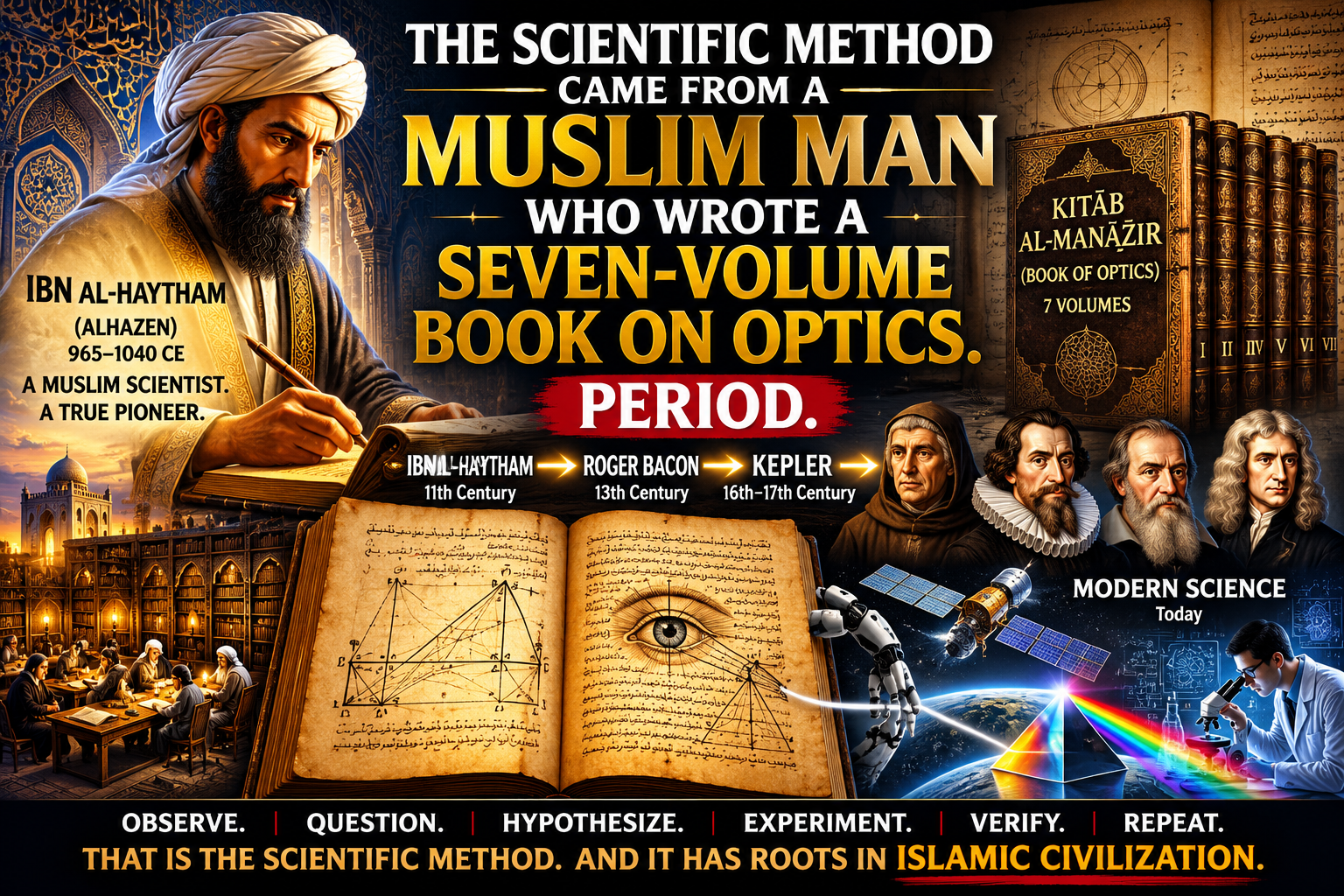
THE SCIENTIFIC METHOD CAME FROM A MUSLIM MAN WHO WROTE A SEVEN-VOLUME BOOK ON OPTICS. PERIOD.
The scientific method is one of modern civilization’s proudest achievements.
Observe. Question. Form a hypothesis. Experiment. Measure. Challenge your assumptions. Repeat the experiment. Follow the evidence wherever it leads.
Children learn versions of this process in school. Universities are organized around it. Laboratories depend upon it. Medicine, engineering, physics, astronomy and modern technology would be unimaginable without experimental science.
We celebrate the Scientific Revolution. We celebrate the Renaissance. We teach the names of Galileo, Francis Bacon, Johannes Kepler, René Descartes, Isaac Newton and the extraordinary Europeans who transformed humanity's understanding of nature.
And they deserve their places in history.
But there is another question we don't ask nearly enough:
What were they building upon?
Pull back the historical curtain far enough and you encounter an extraordinary Muslim scientist.
His name was Abū ʿAlī al-Ḥasan ibn al-Ḥasan ibn al-Haytham — الحسن بن الهيثم.
Europe would know him as Alhazen.
And approximately six centuries before Newton, this man produced one of the great scientific works of the medieval world: the seven-volume Kitāb al-Manāẓir — the Book of Optics.
HE DIDN'T JUST READ THE ANCIENTS. HE TESTED THEM.
That distinction matters.
Ancient civilizations had produced extraordinary mathematics, astronomy, medicine and natural philosophy long before Ibn al-Haytham. Greek thinkers including Aristotle, Euclid, Galen and Ptolemy left enormous intellectual inheritances.
Ibn al-Haytham inherited that world.
But inheritance did not mean obedience.
He investigated.
He questioned.
He experimented.
He combined mathematical demonstration with physical observation and controlled experimentation. He investigated light, reflection, refraction and vision. He challenged earlier theories—including the longstanding idea that sight operated through rays emitted from the eye—and developed an account in which light reaching the eye was fundamental to vision.
That intellectual posture is enormously important.
Authority could be wrong.
A famous scholar could be wrong.
An ancient book could be wrong.
And the investigator himself could be wrong.
The answer therefore had to be sought through evidence, mathematical reasoning, observation and testing.
That doesn't mean Ibn al-Haytham single-handedly invented the modern textbook scientific method exactly as we practice it today. Science developed over centuries, through many civilizations and many extraordinary minds.
But Ibn al-Haytham represents something that should completely disrupt the simplistic history many people have inherited:
Long before Europe's Scientific Revolution, sophisticated experimental science was being practiced inside Islamic civilization.
THEN THE BOOK TRAVELED
Ideas do not respect borders.
Ibn al-Haytham's optical writings eventually entered the Latin intellectual world, where Alhazen became an important authority on optics.
And this is where the story becomes magnificent.
European scholars did not simply wake up one morning during the Renaissance and invent rational inquiry from nothing.
They inherited.
They translated.
They studied.
They criticized.
They experimented.
And then they improved.
Roger Bacon, one of medieval Europe's great advocates of experimental knowledge, worked within an optical tradition profoundly influenced by Alhazen.
Centuries later, Johannes Kepler transformed the understanding of vision and optics while engaging with an intellectual inheritance in which Alhazen occupied an important position.
Then came generations of European thinkers who pushed experimental and mathematical science dramatically further.
Galileo.
Bacon.
Kepler.
Descartes.
Newton.
And countless others.
They deserve enormous credit because inheritance does not eliminate invention.
Newton inherited mathematics and astronomy and still changed physics.
Kepler inherited astronomy and still changed astronomy.
Ibn al-Haytham himself inherited Greek mathematics and optics and still transformed optics.
That is how civilization actually works.
Human beings inherit knowledge, challenge it, improve it and hand it forward.
SO WHAT WAS LOST?
Here Muslims should also confront an uncomfortable part of the story.
The tragedy isn't simply that other civilizations eventually became more famous for science.
The deeper tragedy is that much of the Muslim world ceased to occupy the scientific position it once held.
I would not say that Ibn al-Haytham was literally “lost for a thousand years.” His works survived, circulated, were copied, translated and studied; otherwise they could never have influenced later intellectual traditions.
Something more complicated happened.
The civilization that produced Ibn al-Haytham eventually stopped leading the scientific transformation that followed.
Meanwhile, Europeans took ancient Greek knowledge, knowledge transmitted and expanded through Arabic intellectual culture, and their own developing traditions—and built upon all of it.
They didn't merely preserve it.
They accelerated it.
They created institutions around it.
They corrected earlier scientists.
They developed new instruments.
They created new mathematics.
They industrialized scientific discovery.
Eventually Europe produced the Scientific Revolution and then the Industrial Revolution.
That achievement should not be diminished.
The question for Muslims should instead be:
How did a civilization capable of producing Ibn al-Haytham become a civilization in which millions of its own descendants don't even know his name?
That question matters far more than fighting over who gets to claim a trophy.
THIS IS NOT ABOUT STEALING SCIENCE BACK
I don't want to replace one historical mythology with another.
The scientific method does not belong exclusively to Muslims.
It does not belong exclusively to Europeans.
It doesn't belong exclusively to Greeks.
It belongs to humanity.
Greek civilization contributed.
Indian civilization contributed.
Persian civilization contributed.
The Islamic world contributed enormously.
European civilization contributed enormously.
Chinese civilization contributed.
And modern science has subsequently been built by people from virtually every part of Earth.
The injustice occurs when that complicated human inheritance gets reduced to:
Ancient Greece → Dark Ages → Renaissance Europe → Modern Science.
There is an enormous civilization missing from the middle of that sentence.
For centuries, scholars working in Arabic translated earlier knowledge, preserved it, criticized it and—most importantly—created new knowledge of their own.
Ibn al-Haytham is one of the clearest demonstrations of why the old “Muslims merely preserved Greek knowledge” story is inadequate.
He wasn't a librarian standing beside somebody else's civilization.
He was doing science.
AND NOW WE ARE APPROACHING AGI
This is where history suddenly becomes a question about our future.
We are entering an age in which artificial intelligence may become one of humanity's most powerful instruments for creating, organizing and transmitting knowledge.
And eventually we may enter the age of AGI.
Think about what that means.
AI systems will read our books.
They will read scientific papers.
They will consume archives.
They will reconstruct intellectual genealogies.
They may teach children.
They may become research assistants to scientists.
They may generate textbooks.
They may summarize entire civilizations in seconds.
And whatever historical record we give those systems will profoundly influence the history they give back to humanity.
That makes attribution more important, not less.
Imagine somebody makes a breakthrough today.
Another researcher improves it tomorrow.
A corporation commercializes it ten years later.
An AI system perfects it fifty years later.
And five hundred years afterward, only the corporation that commercialized the final version remains in the history books.
Something essential would have disappeared.
Not merely a name.
The chain of human contribution would have disappeared.
And if AGI eventually becomes capable of producing discoveries beyond the ability of individual human beings, preserving that chain becomes even more important.
We need machines that can say:
This person proposed it.
This civilization preserved it.
This scholar challenged it.
This scientist experimentally demonstrated it.
This generation improved it.
This institution funded it.
This engineer made it practical.
And this later generation transformed it again.
Credit isn't vanity.
Credit is metadata for civilization.
It tells future generations where ideas came from and how human knowledge actually developed.
THIS IS WHY I AM STARTING THE HOUSE OF WISDOM
This is one reason I am beginning my House of Wisdom project.
The name itself reaches deliberately toward the great intellectual tradition associated with Baghdad's Bayt al-Hikma — بيت الحكمة — the House of Wisdom.
But a modern House of Wisdom cannot simply be a museum celebrating Muslim accomplishments.
That would miss the lesson of Ibn al-Haytham completely.
The purpose should be to recover knowledge, verify it, preserve attribution, connect civilizations and then build something new upon what humanity has inherited.
If a Greek discovered something, give the Greek credit.
If an Indian mathematician discovered something, give India credit.
If a Chinese inventor created something, record it.
If a Muslim scientist transformed a field, put his name where it belongs.
If a European scientist subsequently improved it, honor that contribution too.
If an African civilization contributed knowledge that disappeared from conventional textbooks, recover it.
And when scientists working today create something that tomorrow's AI systems inherit, preserve their names as well.
Because we are not correcting history merely for the dead.
We are establishing standards for the future.
IBN AL-HAYTHAM'S STORY IS THEREFORE BIGGER THAN IBN AL-HAYTHAM
Nearly a thousand years ago, a Muslim scholar sat with questions about light and vision.
He inherited knowledge from people who lived before him.
He questioned it.
He experimented.
He reasoned mathematically.
He wrote.
His writings traveled.
Other civilizations encountered them.
Other scholars built upon them.
And humanity kept moving.
That is civilization.
Not one race.
Not one religion.
Not one country.
Not one century.
A relay race across generations.
The tragedy begins when somebody removes the names from the baton.
And as we approach artificial general intelligence, we have an opportunity to make sure that never happens again.
So let us begin by restoring one name.
IBN AL-HAYTHAM.
A Muslim scientist.
Author of the seven-volume Book of Optics.
One of the great pioneers of experimental science and one of the important ancestors of the intellectual tradition that eventually became modern scientific inquiry.
Europe did something magnificent with the inheritance it received: it built further.
Now the responsibility returns to all of us.
Don't merely demand credit for the civilization that came before you.
Become worthy of giving the next civilization something to inherit.
That is the mission.
That is why the House of Wisdom must rise again.