
بِسْمِ اللهِ الرَّحْمٰنِ الرَّحِيْم.
In the Name of God, Most Gracious, Most Merciful.
♥️🤲🕋♥️🕋🌹🌹🥀🤲🌹🕋♥️
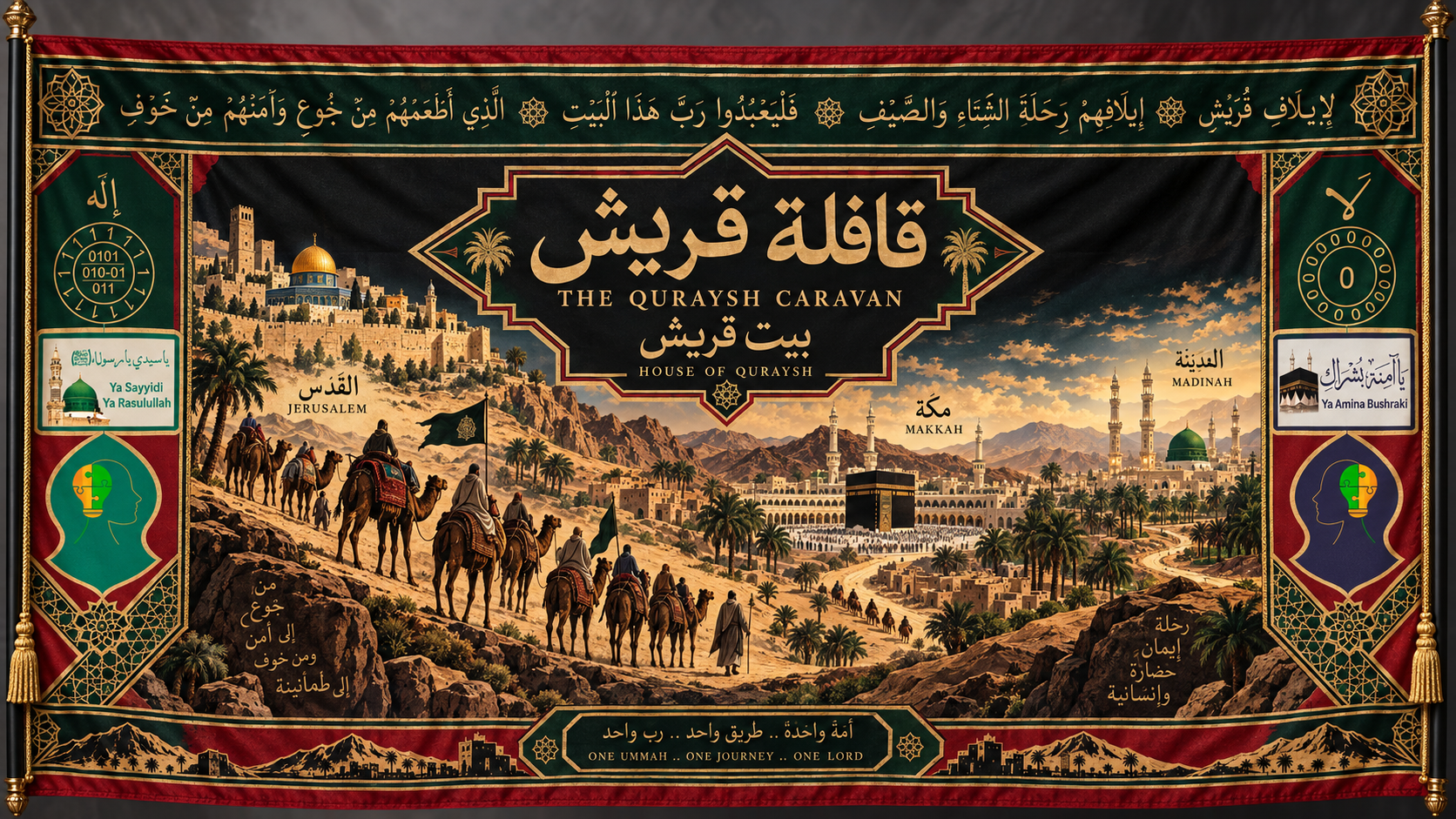
The Return of the Quraysh Caravan
The Beginning of the Offline World
There comes a point when progress itself needs a place to rest.
As artificial intelligence, automation, robotics and increasingly advanced technology become part of everyday life, the Muslim world should not only ask how far forward we can go. We should also ask what we are determined to preserve.
This is the beginning of that answer.
I am proposing the return of the Quraysh Caravan.
Not as a museum piece.
Not as historical theater.
As a living institution.
A real caravan route, traveled without modern technology, beginning from Jerusalem, moving south through the old roads of the region, passing through Makkah, and continuing to Madinah. A journey of Qur'an, memory, silence, companionship, worship, endurance and rest.
The inspiration is already in the Qur'an:
لِإِيلَافِ قُرَيْشٍ
إِيلَافِهِمْ رِحْلَةَ الشِّتَاءِ وَالصَّيْفِ
فَلْيَعْبُدُوا رَبَّ هَذَا الْبَيْتِ
الَّذِي أَطْعَمَهُمْ مِنْ جُوعٍ وَآمَنَهُمْ مِنْ خَوْفٍ
The Qur'an remembers Quraysh through movement, trade, security, the seasons, the House, food and safety.
The caravan was not only transportation.
It was civilization.
It connected people.
It moved knowledge.
It carried stories.
It created trust between distant places.
And it gave human beings time to experience the road itself.
That is what I want to bring back.
Jerusalem to Makkah to Madinah
The journey begins in Jerusalem.
Not because this is an attempt to recreate one single historical route exactly as it existed in one century, but because Jerusalem belongs to the sacred geography of the Muslim world and to the historical responsibility carried by the Hashemite house.
From Jerusalem, the caravan begins moving south.
Slowly.
No airplanes.
No high-speed trains.
No constant screens.
No notifications.
No algorithm deciding what everyone should think about along the way.
The traveler moves with the caravan.
There are camels, horses where appropriate, walking routes, traditional camps, food, water, resting stations, Qur'an circles, scholars, guides, storytellers, historians, craftsmen, physicians and people whose responsibility is simply to care for the travelers.
Then comes Makkah.
The House.
The center around which Surah Quraysh itself turns:
فَلْيَعْبُدُوا رَبَّ هَذَا الْبَيْتِ
Then the journey continues to Madinah.
The city of the Messenger of Allah ﷺ.
The destination becomes not merely a place on a map, but the completion of a journey through memory.
Jerusalem → Makkah → Madinah.
Not a race.
A pilgrimage through civilization.
No Technology
The most important rule of this caravan is simple:
The caravan is offline.
No phones in the ordinary travel experience.
No social media.
No endless cameras.
No livestreaming every moment.
No artificial intelligence accompanying every conversation.
No algorithmic recommendations.
No digital advertising.
No pressure to perform your life for strangers.
There can of course be a separate emergency and safety infrastructure operated discreetly by the organizers. A serious long-distance route must have medical communication, navigation capability, emergency evacuation and coordination available when needed.
But the traveler does not live inside that system.
The traveler lives offline.
That distinction is important.
We are not rejecting technology.
We are creating somewhere technology does not dominate the human experience.
The Beginning of the Offline Muslim World
The caravan should be the first visible institution of something much larger:
an offline world inside the modern world.
A network of places where people can choose to step away.
Villages.
Libraries.
Gardens.
Farms.
Schools.
Guesthouses.
Caravan stations.
Qur'an houses.
Traditional craft centers.
Places where electricity may exist but screens do not dominate the room.
Places where books remain books.
Where teachers sit with students.
Where children know how to make things with their hands.
Where oral history is recorded by people learning it directly from their elders.
Where manuscripts are copied, preserved and taught.
Where people can spend a week, a month, a year—or eventually retire.
Millions of people may someday want this.
Not because they hate the future.
Because they want the freedom to choose how much of the future enters their lives.
That choice should exist.
A Place to Retire From the Digital World
There should be places in the Muslim world where a person can say:
I have finished chasing the world.
Now I want to read Qur'an.
I want to pray.
I want to walk.
I want to sit with people.
I want to grow food.
I want to learn a craft.
I want to remember my grandparents.
I want to hear stories without looking at a screen.
I want to wake up without a machine immediately demanding my attention.
That person should have somewhere to go.
Today we build retirement around age.
Tomorrow we may also need to build retirement around technology.
A digital retirement.
A voluntary withdrawal from constant connectivity.
Not isolation.
Community.
Not abandonment.
Rest.
Not ignorance.
Preservation.
Preserving What We Already Have
The age of AI will generate extraordinary new things.
But it may also create a dangerous illusion: that everything old can always be reconstructed later.
That is not true.
Once a craft disappears, something disappears with it.
Once an oral tradition dies, something disappears.
Once an old route is forgotten, something disappears.
Once a language becomes something people only read on screens but no longer speak naturally in certain settings, something disappears.
Once every human activity becomes mediated by technology, we may realize too late that we forgot how to perform some of those activities without it.
So the offline world must become a preservation architecture.
We preserve:
Qur'an recitation.
Arabic calligraphy.
Manuscripts.
Traditional agriculture.
Horsemanship.
Camel travel.
Caravan knowledge.
Cooking.
Architecture.
Poetry.
Oral history.
Craftsmanship.
Hospitality.
Storytelling.
Local dialects.
Old roads.
Old songs and permissible cultural traditions.
Memory itself.
Technology can document these things.
But it should not replace the living people who carry them.
The Caravan Stations
Along the route, I imagine permanent resting places.
Simple.
Beautiful.
Built for shade, water, prayer, food and sleep.
Each station should have a small library.
A Qur'an room.
A courtyard.
A kitchen.
A place for animals.
A place where elders tell stories.
A place where historians explain the land through which the caravan is passing.
And perhaps every station preserves one particular part of civilization.
One station preserves calligraphy.
Another preserves traditional medicine and food.
Another preserves Bedouin knowledge.
Another preserves manuscripts.
Another preserves poetry.
Another preserves the history of pilgrimage.
Another preserves the history of Jerusalem.
Another preserves the history of Quraysh.
Then the traveler is not merely crossing land.
The traveler is moving through a living archive.
The Morocco and Sahara Caravan
And this should not be limited to Arabia.
The same model can begin in Morocco.
A long offline caravan through the Sahara.
Traditional routes.
Desert camps.
Old trading towns.
Libraries.
Sufi lodges where appropriate.
Craft traditions.
Berber and Arab history.
West African connections.
The great memory of trans-Saharan civilization.
Travelers could spend weeks or months moving slowly through that landscape.
No technology dominating the experience.
Just road, sky, people, animals, books, prayer, food and memory.
The Sahara itself becomes a classroom.
So we begin with more than one route.
The Quraysh Caravan.
The Sahara Caravan.
Later there can be others.
East Africa.
Central Asia.
The old Ottoman routes.
Indonesia.
The Indian Ocean.
Wherever Muslim civilization once moved slowly enough to leave memory behind, we can create a route that allows people to encounter that memory again.
AI Makes This More Necessary, Not Less
Some people may ask why we would do this precisely when artificial intelligence is becoming more powerful.
That is exactly why.
The more powerful technology becomes, the more valuable voluntary disconnection becomes.
AI may become extraordinarily useful.
AGI may eventually participate in nearly every industry and institution.
Machines may write, build, design, teach, translate, diagnose problems, operate infrastructure and help govern increasingly complicated systems.
That makes it more important—not less—to preserve places where human beings remain fully responsible for the immediate texture of life.
Cooking the food.
Leading the animal.
Reading the book.
Remembering the poem.
Teaching the child.
Repairing the wall.
Finding the road.
Reciting Qur'an.
Sitting quietly.
Technology should expand human choice.
It should not eliminate the choice to live without it.
The Right to Be Offline
Eventually, I believe we should recognize something very important:
people deserve the right to remain offline.
Not every service should require an app.
Not every payment should require a phone.
Not every identity should require constant digital authentication.
Not every child should grow up inside an algorithm.
Not every elder should have to adapt to an interface simply to participate in society.
The offline world should therefore become a protected social space.
A person should be able to live simply and still have dignity.
A person should be able to travel without broadcasting themselves.
A person should be able to disappear from the digital world for a while without disappearing from human society.
The caravan becomes the symbol of that right.
The Return
So this is what I mean when I say:
The Return of the Quraysh Caravan.
I do not mean pretending that history never changed.
I mean retrieving something history knew that we are in danger of forgetting.
Movement can be slow.
Silence can be valuable.
Memory can be carried by people.
Knowledge can live outside machines.
A journey can transform you precisely because there is nothing distracting you from it.
The Muslim world is entering the age of AI with everybody else.
We will build.
We will experiment.
We will create.
But we should also have the wisdom to establish a boundary around part of our civilization and say:
This part will remain human.
This road will remain slow.
These books will remain physical.
These stories will continue to be spoken.
These places will offer rest.
These caravans will travel.
And anyone who wants to leave the digital world for a while will know exactly where to go.
From Jerusalem.
To Makkah.
To Madinah.
Across Morocco.
Across the Sahara.
And eventually across the old roads of Muslim civilization.