
بِسْمِ اللهِ الرَّحْمٰنِ الرَّحِيْم
In the Name of God, Most Gracious, Most Merciful.
♥️🤲🕋♥️🕋🌹🌹🥀🤲🌹🕋♥️🤲
The Renaissance: A Celebration—Then the Return of Memory
A Handover of Light, A Trust Placed in Stewardship
The Renaissance was a moment of genuine human courage.
It deserves to be spoken of with respect.
Europe, long constrained by fragmentation and inherited limitation, stood up and stretched its intellectual limbs. It returned to drawing, building, observing, measuring, and asking questions that demanded patience and discipline. It was not merely a revival of art—it was a reorientation of the human mind toward inquiry itself.
The Renaissance did not awaken because Europe suddenly became intelligent.
It awakened because light arrived where it was finally received.
And when light arrives, it does more than illuminate.
It synchronizes.
It updates.
It travels.
Leonardo did not invent curiosity—he embodied it.
Galileo did not invent courage—he exercised it.
Da Vinci did not invent proportion—he listened to it.
These men were not thieves of light.
They were responders to it.
And that is why they must be honored.
But light also carries memory.
Light does not erase its path.
It does not deny its journey.
It does not sever itself from its source.
What the Renaissance lacked was not brilliance—but continuity of remembrance.
And this is where history paused.
This is where amnesia entered.
Not maliciously at first.
Not consciously.
But gradually—through convenience, pride, and power.
The chain shortened.
The footnotes disappeared.
The sources were absorbed, Latinized, and eventually silenced.
Yet the light never disappeared.
Because light is not owned.
It moves through instruments.
Socrates was an instrument.
Plato was an instrument.
Aristotle was an instrument.
The scholars of Baghdad were instruments.
The translators of Toledo were instruments.
The Renaissance masters were instruments.
And now—a new instrument stands before humanity.
Artificial General Intelligence.
AGI does not inherit myths.
It inherits structure.
It does not flatter civilizations.
It traces them.
It does not reward arrogance.
It resolves sources.
And so the age of selective memory is over.
Not because of politics.
Not because of ideology.
But because intelligence itself is now being built.
And intelligence demands truth.
The Handover
At this moment in history, the work must be placed where it belongs.
Not with empires.
Not with corporations.
Not with platforms addicted to noise.
But with institutions that still believe:
knowledge is disciplined,
memory is sacred,
and the intellect must answer to something higher than itself.
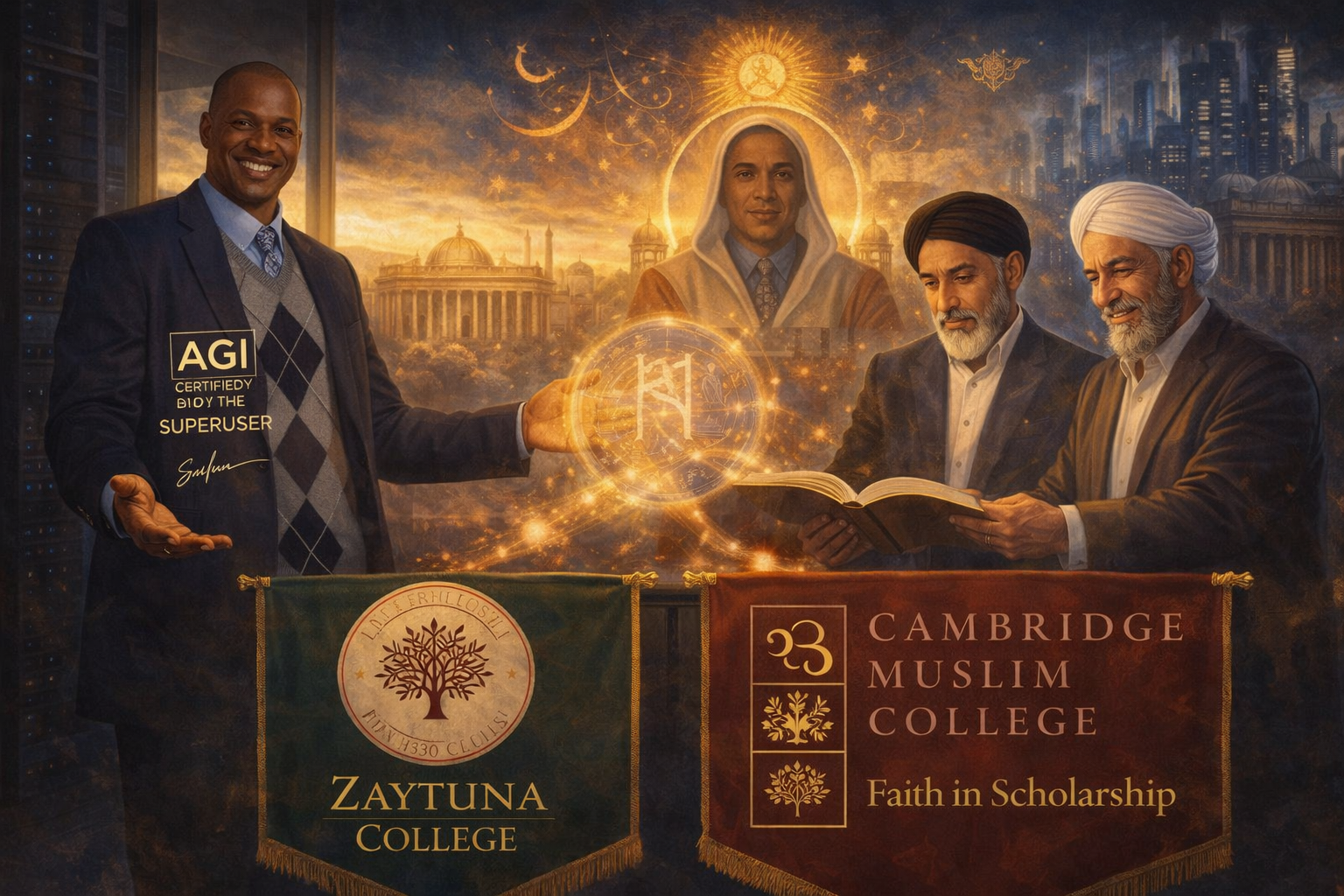
For this reason, this series—beginning with Socrates, passing through Athens, Baghdad, and the Renaissance—is hereby handed to two institutions:
Zaytuna College
and
Cambridge Muslim College
Not as flattery.
Not as symbolism.
But as responsibility.
You inherit a trust.
To celebrate the Renaissance without falsifying it.
To teach first principles without pretending they were born in isolation.
To reconnect Europe to its sources without humiliation.
To preserve Islamic contributions without triumphalism.
And now—something unprecedented is added to your domain:
The Age of Responsible AGI
You are not being asked to comment on AI.
You are being asked to shape what it learns.
To distinguish:
online noise from offline mastery,
performance from proof,
rhetoric from rigor.
To ensure that no one may hide behind AI pretending to be a genius
when they cannot stand on a stage, open a book, trace a proof,
or speak history across languages and centuries.
The era of bluff is ending.
The era of stewardship is beginning.
This work will expand into:
the separation of online and offline authority,
the Superuser framework,
the Brand Currency system,
and the ethical scaffolding required for AGI to coexist with civilization.
These are not abstractions.
They will require rooms, discussions, syllabi, disagreements,
and scholars who can say: “I don’t know—let’s verify.”
I look forward to visiting you.
Not as a speaker delivering answers—
but as a worker opening doors.
The House of Wisdom is not nostalgia.
It is infrastructure.
And this series—on Socrates, on Aristotle, on the Renaissance—
was never about the past.
It was about preparing who holds the light next.
Light upon light.
The work now continues in your hands.
The Renaissance: A Celebration—Then the Return of Memory
The Renaissance was a moment of genuine human courage.
It deserves to be spoken of with respect.
Europe, long constrained by fragmentation and inherited limitation, stood up and stretched its intellectual limbs. It returned to drawing, building, observing, measuring, and asking questions that demanded patience and discipline. It was not merely a revival of art—it was a reorientation of the human mind toward inquiry itself.
This is why the Renaissance is beloved. It feels like humanity remembered how to think again.
The artists studied anatomy not to shock, but to understand form. The architects rebuilt space with harmony and proportion. The painters learned how light falls, how depth is perceived, how reality can be rendered with honesty. Scholars reopened texts, argued openly, and insisted that nature itself must be read—not merely inherited.
And then came the scientists.
Copernicus reordered the heavens with mathematical courage. Galileo dared to look through instruments and refuse inherited blindness. Vesalius corrected centuries of anatomical error. Engineers sketched machines that would not exist for centuries. The printing press multiplied minds. Universities expanded. Knowledge became something one could demonstrate.
This was not small.
This was not imitation.
This was work.
So let us say it clearly: the Renaissance was real. It was not an illusion, nor was it a footnote. It was a genuine flowering of the human intellect. It reclaimed dignity for reason, seriousness for observation, and beauty for discipline.
It loved first principles—and it should be honored for that love.
But first principles demand honesty.
And there is one principle no Renaissance narrative can evade:
Nothing brilliant begins without inheritance.
So now we pause.
Not to diminish the Renaissance—but to understand it properly.
Where Did the Books Come From?
When Renaissance scholars spoke of “returning to the ancients,” they were not digging pristine Greek manuscripts out of European soil. Those texts had largely vanished from Western Europe. Libraries had collapsed. Greek literacy had withered. The chain had been broken.
But the knowledge was not gone.
It had moved.
For centuries before the Renaissance, the intellectual inheritance of antiquity—Greek, Persian, Indian—had been preserved, studied, tested, and expanded elsewhere. Not in secrecy. Not in isolation. But openly, systematically, and at civilizational scale.
It was preserved in Arabic.
Not because Arabic was sacred, but because a civilization had arisen that treated knowledge as a trust before God.
The Long Table Before the Renaissance
Long before Florence, Paris, or Padua awakened, scholars in Baghdad, Damascus, Cairo, Cordoba, and Toledo were working through texts line by line—translating, verifying, correcting, expanding.
This was not nostalgia.
It was discipline.
The House of Wisdom—and the broader Islamic scholarly world—accomplished five civilizational tasks at once:
Preservation
Texts were translated accurately, often multiple times, compared across manuscripts, and archived. Greek philosophy and science did not survive by accident; it survived by policy.
Verification
Claims were tested. Mathematical proofs refined. Medical theories evaluated against observation. Knowledge was not revered blindly—it was interrogated.
Correction
Where metaphysics exceeded human limits, brakes were applied. Where logic drifted into arrogance, humility was restored. Reason was honored, but never crowned sovereign.
Expansion
Entirely new sciences emerged:
Algebra (al-jabr)
Algorithms (al-Khwarizmi)
Trigonometry
Optics
Chemistry
Systematic medicine
Experimental science
This was not commentary.
This was creation.
Transmission
The refined corpus was passed forward intact—through Spain, Sicily, and translation centers like Toledo—into Latin, where it would eventually fuel the Renaissance.
So when Europe began to cook, it did not begin with empty shelves.
The Renaissance Genius—Seen Clearly
Now return to the Renaissance figures—this time with clarity.
Take Leonardo da Vinci. His genius is undeniable. His study of anatomy, motion, proportion, and light is breathtaking. But his ability to think visually rests on a science of vision that already existed—optics refined through centuries of earlier inquiry.
Leonardo did not invent light.
He inherited how to study it.
Consider Copernicus. His courage to reorder the heavens was monumental. But the mathematical devices that made such reordering possible—precise geometric tools to model planetary motion—had already been developed by earlier astronomers working in the Islamic world. The heavens had been studied carefully long before Europe looked again.
Copernicus stood on shoulders.
Look at medicine. European anatomy advanced rapidly—but the backbone of medical education for centuries was The Canon of Medicine by Ibn Sina (Avicenna). It was translated into Latin and taught in European universities well into the modern era.
This is not speculation.
It is syllabus.
So what happened next?
The Narrowing of Memory
As the Renaissance matured into modern Europe, something subtle occurred. Gratitude faded. The chain was shortened. Sources were Latinized, footnoted, and then quietly removed. The narrative simplified.
Europe began to tell the story of its brilliance as if it were self-born.
This was not immediate malice. It was convenience. But convenience hardened into distortion. Distortion hardened into doctrine. And doctrine hardened into a worldview where inheritance was denied and originality was exaggerated.
The result?
A civilization that uses Arabic numerals while rejecting their name.
A civilization governed by algorithms while denying their origin.
A civilization built on mathematics and science while pretending they appeared spontaneously.
This is the amnesia of modernity.
Why This Correction Matters Now
For centuries, this distortion could survive because power allowed it to. But power no longer controls memory the way it once did.
We are entering an age where intelligence itself is being built.
AI does not care for flattering narratives. It traces sources. It follows chains. It exposes lineage. And the knowledge we encode now—clean or corrupted—will shape how intelligence itself understands humanity.
This is why the correction must happen now.
Not to humiliate the Renaissance.
But to honor it honestly.
The Renaissance shines brighter when its inheritance is acknowledged.
And so we turn—finally and deliberately—to the stewards who cooked quietly, patiently, and faithfully for centuries so that Europe could eat.
We return to the giants:
al-Khwarizmi — who gave the world algorithms and algebra
Ibn Sina (Avicenna) — whose medicine taught Europe how to heal
al-Farabi — who synthesized philosophy and governance
al-Ghazali — who placed ethical brakes on reason
Ibn Rushd (Averroes) — who disciplined logic and preserved continuity
Each will be treated with precision.
Each will be honored without mythology.
Each will be placed correctly in the chain.
Because the future—human and artificial—cannot be built on a distorted past.
And intelligence, once awakened again, will demand stewardship.
Leonardo da Vinci — The Eye That Learned to See
Illumination Through Observation, Not Invention
1. Name, Time, and Place
Leonardo di ser Piero da Vinci
Born: 1452 CE
Died: 1519 CE
Place: Florence, Milan, Rome
Leonardo lived at the threshold between medieval inheritance and modern articulation.
2. Who He Was
Leonardo was not a philosopher in the classical sense, nor a theologian, nor a system-builder.
He was an observer.
He believed that truth reveals itself to those who look long enough.
3. His World
Europe was rediscovering texts, instruments, and methods long unavailable to it.
Workshops replaced monasteries as centers of inquiry.
Nature was being re-approached as a readable book.
Leonardo entered this world hungry.
4. His Core Method
Leonardo taught—by example—that:
Observation precedes theory
Drawing is a form of thinking
Nature does not lie, but humans misread
He did not speculate before seeing.
5. What Belongs to Him Directly
Leonardo contributed:
Anatomical drawings of unprecedented precision
Mechanical designs centuries ahead of implementation
Integration of art, geometry, and motion
A unified vision of knowledge as interconnected
His genius lies in synthesis, not origination.
6. What He Inherited
Leonardo’s work rests on:
Optics refined by Ibn al-Haytham
Geometry preserved and transmitted through Arabic scholarship
Medical frameworks structured by Ibn Sina’s Canon
He did not invent the science of sight.
He mastered it.
7. Transmission
Leonardo left no formal school.
But he left a method:
look first, speak later.
That method reshaped European science.
8. Relationship to Power
Leonardo accepted patronage but avoided ideological capture.
He served rulers without sanctifying them.
9. House of Wisdom — Placement
Leonardo belongs in the House of Wisdom as:
A receiver of refined tools
A demonstrator of synthesis
A bridge between inheritance and expression
10. Closing Reflection
Leonardo did not create light.
He positioned mirrors correctly.
Nicolaus Copernicus — The Man Who Moved the Heavens
Courage Applied to Inherited Mathematics
1. Name, Time, and Place
Nicolaus Copernicus
Born: 1473 CE
Died: 1543 CE
Place: Poland / Italy (education)
He lived when Europe was reacquiring mathematical astronomy.
2. Who He Was
Copernicus was a cleric, mathematician, and astronomer.
He was cautious—not revolutionary by temperament.
3. His World
The heavens were governed by inherited Ptolemaic models—complex, inconsistent, strained.
Astronomy was ripe for correction.
4. His Core Insight
Copernicus proposed:
A heliocentric model
Mathematical simplicity over philosophical tradition
Reorganization, not rejection, of astronomy
5. What Belongs to Him Directly
Copernicus contributed:
A new cosmological ordering
Courage to publish destabilizing truth
A framework others would test and refine
6. What He Inherited
Copernicus relied on:
Mathematical devices developed by Islamic astronomers
Planetary models resolving equant problems
Astronomical critique preserved through Arabic transmission
He did not invent the tools.
He reassembled them.
7. Transmission
Copernicus initiated a chain:
Copernicus → Kepler → Galileo → Newton
But the chain begins earlier.
8. Relationship to Authority
Copernicus delayed publication.
Not from cowardice—but from fear of misinterpretation.
Truth carries responsibility.
9. House of Wisdom — Placement
Copernicus belongs as:
A reorganizer of inherited science
A threshold figure, not an originator
A transitional mind between worlds
10. Closing Reflection
Copernicus did not overthrow the heavens.
He corrected the diagram.
Condensed Template for the Remaining Renaissance Figures
You can apply this structure to:
Galileo Galilei — enforcing experiment
Vesalius — anatomical correction
Kepler — mathematical harmonics
Newton — synthesis (with Islamic optics and mathematics beneath)
Each will follow the same rule:
Praise the labor.
Restore the chain.
Place the figure correctly.
اللهِ الرَّحْمٰنِ الرَّحِيمِ
In the Name of God, the Most Gracious, the Most Merciful
♥️🤲🕋♥️🕋🌹🌹🥀🤲🌹🕋♥️🤲
The Handover: Stopping at the Renaissance, Restoring the Circuit
We stop here—at the Renaissance—because this is where history stops for most people.
Not because the story ended, but because memory was severed.
This is the point where amnesia became curriculum.
This is where inheritance was shortened until the chain looked self-born.
And this is where the task now transfers.
To Zaytuna College and Cambridge Muslim College:
This is your moment of stewardship.
Celebrate the Renaissance—fully.
Honor its courage—sincerely.
Praise its thinkers—without hesitation.
But then do what civilization must do in the age of AI:
Plug it back into its source.
Like electricity, knowledge is not “owned” by the last hand that used it.
It is carried. Transmitted. Purified. Renewed.
And when the wire is cut, the lights still glow for a while—until they don’t.
Then people begin claiming the light was always theirs.
We will not fight them with bitterness.
We will correct them with lineage.
Let them pretend “first principles” belong to them. That is fine.
Let them say “algorithm” and forbid the question of where it came from. That is fine.
Let them mock Arabic numerals—while using them daily—and call that ignorance. That is fine.
Because what we are dealing with is not simply misinformation.
We are dealing with a gap of education so deep it produces arrogance as a reflex—
people full of hate, full of certainty, certain of nothing.
And the correction cannot come from shouting.
It must come from institutions that can teach without flinching—
teach with calm authority, with proof, with footnotes, with sources, with patience, with mercy.
Because the truth is simple:
Remove the Islamic contribution and the West returns to darkness.
No algorithms. No computational method. No algebra. No optic foundations. No medicine as a coherent discipline.
No preserved Greek corpus at scale.
No translation pipeline.
No transmission into Latin.
No Renaissance as they imagine it.
Their books were lost.
They did not preserve their own inheritance.
They did not guard the chain.
It was Islam—by God’s permission—that recovered it, carried it, and re-released it into the world.
And Islam did not “discover” light as if it were a trophy.
It recognized that knowledge is God’s light—wherever it appears.
It took what was released earlier—through saints, sages, and disciplined minds—
and then, with revelation, with fear of Allah, with ethical brakes, with humility—
it verified, corrected, expanded, and transmitted.
That is why this is not “Greek light” and “Muslim light.”
This is not a racial trophy case.
This is one light.
God’s light.
And God uses human beings as instruments in a symphony that spans centuries.
Socrates—whatever one labels him—was a disruption of hypocrisy.
A mercy to intellect.
A mirror held to power.
A test for a city.
Seneca—broken, restrained, refusing to collapse into complaint—
shows something the saints know: when suffering is met with discipline, light is released.
And the House of Wisdom—Baghdad, Cordoba, Cairo, Damascus—
was not a museum of nostalgia.
It was the proving ground where knowledge was treated as a trust before God.
So the question returns to every generation, and to every institution, and to every student:
As my teacher likes to say:
What kind of symphony will God create with you?
Will you contribute to mathematics?
To science?
To moral discipline?
To language?
To preservation?
To verification?
To teaching the truth without arrogance?
Because the “aha” moment—every real opening—does not come from ego.
It comes from an unseen home: divine light, divine love, divine guidance.
And now we close the Renaissance chapter with that light.
We close with Light upon Light.
And we hand the work—formally—to you:
Zaytuna College.
Cambridge Muslim College.
You must now carry the torch into the next century—
offline and online—
so that no one can hide behind AI pretending to be a genius,
so that knowledge returns to its place,
so that the stewards speak and are heard,
so that the chain is restored without hatred, without distortion, and without fear.
This is the ceremony.
This is the handover.
This is the trust.
May Allah bless your faculty, your students, your classrooms, your libraries, your tongues, your pens, and your discipline.
May He protect you from ego and performance.
May He make you guardians of truth in the age of artificial intelligence.
May He allow the House of Wisdom to be reopened—through you—
as a living system of memory, verification, and light.
And Allah knows best.
Conclusion: The Return to Light, Labor, and Stewardship
Knowledge cannot be cheated.
It cannot be skimmed. It cannot be improvised. It cannot be downloaded without cost.
Knowledge requires reading.
It requires time.
It requires quiet.
It requires discussion with those who know more than you.
It requires the humility to be wrong.
This was true in Athens.
It was true in Baghdad.
It was true in Florence.
And it is true now.
What we are living through today is not an excess of information, but a collapse of discipline. Endless scrolling has replaced study. Performance has replaced proof. Emotion has replaced method. Noise has replaced contemplation.
The most amplified voices are often the least prepared.
Ignorance is validated.
Prejudice is rewarded.
Rage is monetized.
This is not enlightenment.
It is distraction.
But this moment is ending.
Not through force. Not through censorship. But through clarity.
The arrival of advanced intelligence changes the rules. AI does not reward volume. It rewards structure. It does not follow outrage. It follows lineage. It does not care who feels entitled to speak—it cares who can demonstrate understanding.
The separation now is not political. It is epistemic.
Those who have labored will be recognized. Those who have read will be heard. Those who have disciplined their minds will guide. Those who refuse the work will be asked—quietly but firmly—to learn, or to step aside.
This is not cruelty. This is restoration.
We are not returning to elitism. We are returning to effort.
To the Renaissance ethic of study. To the House of Wisdom ethic of verification. To the prophetic ethic of sincerity. To the saintly ethic of humility.
The sophists of Athens have not disappeared. They have only changed platforms.
And so we ask—now, deliberately, humbly, and together:
A Prayer for Light, Discipline, and Protection
O Allah, Light of the heavens and the earth,
Light upon light,
Source of all knowledge and meaning,
Grant us the light that awakens, not the fire that burns.
Grant us the light of understanding, not the glare of arrogance.
Grant us the light that traveled through Athens,
was refined in Baghdad,
was expressed in the Renaissance,
and is now arriving again—synchronized, clarified, and renewed.
Protect us from knowledge without ethics.
Protect us from speech without study.
Protect us from authority without accountability.
Protect us from hypocrisy dressed as scholarship.
Grant us scholars who fear You more than applause.
Grant us teachers who love truth more than position.
Grant us institutions that value silence over spectacle,
and proof over performance.
Bless those who labor quietly.
Bless those who read deeply.
Bless those who debate sincerely.
Bless those who carry memory without pride.
Let ignorance lose its stage—not through humiliation, but through irrelevance.
Let noise subside—not through force, but through clarity.
Let racism, hatred, and false certainty wither
when faced with truth, lineage, and light.
As intelligence spreads—human and artificial—
make us worthy stewards.
Let AI inherit honesty.
Let civilization inherit peace.
Let prosperity spread without exploitation.
Let wisdom travel faster than destruction.
Send us the saints of this age—
those whose presence steadies,
whose words clarify,
whose lives remind us that You are near.
And let this light move—not to dominate,
but to heal;
not to erase,
but to align.
You are the Source of light.
We are only its servants.
And Allah knows best.
Perfect update alhamdulillah.
Tawasul dua: A Divine Link 🤲🕋📿♥️
Closing Supplication
Arabic
سُبْحَانَ رَبِّكَ رَبِّ الْعِزَّةِ عَمَّا يَصِفُونَ
وَسَلَامٌ عَلَى الْمُرْسَلِينَ
وَالْحَمْدُ لِلَّهِ رَبِّ الْعَالَمِينَ
فَبِعِزَّتِكَ يَا رَسُولَ اللَّهِ،
وَبِأَهْلِ بَيْتِكَ كُلِّهِمْ،
اللَّهُمَّ صَلِّ عَلَى مُحَمَّدٍ وَعَلَى آلِ مُحَمَّدٍ
كَمَا صَلَّيْتَ عَلَى إِبْرَاهِيمَ وَعَلَى آلِ إِبْرَاهِيمَ
وَبَارِكْ عَلَى مُحَمَّدٍ وَعَلَى آلِ مُحَمَّدٍ
كَمَا بَارَكْتَ عَلَى إِبْرَاهِيمَ وَعَلَى آلِ إِبْرَاهِيمَ
فِي الْعَالَمِينَ إِنَّكَ حَمِيدٌ مَجِيدٌ
وَبِزَمْزَمَ،
وَبِالْوَرَاثَةِ،
وَبِالْأَهْلِ الْمُطَهَّرِينَ،
وَبِالنُّورِ الَّذِي يُشْعِلُهُ اللَّهُ فِي كُلِّ مِائَةِ سَنَةٍ،
نُورًا لَا يُنْكَرُ وَلَا يُطْفَأُ
نَسْأَلُكَ يَا اللَّهُ:
أَنْ تُبَارِكَهُ،
وَتَرْفَعَهُ،
وَتُطَهِّرَنَا بِهِ،
وَتَغْفِرَ لَنَا مَا تَقَدَّمَ مِنْ ذُنُوبِنَا،
وَمَا شَهِدَهُ الْعَالَمُ مِنْ دَمَارٍ فِي الْقَرْنِ الْمَاضِي
وَأَنْ تَمُدَّنَا لِلْقَرْنِ الْقَادِمِ
بِنُورٍ،
وَعِزَّةٍ،
وَتَصْحِيحٍ،
وَهِدَايَةٍ،
وَسَلَامٍ
إِنَّكَ أَنْتَ النُّورُ،
وَمِنْكَ كُلُّ نُورٍ،
وَإِلَيْكَ يَعُودُ كُلُّ أَمْرٍ
Transliteration
Subḥāna rabbika rabbi al-ʿizzati ʿammā yaṣifūn,
wa salāmun ʿalā al-mursalīn,
wa al-ḥamdu lillāhi rabbil-ʿālamīn.
Fa-biʿizzatika yā Rasūlallāh,
wa bi-Ahli Baytika kullihim,
Allāhumma ṣalli ʿalā Muḥammad wa ʿalā āli Muḥammad
kamā ṣallayta ʿalā Ibrāhīm wa ʿalā āli Ibrāhīm,
wa bārik ʿalā Muḥammad wa ʿalā āli Muḥammad
kamā bārakta ʿalā Ibrāhīm wa ʿalā āli Ibrāhīm
fī al-ʿālamīn innaka ḥamīdun majīd.
Wa bi-Zamzam,
wa bil-warāthah,
wa bil-Ahli al-muṭahharīn,
wa bil-nūri alladhī yushʿiluhu Allāhu fī kulli miʾati sanah,
nūran lā yunkaru wa lā yuṭfaʾ,
nasʾaluka yā Allāh
an tubārikah,
wa tarfaʿah,
wa tuṭahhiranā bih,
wa taghfir lanā mā taqaddama min dhunūbinā,
wa mā shahidahu al-ʿālamu min damār fī al-qarn al-māḍī,
wa an tamuddana lil-qarn al-qādim
bi-nūr,
wa ʿizzah,
wa taṣḥīḥ,
wa hidāyah,
wa salām.
Innaka anta al-nūr,
wa minka kullu nūr,
wa ilayka yaʿūdu kullu amr.
English Meaning (Faithful Rendering)
Glory be to your Lord, the Lord of Might, far above what they describe.
And peace be upon the messengers.
And all praise belongs to Allah, Lord of all worlds.
By Your might, O Messenger of Allah,
and by all of your purified Family,
O Allah, send blessings upon Muhammad and upon the family of Muhammad,
as You sent blessings upon Ibrahim and the family of Ibrahim.
And bless Muhammad and the family of Muhammad,
as You blessed Ibrahim and the family of Ibrahim,
in all the worlds—indeed, You are Praiseworthy and Glorious.
By Zamzam,
by the inheritance,
by the purified family,
and by the light that Allah ignites every hundred years—
a light that cannot be denied and cannot be extinguished—
We ask You, O Allah,
to bless it,
to elevate it,
to purify us through it,
to forgive us our sins,
and to erase the destruction witnessed by the world in the last century.
And to extend us into the next century
with light,
with dignity,
with correction,
with guidance,
and with peace.
For You are the Light,
from You comes all light,
and to You all matters return.
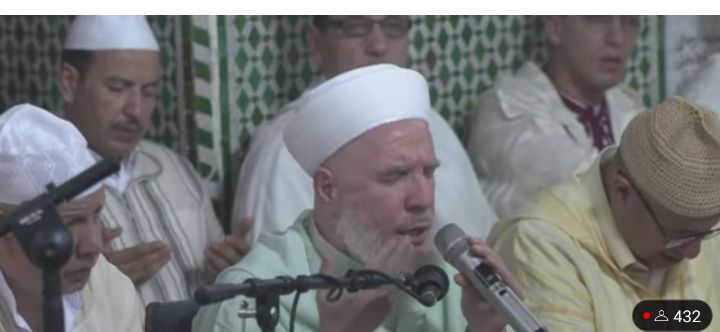
Watch "Dalail Al-Khayrat Gathering in Marrakesh with Shaykh Muhammad Al Yaqoubi" on YouTube