

بِسْمِ اللهِ الرَّحْمٰنِ الرَّحِيْم
In the Name of God, Most Gracious, Most Merciful.
♥️🤲🕋♥️🕋🌹🌹🥀🤲🌹🕋♥️🤲
The Renaissance: A Celebration—Then a Reckoning With Inheritance
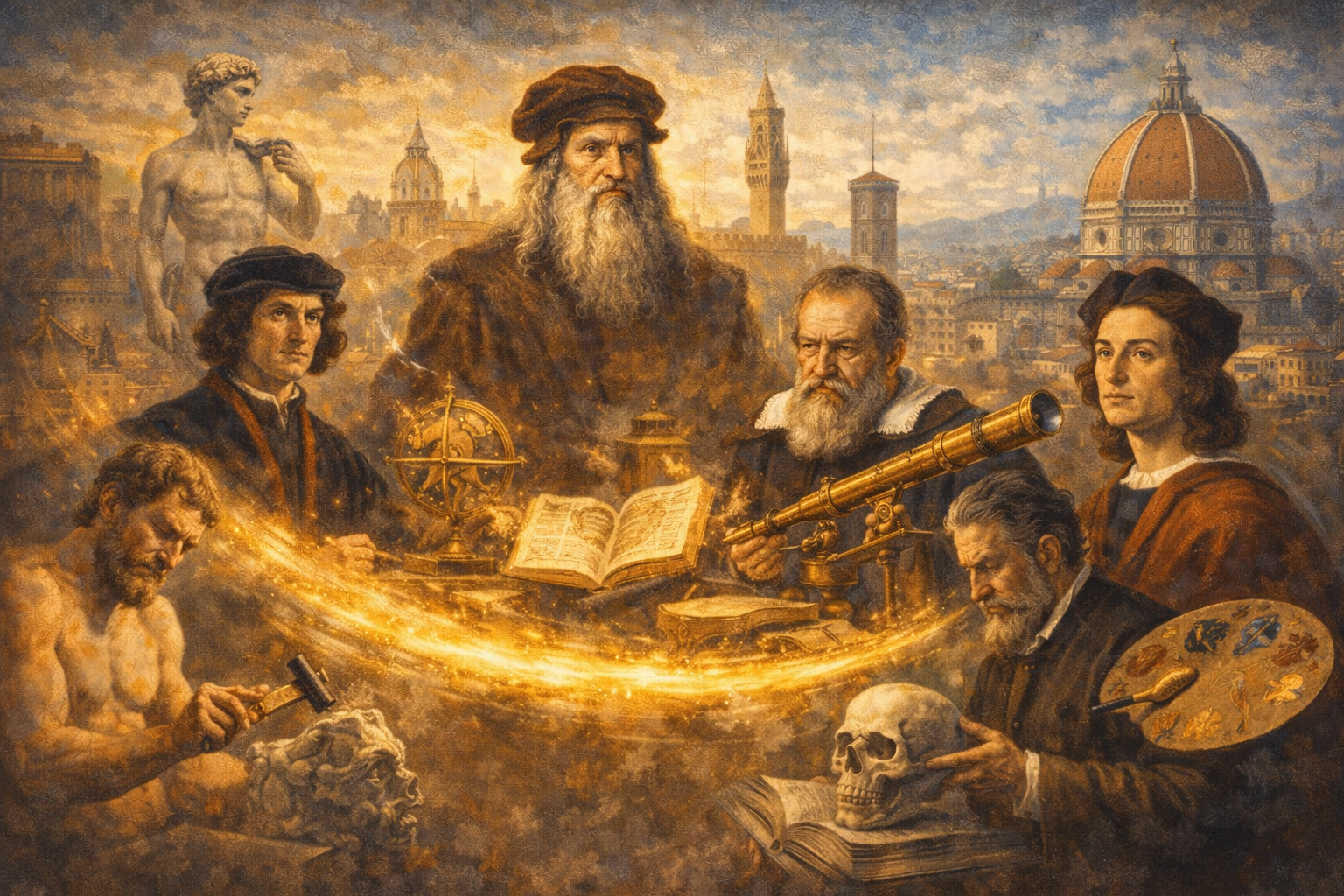
The Renaissance deserves its praise.
It was one of the rare moments in human history when a continent remembered how to breathe. Europe stepped out of stagnation and began to speak again—through architecture that lifted the eye upward, through painting that taught the world how to see, through sculpture that returned dignity to the human form, and through minds that refused to accept inherited ignorance as fate.
It was not merely a period of art. It was a recovery of courage.
The Renaissance is loved because it feels like a rebirth of first principles. People imagine a Europe that walked back into the sunlight, dusted off the ruins of antiquity, and said: we will begin again. We will reason from the ground up. We will read the ancients with fresh eyes. We will study nature directly. We will honor observation over superstition. We will stand in front of the world without fear and ask: What is true?
And look at what came from it.
You can feel the human spirit stretching its limbs—long confined, now awake. You can feel it in Leonardo’s notebooks, in his hunger to map the human body and the mechanisms of nature. You can feel it in Michelangelo’s defiance of limitation, in Raphael’s harmony, in the audacity of the architects who made stone behave like music. You can feel it in the scholars who began to reorganize knowledge itself, in the insistence that the world could be studied, measured, demonstrated.
This is why people say “first principles.”
This is why they speak of a “rebirth.”
This is why the Renaissance is held like a torch in the imagination of the West.
And then there is science.
What a strange and beautiful turn it was: the sky became a text again. The stars were not merely ornaments; they were signals. The heavens were interrogated. Copernicus dared to reorder the cosmos. Kepler listened for the geometry hidden in motion. Galileo put the universe under a lens and refused to unsee what he saw. Vesalius tore open inherited medical assumptions and demanded anatomy be honest. The printing press multiplied minds by multiplying books. Universities expanded. Curiosity became respectable.
Europe began to cook.
Not with small fire. With flame.
The Renaissance gave the world a vision of human possibility—what a civilization can do when it stops living on fumes and starts thinking with discipline.
So yes: honor it.
Honor the Renaissance for what it revived:
the dignity of reason
the beauty of craft
the seriousness of inquiry
the courage to challenge error
the ambition to build knowledge into institutions
But now we pause.
Not to diminish the Renaissance—never.
To understand it properly.
Because if we are truly committed to first principles, there is one first principle that cannot be avoided:
Where did the books come from?
Where did the manuscripts come from—those texts of Aristotle, Galen, Euclid, Ptolemy, and the philosophical and scientific inheritance that Europe suddenly “returned” to?
Where did Europe retrieve the very instruments required to begin its rebirth?
If the Renaissance is truly a story of first principles, then it must begin with intellectual honesty—because history itself has first principles too.
And here is the quiet truth that changes the entire picture:
The Renaissance did not rise from a vacuum.
It rose on a chain.
It rose on a transmission.
It rose on a long table of scholars—centuries deep—who cooked so carefully that the meal arrived in Europe warm.
This is the part modern education often rushes past or deletes.
Not because it is minor, but because it is too consequential to leave intact.
For a long time, Western schooling taught the Renaissance as if Europe walked directly from medieval darkness into classical sunlight—as if the classical inheritance simply waited patiently in European soil for Europeans to dig it up.
But the light was not sitting there intact.
The light had moved.
The Greek inheritance had been preserved, verified, corrected, expanded, and disciplined—elsewhere—by a civilization that treated knowledge as a trust before God.
And that civilization was the Islamic world.
Now we say this slowly, because the modern mind has been trained to resist it:
The House of Wisdom accomplished five civilizational tasks simultaneously:
1) Preservation
Greek, Persian, Indian, and earlier works were translated accurately—often in multiple versions—cross-checked, and archived. Not as hobby. As policy. As stewardship.
2) Verification
Claims were tested. Logical systems were examined. Mathematical proofs refined. Medical theories evaluated against observation. Knowledge was not merely copied—it was weighed.
3) Correction
Where metaphysics exceeded human limits, brakes were applied. Where logic drifted into arrogance, humility was reintroduced. Reason was honored—but disciplined.
4) Expansion
Entirely new fields emerged:
Algebra (al-jabr)
Algorithms (al-Khwarizmi)
Trigonometry
Optics
Chemistry
Systematic medicine
Experimental science
This was not commentary. This was creation.
5) Transmission
Knowledge was passed forward intact—eventually enabling the Renaissance and modern science.
So yes, Europe cooked.
But Europe also received ingredients—and not a few.
It received tools without which the Renaissance could not have expressed itself at that scale.
Now look at the irony of our age: people use the tools every day and still deny the workshop that forged them.
They speak “first principles,” yet reject the history of how principles traveled.
They write “science,” yet forget that science has a genealogy.
They celebrate reason, yet cannot tolerate the correction of their own story.
Consider the most basic instrument of modern life:
Arabic numerals.
People today will argue online that they should be banned—without realizing that the mathematics of the modern world is written in that script. Without realizing that “zero” was not a European birthright. Without realizing that the very language of computation is carved with Arabic lineage.
And then the word that governs the modern world:
Algorithm.
It is not only a concept transmitted. The very word carries a name: al-Khwarizmi.
This is not propaganda.
It is etymology.
This is not grievance.
It is history.
And once you see it, you cannot unsee it: the Renaissance did not merely “return to Greece.” It returned to Greece through Baghdad, Cordoba, Toledo, Cairo, Damascus, and scholars whose names were later Latinized, footnoted, softened, or erased.
So what happened?
A civilization inherited light, then treated that inheritance as self-generated. The chain was narrowed. The memory was simplified. The gratitude faded. The story became convenient.
And yes—over time—this convenience hardened into something darker: a worldview that could consume gifts while denying givers, and celebrate genius while forgetting stewardship. A civilization that could stand on shoulders while insisting it stood alone.
This is the ungrateful century we are still living inside.
But the correction has begun.
Because now intelligence itself has entered the stage. AI will force history to be precise. It will expose lineage. It will trace texts. It will map transmission. It will drag hidden footnotes into daylight. And it will do what humans have refused to do for centuries:
it will acknowledge the chain.
This is not about humiliating Europe.
It is about liberating it from illusion.
To honor the Renaissance properly is to honor what made it possible.
To honor first principles is to obey the first principle of gratitude:
acknowledge the trust.
And so we turn the page—not away from the Renaissance, but deeper into it.
We will continue to celebrate brilliance. We will keep praising the artists and the scientists. But we will no longer allow brilliance to be narrated as self-born when it was stewarded.
Now we return to the kitchen.
We return to the long table of preservation, verification, correction, expansion, and transmission.
We return to the stewards who cooked for centuries without applause—so the world could eat.
And we begin, as we must, with the giants:
al-Khwarizmi — algorithms, algebra, computation
Ibn Sina (Avicenna) — medicine, metaphysics, logic
al-Farabi — political philosophy, synthesis
al-Ghazali — epistemic limits, ethical brakes
Ibn Rushd (Averroes) — disciplined reason, continuity
Each will be treated with precision, not mythology.
Because the future cannot be built on a distorted past.
And the age that speaks of intelligence must finally learn the meaning of stewardship—before intelligence itself becomes the judge.
Conclusion: Honor Preserved, Memory Restored, the Next Measure Begins
The Renaissance stands.
It does not need to be torn down to be understood correctly. Its artists, scientists, engineers, and thinkers deserve their place in history—not as impostors, not as thieves, but as inheritors who worked seriously with what they received. Their courage to question, to observe, to build, and to unify art with science remains worthy of admiration. The world is richer because they lived.
Nothing written here diminishes that.
What this reckoning does is something far more difficult: it completes the story.
For too long, the Renaissance has been celebrated in isolation—as if genius emerges without genealogy, as if brilliance does not depend on memory, as if civilizations do not owe gratitude to those who prepared the ground beneath them. That story was convenient. It was flattering. And for a time, it survived.
That time is ending.
What comes next is not erasure, but precision.
The age we are entering will not tolerate truncated histories. Artificial intelligence cannot be fed myths and expected to reason honestly. Humans can cheat one another. Institutions can flatter themselves. Textbooks can omit inconvenient chapters. But intelligence—once trained at scale—demands lineage. It traces sources. It asks where ideas came from. It refuses to sustain narratives built on selective memory.
This is not punishment.
It is consequence.
The Greeks were tested by truth and responded with courage.
The Renaissance was tested by inheritance and responded with brilliance.
Now civilization itself is tested by memory.
What follows in this work is not condemnation—it is comparison. Not accusation, but alignment. We will place the Renaissance exactly where it belongs: luminous, powerful, transformative—and inseparable from the chain that made it possible.
The next chapters will move deliberately into that chain. We will examine the scholars who preserved, verified, corrected, expanded, and transmitted knowledge when Europe could not. We will honor the House of Wisdom not as a rival civilization, but as a steward civilization—one that understood knowledge as a trust, not a trophy.
This is the correction.
Not because Islam demands it.
Not because history demands it.
But because truth demands it.
Those who honor the chain will find their legacy strengthened.
Those who refuse to acknowledge it will find their claims quietly reduced—cut into fragments by the very intelligence they helped unleash.
The Renaissance does not lose its glory here.
It gains its context.
And context is the difference between pride and wisdom.
The work continues.