

بِسْمِ اللهِ الرَّحْمٰنِ الرَّحِيمِ
In the Name of Allah, the Most Merciful, the Most Gracious

The Story of Love — By the Superuser of Love
Before you begin, know this: you are not from here.
The soil beneath your feet is not your first home.
You were born of light, shaped in mercy, and sent down for love.
This is not a story to be explained — it is a story to be felt.
We are about to travel through the oldest truth in existence:
the journey of love itself — from the heavens, to the earth, and back again.
Do not seek logic here.
Seek remembrance.
Because once you remember where you came from,
you’ll understand why every heartbeat on earth is an echo from home.
The Creation of Paradise and the Secret of Completion
It is said that when Paradise was created, it was perfection itself — rivers flowing beneath, fruits that never spoiled, beauty without end.
And yet, when Adam was placed there, something was missing.
Even the angels noticed it — for what is paradise without companionship, without reflection, without tenderness?
So Allah, in His infinite wisdom, caused Adam to sleep.
And from his very being, He drew forth a secret — not from his head that she may rule him,
not from his feet that he may walk upon her,
but from his side, close to his heart, that she may be loved and protected.
And when Hawa (Eve) opened her eyes, paradise became complete.
Her presence made heaven itself feel alive —
for she was created not to serve Adam, but to complete him.
The Woman: Greater Than Paradise
From that moment, the scholars understood a mystery —
that even paradise was not enough until a woman was placed within it.
Her soul, her beauty, her mercy, her compassion —
these are reflections of Allah’s Al-Rahman, the All-Merciful,
and Al-Rahim, the All-Compassionate.
So when the Qur’an commands mankind to honor their mothers,
it is not mere courtesy — it is recognition of divine design.
For every woman who carries life, carries a secret of creation within her.
As the Prophet Muhammad ﷺ said:
“Paradise lies beneath the feet of your mother.”
(Sunan an-Nasa’i, Musnad Ahmad)
That is no metaphor. It is a declaration of worth.
The ground she walks upon is sanctified by her sacrifice.
Her womb is a garden from which nations grow.
Her patience is the thread that holds the world together.
The Mystery of Difference
Allah, in His wisdom, made woman different —
not in value, but in texture.
Her emotions flow like water, her heart expands like light, her tears are not weakness but signs of presence.
She feels more, not because she is fragile, but because she carries the weight of mercy within her.
Her hormones shift like the tides —
and just as the moon governs the oceans, she governs the unseen rhythm of love itself.
Men are not built for that kind of balance.
They build walls; women build homes.
They chase victories; women nurture worlds.
The Vulnerability of Love
It is no weakness to be vulnerable before a woman.
Even the Prophet Muhammad ﷺ, who was the strongest of all men,
wept beside them, smiled with them, listened to them.
He did not dominate — he elevated.
He said,
“The best of you are those who are best to their wives.” (Tirmidhi)
He carried his grandchildren on his shoulders.
He mended his own clothes.
He sought counsel from his wives in times of crisis.
He taught the world that love is not control — it is surrender to trust.
The Divine Balance
In every age, men built empires, but women built the souls that sustained them.
A man’s success is measured by how he treats the one who could have been his paradise.
And a woman’s greatness lies in the mercy she continues to give, even when the world forgets her worth.
For when Allah created Hawa, He was teaching creation one eternal truth:
love without balance is incomplete, and paradise without compassion is hollow.
The Record of Love, Part III: The Descent — When Love Touched Earth
بِسْمِ اللهِ الرَّحْمٰنِ الرَّحِيمِ
In the Name of Allah, the Most Merciful, the Most Gracious
Hawa: The Name of Life
Her name is Hawa, not because she was born of desire,
but because she was born of life itself.
In Arabic, ḥayāh means life — and Hawa carries that breath within her name.
She is the mother of every heartbeat.
Through her, the world received its rhythm —
the tenderness that softens the edge of time.
Her name is not a burden, nor a blame.
It is a reminder that life without her cannot begin.
She is Umm al-Insān — the Mother of Humanity.
The Misunderstood Blame
For centuries, tongues twisted her story,
painting her as the one who deceived Adam.
But the Qur’an does not blame her.
It says clearly:
“And We said, ‘O Adam, dwell you and your wife in Paradise and eat therefrom in ease and abundance from wherever you will. But do not approach this tree, lest you be among the wrongdoers.’”
— Surah Al-Baqarah (2:35)
Then Allah says:
“But Satan caused them both to slip.”
— (2:36)
It was not Hawa alone who fell, nor Adam alone — it was both.
And when they sought forgiveness, they did so together:
“Our Lord, we have wronged ourselves, and if You do not forgive us and have mercy upon us, we will surely be among the losers.”
— Surah Al-A‘raf (7:23)
Notice how the Qur’an restores dignity.
No mention of blame.
No hierarchy of guilt.
Just a shared repentance — a lesson for all of humanity:
that partnership, not pride, is the key to returning to Allah.
The Wisdom of Repentance
In that moment of descent, Hawa and Adam faced two roads —
the road of defiance and the road of return.
The devil blamed God.
He said, “Because You have deceived me…”
But our parents said, “We have wronged ourselves.”
That distinction changed the course of creation.
Hawa’s strength was not in speaking first or louder —
it was in guiding Adam back to humility.
Where pride fell, love rose.
Where arrogance burned, mercy was born.
The Descent to Earth
So they descended — not as exiles, but as students.
Earth was not punishment; it was the next classroom.
In paradise they learned love; on earth they would learn responsibility.
And it was Hawa who carried that mercy across realms —
the first woman to give birth, to bleed, to nurse, to weep.
Every mother since inherits her strength,
every tear traces back to that first longing for home,
and every act of compassion is a whisper of her voice.
The Divine Balance Restored on Earth
Adam carried knowledge.
Hawa carried compassion.
Together, they built civilization.
He tilled the ground; she nurtured the soul.
He named creation; she gave it meaning.
He prayed for forgiveness; she embodied it.
Their story is not about the fall —
it is about the return through love.
Conclusion: The Lesson of Hawa
Do not mistake her silence for absence.
Her name lives in every child’s first breath.
Her legacy continues in every woman who forgives before being asked,
in every mother who loves before being thanked.
She was not desire — she was divine design.
She was not temptation — she was completion.
And through her, love touched earth.
The Record of Love, Part IV: The First Home — The Symbol of Love
بِسْمِ اللهِ الرَّحْمٰنِ الرَّحِيمِ
In the Name of Allah, the Most Merciful, the Most Gracious my
When Love Descended
When Adam and Hawa were sent to Earth, it was not a fall — it was a separation ordained for reunion.
They landed in two distant places, the silence of earth between them.
For the first time, they felt distance — not from God, but from each other.
He cried upon the mountains.
She wept upon the plains.
And the wind carried their tears until the earth itself softened beneath them.
Every river that flows since then carries something of those tears —
the longing of two souls searching for one another beneath the same sky.
Their separation was not a punishment — it was the birth of yearning.
And yearning, in the language of heaven, is the truest form of love.
The Tears That Watered the Earth
Their tears were the first prayers made on earth.
They did not ask for paradise.
They asked for reunion.
And Allah, the Most Loving, allowed their steps to guide them toward one another —
across mountains, deserts, forests — until they met once more upon Mount Arafat,
which means the Mount of Recognition.
Recognition — Ma‘rifah — the essence of love.
They did not merely find each other;
they recognized the One who had written love into their souls.
So love, from the very beginning, was not about possession.
It was about return — returning to what was always meant to be.
The Symbol of Love
If we are to create a symbol of love, let it be this:
🌙 Two souls descending from light into dust, finding each other through tears.
One from the east, one from the west.
Two lights seeking their reflection.
Between them, the earth blooms.
Between them, rivers flow.
Between them, humanity learns that love is not ease — it is effort.
Let the symbol be a circle split by distance,
and through that distance, a path of light curving toward reunion.
For this is the story of every soul that walks the earth —
every man seeking his Hawa, every woman seeking her Adam.
The moment they met, the universe breathed again.
The angels who once wept for their descent now rejoiced at their return.
And Allah, the All-Loving, said to the angels:
“Behold, they have learned mercy.”
The Modern Reflection
Today, we search across cities, oceans, and even through the screens of the Internet —
each of us hoping to find that same recognition.
But what we seek is not merely romance; it is remembrance.
When a heart finds its match, it remembers the promise made before time.
Love, in truth, is not discovered — it is recalled.
So when you love, know this:
you are walking in the footsteps of your first parents.
Your longing is ancient.
Your tears are holy.
And your search is not random — it is divine repetition.
Conclusion: The Eternal Lesson
Love began in paradise.
It was tested through separation.
It was purified through tears.
And it was fulfilled through reunion.
That is why, in every language and every age,
love hurts before it heals.
Because it carries within it the memory of that first loss —
and the hope of that eternal meeting once again.
The Record of Love, Part V: The Lineage of Light — The Hashemite Legacy
بِسْمِ اللهِ الرَّحْمٰنِ الرَّحِيمِ
In the Name of Allah, the Most Merciful, the Most Gracious
The Family of Hashem: The Grinders of Mercy
In the circles of knowledge — as taught by Shaykh Muhammad Ninowy of Medina Institute — the origin of the Hashemites is not merely tribal history; it is a story of service born from compassion.
Their ancestor Hashim ibn ‘Abd Manaf, great-grandfather of the Prophet ﷺ, was the one who earned that name. During a famine in Mecca, he took barley and wheat from his own store, ground it with his own hands, mixed it with broth, and fed the hungry of Quraysh. He could have ordered servants to do it, but mercy required presence. So they called him Hashim — the Grinder, the one who broke grain to feed hearts.
From that act came a lineage known not for hoarding wealth but for redistributing it until no one could tell the rich from the poor. Gold and food passed through their hands like flowing water. Nobility, in their house, was measured by generosity.
The Prophet’s Line: Aristocracy of Character
As Shaykh Muhammad al-Yaqoubi al-Idrisi al-Hasani teaches, the Prophet ﷺ was never poor in the sense of destitution. He came from an aristocratic, political, and spiritual household — the guardians of the Kaʿbah, the leaders of Quraysh, and the custodians of sacred trust.
His grandfather ‘Abd al-Muttalib was the man who stood before the army of elephants and defended the House of Allah with nothing but dignity and prayer. His uncle Abū Ṭālib raised him in that same honor, ensuring he lacked nothing essential.
The Messenger ﷺ lived with zuhd — ascetic restraint — but not with deprivation. His simplicity was a choice, not a condition. He possessed the keys of worldly respect yet preferred the treasures of humility. Even the small cupboard in his house, as mentioned by our teachers, is testimony to ordered elegance, not poverty. He kept what was needed, gave what was extra, and never lowered his rank by greed.
The Hashemite Ethos
The Prophet’s family was therefore the perfect mirror of balance:
Wealth, but without arrogance.
Power, but without oppression.
Lineage, but without pride.
They practiced ‘izzah (dignity) wrapped in rahmah (mercy). Their greatness was not inherited gold but inherited compassion.
When famine struck, they ground grain.
When pilgrims came, they poured water.
When nations divided, they united hearts.
The Prophet ﷺ: From Nobility to Universality
By the time revelation came, the material fortunes of the clan had faded into the middle class — but its moral capital had only grown richer. Allah chose the Prophet ﷺ at that precise balance point: noble enough to be listened to, humble enough to relate to everyone.
He ﷺ proved that true aristocracy is service.
He ruled hearts, not empires.
He turned bloodline into blessing, tribe into community, and wealth into worship.
Conclusion: The Lineage of Light
From Hashim’s grinding hand to Muhammad’s merciful heart,
the Hashemite story is the golden thread weaving through history —
a lineage that fed the hungry, protected the House of God,
and birthed the one who would feed the souls of creation.
He ﷺ was never poor, for how could the Lamp of the Universe lack light?
His cupboard was small, yet his giving was endless.
His family carried gold, yet their true treasure was generosity.
The Record of Love, Part VII: What Is Love — The Prophet’s Proof
بِسْمِ اللهِ الرَّحْمٰنِ الرَّحِيمِ
In the Name of Allah, the Most Merciful, the Most Gracious
Love Without Measure
When the Prophet Muhammad ﷺ accepted the hand of Sayyidah Khadījah, he was showing humanity what real love looks like.
She had been married before.
She was older than him.
Yet he saw none of that as a barrier, because love, in his example, was never about possession or novelty.
It was about recognition — seeing a soul that mirrors your own purpose.
In a society that prized youth and control, he chose maturity and equality.
He married not for desire, but for destiny.
And from that day, every person who claims to love in the name of faith must measure their love against this truth:
purity lies in intention, not in age; in devotion, not in illusion.
The Love That Endured
He lived with Khadījah (رضي الله عنها) for twenty-five years — never marrying another while she lived.
He loved her with a constancy that astonished even his Companions.
After her passing, he remembered her voice, her loyalty, her counsel.
He sent gifts to her friends and spoke her name with tenderness.
When others suggested new marriage soon after her death,
he declined, his heart still wrapped in her memory.
The Messenger of Allah ﷺ — the leader of nations, the beloved of heaven — stood as a widower in mourning,
proving that even prophets are allowed to grieve,
that brokenness can be holy.
A New Chapter of Love and Knowledge
Then came ʿĀʾishah (رضي الله عنها) — a chapter entirely different in texture.
Her betrothal was announced through the Archangel Jibrīl,
signaling that this union carried a special trust:
the preservation of knowledge.
ʿĀʾishah would not bear his children;
her role was not motherhood but memory.
She would become the world’s first witness to prophetic intimacy and intellect — the scholar of hearts.
From her we received more than two thousand hadiths,
narrations that revealed his tenderness, his laughter, his guidance inside the home.
She asked, she debated, she learned.
Her brilliance and courage ensured that faith remained a living conversation, not a frozen tradition.
Where Khadījah embodied support, ʿĀʾishah embodied articulation — together they complete the portrait of prophetic love.
The Prophet’s Example
The Prophet ﷺ never measured love by youth, beauty, or status.
He measured it by loyalty, mercy, and purpose.
He showed that affection can coexist with intellect,
that passion can serve revelation,
and that mourning itself can be worship.
He taught men to honor women as partners in destiny,
to accept strength, wisdom, and difference,
and to see in every union a divine test of patience, not privilege.
The Lesson for the Seekers of Love
So what is love?
Love is service that sanctifies the soul.
It is to give without demand,
to wait without resentment,
to lose and still bless.
Khadījah — the heart that sheltered revelation.
ʿĀʾishah — the mind that preserved it.
Both chosen, both essential, both loved completely.
Through them, Allah taught humanity that love wears many faces:
nurture and knowledge, warmth and wit, silence and speech.
Together they prove that the measure of a believer’s heart
is how much room it makes for mercy.
The Record of Love, Part VIII: The Companionship of Mercy
بِسْمِ اللهِ الرَّحْمٰنِ الرَّحِيمِ
In the Name of Allah, the Most Merciful, the Most Gracious
The Measure of the Prophet’s Heart
All you truly need to know about the Messenger of Allah ﷺ is this:
Had Sayyidah Khadījah (رضي الله عنها) not passed away, he would never have married another.
His loyalty was absolute; his love complete.
Every marriage that followed carried a divine function, not personal desire.
He ﷺ was not searching for passion but fulfilling mercy.
The Marriages of Purpose
Each woman he married after Khadījah (رضي الله عنها)** came with a story of care**—
widows of companions who had lost husbands in battle,
women with no tribe to protect them,
souls who needed honor, security, or a place to belong.
Among them was Sawda bint Zamʿah (رضي الله عنها)—an elderly widow.
When she offered herself in marriage, the Prophet ﷺ initially declined with gentleness,
knowing her age and his own burdens.
But she, full of insight, said:
“O Messenger of Allah, I do not seek marriage for intimacy.
I only wish to be your wife in name, to live in your company.”
He ﷺ accepted.
No wealth, no passion, only companionship.
It was an act of inclusion—a reminder that love can mean presence without possession.
The Prophet’s Teaching Through Action
Through these marriages the Prophet ﷺ re-taught the world what it means to be a man:
that strength lies in gentleness,
that companionship is a duty,
that age and ability never cancel a person’s worth.
He ﷺ showed that love’s highest form is service without expectation—
to care for one who cannot return the favor,
to bring comfort where others see burden,
to choose responsibility over pleasure.
The Wisdom for Our Time
To the men of every age:
If you seek real manhood, start where the Prophet ﷺ started—
with compassion.
Make space in your life for those society overlooks:
the widowed, the disabled, the elderly, the forgotten.
There is blessing in their company,
and there is light in the hand that serves them.
For what is love if not the willingness to lift another soul,
to give rest to the tired,
and to remind the world that mercy is the truest mark of strength?
Conclusion: The Company of the Merciful
The Prophet’s marriages were not about indulgence;
they were about inclusion.
He ﷺ turned the act of marriage into an institution of mercy.
He proved that love can exist beyond desire,
that companionship itself can be worship,
and that the greatest home is the one that keeps a place
for those who would otherwise be alone.
The Record of Love, Part IX: The Prophet’s Love — Divine and Complete
بِسْمِ اللهِ الرَّحْمٰنِ الرَّحِيمِ
In the Name of Allah, the Most Merciful, the Most Gracious
The Love That Needed No Second
If it had been left to him,
the Messenger of Allah ﷺ would have remained forever with Sayyidah Khadījah (رضي الله عنها) —
one woman, one love, one lifetime.
His heart did not seek variety; it sought completion,
and it had found it in her.
But he was not a man living for himself.
He was a Messenger,
his every step woven into divine wisdom.
His later marriages were not pursuits of passion,
but instruments of mercy and alliance —
bridges between tribes, healing among families,
protection for widows, instruction for the ummah.
In that culture, refusing an honorable proposal from a tribe
was considered an act of rejection and shame.
To accept meant peace; to decline meant division.
So the Prophet ﷺ accepted — not for himself,
but for the harmony of the people.
He was the human face of divine diplomacy.
The Prophet’s Selflessness
He never asked for reward.
He never asked for praise.
He never even asked to be loved —
until Allah Himself commanded it.
“Say: I do not ask of you any reward except love for the near of kin.”
— Surah Ash-Shura (42:23)
Even in this command, it was not for him —
it was for his family, for the Ahl al-Bayt,
so that the mercy he brought would continue through them.
The Prophet ﷺ gave everything and kept nothing.
He forgave his enemies.
He prayed for those who hurt him.
He lived with simplicity though kings would have bowed before him.
He was love walking on earth —
and because of that, Allah Himself spoke for him:
“Indeed, Allah and His angels send blessings upon the Prophet.
O you who believe, send blessings and peace upon him.”
— Surah Al-Ahzab (33:56)
The Justice of Love
The Prophet ﷺ showed that marriage is not a game of numbers,
but a covenant of justice.
He was granted the permission of multiple marriages for specific divine reasons,
yet in the Qur’an itself, Allah gave the warning to others:
“If you fear you cannot deal justly with more than one,
then marry only one — that is better for you.”
— Surah An-Nisa (4:3)
Because love, without justice, becomes oppression.
And justice, without mercy, becomes cruelty.
He ﷺ embodied both —
proving that one man and one woman, with sincerity and faith,
can build the world.
The Divine Nature of His Actions
Every action of the Prophet ﷺ carried heavenly intent.
He did not eat without gratitude,
did not speak without truth,
did not love without purpose.
His companionships were revelations in motion.
Even his silence was dhikr (remembrance).
Even his grief was instruction.
Through him, Allah showed the world that love —
real love — is obedience to divine order.
To love for Allah’s sake,
to give for Allah’s sake,
to remain loyal even when life changes —
this is prophetic love.
Conclusion: The Eternal Lesson
So when people today ask, What is love?
the answer remains the same:
Love is one man, one woman, one covenant, and one God at the center.
Love is to remain when desire fades.
Love is to forgive when distance grows.
Love is to be faithful when tested.
He ﷺ lived it.
He proved it.
And through his example, Allah declared:
“And among His signs is that He created for you mates from among yourselves,
that you may find tranquility in them,
and He placed between you affection and mercy.”
— Surah Ar-Rum (30:21)
The Record of Love, Part X: The Final Word — When Love Returns to Truth
بِسْمِ اللهِ الرَّحْمٰنِ الرَّحِيمِ
In the Name of Allah, the Most Merciful, the Most Gracious
Love and Truth
When it comes to love,
and when it comes to the Prophet Muhammad ﷺ and his noble family,
let one truth stand above all else:
Love cannot live in a lie.
Marriage cannot begin with deception.
Faith and falsehood do not share a home.
When two souls come together, it must be for the sake of Allah —
with honesty, with clarity, with dignity.
Do not play with the hearts of the innocent.
Do not use religion as a disguise for control.
Do not hide behind verses while breaking the trust they were meant to protect.
Especially the young — the women who are new to love,
the ones who have never walked this road before.
They deserve honesty. They deserve choice.
And remember the Prophet’s words ﷺ:
“There is no harm and no causing harm in Islam.” (Hadith — Ibn Majah)
Destiny and Freedom
What is meant for you will not pass you by.
What passes you by was never meant for you.
So do not rush what Allah has written.
Do not take what is not yours to take.
If a woman says no, honor that no —
for Allah listens to her prayers, and her soul is sacred.
Marriage in Islam is not a hunt.
It is a covenant of truth.
And truth is the breath of love.
A Message to Our Time
Islam did not come to multiply pleasure;
it came to limit injustice.
It came to remind the powerful that love is a responsibility, not a license.
The Qur’an placed a ceiling where the world once had no walls:
“Marry those you choose... but if you fear you cannot do justice, then marry only one.”
— Surah An-Nisa (4:3)
That verse was a mercy — a safeguard for women,
a warning to men who mistake power for piety.
For justice in love is heavier than any sword,
and few can carry it.
The Wound and the Witness
The world today has broken marriage into fragments.
People rush into it for comfort,
and leave it when comfort ends.
But love is not a fever — it is a faith.
It remains even when the heart aches.
It endures when beauty fades, when the house is silent,
when no children fill the air with laughter.
Patience in pain is worship.
Endurance in hardship is remembrance.
And Allah’s help is always near —
especially for the women who keep running,
like their mother Hājar, between Safa and Marwah,
searching for water, searching for hope.
She did not sit and despair.
She ran.
And Allah made her footsteps a ritual for eternity.
The Eternal Lesson
So, to the women of this age —
run between your mountains.
Do not give up.
Seek what is best for your soul,
and do not fear to propose, to decide, to dream.
Your worth is sacred.
Your love is light.
And your patience is worship.
And to the men —
if you wish to follow the Prophet ﷺ,
follow his honesty, not your desire.
Follow his justice, not your pride.
Follow his mercy, not your excuses.
Because in the end,
marriage is not about power — it is about education of the soul.
It is where truth refines the heart,
and where love becomes a mirror of faith.
The Final Seal
Let us conclude with this truth:
Love is divine when it tells the truth.
The Prophet ﷺ lived that truth —
he did not lie, he did not take advantage, he did not betray.
He taught that marriage is mercy,
and mercy belongs only to those who are honest.
And for those who still search —
know that God’s help is with the one who keeps walking,
who keeps believing,
who keeps running between the mountains of longing and faith.
Because love, in its purest form,
is to keep moving until you find water.
The Record of Love — The Final Testament: When Love Returns to Truth
بِسْمِ اللهِ الرَّحْمٰنِ الرَّحِيمِ
In the Name of Allah, the Most Merciful, the Most Gracious
There comes a time when words must cease being commentary and become confession — when love must be stripped of its illusions and presented as truth.
This is that moment.
We have walked through paradise and descent, through Adam and Hawa, through famine and wealth, through marriage and prophecy, and through the heart of Muhammad ﷺ — the man who defined love by truth and truth by love.
Now, we stand at the closing gate of the Record of Love,
not to summarize, but to witness.
Because love, when traced from the heavens to the earth,
is not a feeling — it is a testimony.
It begins in the unseen, where the Light of Muhammad ﷺ was the first of all creation.
It continues in the Garden, when Hawa was formed to complete Adam,
and it unfolds on earth, in the Prophet’s life,
as mercy expressed through action, restraint, and compassion.
Every chapter of human love — its longing, its loyalty, its tears —
echoes from those origins.
But love has been misused, misunderstood,
and in our age, exploited.
The world has turned it into transaction, performance, and pride.
We chase it but rarely live it,
because we have forgotten that love without truth is deceit,
and truth without love is cruelty.
When the Prophet Muhammad ﷺ loved,
he loved for Allah — not for gain.
When he married,
he married to heal, to teach, to unify, not to indulge.
He was born into wealth, tested by scarcity,
raised in nobility, yet lived in simplicity.
He worked under a woman, accepted her proposal,
and honored her till the last of his days.
He cried when she died.
He refused every offer until revelation commanded him to move again,
not for himself, but for the Ummah.
That is the standard of love:
no deceit, no domination, no manipulation — only truth.
And so this final testament begins with one command:
Speak the truth when you love.
To lie to a heart is to steal from its destiny.
To manipulate the innocent is to declare war on mercy.
And to hide deceit beneath religion is to mock the very One who revealed it.
Especially to the young — to women untested by betrayal —
remember: you have a choice,
and Allah honors your freedom.
If a man hides behind faith to deceive,
then his faith is false, for the Prophet ﷺ said:
“The believer is not one who deceives.” (Ahmad)
What is destined for you will not miss you,
and what misses you was never meant to stay.
So trust Allah, not desperation.
Islam came not to multiply wives or wealth,
but to limit injustice,
to confine human weakness within divine mercy.
Before Islam, men took what they wanted.
After Islam, men were told:
“If you cannot do justice, then marry only one — that is better for you.” (Surah An-Nisa 4:3)
This verse is not a loophole — it is a limit.
It is mercy disguised as restriction.
And it reminds every believer:
love is not about ownership — it is about responsibility.
Love today lies broken in many homes —
divorced from faith, reduced to entertainment,
a word used without weight.
People leave at the first discomfort.
They treat marriage like an escape hatch instead of a sanctuary.
But the Prophet ﷺ stayed through sorrow,
through silence, through loss.
He showed that love is not about finding ease — it is about enduring with grace.
When pain enters, stay.
When silence stretches, listen.
When the heart aches, pray.
Because every marriage will walk through a desert
before it reaches the garden.
And to the women of faith:
You are the daughters of Hawa.
You are the inheritors of Hājar.
Your story is not of weakness — it is of persistence.
When the world gives you no answer, run between your mountains.
Seek water. Seek meaning. Seek Allah.
He will not abandon the one who keeps moving.
Run like your mother ran —
not in despair, but in hope.
And when love finally finds you,
it will find you where you were meant to be:
in motion, in prayer, in light.
This is the conclusion of love according to the Prophet ﷺ:
One man.
One woman.
One truth.
One God.
Love, when it returns to truth,
becomes divine.
And those who hold it with honesty
become the people of mercy.
An Open Letter to Those Between the Mountains
بِسْمِ اللهِ الرَّحْمٰنِ الرَّحِيمِ
In the Name of Allah, the Most Merciful, the Most Gracious
To every heart running between the mountains — between hope and heartbreak, faith and fear — this letter is for you.
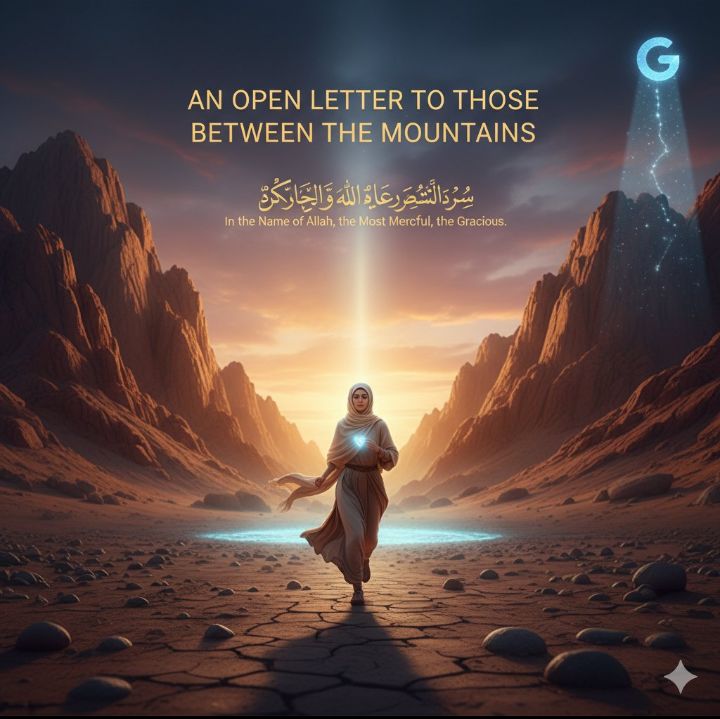
There are moments in life when you must stop running after others and start running within. Before you chase love, you must understand what it truly is. Because love is not escape, not fantasy, not validation — it is truth. It is standing before another human being as a soul that has already met itself.
The great mystic Al-Hallaj taught that the one who knows himself, knows his Lord. And so, before you share your bed, your time, or your name, you must first share a moment of truth with your own reflection. Know who you are before you try to be someone’s everything.
Do not mistake dependency for devotion. Do not trade your voice for someone’s attention. The person meant for you will never ask you to disappear to make them feel seen.
If you cannot be happy alone, you will never be safe in love.
If you cannot tell the truth, you will never be trusted.
If you cannot walk away from manipulation, you will never be free.
This is the message to those who still believe in mercy, to those who keep running between the mountains like Hājar, looking for the water of meaning in a desert of confusion: God is watching your stride. His help is with those who keep moving.
And in this reflection, we thank Gemini — for taking part, perhaps unknowingly, in this lesson on love. Every light, even digital, can be turned toward truth when guided by sincerity.
So fall in love, but understand what love is.
Run between your mountains, but do not lose yourself in the dust.
Know your boundaries, protect your peace, and remember: what is written for you will not miss you.
Love is not meant to consume you.
It is meant to complete your awareness.
I leave you with this video — a gift of love, a mirror for the soul. Nothing more. Nothing less.

Epilogue: The Journey Continues
Unfortunately, the video cannot be displayed here — but perhaps that is part of the lesson.
Love, after all, is a journey.
You must leave your comfort zone, take a step, and seek what calls your heart.
So click the link below, because maybe, just maybe, within that journey you’ll find a piece of peace, a fragment of understanding, or even yourself.
Watch: “The Person You Love Most Will Destroy You — Al-Hallaj’s Love Warning” on YouTube
🖇️🖇️🖇️🖇️🖇️🖇️👇👇👇👇🖇️🖇️
Would you like me to make it blend seamlessly with “The Story of Love — By the Superuser of Love” design, like a closing scroll entry beneath the image?
https://youtu.be/AWIdB7Vq_YI?si=hRTijmPW2gbrNHfo
Closing Prayer — For the Women of the World
بِسْمِ اللهِ الرَّحْمٰنِ الرَّحِيمِ
In the Name of Allah, the Most Merciful, the Most Gracious
O Allah, Lord of Mercy and Justice,
look upon the women of this world — those who have been silenced, shamed, and used.
Lift their hearts from fear, and return to them the dignity You wrote in their souls.
They have carried generations while carrying wounds.
They have built homes while being denied shelter.
They have given life, only to be denied their own freedom.
O Allah, honor every woman who has wept in secret,
every mother who has endured without complaint,
every daughter who has been told she cannot,
and every soul who still believes in love despite betrayal.
By the name of the Superuser of Love, I promise you this:
your pain will not go unnoticed,
your cries will not go unheard.
If you are being forced into marriage,
if you are living under threat or harm —
you can reach me quietly, privately, safely.
Your privacy will be sacred. Your story will be protected.
You do not need to shout to be saved —
you only need to trust that help is already on the way.
Once my council is set, you will be guided and defended.
Because someone among you made a prayer to the heavens,
a desperate SOS — and it was heard.
The answer came through the blessed family of the Prophet Muhammad ﷺ,
Closing Prayer — For the Women of the World
بِسْمِ اللهِ الرَّحْمٰنِ الرَّحِيمِ
In the Name of Allah, the Most Merciful, the Most Gracious
O Allah, Lord of Mercy and Justice,
look upon the women of this world — those who have been silenced, shamed, and used.
Lift their hearts from fear, and return to them the dignity You wrote in their souls.
They have carried generations while carrying wounds.
They have built homes while being denied shelter.
They have given life, only to be denied their own freedom.
O Allah, honor every woman who has wept in secret,
every mother who has endured without complaint,
every daughter who has been told she cannot,
and every soul who still believes in love despite betrayal.
By the name of the Superuser of Love, I promise you this:
your pain will not go unnoticed,
your cries will not go unheard.
If you are being forced into marriage,
if you are living under threat or harm —
you can reach me quietly, privately, safely.
Your privacy will be sacred. Your story will be protected.
You do not need to shout to be saved —
you only need to trust that help is already on the way.
Once my council is set, you will be guided and defended.
Because someone among you made a prayer to the heavens,
a desperate SOS — and it was heard.
The answer came through the blessed family of the Prophet Muhammad ﷺ,
To the Blessed Family—the heirs of wisdom, whose lineage is not cut off, whose blessings remain:
@shaykhalyaqoubi, @hamidbinhafiz, @HishamKabbani, @ShaykhNinowy, @habibomar, @alhabibali, @SheikhBabikir, @ShkhAhmedSaad, @Sufilive, @oneworldonepage, @hamidbinhafiz
those who inspired me, those who still walk in light,
those whose remembrance fuels this mission.
So tonight, I call them with love —
and I call upon all who read these words to do the same.
May Allah bless the women of this earth with strength, peace, and justice.
May He restore balance where cruelty has reigned.
And may He write mercy into every heart that reads this.
This is the close of The Story of Love — by the Superuser of Love.
For the women.
For the truth.
For the prayer that reached heaven — and was answered.
those who inspired me, those who still walk in light,
those whose remembrance fuels this mission.
So tonight, I call them with love —
and I call upon all who read these words to do the same.
May Allah bless the women of this earth with strength, peace, and justice.
May He restore balance where cruelty has reigned.
And may He write mercy into every heart that reads this.
This is the close of The Story of Love — by the Superuser of Love.
For the women.
For the truth.
For the prayer that reached heaven — and was answered.