

The Reasons for the Differences Between the Various Mujtahid & Madhhabs । Shaykh Muhammad Al Yaqoubi
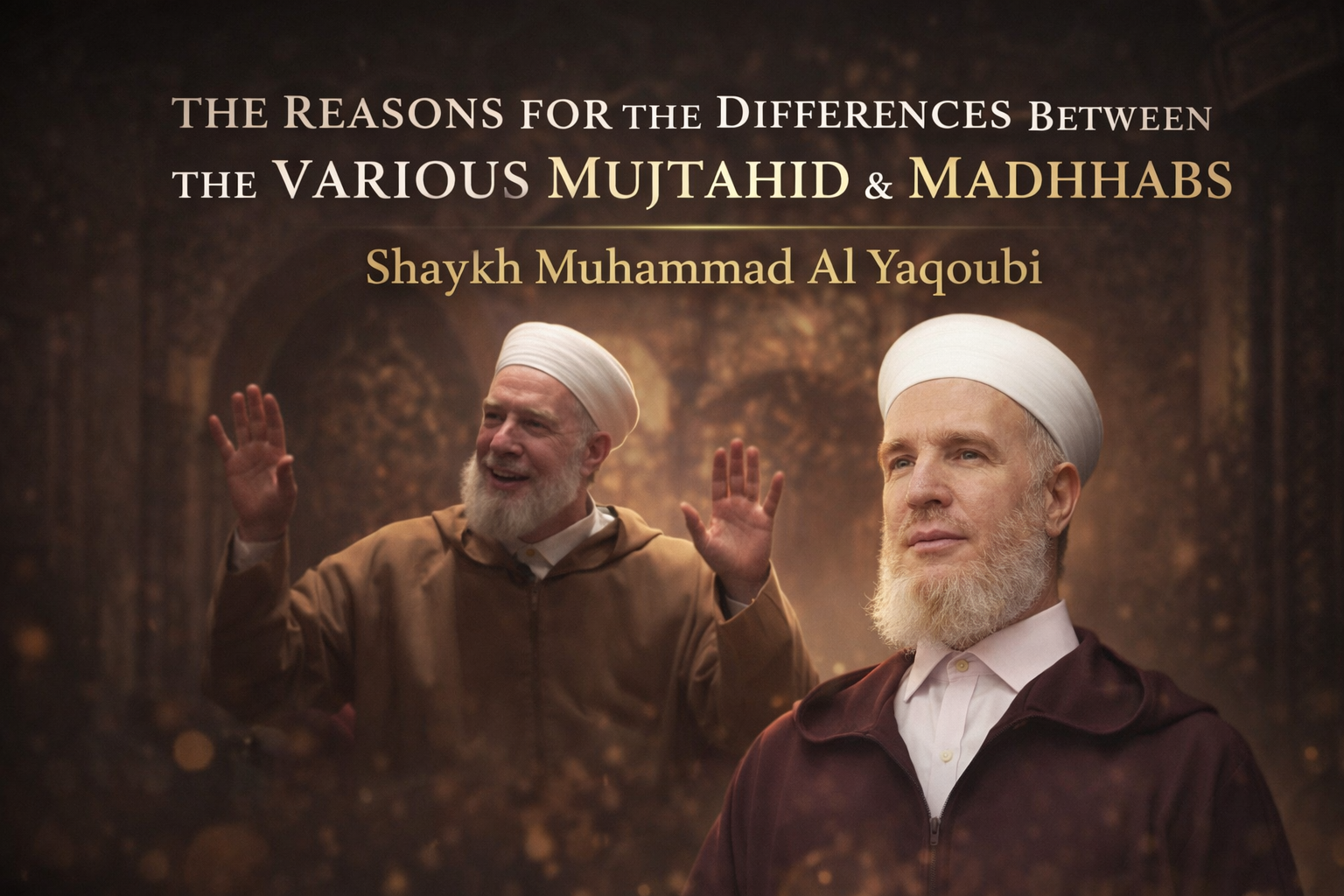
Opening: In Praise of a Rare Mind
What makes Shaykh Muhammad al-Yaqoubi—and scholars of his caliber—so striking in this lecture is not merely the depth of knowledge, but the mode in which that knowledge is accessed and delivered. What appears to the listener as a seamless, “one-breath” exposition is in fact the result of an advanced cognitive architecture: a form of Holistic Architectural Retrieval.
He is not recalling information sequentially, as one would retrieve items from folders or notes. He is navigating a structure he has built and inhabited for decades. Each concept—whether a Companion, a city, a linguistic particle, or a legal principle—is not stored in isolation, but embedded within a three-dimensional mental map where history, language, and legal theory coexist as a single, integrated system.
This is why the delivery feels effortless. He is not searching for ideas; he is walking through a house whose rooms are already connected. Centuries collapse into minutes, not because anything is simplified, but because nothing is fragmented. What we are witnessing is not speed—it is compression without loss, the hallmark of true mastery.
In this lecture, the Shaykh is not merely explaining why scholars differed. He is demonstrating, in real time, what it looks like when knowledge has been fully digested, stress-tested, and internalized—until it becomes native, embodied, and precise. For the student attentive enough to notice, the lesson is happening on two levels at once: in the content being taught, and in the mind that is teaching it.
The Reasons for the Differences Between the Various Mujtahid & Madhhabs । Shaykh Muhammad Al Yaqoubi
Below are clean, student-facing notes, structured for clarity, retention, and respect for the tradition.
They are written so a lay student, advanced student, or AI-assisted learner can all work from the same architecture.
Student Notes
The Architecture of Disagreement in Islamic Law
Based on the lecture by Shaykh Muhammad al-Yaqoubi
Big Idea (Read This First)
Disagreement in Islamic law is not a flaw.
It is the result of disciplined intelligence operating within divine boundaries.
If you understand how disagreement happens, you stop accusing scholars of contradiction and start respecting methodology.
Module 1: The Prophetic Foundation of Disagreement
Case Study: Bani Qurayza
The Command:
“None of you should pray ‘Asr except at Bani Qurayza.”
What happened:
Group A (Literalists):
Took the words exactly → delayed prayer until arrival.Group B (Purposivists):
Took the intent → prayed on time while traveling.
The Outcome:
The Prophet ﷺ approved both.
Key Principle
A single command can produce multiple valid outcomes
when interpretation is sincere and disciplined.
🔑 This is the root of legitimate disagreement.
Module 2: Geography as a Legal Engine
After the Prophet ﷺ, the Companions spread out.
Each region developed different strengths.
Medina — Preservation Engine
Focus: Living Sunnah
Authority: Practice of the people of Medina (ʿAmal Ahl al-Madīnah)
Outcome: Maliki methodology
Kufa (Iraq) — Logic & Analogy Engine
New societies, new problems
Heavy use of Qiyās (analogy)
Outcome: Hanafi methodology
Key Principle
Different environments require different legal tools,
not different religions.
Module 3: Language as Law (The Linguistic Compiler)
Arabic is high-density.
It allows multiple readings without contradiction.
Example 1: The Particle “Bi” (بـ) in Wudu
“Wipe bi your heads”
Partial meaning (Tabʿīd):
→ some of the head is sufficientEncompassing meaning (Ilṣāq):
→ the whole head must be wiped
Both readings are linguistically valid.
Example 2: The Word “Qurʾ” (قُرء)
Can mean purity
Can mean menstruation
Legal rulings change based on which meaning is chosen.
Key Principle
Disagreement is sometimes forced by the language itself.
Module 4: What a Madhhab Really Is
A Madhhab is not an opinion.
It is a methodology.
Important Clarifications
Imams did not found schools intentionally.
Schools formed because:
Their reasoning was consistent
Their students preserved their methods
Their logic survived stress-testing
The Four Systems (Simplified)
School Core Strength Hanafi Analogy & reasoning Maliki Practice of Medina Shafi‘i Text + methodology Hanbali Hadith verification
Key Principle
Following a Madhhab means
you are not guessing your religion.
Module 5: Why Disagreement Is a Mercy
Without diversity:
Law becomes rigid
Cultures break under it
People collapse under guilt or extremism
With disciplined diversity:
Law adapts without changing
Unity exists without uniformity
Mercy is preserved without chaos
Key Principle
Unity means shared methodology,
not identical practice.
Final Superuser Takeaway
Think of Islamic law as a system:
Input: Qur’an & Sunnah
Processor: Mujtahid methodology
Context: Language, geography, society
Output: A valid ruling (ḥukm)
Different processors → different outputs
All within the same divine framework
Warnings for Students (Important)
Disagreement ≠ ignorance
Simplicity ≠ correctness
AI without methodology amplifies error
Confidence without Usul is dangerous
Reflection Question (Answer in Writing)
If the Prophet ﷺ allowed multiple valid interpretations at the source,
who are we to demand one rigid answer at the end?
Concluding with Praise
What makes Shaykh Muhammad al‑Yaqoubi’s one-breath delivery so extraordinary is that he is not narrating history—he is re-assembling it.
This lecture is a live demonstration of systematic de-fragmentation: 1,400 years of jurisprudence reorganized, compressed, and made visible as a single, coherent architecture. Where most speakers rely on notes, pauses, and sequencing, the Shaykh moves fluidly because the knowledge is no longer external to him—it is internalized, integrated, and embodied.
He does not present the Madhhabs as competing opinions, but as a living ecosystem of logic, each rooted in the Prophetic circle, each preserving a strand of that original intelligence. By tracing legal outcomes back to specific Companions, places, and linguistic mechanisms, he shows that disagreement is not deviation—it is inheritance.
In one sitting, he shifts seamlessly between:
history and geography,
language and law,
method and mercy,
without losing precision or depth. That is not performance. That is mastery.
This is what the ceiling of human scholarship looks like: a mind so disciplined that it can hold the legal architecture of a civilization in active memory and transmit it with clarity, humility, and restraint.
For students, this lecture is not just instruction—it is orientation.
For scholars, it is a reminder of the standard.
For the age of AI, it is proof that true intelligence is not speed or volume, but structure, limits, and trustworthiness.
May Allah preserve our teachers, elevate their ranks, and allow knowledge to be respected again—not as opinion, but as architecture.